

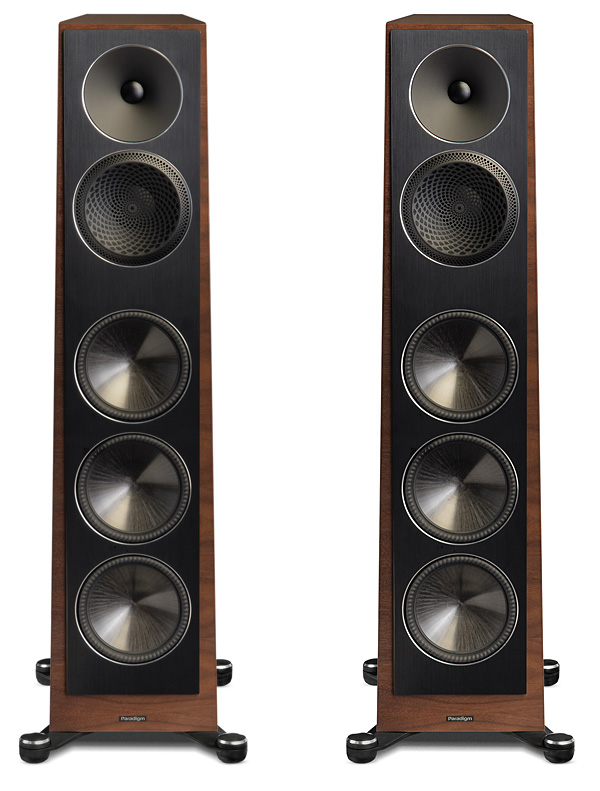
Paradigm Founder 120H loudspeaker
As a native European, I don't particularly love bubbly people: Too much sugar makes my teeth hurt. I'm sympathetic to my friend Nick, a Brit who reliably bristles when he hears Americans use the word "awesome" for the most mundane things. A slight drop in gas prices? Awesome! How was the meatloaf? Awesome!
It irks him that the words awe and awesome are now nearly divorced. But I like to remind Nick that this hyperpleasant, optimistic American attitude is surely preferable to the alternative.
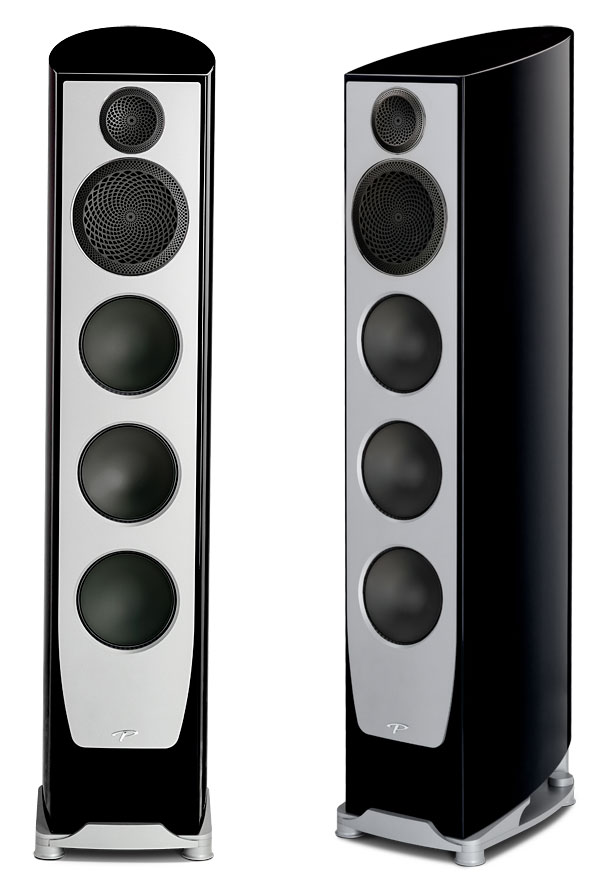
Paradigm Persona 5F loudspeaker
Since its founding in 1982, Paradigm has developed and sold high-value loudspeakers. When my wife and I acquired our weekend house in 1992, I selected a pair of Paradigm Esprit/BP speakers for our audio system there. Shortly thereafter, however, I wanted to take my big step into multichannel, and it seemed that the Esprits' bipolar radiation would present problems for multichannel sound in my relatively small room. Back then, Manhattan still had many audio salons; after shopping around, I replaced the Esprit/BPs with Paradigm's Reference Studio/60 v.2s, and in 2004 stepped up to the Studio/60 v.3s.
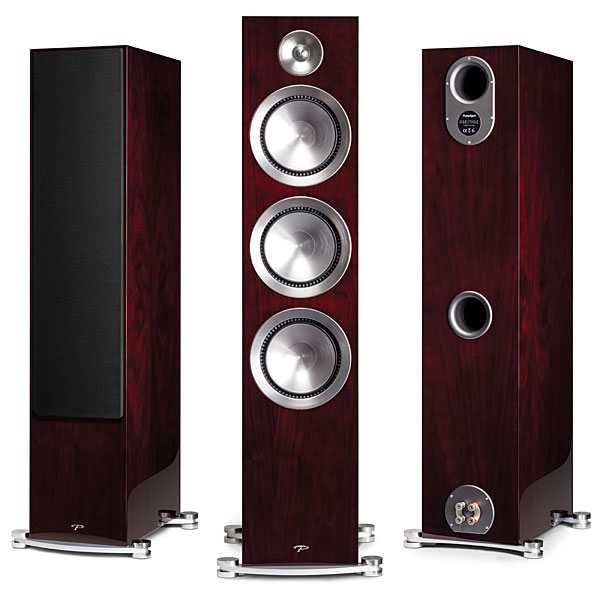
Paradigm Prestige 95F loudspeaker
Déjà vu all over again?
Apart from being reminded of this Yogi-ism by the death, in September 2015, of its originator, I was all set to begin by commenting that this would be my first review for Stereophile of a Paradigm loudspeaker. Butthe recent online posting of my June 1992 review of Paradigm's Studio Monitor took me back.
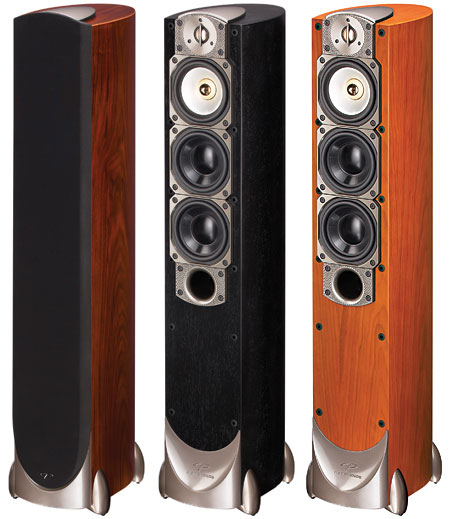
Paradigm Reference Studio 60 v.5 loudspeaker
I have reviewed and owned so many Paradigm speakers that they feel almost like members of the family. I've owned the v.2 and v.3 versions of the Reference Studio 60, and reviewed the v.3 version in Stereophile (in December">http://www.stereophile.com/floorloudspeakers/1204paradigm">December 2004, Vol.27 No.12). My long and intimate relationship with this speaker is founded on the best of reasons: We are extremely compatible. The Studio 60, in all its incarnations, is large enough to be used as a full-range speaker with nearly any program material, and yet is compact enough to be easily accommodated in my relatively small Connecticut listening room. It neither looms over me nor disappears into the space. Used as a center-channel speaker, it's just short enough to clear my line of sight to the video display. Finally, and despite inevitable price creep over the last decade, the Studio 60 still comes in under $2000/pair—my line in the sand for a reasonably priced system.
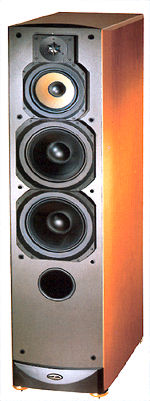
Paradigm Reference Studio/100 v.2 loudspeaker
It may come as a surprise to relative newcomers to the field of audio, but some loudspeaker manufacturers are manufacturers in only a limited sense. They buy drivers, off-the-shelf or custom-built, from companies like VIFA, SEAS, Focal, etc.; cabinets from a woodworking shop; and crossovers from an electronics subcontractor. While the system design will have taken place in-house, actual manufacturing is restricted to assembling the components, perhaps tweaking the crossover, and final QC. Even some highly successful loudspeaker manufacturers use this approach, which can work well as long as the suppliers do their jobs properly.
Paradigm Reference Studio/100 v.3 loudspeaker
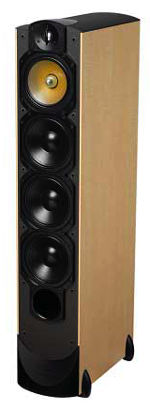
Like the Reference Studio/60, which was enthusiastically">http://www.stereophile.com/loudspeakerreviews/1204paradigm">enthusiasti… reviewed in the December 2004 issue by Kalman Rubinson, Paradigm's floorstanding Reference Studio/100 is now available in a v.3 version. The '100 is the flagship model in the Canadian manufacturer's Reference line. Its earlier incarnations, the original Studio/100 and the Studio/100">http://www.stereophile.com/loudspeakerreviews/252/">Studio/100 v.2, were reviewed by Tom Norton and Robert Deutsch in the August 1997 and June 2000 issues of Stereophile, respectively, and both writers were well impressed at how much sound quality could be wrought from this competitively priced speaker design. Bob Deutsch, in particular, referred to the v.2 as a "a serious high-end contender, and a formidable one for just about any speaker in its price range and even well above."
Paradigm Reference Studio/60 v.3 loudspeaker
I am biased in favor of Paradigm loudspeakers. I've used them for 10 years; they offer good sound and good value, properties they share with a number of other Canadian makes who have taken advantage of Canada's National Research Council facilities in Ottawa. In fact, the first components I bought specifically for what is now my multichannel system were Paradigm Esprit/BP speakers, which had impressed me at a Stereophile show. When I took the step into multichannel and found that there wasn't a matching center-channel speaker for the Esprits, I replaced them with Paradigm's Reference Studio/60 v.2s. But while the smaller Reference">http://www.stereophile.com/loudspeakerreviews/628">Reference Studio/20, and the larger Studio/100http://www.stereophile.com/loudspeakerreviews/252">Studio/100; have both been reviewed in Stereophile, the Studio/60 had not. The release of the v.2's successor, the Reference Studio/60 v.3 ($1699/pair), was an opportunity to fill that gap.
Paradigm Studio Monitor loudspeaker
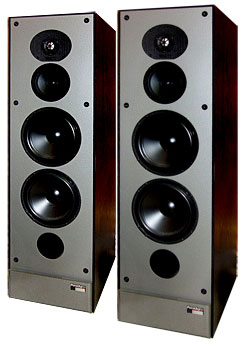 Paradigm is not a new name to US audiophiles, but the Canadian loudspeaker company hopes to increase awareness of its products with their Monitor series, all members of which incorporate a similar design philosophy and drive-units. Heavy and apparently massively constructed, the top-of-the-line Paradigm Studio Monitors ($1899/pair) are the first commercial loudspeakers to pass my way with provision for tri-wiring: three sets of terminals on the back of the enclosures provide direct links to the crossover segments feeding each separate driver (or drivers, in the case of the low end).
Those crossovers use quasi-Butterworth filters, but there is, by design, little attempt to correct for driver aberrations in the crossover, a technique which Paradigm does not believe produces the best results. The wood-veneered cabinet is solidly constructed, making use of a combination of high-density composite hardboard and MDFa technique claimed to reduce uncontrolled resonances. MDF cross-bracing is provided, and four heavy-duty spikes are furnished per speaker. (I used Tonecones in my listening for the simple reason that three spikes are self-leveling, four are not.)
Paradigm is not a new name to US audiophiles, but the Canadian loudspeaker company hopes to increase awareness of its products with their Monitor series, all members of which incorporate a similar design philosophy and drive-units. Heavy and apparently massively constructed, the top-of-the-line Paradigm Studio Monitors ($1899/pair) are the first commercial loudspeakers to pass my way with provision for tri-wiring: three sets of terminals on the back of the enclosures provide direct links to the crossover segments feeding each separate driver (or drivers, in the case of the low end).
Those crossovers use quasi-Butterworth filters, but there is, by design, little attempt to correct for driver aberrations in the crossover, a technique which Paradigm does not believe produces the best results. The wood-veneered cabinet is solidly constructed, making use of a combination of high-density composite hardboard and MDFa technique claimed to reduce uncontrolled resonances. MDF cross-bracing is provided, and four heavy-duty spikes are furnished per speaker. (I used Tonecones in my listening for the simple reason that three spikes are self-leveling, four are not.)PBN Montana EPS loudspeaker
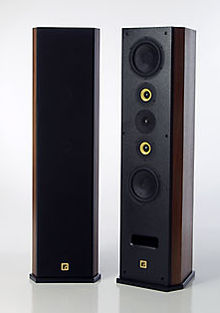
Most speakers don't come in heavy wooden crates—they come in cardboard cartons, two per box, light enough to be tucked under one arm and carried out to the car. Not so in HighEndLand, where the smallest minimonitor can test a healthy man's strength. There are plenty of good reasons for this cult of robustness, foremost among them structural stability and the suppression of resonances.
PBN Montana SP loudspeaker
Astute readers will note that although my name appears under the "hardware" heading of Stereophile's masthead, I have rarely written about specific products, and, apart from secondary comments or Follow-Ups, have never written a formal equipment report. For years I resisted reviewing because I was usually connected in some way to audio manufacturers and/or retailers, and felt very uncomfortable with the conflict of interest. The other reason I was disinclined to review is that the critical listening required of reviewers is work, and after a long day or week of working on, or with, audio equipment, the only thing I wanted to do when I came home was relax. But since I have hung up my soldering iron and oscilloscope probe for what I hope is the last time, and am cleaving instead to my word processor (or, as playwright David Ives dubbed it, my "verboblender"), you may see more of this—WP, JA, and God willing.