

Monitor Audio Studio 50 loudspeaker
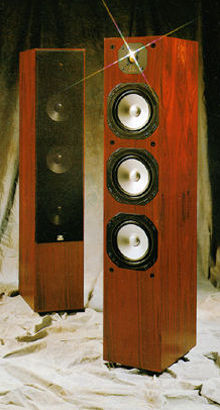
English loudspeaker manufacturer Monitor Audio has mined a rich vein with their exclusive 6½" metal-cone driver, which covers a range from the bass to the midrange. MA designs using this drive-unit have fared well in these pages, ranging from the Monitor Audio Studio 6 minimonitor (reviewed">http://www.stereophile.com/standloudspeakers/910">reviewed by JA in February '94, Vol.17 No.2) to the floorstanding Studio 20 (reviewed by RH in December '91, Vol.14 No.12, and by ST in April '92, Vol.15 No.4).
Monsoon Audio FPF-1000 loudspeaker
I used to be an audio cheapskate even worse than Sam Tellig. Anytime I saw an interesting device for sale, I immediately began to figure out how I might build it for myself for a fraction of the cost.
Mordaunt-Short Performance 6 loudspeaker
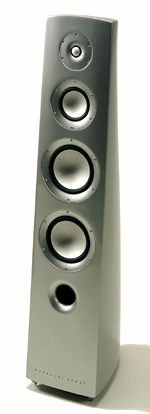
Wood is not an engineering material. It might look pretty, but it's inconsistent and therefore unpredictable. So we smash cheap wood into sawdust and then glue it all together again to create something that can be machined. This is called medium-density fiberboard, or MDF. We then thinly slice some classy hardwood—hopefully harvested from sustainable sources—and use it to cover the ugly MDF. This might have made sense back when Chippendale was making furniture, but it seems strangely old-fashioned in our age of plastics and composites. I haven't seen wood trim on a TV set for more than a decade. Why is it still the norm for loudspeakers?
Moth Audio Cicada loudspeaker
Like most people, I'm not interested in long, windy essays about audio reviewing, having barely enough time and interest for audio itself. But I do perk up when the debate turns to the audio reviewer's purpose in life: Should I write about everything that crosses my path, or should I limit my attention to those products that interest me, and that stand a chance of being good?
Museatex Hybrid 6 loudspeaker
I find quite appealing the image invoked by Museatex to describe its Real Time Ripple Effect (RTRE) loudspeaker line: a stone rippling the surface of a "still pond on a warm summer afternoon." Replace the stone with a voice-coil attached to the center of a stretched Mylar diaphragm and you begin to get a glimpse of the RTRE technology's conceptual beauty and promise. The idea of cohesively covering at least the midrange and treble with a single driver, without crossover filters, quickens my audio pulse.
Naim NBL loudspeaker
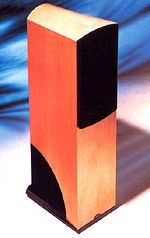
I've long been a fan of Naim electronic gear, and have used it for many years. I also have admiration and respect for the company's uncompromisingly consistent and determinedly individualistic approach to the various tasks and problems of loudspeaker design. But my enthusiasm for Naim speakers has long been tempered by a feeling that mechanical aspects of the design are given priority over acoustics and styling.
NEAT Acoustics Iota Alpha loudspeaker
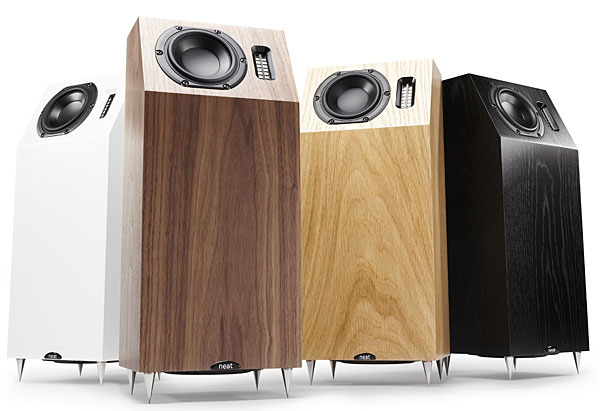
Reviewers of high-fidelity gear are a trend-sniffing, topology-bandying bunch. When four of our kin gathered last November over lunch, during the 2016 New York Audio Show, the high-end chatter flew fast and furious. "Did you hear those mother-rocking big horns on the seventh floor?" "Nah, man, the Bruno Putzeys speakers on nine were best in show." "What about those li'l Lowthers on eight? Great sweet spot, but small as peanuts."
Nelson-Reed 8-04/B loudspeaker
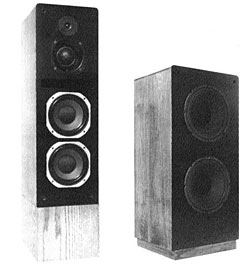 According to designer Bill Reed, the Nelson-Reed 8-04/B was not originally intended to be an audiophile speaker system, but was instead designed as a high-quality monitor for the critical recording engineer who wanted to be able to walk from the studio into the control room and hear the same thing from his speakers that he heard "live." The fact that modern studio mike technique ensures that this could never happen is probably beside the point. The point is that reproducing the original power and dynamic range of live music is a formidable challenge, which practically no audiophile speakers have met successfully. On the other hand, so-called studio monitors, which can do that routinely, have tended to be highly colored and otherwise generally lousy in all areas of fidelity except output capability. The 8-04/B was an attempt to combine the strengths of both kinds of speaker, while avoiding their usual weaknesses.
New England Audio Resource NEAR-50M loudspeaker
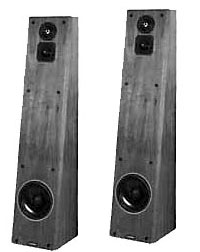 New England Audio Resource's NEAR-50M is a cyborg: metal innards in a wooden body. It represents NEAR's top statement in the firm's Metal Diaphragm Technology speaker line, which features the "NEAR-Perfect" driver cone. Metalin this case an anodized aluminum alloyis much more rigid than paper or plastic. Hence, a driver with a metal cone acts more nearly as a true piston. When it comes to loudspeaker cones, breaking up is not hard to do. When that happens, the cone flexes in a complex pattern, generating harmonic distortion. A typical plastic or paper 8" woofer may experience its first breakup mode at a frequency as low as 500Hz. The NEAR 8" metal-cone woofer's first breakup mode is said to be well above 2kHz, and their 4" metal-cone midrange does much better than that.
NHT 2.9 loudspeaker
Hard to believe it's been more than six years since NHT launched its flagship 3.3 loudspeaker (footnote 1). At the time, the floorstanding 3.3 was a revolutionary product for the company, whose product line until then had been aimed squarely at the customer who wanted good sound, but wanted it in a small, affordable package. While the 3.3 didn't change NHT's dedication to its roots, it did signal to audiophiles that the manufacturer could play ball with the big boys.