

Meadowlark HotRod Shearwater loudspeaker
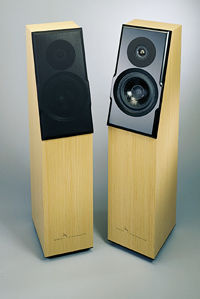
Though each link in the audio chain is significant in its own way, we seem to spend more time agonizing over the choice and setup of loudspeakers than any other component. Floorstanding or stand-mounted? Full-range frequency extension or minimonitor coherence? Multiple-driver complexity or two-way simplicity? Pleasurable and forgiving or resolved and revealing? And even when money is no object, how much speaker do you really want...or need? It might sound splendid in the shop, but how will it couple with your room? How will it integrate with your other gear? Is it easy to set up and drive or will it involve specialized gear and a massive overhaul of your current rig?
Meadowlark Swift loudspeaker
Like most people, I'm not interested in long, windy essays about audio reviewing, having barely enough time and interest for audio itself. But I do perk up when the debate turns to the audio reviewer's purpose in life: Should I write about everything that crosses my path, or should I limit my attention to those products that interest me, and that stand a chance of being good?
Meridian D600 digital active loudspeaker
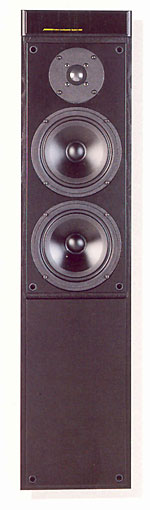
In audiophile circles, it is the "Stuart"—electronics designer Bob Stuart of the Boothroyd-Stuart collaboration—who has received most recognition. The contribution of industrial designer and stylist Allen Boothroyd has gone relatively unremarked. Yet as I unpacked Meridian's D600 "Digital Active" loudspeaker, I was struck by Boothroyd's ability to make the humdrum—a rectangular box loudspeaker—seem more than just that. The man has one hell of an eye for proportion. From the first Orpheus loudspeaker of 1975, through the Celestion SL6 and 'SL600http://www.stereophile.com/standloudspeakers/744">SL600; (where AB did the industrial and package design), to this latest Meridian loudspeaker design, his brainchildren look "right," to the extent of making competing designs appear at minimum over-square and clumsy, if not downright ugly.
Meridian DSP8000 digital active loudspeaker
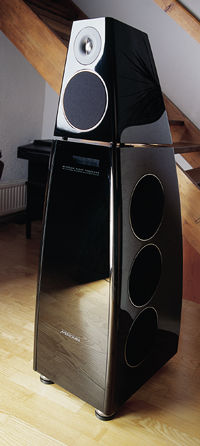
Nestled south of the North Downs in England's southeast, the Kentish dormitory town of Sevenoaks is about as sleepy a place as you can imagine. Yet 20 years ago, in the unlikely circumstances of the back room of a Sevenoaks pub, I witnessed the world of consumer loudspeakers changing. Meridian's Steve Hopkins was showing a pair of the company's active M2 loudspeakers connected directly to a 101 preamplifier.
Merlin Excalibur II loudspeaker
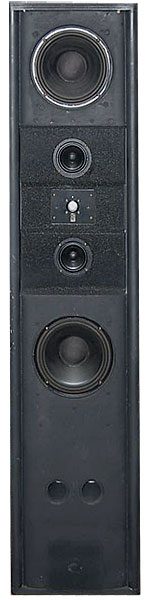
Despite displaying its products at nearly every CES since 1985, Merlin remains essentially unknown in the US. Problems have plagued the company in this country: key suppliers have gone under, marketing efforts have lacked focus, and the principals of the company seemed to have gotten caught up in audio politics.
Merlin Music Systems VSM Millennium loudspeaker system
"Viagra couldn't cure our voltage droop!"
Metaphor 2 loudspeaker
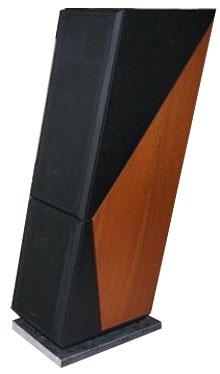 "Wow!" Jerome Harrisjazz guitarist, bassist, and composerstopped talking and listened intently to the rough-mixdown dub of his latest album, Hidden in Plain View: The Music of Eric Dolphy (New World 80472-2 CD) (footnote 1). He'd brought it by my house in order to hear it on another system before pronouncing judgment. "That sounds like us! And I ought to know because I was there..."
It wasn't the first time the Metaphor 2s had totally transfixed a visitor with their accurate portrayal of a musical event. This time, however, they'd done it to one of the participants of that specific performance. It isn't as if it was easy stuff to disentangle, either. Jerome's disc is texturally dense: Marty Ehrlich and Don Byron on reeds, Ray Anderson on trombone, E.J. Allen on trumpet, Bill Ware on vibes, Bobby Previte on drums, and Jerome himself on acoustic bass guitaroccasionally all wailing away simultaneously. The Metaphor 2s have the articulation to sort out all of those interweaving melody and rhythm lines, the frequency balance to render them with astonishing timbral veracity, and the speed to ensure that, even with four drivers in a large enclosure, it all arrives at the same time and with swing aplenty. Does it sound as though I'm describing one hell of a speaker? I think so anyway.
"Wow!" Jerome Harrisjazz guitarist, bassist, and composerstopped talking and listened intently to the rough-mixdown dub of his latest album, Hidden in Plain View: The Music of Eric Dolphy (New World 80472-2 CD) (footnote 1). He'd brought it by my house in order to hear it on another system before pronouncing judgment. "That sounds like us! And I ought to know because I was there..."
It wasn't the first time the Metaphor 2s had totally transfixed a visitor with their accurate portrayal of a musical event. This time, however, they'd done it to one of the participants of that specific performance. It isn't as if it was easy stuff to disentangle, either. Jerome's disc is texturally dense: Marty Ehrlich and Don Byron on reeds, Ray Anderson on trombone, E.J. Allen on trumpet, Bill Ware on vibes, Bobby Previte on drums, and Jerome himself on acoustic bass guitaroccasionally all wailing away simultaneously. The Metaphor 2s have the articulation to sort out all of those interweaving melody and rhythm lines, the frequency balance to render them with astonishing timbral veracity, and the speed to ensure that, even with four drivers in a large enclosure, it all arrives at the same time and with swing aplenty. Does it sound as though I'm describing one hell of a speaker? I think so anyway.Mirage M-1 loudspeaker
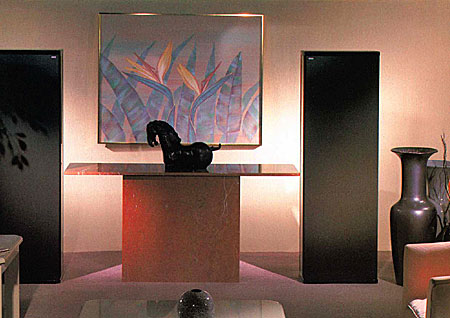
Mirage /ma-'räzh/ n [F, fr mirer to look at. fr. L mirari] 1: an optical effect that is sometimes seen at sea, in the desert, or over a hot pavement, that may have the appearance of a pool of water or a mirror... 2: something illusory and unattainable, like a mirage.
Mirage M-1si loudspeaker
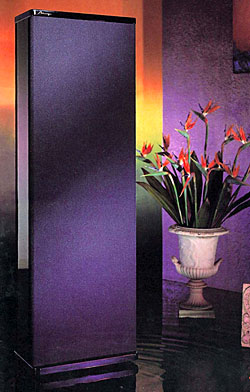
I only found out after beginning my auditioning of Mirage's M-1si loudspeakers that the film 2001, A Space Odyssey was, at practically the same instant, undergoing a brief theatrical revival in major cities around the US. I might have known. Perhaps it was the persistent Strauss melodies that rattled around in my head as I set them up. Perhaps it was the two 5'-tall monoliths that subsequently stared at me as I sat in my listening chair. For whatever reason, the M-1sis were an imposing sight, and the association with out-of-this-world events was not a difficult one to make.
Mirage M-3 loudspeaker
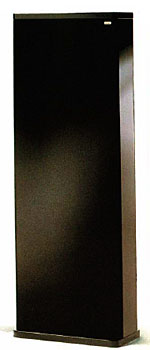
It may surprise some readers to learn that all of the contributors to Stereophile do not get the chance to hear, at our leisure and in familiar circumstances, everything that passes through the magazine's portals. Not that we wouldn't like to, but there just isn't time. Nor are the logistics always right. I was therefore probably as intrigued as the average reader by LA's glowing">http://www.stereophile.com/floorloudspeakers/689mirage">glowing report on the $5000/pair Mirage M-1 in the June 1989 issue. The M-1s had been on the market long enough for me to have heard them on several occasions, of course, but generally at shows and not under the best of conditions. I did get to hear them briefly at LA's later that same summer, but the hustle and bustle of a Stereophile Writers' Conference party isn't the optimum place for value judgments.