

MartinLogan Montage loudspeaker
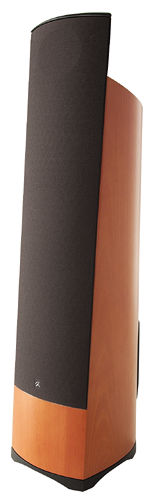
This lapsed fan of electrostatic speakers finds it curious that, while MartinLogan is the predominant representative of this technology in the US, I had never auditioned an ML design in my home. I've enjoyed many Janszen tweeters, a KLH 9, an AcousTech X, Stax ELS-F81s, and I've dallied with Quad">http://www.stereophile.com/loudspeakerreviews/416">Quad ESL-63s. But as dumb luck would have it, the first MartinLogan speaker to reach me, the new Montage, is a hybrid model.
MartinLogan Montis loudspeaker
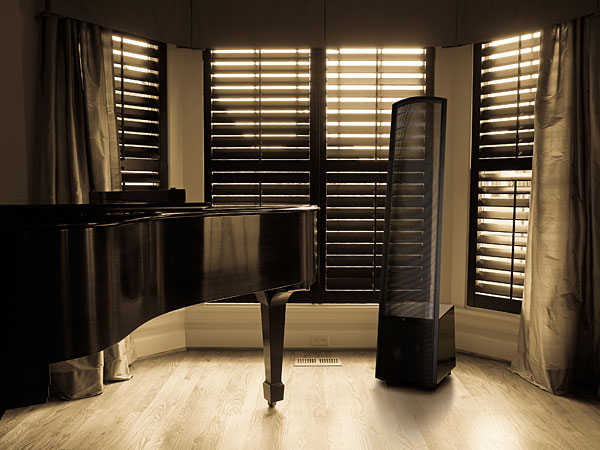
One of my formative audiophile experiences was the first time I heard electrostatic speakers. I walked into an audio store and heard music played by a live jazz combo. But where were the musicians? I saw none, though I did notice a couple of room-divider panels in the part of the store where the music seemed to be coming from. Eventually, it dawned on me that these must be loudspeakersbut they sounded like no other speakers I'd ever heard, and nothing like the Advents I had at home.
MartinLogan Prodigy loudspeaker
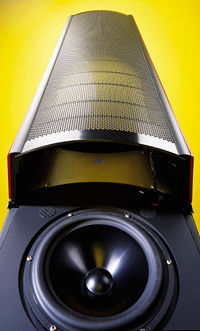
Electrostatic speakers are my passion. Why else have I put up with their high prices, unreliability, low power handling, tendency to arc, high-frequency beaming, limited bass response, and widely fluctuating impedances?
MartinLogan Quest Z loudspeaker
MartinLogan's Gayle">http://stereophile.com/loudspeakerreviews/145/index7.html">Gayle Sanders has almost single-handedly raised the electrostatic/dynamic hybrid loudspeaker to a position of prominence in the High End. First, there was the MartinLogan Monolith (reviewed in Vol.8 No.3 and Vol.9 No.3), followed by the much more affordable Sequel (reviewed in Vol.11 No.12, Vol.12 Nos.8, 9, and 12, and Vol.14 No.2). Then came the subject of this review, the Quest, and most recently the diminutive Aerius, reviewed">http://www.stereophile.com/loudspeakerreviews/312">reviewed by JA elsewhere in this issue.
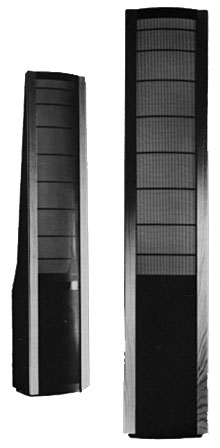
MartinLogan Sequel II loudspeaker
Loudspeaker designers are dreamers. Something takes hold of a man—the fact that loudspeaker designers are all men must be significant—and he wrestles with recalcitrant wood, arcane drive-units, and sundry coils, capacitors, and cables, to produce something which will be individual in its sound quality yet inherently more true to the original sound. An impossible task. Yet if there were to be an aristocratic subset of those dreamers, it would be those who have taken upon themselves the burden of producing electrostatic loudspeakers. For these farsighted engineers, there is no standing on the shoulders of others, there is no recourse to tried and tested combinations of other manufacturers' drive-units. Every aspect of the design, no matter how apparently insignificant, has to be created afresh from first principles. For a new electrostatic design to produce a sound at all represents a great triumph for its progenitor, let alone having it sound musical. And to produce an electrostatic loudspeaker that is also possessed of great visual beauty is indeed a bonus.
MartinLogan SL3 loudspeaker
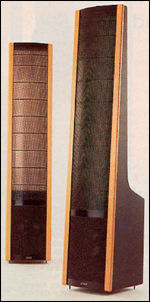
"Wow! What's that?" asked the pizza delivery boy, peering over my shoulder at the slender, 5'-tall Martin-Logan SL3 visible behind me.
mbl 101E Radialstrahler loudspeaker
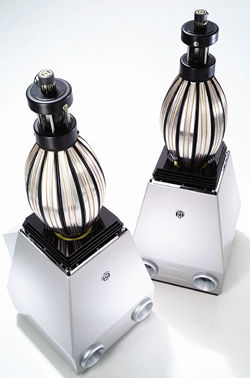
Back in the late 1980s, when I was writing for The Abso!ute Sound and couldn't afford any of the audio gear I was reviewing, my system consisted of an Oracle turntable with Magnepan unipivot arm, a pair of Spica TC-50 loudspeakers, and a heavily modified Hafler DH-200 power amp and DH-101 preamp. It was a fun system that imaged like hell, but my fondest audio memories of that time were of visiting fellow TAS reviewer Dr. Michael Gindi, who lived on Manhattan's West End Avenue, and listening to his mbl speakers. (With his shrink's paycheck, he could afford them.)
MBL 111 loudspeaker
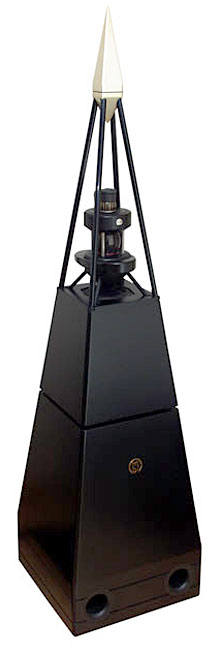
The speaker review in the July 1996 issue of the German audio magazine Stereoplay didn't hold back the praise. "Absolut Spitzenklasse III Referenz" was their overall rating, which I guess translates to "You'd better hear this, buddy," in American English. So when MBL of America's Marc Lawrence called to find out if I wanted to review the subject of that review, the MBL 111, I didn't need to be asked twice.
MBL 111B loudspeaker
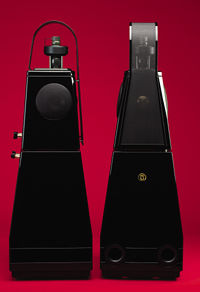
It was almost five years ago that I first spent some serious auditioning time with an omnidirectional two-piece speaker from German manufacturer MBL: the four-way MBL 111. When I reviewed the 111 in the April 1998 Stereophile, I had been extremely impressed with the speaker's stereo imaging, which was superbly stable and well-defined, with images that floated completely free of the speaker positions. The tonal balance was also excellent, with a rich midrange, superbly clean highs, and extended lows. "This Radialstrahler is one of the best tweeters I have experienced," I wrote. In fact, the 111 was let down only by bass frequencies that tended to lag behind the music slightly.
MBL Radialstrahler 101E Mk.II loudspeaker

Take a casual look at the Mk.II edition of MBL's Reference 101E Radialstrahler loudspeaker, and you won't immediately see what's new compared with the original version, which I reviewed in October 2004. But the Mk.II has a shorter, sleeker bass cabinet, designed to, among other things, slightly lower the stack of omnidirectional drivers it supports. While the many other major revisions to this familiar and fascinating loudspeaker can't be seen, it's fair to say that, from the ground up, the Reference 101E Mk.II is a new loudspeaker in design, if not in concept.