

Krell Resolution 1 loudspeaker
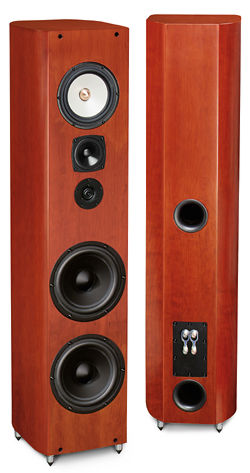
Sometimes you have to make peace with a loudspeaker. You have to accept it on its own terms rather than ask it to bend to your sonic wishes, or to be something it's not. This is especially true when you're auditioning a seemingly endless succession of them, as I have this year. Like beauty-pageant contestants parading across the stage, all different-looking yet all enticing in one way or another, each speaker I've listened to of late has sounded different from the rest, and each has had a unique combination of strengths and weaknesses—yet each has been sufficiently "in the pocket" to paint a credible musical picture. Nonetheless, some required more bending on my part than did others, in order for me to believe the musical portraits they were attempting to create.
Lansche Audio 5.1 loudspeaker

The phenomenon of the "singing flame" has been known since the 19th century. Place electrodes either side of a flame and, if you apply a high enough audio-modulated voltage to those electrodes, the ionized particles in the flame will cause it to emit sound. (Search YouTube for "singing flame" and you'll find many examples.) This principle was developed into a practical loudspeaker in 1946 by a French inventor, Siegfried Klein, who confined an RF-modulated arc to a small quartz tube, coupled it to a horn, and called the resulting speaker the Ionophone. An intense radio-frequency electrical field ionizes the air between inner and outer electrodes to produce a distinctive, violet-tinged yellow flame in the quartz combustion chamber. When the RF field is modulated by the audio signal, this causes the almost massless ionized flame to expand and contract in what should be a perfectly pistonic manner.
Larsen HiFi 8 loudspeaker
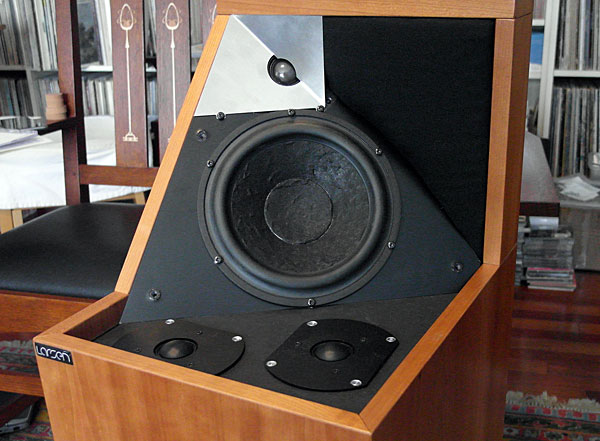
I wouldn't normally begin a review of an imported product with generalities about the culture from which it sprang, but this isn't just any imported product. It's a Scandinavian loudspeaker, and Scandinavian speakers are subject to a different and altogether more liberal set of rules.
For one thing, because they tend to be healthy and well educated, and because their governments are at peace and, for the most part, economically and politically sound, Scandinavians can take a joke. For another, Scandinavians are famous for not only having a loudspeaker industrysomething that has thus far eluded Spaniards, Corsicans, Ethiopians, and the Maltese, among othersbut also for the distinctiveness of the speakers they make. Like the Scandinavian people themselves, their speakers are intelligent, serene, uncompromising, outwardly serious and inwardly whimsical, outwardly tidy and inwardly complex, and a bit quirky.
Legacy Audio Focus 20/20 loudspeaker
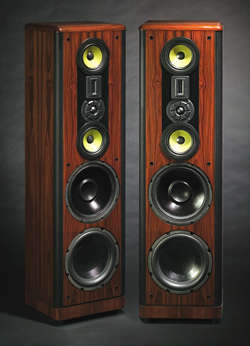
I was introduced to Legacy Audio at the CEDIA Expo in September 2002, and I'll long remember it. A pair of Legacy's huge new Helix loudspeakers anchored the company's silent display, and I was irresistibly drawn to them. Sales manager Bob Howard introduced himself, and, after a few minutes of chatting, introduced me to Bill Dudleston, Legacy's founder and chief designer. Within two minutes, Dudleston had told me "I don't design speakers for hi-fi people. I design speakers for people who love music."
Legacy Audio Whisper loudspeaker
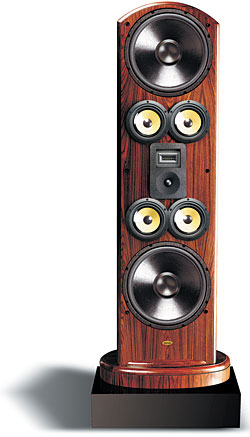
More than any other component, it is the loudspeaker that seems to invite the most audacious—some would say flat-out lunatic—efforts at design. There have been attempts at full-range plasma speakers, speakers one had to hook up to tanks of pressurized gas, speakers with drivers attached to what looked like copper salad bowls (the infamous Tri-Torr of the early 1990s).
Linaeum Model 10 & Center-Channel loudspeakers
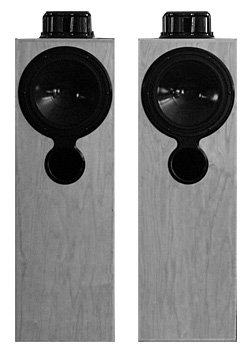 It's been a long time since we've seen a really new tweeter design. Only five basic types have ever been developed: cones, domes, panels, ribbons, and ionic plasmas. And the most recent of thesethe long-defunct DuKane "blue-glow" Ionovacwas introduced 40 years ago. Since then, tweeter development has been more evolutionary than revolutionary, a series of refinements that has made them more efficient, more reliable, and smoother and more extended in response.
Linn Akurate 242 loudspeaker
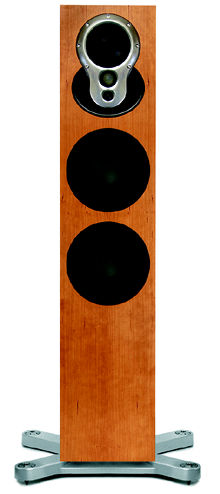
In 1985 or so, a middle-aged audiophile who lived in New York City called to invite me to come listen to his stereo: It was, he assured me, the best in the world. All he wanted was the pleasure of my opinion, for which he offered the princely sum of $100. (As I learned in the months and years to come, this same audiophile called virtually every other audio writer in the metropolitan area whose phone number he could get hold of, making the same offer.)
Linn AV 51 System (SGHT Review)
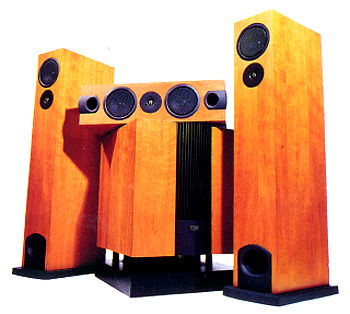
Note: This review appeared in the February 1999 issue of Stereophile Guide to Home Theater (issue number 22) and is appearing here until SGHT completes its own Archives database.
Linn Komri loudspeaker
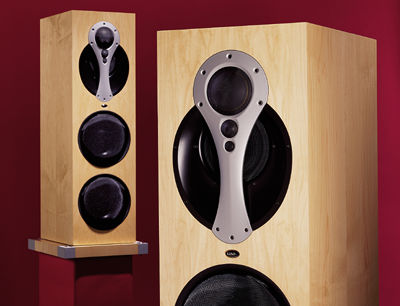
No doubt about it—Linn's top-of-the-line Komri loudspeaker is a queer-lookin' duck. It's a large, boxy thing, fairly deep, and weighing a hefty 176 lbs, including the base. Whew. I'll put it this way: rap your knuckles, break your hand.
Linn Majik 140 loudspeaker

In the May 2009 issue, I gushed over the performance of Linn Products' remarkable little bookshelf speaker, the Majik 109 ($1590/pair). In particular, I was struck by how I'd never heard any speaker at any price whose high frequencies sounded more natural, detailed, or pure than the 109's. Then, wondering what a pricier Linn speaker might sound like in my system, I asked Linn which was their most expensive model that also incorporates the 2K tweeter-supertweeter array used in the Majik 109. The answer: the floorstanding Majik 140 ($2995/pair). Once I'd worked through my reviewing backlog, two 140s were on their way to my listening den.