

Hales Audio System Two Signature loudspeaker
When a loudspeaker designer produces a world-class product, it is usually the result of years, perhaps decades, of experience gained from designing less ambitious products. To review a particular designer's product history is to witness the learning curve in action as both his skill and technology advance. Successfully battling the laws of physics to produce a truly exceptional loudspeaker is thus thought of as the domain of the seasoned veteran whose vast knowledge and experience culminate in the pinnacle of his career—a world-class loudspeaker. Moreover, it is just these designers, working their way up to their masterpiece, who are the most successful at getting an ambitious design right. The high-end loudspeaker business is littered with the remains of companies that attempted to build a first product far too lofty for their skills.
Hales Design Group Concept Five loudspeaker
Paul">http://www.stereophile.com/interviews/117">Paul Hales does things differently. "I set out to build a true reference speaker," he asserted when I asked him about the, er, concept behind his Concept Five loudspeaker. For a mere six grand? The other guys don't even blink at $20k, $30k, even $70k statement speakers.
Hales Design Group Transcendence Five loudspeaker
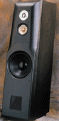
Paul">http://www.stereophile.com/interviews/117">Paul Hales has been a busy guy lately. In little over a year, he has designed and brought to production four new speakers in his Revelation series (footnote 1); his cost-no-object flagship, the Alexandra, which had been seen but not heard at a number of shows, was finally demonstrated at the 1999 CES; and he has introduced the new Transcendence series, which replaces the Concept series. (He's also produced a brand-new baby girl during this period, although I believe his wife made a significant contribution to that project.)
Hales Revelation Three loudspeaker
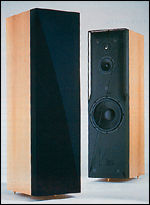
What's in a name? One of my favorite Rodrigues cartoons (footnote 1) shows a meeting of a loudspeaker manufacturer's marketing people, trying to come up with a name for the company's latest product:
Hales System Two loudspeaker
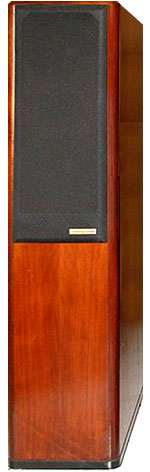 Last July I reviewed the $4850/pair Hales System Two Signature loudspeakers and enthusiastically recommended them. In fact, they displaced the B&W 801 Matrix 2 as my reference loudspeaker, and have become a fixture in my listening room. Over the past seven months, my impressions of the Signatures have been largely confirmed: transparent and uncolored midrange, resolution of fine detail, precise imaging, superb transient abilities, and, most importantly, an ability to thoroughly involve the listener in the music. These qualities earned the Signature a Class A recommendation in Stereophile's "Recommended Components." I've greatly enjoyed the many hours spent with the Signatures.
Hales Audio makes another loudspeakerthe System Two reviewed herethat is very similar to the Signature, but much less expensive (footnote 1). Because the System Two is such a close relation to the Signatureit uses identical drivers, a nearly identical crossover, and similar cabinet constructionand costs nearly 2 kilobucks less, I was eager to hear what the smaller system had to offer. Because the Signature was recommendable at $4850, the System Two just might be a bargain at $3000 if it even came close to the Signature's musicality.
Last July I reviewed the $4850/pair Hales System Two Signature loudspeakers and enthusiastically recommended them. In fact, they displaced the B&W 801 Matrix 2 as my reference loudspeaker, and have become a fixture in my listening room. Over the past seven months, my impressions of the Signatures have been largely confirmed: transparent and uncolored midrange, resolution of fine detail, precise imaging, superb transient abilities, and, most importantly, an ability to thoroughly involve the listener in the music. These qualities earned the Signature a Class A recommendation in Stereophile's "Recommended Components." I've greatly enjoyed the many hours spent with the Signatures.
Hales Audio makes another loudspeakerthe System Two reviewed herethat is very similar to the Signature, but much less expensive (footnote 1). Because the System Two is such a close relation to the Signatureit uses identical drivers, a nearly identical crossover, and similar cabinet constructionand costs nearly 2 kilobucks less, I was eager to hear what the smaller system had to offer. Because the Signature was recommendable at $4850, the System Two just might be a bargain at $3000 if it even came close to the Signature's musicality.Hansen Audio Prince V2 loudspeaker
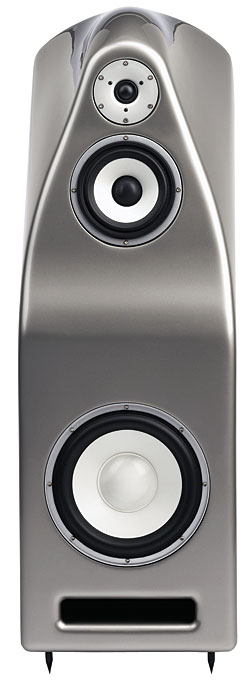
No matter how well you think you know the specialized world of high-end audio, there are always new companies, new technologies, and new products you just haven't gotten around to knowing yet.
Hegeman Model 1 omnidirectional loudspeaker
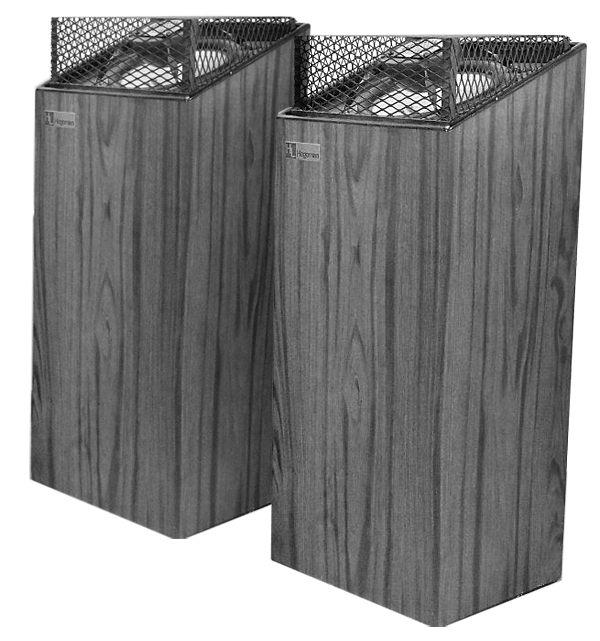
Ye Editor had his first exposure to a true omnidirectional speaker system 15 years ago, while he was employed as chief equipment tester for High Fidelity magazine. The speaker was a most unusual-looking device for its time, being roughly a foot square and standing 3 feet high, with a "cube" of grille cloth at the top like a cupola. Inside the cupola was an 8" woofer facing upwards. Directly above it was the weirdest-looking tweeter you ever saw.
Hill Plasmatronics Type 1 loudspeaker
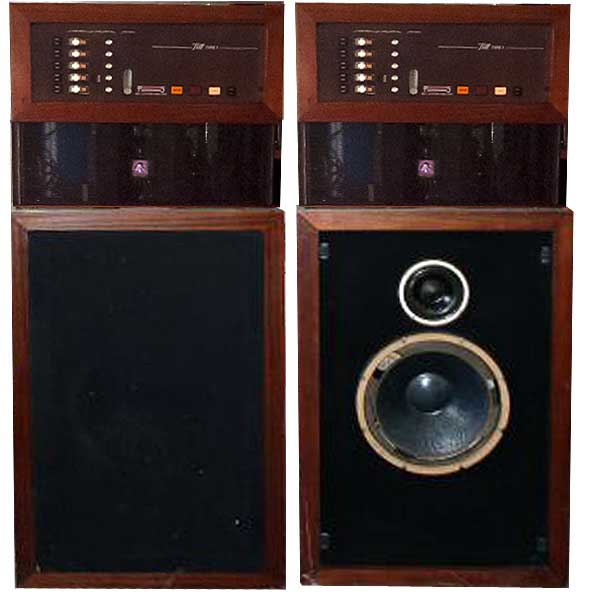
Dr. Alan Hill, president of Plasmatronics Inc., was previously employed by the US Government in laser research. His assignment: To increase the efficiency of lasers so that they could do something more impressive than produce holograms, mend leaky retinal blood vessels, and punch pinholes in steel blocks. Dr. Hill earned his keep, thus advancing laser technology a giant step closer to Star Wars, and then retired from government service to design. . . a loudspeaker?!!!?
Horn Shoppe Horn loudspeaker
Like most people, I'm not interested in long, windy essays about audio reviewing, having barely enough time and interest for audio itself. But I do perk up when the debate turns to the audio reviewer's purpose in life: Should I write about everything that crosses my path, or should I limit my attention to those products that interest me, and that stand a chance of being good?
Icon Parsec loudspeaker
"My vision for the future is one where all manufacturers sell their products directly to the end user. In this way, even the audiophiles in Dead Horse, Alaska can have access to all the audio manufacturing community has to offer." Thus wrote loudspeaker designer David Fokos in a letter introducing his new company Icon Acoustics to the press at Stereophile's High End Hi-Fi show in San Mateo, CA last April (footnote 1). Mr. Fokos, a Cornell graduate who for some years worked for Conrad-Johnson Design and designed that company's well-regarded Synthesis and Sonographe loudspeaker models, feels very strongly that the traditional retailing setup is inefficient when it comes to exposing audiophiles to a wide enough choice of product, particularly when it comes to loudspeakers. With 300 speaker manufacturers listed in the Audio directory issue but even a major retailer restricted to probably six brands, even big-city audiophiles will only be able to audition a fraction of the total number of brands. "Our industry is suffering from product saturation of its retail distribution network."