

Image Concept 200 loudspeaker
I like reviewing loudspeakers. The more you become familiar with the art, the greater the sense of anticipation as you open up a pair of cartons. A visual inspection of the speaker always reveals a challenging mixture of the familiar and the new. The size of the cabinet is always the first clue—has sensitivity been a design priority or was low-frequency extension uppermost in the designer's thoughts? You espy a known drive-unit—has this tweeter's propensity for upper-presence sizzle been tamed? You find a reflex port on the rear panel—has the temptation to go for a "commercial," under-damped bass alignment been successfully resisted? You spot factors which intuitively seem wrong for precise stereo—a wide baffle lacking any kind of absorbent covering for diffraction control; a grille frame which puts acoustic obstacles in the way of the wavefront emerging from the tweeter.
Impact Airfoil 5.2 loudspeaker system
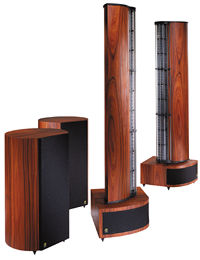
"You're a toy junkie!" laughed Trish, my fiancée. "Your life is a search for bigger and better toys!"
Infinity Composition Prelude P-FR loudspeaker
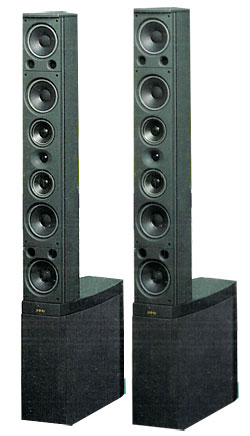 I can't think of two products at further ends of the audio spectrum than a single-ended triode tubed amplifier and a mass-market Home Theater loudspeaker. Single-ended tubed amplifiers are about reproducing subtlety, delicacy, nuance, and communicating the music's inner essence. Conversely, a Home Theater loudspeaker systemparticularly one made by a mass-market manufacturerwould appear to put the emphasis on booming bass and reproducing shotgun blasts, with little regard for musical refinement.
What a bizarre marriage it was, then, to pair the new Infinity Composition Prelude P-FR loudspeakers with the Cary Audio Design CAD-300SEI 11W single-ended triode amplifier (reviewed elsewhere in this issue). This combination didn't happen by accident; as you'll see, these apparently disparate products are a match made in heaven.
I discovered the Infinity Preludes while surveying Home Theater loudspeaker systems for the upcoming second issue of the Stereophile Guide to Home Theater. In addition to evaluating the loudspeaker systems under review with video soundtracks, I assessed their musical qualitiesor lack thereof. The Preludes were such a musical standout that I rescued them from the Home Theater room (where they had been powered by mass-market receivers and fed with a laserdisc source) and gave them a new lease on life in the larger music room, with reference-quality source and amplification components. The Preludes' extraordinary musical performance and unique design compelled me to tell you about how they performed in an audiophile-quality two-channel playback system.
I can't think of two products at further ends of the audio spectrum than a single-ended triode tubed amplifier and a mass-market Home Theater loudspeaker. Single-ended tubed amplifiers are about reproducing subtlety, delicacy, nuance, and communicating the music's inner essence. Conversely, a Home Theater loudspeaker systemparticularly one made by a mass-market manufacturerwould appear to put the emphasis on booming bass and reproducing shotgun blasts, with little regard for musical refinement.
What a bizarre marriage it was, then, to pair the new Infinity Composition Prelude P-FR loudspeakers with the Cary Audio Design CAD-300SEI 11W single-ended triode amplifier (reviewed elsewhere in this issue). This combination didn't happen by accident; as you'll see, these apparently disparate products are a match made in heaven.
I discovered the Infinity Preludes while surveying Home Theater loudspeaker systems for the upcoming second issue of the Stereophile Guide to Home Theater. In addition to evaluating the loudspeaker systems under review with video soundtracks, I assessed their musical qualitiesor lack thereof. The Preludes were such a musical standout that I rescued them from the Home Theater room (where they had been powered by mass-market receivers and fed with a laserdisc source) and gave them a new lease on life in the larger music room, with reference-quality source and amplification components. The Preludes' extraordinary musical performance and unique design compelled me to tell you about how they performed in an audiophile-quality two-channel playback system.
Infinity IRS Beta loudspeaker
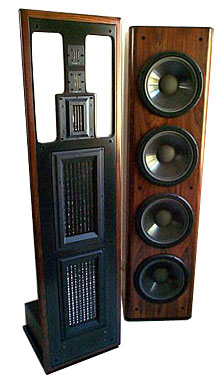
In 1966, two avid audiophile/music lovers—a nuclear physicist named Arnold Nudell and an airline pilot named Cary Christie—labored over weekends and evenings for 18 months in Nudell's garage to put together the world's first hybrid electrostatic/dynamic loudspeaker system. It cost them $5000 for materials, launched a company (New Technology Enterprises), and helped contribute to the popular myth that all of the really important audiophile manufacturers got started in somebody's basement or garage (footnote 1). The system was marketed as the Servo-Statik I, for the princely sum of $1795. (At the time, the most expensive loudspeaker listed in Stereo Review's "Stereo/Hi-Fi Directory" was JBL's "Metregon," at $1230.)
Infinity IRS Epsilon loudspeaker
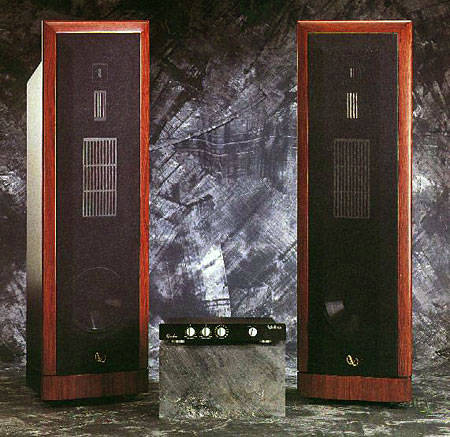
Like all companies that have been in business long enough to become fixtures in the marketplace, Infinity has seen its share of changes. It has long been that audio rarity—a company with one foot in the High End and one in the mass market. For the past few years, however, and despite continuing production of the now-classic IRS in its Series V incarnation, Infinity's mass-market foot has been the more firmly planted. Infinity, now a large company, is part of an even larger conglomerate, Harman International.
Infinity Prelude MTS loudspeaker
Sometimes you have to wonder why big corporations gobble up small speaker companies. Most such firms are built by individualist entrepreneurs chasing an elusive dream—an up-close and personal thing that is the antithesis of the corporate mentality. That's why speaker companies are so often named after the founder.
Infinity Primus 360 loudspeaker
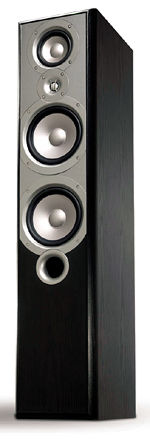
When I reviewed Infinity's">http://www.stereophile.com/loudspeakerreviews/404infinity">Infinity's Primus 150 loudspeaker in the April 2004 Stereophile, I was very impressed with its overall performance. To this day, I continue to be amazed at the level of realism this $198/pair loudspeaker can reproduce, and I've kept the review pair to serve as a benchmark for an entry-level audiophile speaker. When I'd completed that review, my first thought was: Now—what can Infinity do within the affordable Primus series for more money? So I requested a review sample of the Primus series' flagship, the three-way Primus 360 floorstanding speaker. After all, how could I resist listening to a speaker that claims 38Hz bass extension for only $658/pair?
Infinity Reference Standard 1B loudspeaker
I'll say one thing right off about the Infinity RS-1B: It sure looks as if you're getting your money's worth.
Infinity RS-4.5 loudspeaker system
There are certain manufacturers for whom every new product implies the promise of countless modifications, Usually a month or so apart, culminating inevitably in a version so far removed from the original that it must be assigned a new model designation—usually a letter suffix ranging from A, to D. By the time E is envisioned, another CE Show is approaching, so the decision is made to give the unit an exterior facelift and a brand-new model number. Presto! A new product for CES.
Infinity Servo-Statik 1 loudspeaker
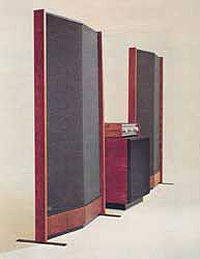
An equipment reviewer for one of the consumer hi-fi magazines once confided to a manufacturer that he found it hard to like electrostatics because of the kind of people who usually like electrostatics. His implication—that certain kinds of people gravitate towards certain kinds of sound—is an interesting thought, and one that might bear some further investigation. But there is no questioning the fact that electrostatic speakers in general do have a particular kind of sound, that might be characterized as "polite."