During some 1970's summer, in the housing projects of Newark, NJ, a young Puerto Rican girl would listen as the bold, brassy sounds of New York City's salsa wafted from open windows, like the unmistakable scent of chuletas fritas. (No, that's too obvious.) The bold, brassy sounds of New York City's salsa fell from open windows like newborn babies. (Oh, god, too gruesome.) The bold, brassy sounds erupted like gunfire, falling into rhythm with police sirens and train whistles. (Whatever.) The music was everywhere. Our young Puerto Rican girl listened to it, and fell in love with it. She (very innocently) plastered the walls of her virginal bedroom with the colorful artwork of her favorite album covers.
Before her 16th birthday, the girl would learn to shake her ass better than the Soul Train Dancers. Soon she would be allowed to tag along with her older cousins, aboard the same trains that passed so often outside her bedroom window. She would go from Newark's Penn Station straight into the heart of Manhattan and up into its Barrio. She would go to the clubs—the Red Garter, the Cheetah Lounge—and she would dance to the music she had grown to love so intimately. Her ass parted dance floors like Moses parted the Red Sea. (Whatever.) She caught the eyes of so many of the young, flamboyant salseros, but she was immune to their advances. She was only interested in dancing.
Then, on one particularly hot summer evening, with the Willie Colon band raging harder than ever and the dance floor jumping higher than ever and the cuchifritos smelling better than ever, our young Puerto Rican girl would fall. (One of her six-inch red heels had given up on her.) The tall, lanky, loud-mouthed emcee would notice her fall and he would laugh. He would direct the crowd to her mishap and, together, they would laugh.
She hated him. (Of course, at the time, she did not know that it was his artwork that hung from her bedroom walls!) He jumped from the stage and danced through the crowd to the spot on the floor where our young girl remained, petrified.
Como te llamas?
She did not reply.
He held out his right hand, his drawing hand.
She smacked at it. (Imagine her regret had she broken a bone!)
He laughed.
She pouted.
He grabbed her by the arm, raised her from the floor, and gave her a mighty spin.
Now she was mad. She returned his mighty spin with a wild and powerful hip shake. Soon, they were locked in dance. The rest is history: They are married still today.
The young girl was my father's cousin. The tall, lanky emcee was Izzy Sanabria, graphic designer for the Fania record label. I made up the rest.
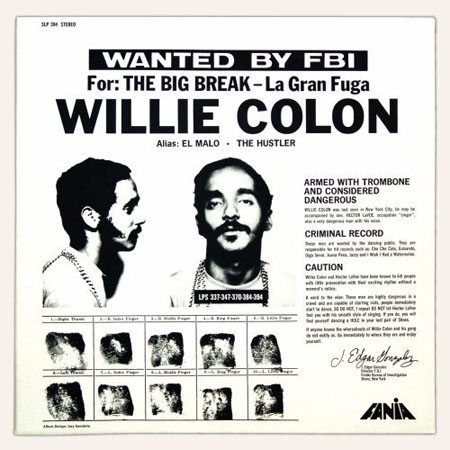
Of all the outrageous and colorful LP covers designed by the inimitable "Dizzy" Izzy Sanabria, the one for Willie Colon's sixth album,
La Gran Fuga, may be the most infamous.
The story goes that Willie Colon was given the nickname, "El Malo," not because he was a bad, thuggish kid, but because he was a horrible trombone player. Being the bad, thuggish kid that he was, he embraced the nickname and ran with the gangster image it conveyed. Sanabria thought it was a hoot, too, and came up with album artwork that mimicked an FBI "Wanted" poster. In promoting the album, the pair would drive all over Manhattan, Brooklyn, the Bronx, and Queens (even then, Staten Island got the boot) tacking their artwork onto billboards and telephone poles.
Word spread fast. Willie Colon, that horrible trombonist, was wanted by the FBI! Izzy had done too good of a job.
Local police stations were inundated by phone calls from people who had seen Willie at the bodega, or who had run into him at the club. Had they stopped to read the fine print, this might have all been avoided:
ARMED WITH TROMBONE AND CONSIDERED DANGEROUS
WILLIE COLON was last seen in New York City, he may be accompanied by one, HECTOR LAVOE, occupation "singer," also a very dangerous man with his voice.
CAUTION
A word to the wise: These men are highly dangerous in a crowd and are capable of starting riots, people immediately start to dance, SO DO NOT, I repeat DO NOT let Hector Lavoe fool you with his smooth style of singing. If you do, you will find yourself dancing a HOLE in your last pair of Shoes.
If anyone knows the whereabouts of Willie Colon and his gang do not notify us. Go immediately to where they are and enjoy yourself.
Due to all the confusion, the authorities would order Fania to tear down the posters. Fania would even have to alter the album artwork.
For these reasons, the original album has become very valuable. I have seen this album, in poor condition, sell for as much as $180 on eBay. I have seen it, in wretched condition, sell for five. I found my copy at the Princeton Record Exchange, in near mint condition. It looks as if it had never been played.
Last night, a 31-year old Puerto Rican boy shook his ass to
La Gran Fuga, as if time didn't exist.