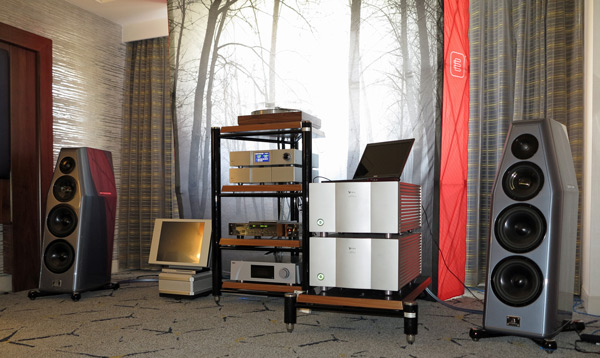
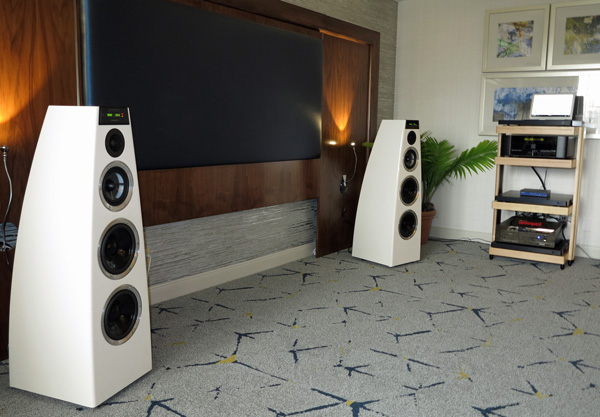
In the first of two floor rooms from Elite Audio Systems of San Francisco, Viola Audio Labs' Paul Jayson partnered with Elite's Michael Woods to pair the Viola Bravo 2 amplifier ($58,000) and Viola Sonata preamplifier ($35,000) with Kharma DB9 loudspeakers ($37,500/pair), Linn Klimax LP12 turntable ($25,000), Viola cabling (produced by ZenSati), and an Isotek Titan power purifier ($4999) with matching power strip ($1500). Paul's choice of the Speaker Corner reissue of Michelangeli's live 1979 performance of Beethoven Piano Concerto 1, with Giulini and the Vienna Symphony, enabled me to hear the system's lovely shine and ability to convey extremely rapid timpani rolls with minimal smudging and utmost credibility.
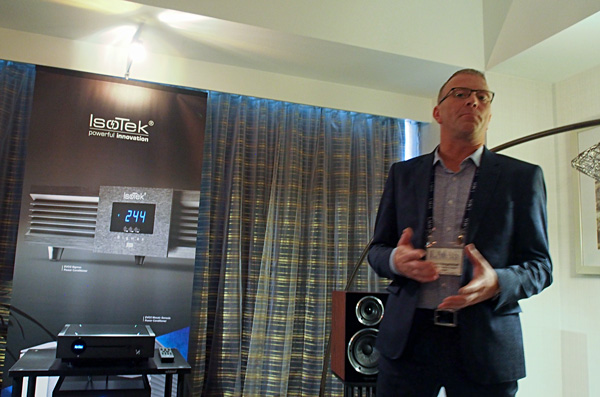
I tend to be skeptical of tweaks. Too often in the past, I have heard an astonishingly audible difference when the whatever is demonstrated by its promoter, only for any difference to stubbornly disappear when I try the same thingamabob in my own system. But listening to the difference when Isotek's Bjorn Hegelsted replaced the cheap power strip and stock AC cords in a MoFi Distribution system using the impressive but affordable Wharfedale Diamond 225 speakers ($449/pair) driven by a Quad Artera Play CD player ($2199) and Artera Stereo amplifier ($2299) with a star-wired, 6-outlet Isotek Polaris conditioner ($495) and Isotek Premier AC cords ($149 each), the improvement in image palpability and dimensionality, the elimination of "shoutiness" on female voice, was extraordinary.
How to conduct a successful MQA demo when the person requesting same already has made up their mind? That question, or some variation thereof, must have run through the mind of Meridian's SW regional sales manager, Courtney Careccia, when the sole attendee (besides me) in her room on a slow Sunday asked for a non-MQA/MQA comparison on her all-Meridian system. After no more than 45 secondsit could have been less, but certainly not morethe man asked to switch to the MQA version, listened for a much shorter time, stood up, declared the whole thing was a sham, and marched out the door. It was almost as if the comparison had never happened.
Following my keynote speech at the ribbon-cutting ceremony Friday morning, my beat at the Los Angeles Audio Show was the Sheraton Gateway's 1st and 5th floors. Even with just the two floors, this was a daunting prospectconsidering that this was the show's debut, it had a larger number of exhibitors than any of us had anticipated. So without further ado, here's the first of my three reports.
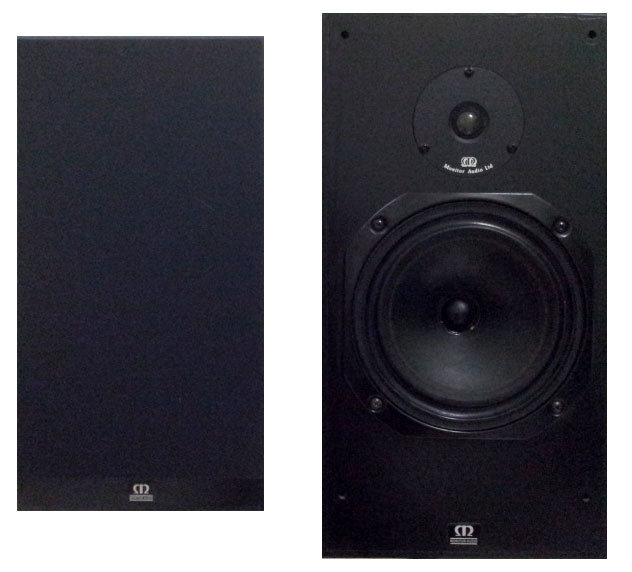
The Monitor Audio R300/MD ($669/pair) debuted at the 1988 SCES in Chicago. English company Monitor Audio is one of the pioneers in spreading the use of metal-dome tweeters in relatively low-cost loudspeaker systems. The tweeters they have designed in conjunction with SEAS and British manufacturer Elac may have now found their ways into a number of designs from competing manufacturers, but there is no doubt that Monitor leads the way. The new R300/MD features a new ¾" version of the SEAS 1" aluminum-dome unit Monitor introduced with their R652/MD (reviewed in Vol.10 No.5), in conjunction with an 8" doped paper-cone woofer.