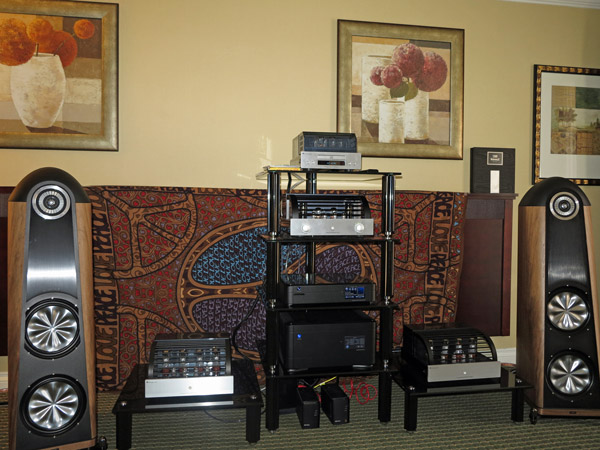
The Thiel CS 3.7 loudspeakers ($12,900/pair) were making bright and incisive sound with PrimaLuna's ProLogue Premium monoblock amplifiers ($4395/pair), DiaLogue 3 preamplifier ($2700), and ProLogue CD player ($3000); PS Audio Perfect Wave II DAC with Bridge/NAS server ($4795) and P10 Power Regenerator ($4495); and Analysis Plus Oval speaker cable ($500/pair).
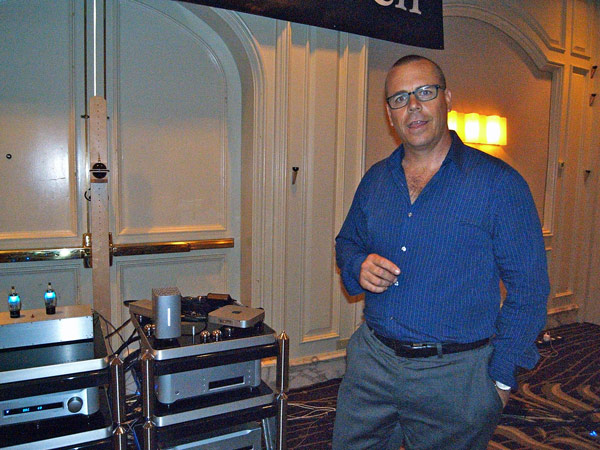
"Let me turn off the Tranquility Bases and you'll hear what I am talking about," said Synergistic Research's Ted Denney.
I sighed inside. Ted had been subjecting me to the improvement on room acoustics wrought by his ART Acoustic bowls for the past few years and despite my skepticism, I kept hearing that improvement. Now he was talking about his series of Tranquility Bases. Ranging in price from $995 to $2995, these powered platforms have a ground plane and generate beneficial electromagnetic fields that are said to condition the signals passing through the components sitting on them and drain away the bad fields to ground. Yeah, right!
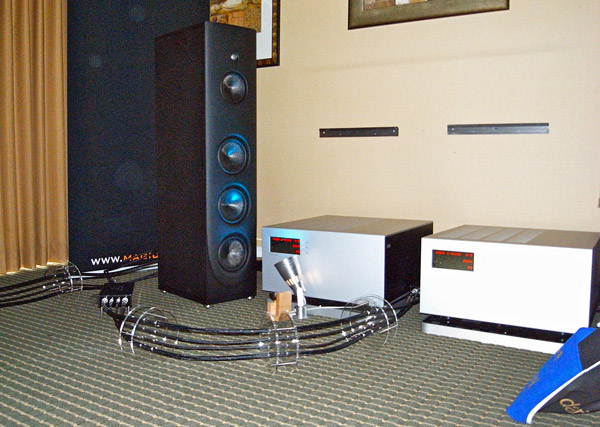
In their second room, Anaheim retailer Scott Walker Audio was showing Magico's Q3 floorstander ($38,950/pair) with the Soulution 700 monoblock amplifiers, hooked with Synergistic's cumbersome spaced-conductor speaker cable. Source was a Soulution 540 SACD player and a Soulution 700-series preamp. The Q3 was launched at the 2011 CES. A smaller derivative of the Q that Michael Fremer positively reviewed for Stereophile in November 2010, the Q3 uses the same proprietary beryllium-dome tweeter as the Q5 in the same type of space-frame enclosure, with a 6" Nano-tec midrange unit. The lower woofers roll off earlier than the upper one, to optimize the crossover to the midrange unit. Frequency response is specified as 20Hz50kHz, sensitivity as 90dB, and impedance as 5 ohms.
Sharing a Hilton ballroom with Legacy and AVM, the Austrian Ayon tube amplification was being demmed with Lumenwhite Artisan speakers ($40k/pair). Source was the new Ayon Music Server and two-box preamp. Listening to Pink Floyd's "Another Brick in the Wall," I thought the sound was better than it had any right to be given the suboptimal acoustics. Then I spotted some of the Synergistic ART Acoustic bowls on the wallsmy left brain knows these silly little bowls can have no audible effect on room acoustics in the audio range; my right brain was busy telling my feet to tap!
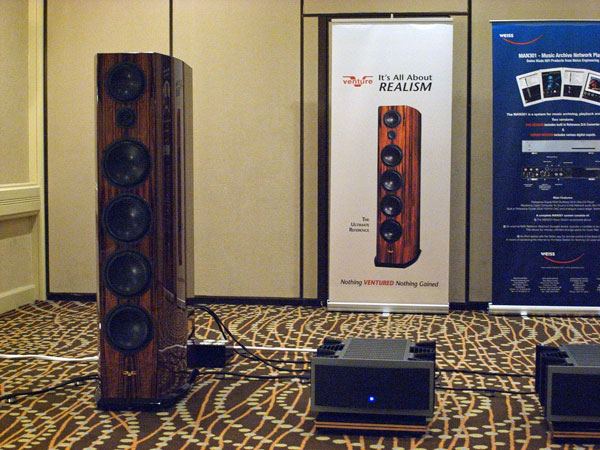
Like the MartinLogan speakers in the next story, the Belgian Venture Ultimate speakers ($59,500/pair), distributed in the US by Precision Audio & Video, were set-up in a room that was really too big for them. Even at a fairly close listening distance, the room's reverberant field was dominating what I was hearing. Even so, on "Good Morning Little Schoolgirl" from Muddy Waters' Folksinger, this three-way, five-driver tower had a natural tonality, precise stereo imaging, and a full-range sound. The 48.5"-tall, 152lb Ultimate has a specified frequency range of 26Hz40kHz, a nominal impedance of 6 ohms, and a sensitivity of 90dB/W/m.
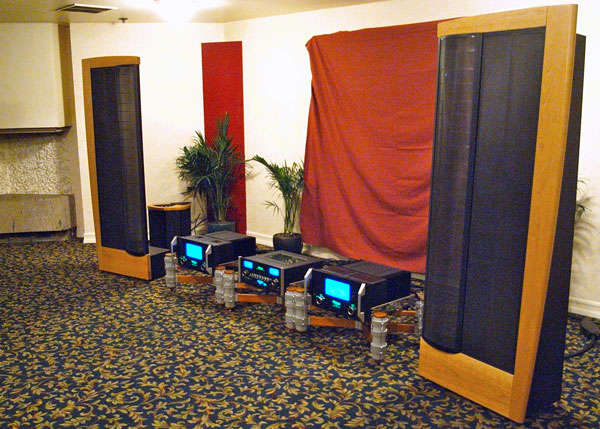
Whether they be Quads or Staxes, Roger Sanders' designs, or MartinLogans, electrostatic speakers generate passionate advocates. Retailer Digital Ear was demming the enormous Martin-Logan CLX speakers ($25,500/pair) in a huge ballroom in the Atrium hotel, along with two MartinLogan Depthi subwoofers, driving them with McIntosh MC601 monoblocks, a McIntosh C50 D/A preamp and a Meridian-Sooloos server, all hooked up with Transparent cable. The CLX's curvilinear section operates above 360Hz, meaning that all the harmonics of the music and the upper fundamentals are not interrupted by a crossover. Unlike Jason Serinus, I love Diana Krall's music making, so I requested a track from her Live in Paris album. Despite the size of the room, her version of Billy Joel's "Just the Way You Are" was reproduced with Ms. Krall's voice palpably hanging in the center of the stage.
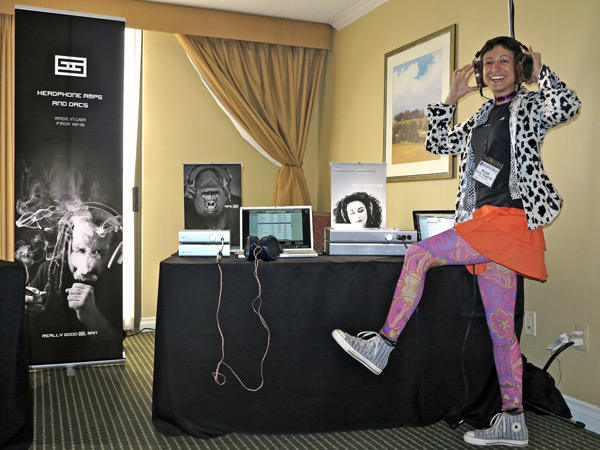
Okay. I know what you're wondering. So do Jason and Lisa Stoddard, whose curiously named headphone amplifier and headphone DAC company celebrates its second anniversary on June 17. In fact, your curiosity is one of the reasons why Lisa is smiling so.
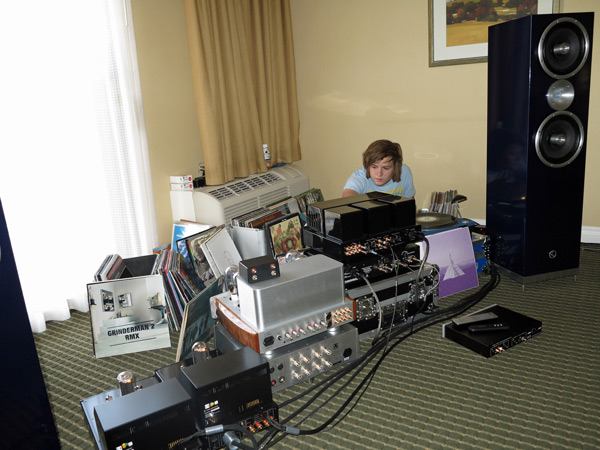
Zu Audio's room was like no other. While the "normal" set-up has components facing attendees and carefully stacked on equipment racks, Zu more or less duplicated the DJ experience. Spinning vinyl as if in a cage, and very happy to be there, I might add, sat Zu owner Sean Casey's delightfully high-spirited son, Ian.
One of my fondest memories of a past CES was sitting with John Atkinson at T.H.E. Show, playing a track from one of his superb recordings of Cantus on an all-out darTZeel /Evolution Acoustics system from Jonathan Tinn's Blue Light Audio. Here, on more modest speakers and electronics, I was again blown away, this time by the fabulous soundstage height, three-dimensionality, and realistic depiction of horns and cymbals on Michael Tilson Thomas' recording of Mahler's Symphony 3.
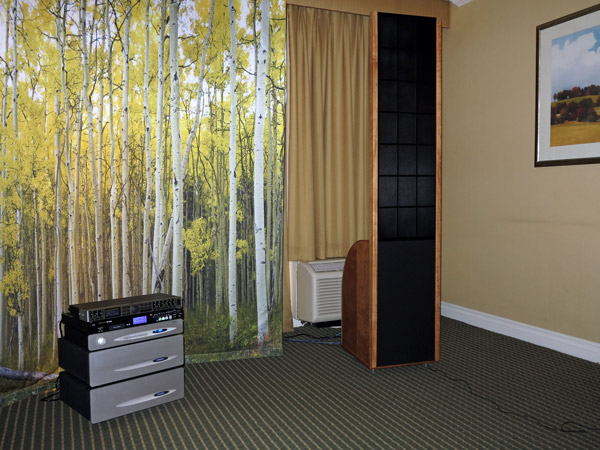
Although Roger Sanders was not in the room when I finally got there on the third day, his "handcrafted in Colorado" electrostats were singing as if he were. In addition to the superb transparency that one expects from a good electrostat, the bass was not just convincing, but simply amazing. The sound was a bit sharp in the small room, and at one point, in an unfortunate performance of Puccini's "O mio babbino caro," distorted on top. Since I've not had either experience in previous auditions of Sanders electrostats, I have a hunch the distortion probably due to the mikes used to record this unsuited-for-the-role-of-Lauretta soprano. (I have a number of recordings from EMI that grow harsh and noisy on vocals due to the choice of microphones).