I had hooked up the speakers earlier and been running them in. In this old house, built in 1872, my listening room was originally intended as one of two master bedrooms. The room is not huge: 13' wide by 17' long by 10' high. (I like the ceiling height you can get in an old wood Victorian.) In spite of what may well be a minefield of resonant nodes, this is the most satisfying space I have had for listening to music.
Were the imposing Sasha DAWs going to be too much loudspeaker for my room? Only proper setup and listening time would tell.
The afternoon McGrath arrived, we listened for a while with the Sasha DAWs where I had set them out of their crates. Peter pronounced that things weren't too bad, and he felt the speakers might end up quite close to their starting positions. The next morning, McGrath got to work with tape measures, a pad of paper, and his ears—no electronic measuring devices. Following the Wilson Audio setup procedure, Peter proceeded to listen, over and over again, for hours, to his favorite test track, Christy Moore's "So Do I," from This Is the Day (Sony 5032552), which features a deep male vocal and a plucked string bass. McGrath finds this recording helpful in detecting undesirable room resonant points.
With the speakers now set on large plastic furniture pads, we moved them in carefully measured half-inch increments from front to back and side to side; at each spot, McGrath would stop to listen and make notes. These included distance from the front wall and numerical grades—1 being worst, 5 being best—in five categories: Low, Low Mid, Upper Mid, Bloom, and Dynamics. McGrath is a tough grader: In only one position out of 13 did he assign three or more points in all five categories. The magic spot was 42.5" from the front wall. This was only a bit more than 4" farther from my listening chair than the speakers were initially, slightly farther apart, and more toed in than the speakers they replaced—and quite close to an equilateral triangle with respect to my chair. Grilles on or off? They were in place when McGrath first arrived, but he wanted me to take the grilles off. We also leveled the speakers once they were set—all the floors in my old house go in different directions. This improved the stereo sound- stage balance and detail.
 Listen to this
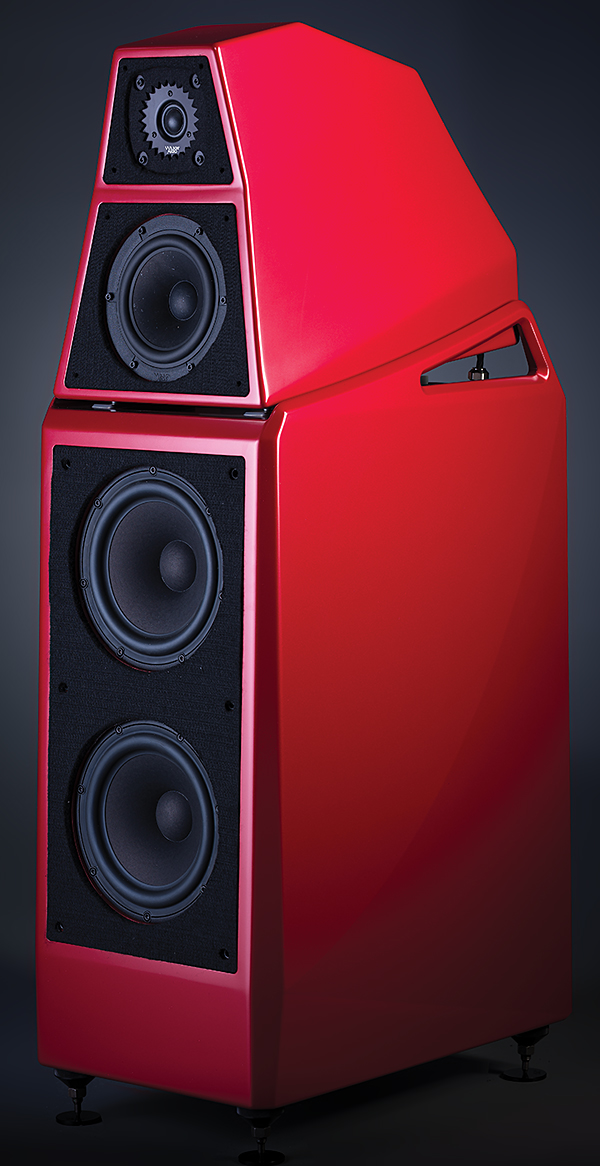
The Wilson Sasha DAWs were well fed. Powering up the 450Wpc McIntosh MC462 stereo amplifier, McGrath and I began to explore a bit. The Sasha DAW's specified sensitivity of 91dB is higher than average—they can indeed play loud—and their nominal impedance is specified as 4 ohms. Counterintuitively, McGrath suggested that with some amps the speakers might sound better using an 8 ohm output tap. We compared, and this proved to be the case: Bass was deeper and tighter and the spatial performance better using the 8 ohm taps instead of the 4 ohm taps. I ran this observation by Wilson designer Credille, who stated that "On tube amps with multiple taps, we have found that the 8 ohm tap generally works the best." John Atkinson took another look at his measurements of the McIntosh MC462 for me and decided that "The 8 ohm tap of the MC462 has the lowest output impedance, which will control the bass best—the opposite of what I would expect." All this adds up to: Each user will need to determine these things for themselves, case by case. Wilson's specified minimum amplifier power for the Sasha DAW is 25Wpc. I would suggest even more—you probably won't experience all the Sasha DAW has to offer with flea-circus amplification.
I don't know what unseen planchette guided my fingers to my original copy of Captain Beefheart and The Magic Band's Clear Spot (LP, Reprise MS 2115 0598): my favorite album from Don Van Vliet, not only for the material but because it is by far the best-sounding recording of Don's career. The incredible pow of the drums and the wailing harmonica on "Circumstances" . . . well, as Little Richard put it, they "made my big toe jump up in my boot." Deputy Editor Art Dudley motored by the next day for a listen and asked to hear "Her Eyes Are a Blue Million Miles." Art commented that this was the best he had ever heard that particular track sound, with its surprisingly soulful vocal from the Captain. Outstanding.
 If you want to really vet the quality of vocal reproduction from a loudspeaker, reach for Joni Mitchell's masterpiece Blue (LP, Reprise/Rhino MS 2038). Listening to the superb recent vinyl remastering from Rhino Vinyl, my eyes welled and my ears perked up when I got to "Little Green." I have heard this tune innumerable times, but I never noticed how long Joni sustains the last word of the song, "sorrow": heartbreak made audible by the Sasha DAW. My reference Harbeth 30.2 40th Anniversary Edition loudspeakers, reviewed by Herb Reichert in the April 2018 issue, utilize a 1" soft-dome tweeter, as do the Sasha DAWs. However, the Harbeths provide less texture, detail, and diction than I heard from the Wilsons. This does not mean the latter were forward or strident: With the Sasha DAWs, there was no sense of that up-in-your-face-and- ears sound that I have sometimes experienced with large monitors in recording studios.
In the mood for some Steely Dan, I turned to the album that won them their overdue Grammy in 2000, Two Against Nature (CD, Giant/Warner Bros. 9 24719-2). Donald Fagen and Walter Becker honed what they termed their "junkie grooves" to a fine edge over the years, and this album is chock-full of 'em. Listening to "Cousin Dupree" felt like driving a really high-powered go-kart: Through the Sasha DAWs there were pace, snap, drive, and speed, all propelling the energy of the track forward.
Turning to a more uptown kind of music, I streamed from Qobuz the fifth and final movement of the Shostakovich Symphony No.8 from the cycle-in-progress by conductor Andris Nelsons and the Boston Symphony Orchestra (24/96 WAV, Deutsche Grammophon 289 479 5201). As the concert bass drum and the rest of the orchestra repeat the same bone-crunching crescendo, the effect heard through the Sasha DAWs was beyond exciting—it was terrifying. I think this is what Dimitri wanted us to feel. (The subtitle on the album cover is "Under Stalin's Shadow.") The low-end performance of the Sasha DAWs was sui generis: Though I have owned other fine floorstanders and subwoofers, the low-end performance of the Sasha DAWs took things to another level.
Shostakovich is among the most varied of composers. When he mutes the strings, and a single woodwind softly takes the lead, the Sasha DAWs reveled in the most delicate of musical colors. The soundstage was fantastic, laid out in sparkling width, depth, and detail. Stereo soundstaging is high on my to-do list; if I want to listen to mono, I'll crank up one of my three Victrolas. With the Sasha DAWs properly dialed in, with the room "completing the acoustic circuit," I could answer my earlier question I started with: No, not too much loudspeaker. The electronics, the speakers, and the listening space were all pulling together now, putting their backs into it like a well-trained crew team.
The sweet spot?
If you want to really vet the quality of vocal reproduction from a loudspeaker, reach for Joni Mitchell's masterpiece Blue (LP, Reprise/Rhino MS 2038). Listening to the superb recent vinyl remastering from Rhino Vinyl, my eyes welled and my ears perked up when I got to "Little Green." I have heard this tune innumerable times, but I never noticed how long Joni sustains the last word of the song, "sorrow": heartbreak made audible by the Sasha DAW. My reference Harbeth 30.2 40th Anniversary Edition loudspeakers, reviewed by Herb Reichert in the April 2018 issue, utilize a 1" soft-dome tweeter, as do the Sasha DAWs. However, the Harbeths provide less texture, detail, and diction than I heard from the Wilsons. This does not mean the latter were forward or strident: With the Sasha DAWs, there was no sense of that up-in-your-face-and- ears sound that I have sometimes experienced with large monitors in recording studios.
In the mood for some Steely Dan, I turned to the album that won them their overdue Grammy in 2000, Two Against Nature (CD, Giant/Warner Bros. 9 24719-2). Donald Fagen and Walter Becker honed what they termed their "junkie grooves" to a fine edge over the years, and this album is chock-full of 'em. Listening to "Cousin Dupree" felt like driving a really high-powered go-kart: Through the Sasha DAWs there were pace, snap, drive, and speed, all propelling the energy of the track forward.
Turning to a more uptown kind of music, I streamed from Qobuz the fifth and final movement of the Shostakovich Symphony No.8 from the cycle-in-progress by conductor Andris Nelsons and the Boston Symphony Orchestra (24/96 WAV, Deutsche Grammophon 289 479 5201). As the concert bass drum and the rest of the orchestra repeat the same bone-crunching crescendo, the effect heard through the Sasha DAWs was beyond exciting—it was terrifying. I think this is what Dimitri wanted us to feel. (The subtitle on the album cover is "Under Stalin's Shadow.") The low-end performance of the Sasha DAWs was sui generis: Though I have owned other fine floorstanders and subwoofers, the low-end performance of the Sasha DAWs took things to another level.
Shostakovich is among the most varied of composers. When he mutes the strings, and a single woodwind softly takes the lead, the Sasha DAWs reveled in the most delicate of musical colors. The soundstage was fantastic, laid out in sparkling width, depth, and detail. Stereo soundstaging is high on my to-do list; if I want to listen to mono, I'll crank up one of my three Victrolas. With the Sasha DAWs properly dialed in, with the room "completing the acoustic circuit," I could answer my earlier question I started with: No, not too much loudspeaker. The electronics, the speakers, and the listening space were all pulling together now, putting their backs into it like a well-trained crew team.
The sweet spot?
I think it's likely that the increased size and solidity of the Wilson Audio Sasha DAW cabinets, along with revisions to the drivers and other elements, may have resulted in improvements, overall, compared with the prior Sasha models. (John Atkinson's measurements should shed further light on this.) There is tonal beauty, alongside an amazing dynamic range. The end result helps create the tactile sensation of actual music being performed by actual musicians, not virtual ones.
Listen to thisThe Wilson Sasha DAWs were well fed. Powering up the 450Wpc McIntosh MC462 stereo amplifier, McGrath and I began to explore a bit. The Sasha DAW's specified sensitivity of 91dB is higher than average—they can indeed play loud—and their nominal impedance is specified as 4 ohms. Counterintuitively, McGrath suggested that with some amps the speakers might sound better using an 8 ohm output tap. We compared, and this proved to be the case: Bass was deeper and tighter and the spatial performance better using the 8 ohm taps instead of the 4 ohm taps. I ran this observation by Wilson designer Credille, who stated that "On tube amps with multiple taps, we have found that the 8 ohm tap generally works the best." John Atkinson took another look at his measurements of the McIntosh MC462 for me and decided that "The 8 ohm tap of the MC462 has the lowest output impedance, which will control the bass best—the opposite of what I would expect." All this adds up to: Each user will need to determine these things for themselves, case by case. Wilson's specified minimum amplifier power for the Sasha DAW is 25Wpc. I would suggest even more—you probably won't experience all the Sasha DAW has to offer with flea-circus amplification.
If you want to really vet the quality of vocal reproduction from a loudspeaker, reach for Joni Mitchell's masterpiece Blue (LP, Reprise/Rhino MS 2038). Listening to the superb recent vinyl remastering from Rhino Vinyl, my eyes welled and my ears perked up when I got to "Little Green." I have heard this tune innumerable times, but I never noticed how long Joni sustains the last word of the song, "sorrow": heartbreak made audible by the Sasha DAW. My reference Harbeth 30.2 40th Anniversary Edition loudspeakers, reviewed by Herb Reichert in the April 2018 issue, utilize a 1" soft-dome tweeter, as do the Sasha DAWs. However, the Harbeths provide less texture, detail, and diction than I heard from the Wilsons. This does not mean the latter were forward or strident: With the Sasha DAWs, there was no sense of that up-in-your-face-and- ears sound that I have sometimes experienced with large monitors in recording studios.
In the mood for some Steely Dan, I turned to the album that won them their overdue Grammy in 2000, Two Against Nature (CD, Giant/Warner Bros. 9 24719-2). Donald Fagen and Walter Becker honed what they termed their "junkie grooves" to a fine edge over the years, and this album is chock-full of 'em. Listening to "Cousin Dupree" felt like driving a really high-powered go-kart: Through the Sasha DAWs there were pace, snap, drive, and speed, all propelling the energy of the track forward.
I think it's likely that the increased size and solidity of the Wilson Audio Sasha DAW cabinets, along with revisions to the drivers and other elements, may have resulted in improvements, overall, compared with the prior Sasha models. (John Atkinson's measurements should shed further light on this.) There is tonal beauty, alongside an amazing dynamic range. The end result helps create the tactile sensation of actual music being performed by actual musicians, not virtual ones.
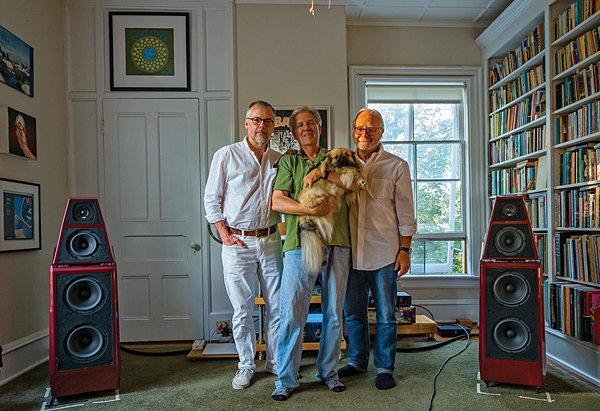
L–R Art Dudley, Sasha Matson, Toby, and Wilson Audio’s Peter McGrath in Sasha's listening room.
Are the Wilson Audio Specialties Sasha DAW loudspeakers worth their price of admission? It's a matter of priorities. Usually, when hi-fi buffs complain about high-end pricing, they compare audio gear to cars. But, as Dylan puts it: "I don't have no sports car, and don't even care to have one. I can walk anytime—around the block." To my way of thinking, a more apt analogy for the Sasha DAW would be to a really fine musical instrument, which musicians can and do find a way to have in their lives.
When I examine product lineups from high-end manufacturers, I tend to seek out the model where the cost and performance vectors intersect. In my view, within the current Wilson Audio Specialties lineup, the Sasha DAW occupies that spot. This loudspeaker is at the center of the design concepts that David Wilson first created for his company. In a less costly world, would I choose to keep the Sasha DAWs? In a needle drop. I have never heard music recreation in my own home like this before. The Sasha DAW has rocked my listening world. The Wilson Audio Specialties Sasha DAW loudspeaker is a beautifully balanced fusion of technology, craft, and art, and a fine living tribute to David A. Wilson.