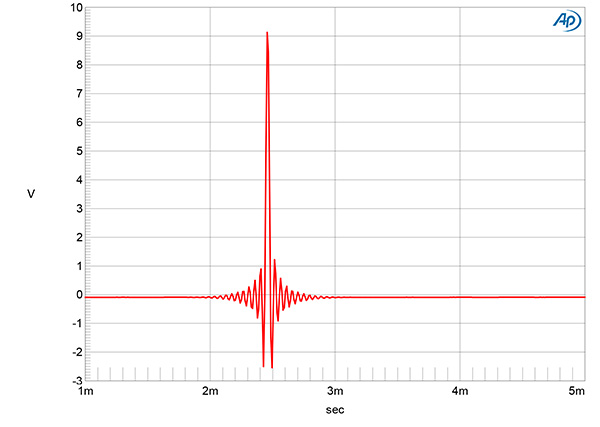
Fig.13 WiiM Amp, optical input, impulse response (one sample at 0dBFS, 44.1kHz sampling, 4ms time window).
I examined the behavior of the WiiM's D/A conversion circuitry with Ethernet data sourced from Roon and with the optical input. The latter locked to S/PDIF data with sample rates up to 192kHz. The Amp's digital inputs preserved absolute polarity and with the volume control set to the maximum, a 1kHz digital signal at –20dBFS resulted in an output level of 2.283V from loudspeaker outputs, which is exactly 20dB below the amplifier's clipping voltage into 8 ohms. It is rare to find a gain architecture as well-managed as this.
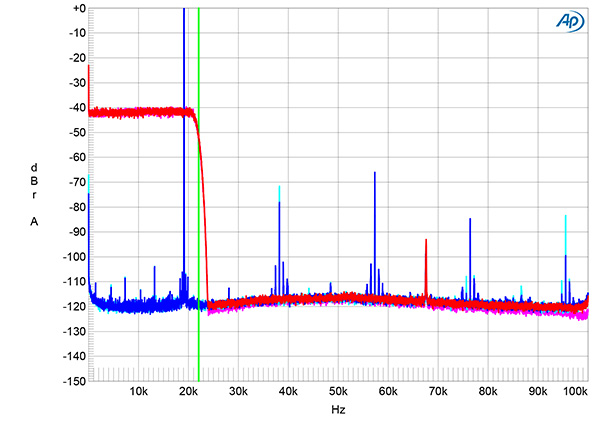
Fig.14 WiiM Amp, optical input, wideband spectrum of white noise at –4dBFS (left channel red, right magenta) and 19.1kHz tone at 0dBFS (left blue, right cyan), with data sampled at 44.1kHz (20dB/vertical div.).
The Amp's reconstruction filter is a conventional linear-phase type, with time-symmetrical ringing on either side of the single full-scale sample (fig.13). With 44.1kHz-sampled white noise, the Amp's response rolled off sharply above 20kHz (fig.14, red and magenta traces), reaching full stop-band suppression at 24kHz. No aliased images are visible with a full-scale tone at 19.1kHz (blue and cyan traces) and the third harmonic is the highest in level, at –66dB (0.05%). Some low-level sidebands are visible around the 19.1kHz tone and its harmonics, these of unknown origin, but possibly due to jitter (see later).
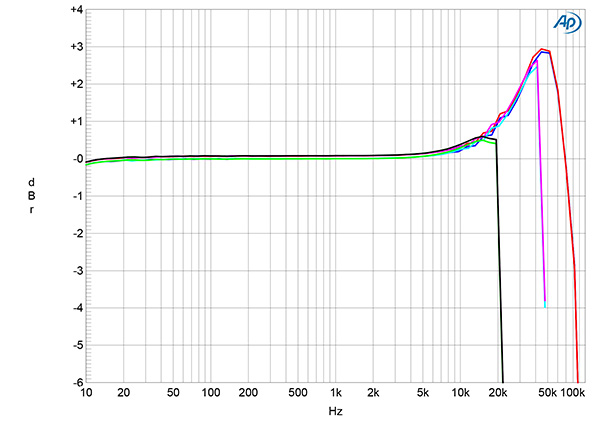
Fig15 WiiM Amp, optical input, frequency response at –12dBFS into 100k ohms with data sampled at: 44.1kHz (left channel green, right gray), 96kHz (left cyan, right magenta), and 192kHz (left blue, right red) (1dB/vertical div.).
The WiiM's frequency response with data sampled at 44.1, 96, and 192kHz (fig.15) followed the same basic shape before dropping off sharply just below half of each the sample rate. Channel separation (not shown) was significantly better than it had been from the analog input, at >110dB at low frequencies and still 80dB at the top of the audioband.
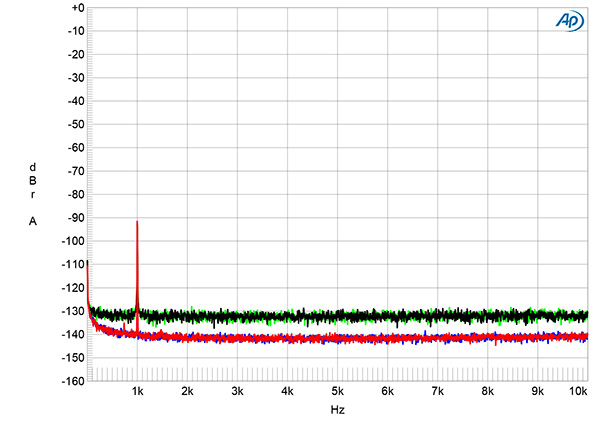
Fig.16 WiiM Amp, optical input, spectrum with noise and spuriae of dithered 1kHz tone at –90dBFS with 16-bit data (left channel cyan, right magenta) and 24-bit data (left blue, right red) (20dB/vertical div.).
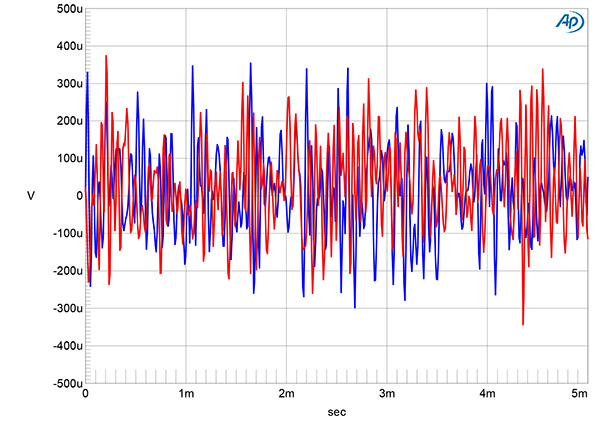
Fig.17 WiiM Amp, optical input, waveform of undithered 1kHz sinewave at –90.31dBFS, 16-bit data (left channel blue, right red).
Fig.16 shows the spectrum of the WiiM's output as it decoded dithered data representing a 1kHz tone at –90dBFS with 16-bit and 24-bit data. The increase in bit depth lowers the noisefloor level by 10dB, which suggests that the Amp's DAC offers between 17 and 18 bits of resolution. With undithered 16-bit data representing a tone at exactly –90.31dBFS, the three DC voltage levels described by the data were obscured by noise (fig.17).
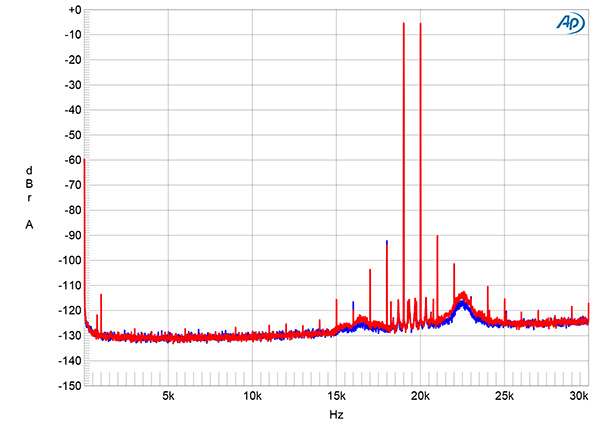
Fig.18 WiiM Amp, 24-bit Ethernet data, HF intermodulation spectrum, DC–30kHz, 19+20kHz at 0dBFS peak, sampled at 44.1kHz (left channel blue, right red).
Intermodulation distortion with an equal mix of 19kHz and 20kHz tones sampled at 44.1kHz and peaking at 0dBFS was very low, though there was an odd rise in the noisefloor on either side of the tones with Ethernet data (fig.18) that was not present with optical data.
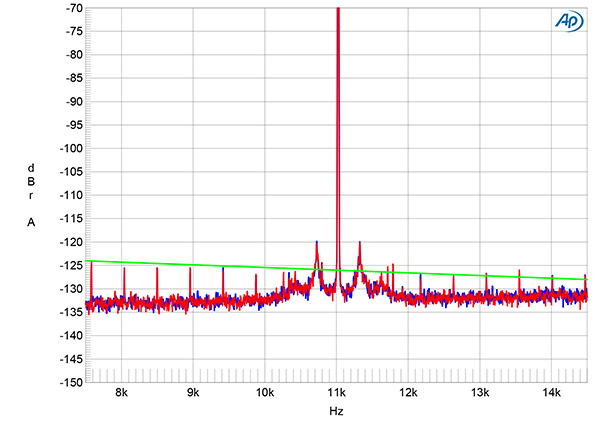
Fig.19 WiiM Amp, high-resolution jitter spectrum of analog output signal, 11.025kHz at –6dBFS, sampled at 44.1kHz with LSB toggled at 229Hz: 16-bit Toslink data (left channel blue, right red). Center frequency of trace, 11.025kHz; frequency range, ±3.5kHz.
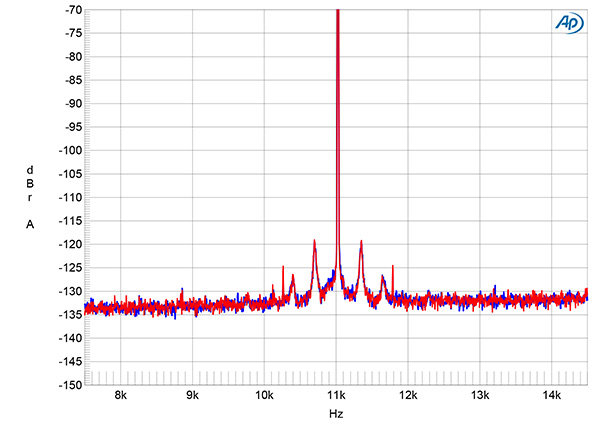
Fig.20 WiiM Amp, high-resolution jitter spectrum of analog output signal, 11.025kHz at –6dBFS, sampled at 44.1kHz with LSB toggled at 229Hz: 24-bit Ethernet data (left channel blue, right red). Center frequency of trace, 11.025kHz; frequency range, ±3.5kHz.
The Amp offered good rejection of word-clock jitter, with both optical and Ethernet data. Fig.19 was taken with 16-bit optical J-Test data. All the odd-order harmonics of the LSB-level, low-frequency squarewave lay at the correct levels, shown by the sloping green line, and there is no broadening of the spectral spike at one-quarter the sample rate. However, a pair of low-level sidebands was present at ±328Hz. These were also present with 24-bit J-Test data (fig.20).