Turning to the UD-701N's analog line inputs, these preserved absolute polarity for all four output types. The single-ended line input impedance was a fairly high 23.4k ohms at 20Hz and 1kHz, 19.6k ohms at 20kHz. The balanced input impedance was much lower, at 1920 ohms at all audio frequencies. With the volume control set to the maximum, "100," the voltage gain with a 1kHz balanced input was 18dB from the balanced line output and 25.3dB from the balanced headphone output. The gain with an unbalanced input was 5.8dB higher from all the outputs. Setting the line outputs to "Fixed 0dB" gave the same output voltages as with the volume control set to "100."
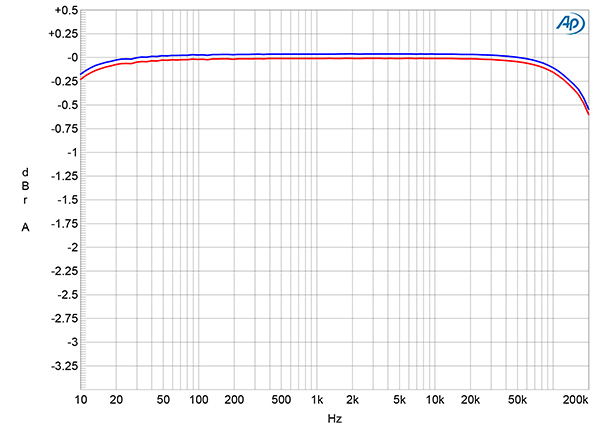
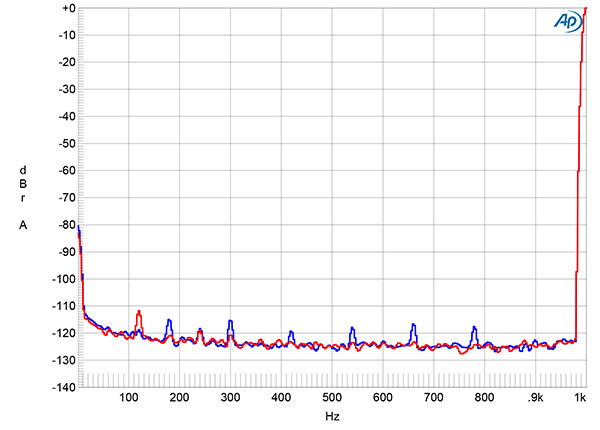
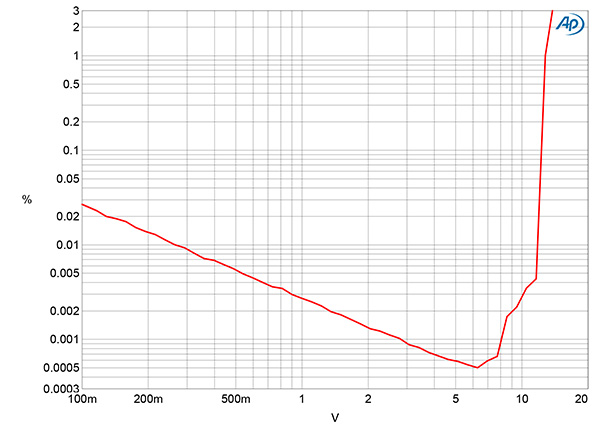
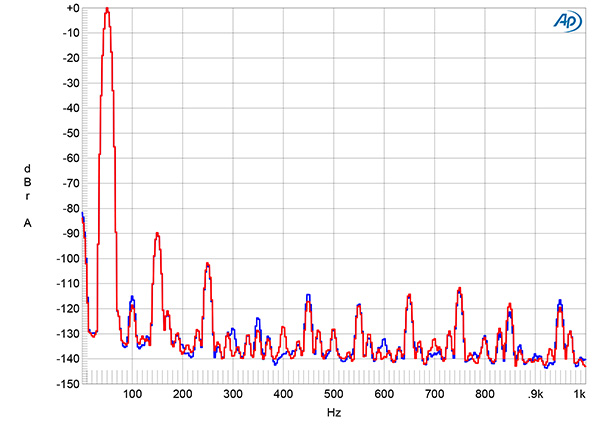
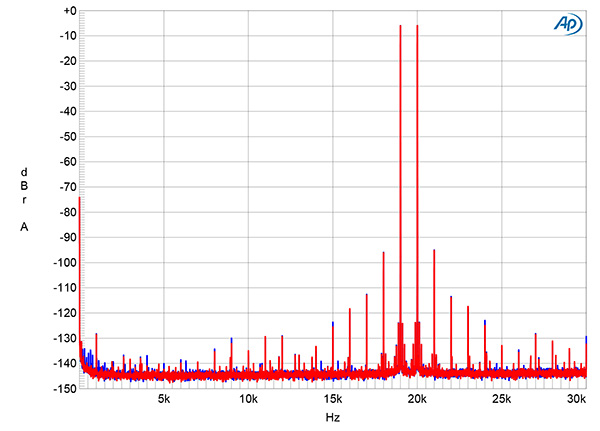
Fig.17 TEAC UD-701N, line input, balanced output, frequency response at 1V into 100k ohms left channel blue, right red; 0.25dB/vertical div.).
Fig.18 TEAC UD-701N, line input, balanced output, spectrum of 1kHz sinewave, DC–1kHz, at 1V into 100k ohms (left channel blue, right red, linear frequency scale).
The balanced line frequency response was flat up to 100kHz into 100k ohms and 600 ohms (fig.17); the very close channel balance and the overall response were preserved at lower settings of the volume control and from the headphone output. Channel separation was astonishingly high, at >130dB in both directions below 2kHz and still 115dB at the top of the audioband. The wideband, unweighted signal/noise ratio, taken with the unbalanced input shorted to ground and the volume control set to its maximum, was a very good 80dB ref. 2V in both channels. This ratio improved to 95dB when the measurement bandwidth was restricted to the audioband and to 97.9dB when A-weighted. The low-frequency noise spectrum was clean (fig.18), with supply-related spuriae very low in level.
Fig.19 TEAC UD-701N, line input, balanced output, THD+N (%) vs 1kHz output voltage into 100k ohms.
Fig.19 plots how the THD+noise percentage in the UD-701N's balanced mode varied with output voltage into 100k ohms. At Stereophile's usual definition of clipping, which is when the THD+N reaches 1%, the UD-701N's balanced outputs clipped at 12.75V into 100k ohms. The single-ended outputs clipped at half this voltage. The downward slope of the trace indicates that the distortion lies below the noise up to 6V.
Fig.20 TEAC UD-701N, line input, balanced output, line input, balanced output, spectrum of 50Hz sinewave, DC–1kHz, at 10V into 100k ohms (left channel blue, right red, linear frequency scale).
Fig.21 TEAC UD-701N, line input, balanced output, HF intermodulation spectrum, DC–30kHz, 19+20kHz at 10V peak into 100k ohms (left channel blue, right red, linear frequency scale).
Fig.20 is a spectral analysis of the TEAC's output with its balanced line output driving 50Hz just below clipping into 100k ohms. Even at this very high output level, the third harmonic, which was the highest in level, lay at just –80dB (0.01%). Intermodulation distortion was also superbly low in level despite the very high output voltage (fig.21).
The measured performance of the TEAC UD-701N's digital inputs suggests that the least distortion will be obtained with data upsampled to DSD, though this gives lower measured resolution. I was puzzled by the higher distortion in multibit mode, though it is fair to note that perhaps this looks worse than it sounds, as HR enjoyed the UD-701N and told me he did most of his listening in that mode.
There are no puzzles about the UD-701N's behavior as an analog preamplifier; it offers a wide frequency response coupled with superbly low crosstalk, noise, and distortion, even into 600 ohms.—John Atkinson