Editor's Choice:
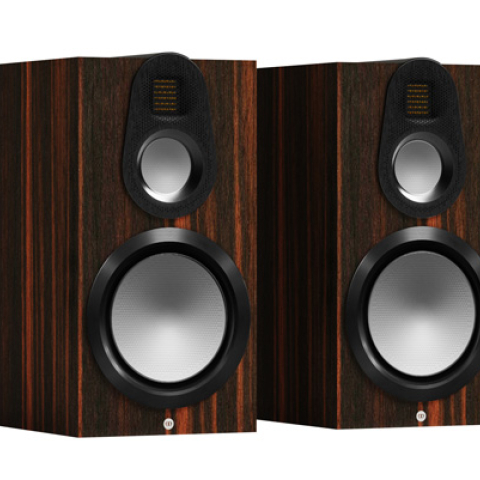
Rogers/Harbeth/Spendor/KEF BBC LS3/5a loudspeaker ($896/pair–$1199/pair; reviewed by J. Gordon Holt, Vol.3 No.12, Spring 1977, & Vol.4 No.1, December 1977; Dick Olsher, Vol.7 No.4, June 1984; John Atkinson, Vol.11 Nos.2 & 3, February & March 1988, Vol.14 No.10, October 1990, Vol.16 No.12, December 1993; Corey Greenberg, Vol.17 No.1, January 1994 Review)
Back in the early '70s, the BBC needed a physically unobtrusive nearfield monitor loudspeaker for use in mobile broadcast studios. Accordingly, they instructed their design department, which at that time featured such luminaries as Dudley Harwood (the "father" of the polypropylene cone, who went on to found Harbeth) and the late Spencer Hughes (the "father" of the Bextrene cone, who went on to found Spendor), to produce such a model. Thus, not only was what was then probably the finest collection of British speaker-design talent involved in its development, there were no commercial constraints placed on the design. The only limitations were intended to be those arising from the necessarily small enclosure and the absence of the need for a wide dynamic range under close monitoring conditions.
The result of their efforts, the LS3/5a, was licensed to commercial speaker companies for production in 1975. In all the years since, the design has been revised just twice: In 1988, the woofer's springy Neoprene rubber surround was changed to a more lossy vinyl compound, and the crossover was redesigned—not to change the response, but to bring the production response window closer to target and to make the impedance a little less demanding. A bi-wiring option was approved by the BBC in 1990, provided the performance in single-wired mode met the original specification.
The LS3/5a has never boogied and never will; it's just too polite ever to cut the mustard on rock, or even straightahead jazz. But for a classical music-lover who has only a small room and perhaps keen-eared neighbors, the LS3/5a, used on a good, rigid pair of stands well away from room boundaries, is still, two decades after it was designed, a loudspeaker that sets the standard for minimonitor performance.—John Atkinson
Stereophile's Products of 1994 Editor's Choice

ARTICLE CONTENTS
- Log in or register to post comments