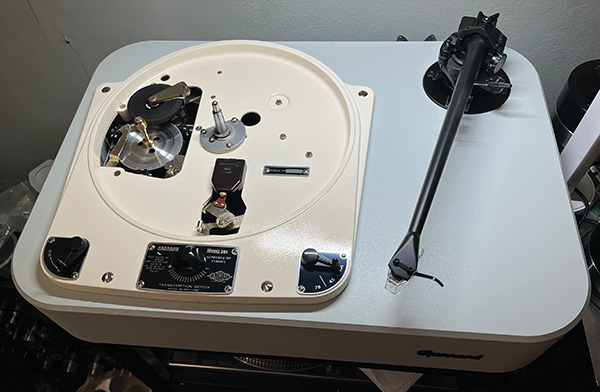
 In 1957, the grease-bearing Schedule 1 301 was replaced by the Schedule 2 version, which introduced an oil bearing with oil-retaining sintered bushings, minimizing user maintenance. There is spirited debate among 301 aficionados as to which bearing sounds better, but as often happens with vintage gear, the earlier and much rarer Schedule 1 grease-bearing models have more value to collectors.
To build a 301 Advanced, Garrard starts by removing every part from the vintage donor chassis. The aluminum is then stripped to bare metal, partly for safety reasons—the original used lead-based paint—before repainting it in ivory, the most common of the three paint finishes offered at various times on original 301s. New control plates and switches are fitted, then the 6lb platter with its stroboscopic markings—a £2 option when this 'table was new!—is rebalanced, repainted, and remachined to give it the clearest strobe markings I have seen on a 301. Cosmetically, the Advanced truly looks like a brand-new 301, just like the first Garrard-restored 301 I saw at High End Munich 2019.
Under the hood, the same level of care is observed. The original motor and main platter bearing are retained but get complete rebuilds, with new sintered bearing bushings machined (like every new part) to the original tolerances. The linkages are stripped of their cadmium plating and are instead plated with zinc because, as with the chassis paint, that cadmium plating doesn't meet modern toxicity regulations.
In 1957, the grease-bearing Schedule 1 301 was replaced by the Schedule 2 version, which introduced an oil bearing with oil-retaining sintered bushings, minimizing user maintenance. There is spirited debate among 301 aficionados as to which bearing sounds better, but as often happens with vintage gear, the earlier and much rarer Schedule 1 grease-bearing models have more value to collectors.
To build a 301 Advanced, Garrard starts by removing every part from the vintage donor chassis. The aluminum is then stripped to bare metal, partly for safety reasons—the original used lead-based paint—before repainting it in ivory, the most common of the three paint finishes offered at various times on original 301s. New control plates and switches are fitted, then the 6lb platter with its stroboscopic markings—a £2 option when this 'table was new!—is rebalanced, repainted, and remachined to give it the clearest strobe markings I have seen on a 301. Cosmetically, the Advanced truly looks like a brand-new 301, just like the first Garrard-restored 301 I saw at High End Munich 2019.
Under the hood, the same level of care is observed. The original motor and main platter bearing are retained but get complete rebuilds, with new sintered bearing bushings machined (like every new part) to the original tolerances. The linkages are stripped of their cadmium plating and are instead plated with zinc because, as with the chassis paint, that cadmium plating doesn't meet modern toxicity regulations.
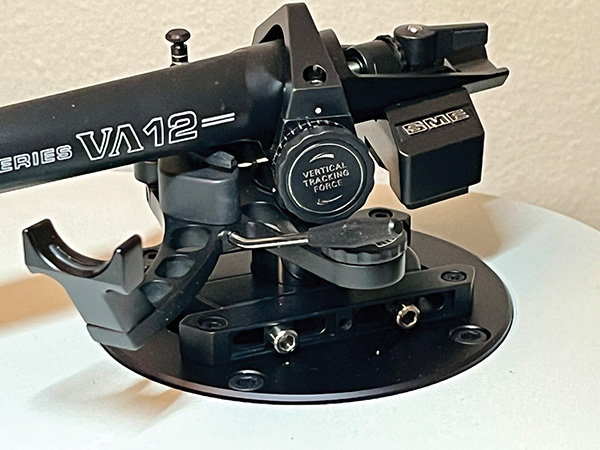 The parts that make the new 301 "Advanced" are the new plinth and tonearm. When I reviewed the SME Model 60 in 2023, one part that made it really stand out was the Series VA tonearm with its unique resin armtube. For the Garrard 301 Advanced, SME has taken a step beyond that, by using a resin version of the longer Series V-12 12" arm, called the VA-12. As with the SME Model 60's Series VA arm, this new version cannot be purchased separately and is only available on the 301 Advanced.
If you had bought a 301 between 1957 and 1965, it would not have come with a plinth or tonearm. Back then, the new owner specified which plinth and arm they wanted, even if it meant cutting the appropriate hole in your radiogram's shelf or (if you were a professional user) a radio station's studio console. The original owner's manual included a foldout cutting template, with instructions on how to mount your new 301 in whatever slab of wood you deemed appropriate. The 301 Advanced comes with a lovingly reproduced facsimile of that original clothbound hard-cover manual, complete with the foldout cutting template and exploded diagrams of every part. But these days, Garrard doesn't expect you to pull out the jigsaw and cut a hole in a slab of wood.
The parts that make the new 301 "Advanced" are the new plinth and tonearm. When I reviewed the SME Model 60 in 2023, one part that made it really stand out was the Series VA tonearm with its unique resin armtube. For the Garrard 301 Advanced, SME has taken a step beyond that, by using a resin version of the longer Series V-12 12" arm, called the VA-12. As with the SME Model 60's Series VA arm, this new version cannot be purchased separately and is only available on the 301 Advanced.
If you had bought a 301 between 1957 and 1965, it would not have come with a plinth or tonearm. Back then, the new owner specified which plinth and arm they wanted, even if it meant cutting the appropriate hole in your radiogram's shelf or (if you were a professional user) a radio station's studio console. The original owner's manual included a foldout cutting template, with instructions on how to mount your new 301 in whatever slab of wood you deemed appropriate. The 301 Advanced comes with a lovingly reproduced facsimile of that original clothbound hard-cover manual, complete with the foldout cutting template and exploded diagrams of every part. But these days, Garrard doesn't expect you to pull out the jigsaw and cut a hole in a slab of wood.
 The Reliable Uberlight Frame
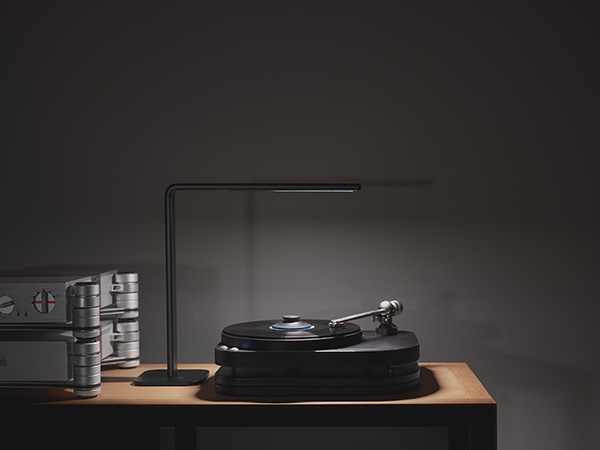
Whenever I travel to someone's home to perform surgery on a turntable, one of the most essential parts of my toolkit is a couple of high-intensity LED flashlights that allow me to see what the heck I'm doing. Many people—too many—set up their turntables in a dark corner of their man caves, making it hard to see much of anything. Even if you're just playing records, it really helps to have bright, clear lighting near your turntable so that you can see whether the record needs cleaning, what kind of condition it's in, and how precisely your stylus is lined up before you lower it onto the record. Good lighting makes everything so much easier.
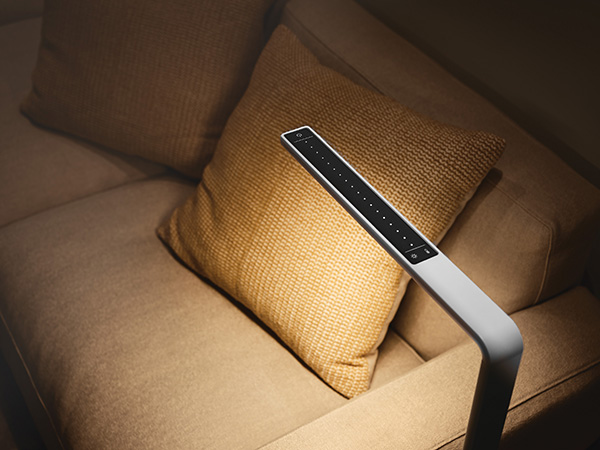
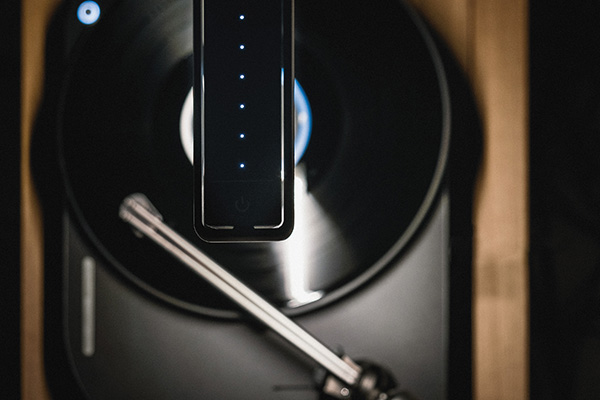 The Frame is loaded with features, going way beyond the on and off switch with a couple of brightness options you get with most LED lamps. The row of 18 LEDs can be turned on and off selectively in six groups of three, allowing you to focus the illumination over a certain area. There are six brightness levels, three color-temperature options, and the LED panel can be swiveled within the frame to direct the light forward or backward by up to 30 degrees from vertical. The maximum light output is about 600 lumens, which is fantastic when you want to assess a record's condition or cleanliness or read the pressing information stamped in the dead wax.
Coolest of all, there's a remote control, which lets you adjust the brightness and color temperature and power it on and off. The remote has its own storage cavity within the Frame, and when the remote is stored, the Frame charges its battery. Finally, the remote has a tiny built-in flashlight, which is useful for illuminating your cartridge's stylus when you need to clean it.
While it isn't exactly cheap, the price—at $399—seems pretty fair in the context of a lot of high-end audio equipment, especially considering its plethora of useful features. Saving you from one stylus-cueing or cleaning accident could pay for the UberLight Frame several times over. For me, it's a keeper. If I could convince everyone whose turntable I'm going to set up to get one of these before I arrive, I'd be able to leave my flashlights at home.
The Frame is loaded with features, going way beyond the on and off switch with a couple of brightness options you get with most LED lamps. The row of 18 LEDs can be turned on and off selectively in six groups of three, allowing you to focus the illumination over a certain area. There are six brightness levels, three color-temperature options, and the LED panel can be swiveled within the frame to direct the light forward or backward by up to 30 degrees from vertical. The maximum light output is about 600 lumens, which is fantastic when you want to assess a record's condition or cleanliness or read the pressing information stamped in the dead wax.
Coolest of all, there's a remote control, which lets you adjust the brightness and color temperature and power it on and off. The remote has its own storage cavity within the Frame, and when the remote is stored, the Frame charges its battery. Finally, the remote has a tiny built-in flashlight, which is useful for illuminating your cartridge's stylus when you need to clean it.
While it isn't exactly cheap, the price—at $399—seems pretty fair in the context of a lot of high-end audio equipment, especially considering its plethora of useful features. Saving you from one stylus-cueing or cleaning accident could pay for the UberLight Frame several times over. For me, it's a keeper. If I could convince everyone whose turntable I'm going to set up to get one of these before I arrive, I'd be able to leave my flashlights at home.
Footnote 4: See ral-farben.de/en. Footnote 5: Reliable Corporation, 100 Wingold Ave., Toronto, Canada. Tel: (800) 268-1649. Web: reliablecorporation.com.