Much of the coverage of the passing of Marianne Faithfull has focused on her private life rather than her music. That is understandable—yet it's also regrettable because it misses the important fact that for 60 years, Faithfull produced an impressive catalog of music, releasing 21 solo studio albums plus collaborations, compilations, and live recordings.
To oversimplify, her career can be divided in two periods. The first, which received most of the attention in obituaries, was in the 1960s, when she was a face of the British Invasion. In the mid-'60s, with her soft, folky voice and very English pop, she enjoyed several US hits including "As Tears Go By" and "Come and Stay with Me," both from her self-titled 1965 debut album, though "As Tears Go By" was released as a single in 1964. The other charting singles were "This Little Bird" and "Summer Nights," both from her second album, The World of Marianne Faithfull. ("Go Away from My World," from the same album, also charted in the US—barely.)
My interest in Marianne Faithfull didn't begin with her personal life or her '60s successes. Until the late '70s, I hardly knew who she was. At first she was of interest to me only because of her duet with David Bowie, a 1973 version of Sonny and Cher's "I Got You Babe," Bowie in his Ziggy Stardust persona and Faithfull dressed as a nun.
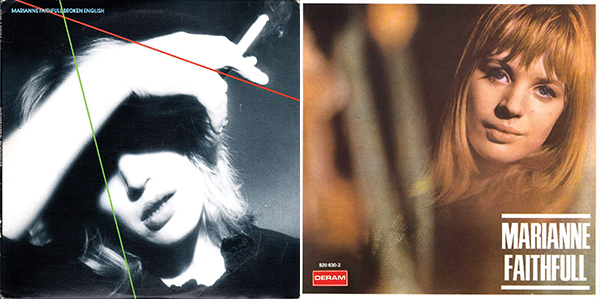
My interest in Faithfull expanded in 1979, when I plus more than a million others took home Broken English, which relaunched her career.
By 1979, years of alcohol and other substance abuse had destroyed her voice's softness and innocence. Her later voice was gravellier, growling, experienced, and loaded with sincerity. At the same time, the music on Broken English sounded fresh and new, not from some hippie past but of the post-punk present. Sonically, it packed a punch. It was modern, danceable, and electronic (with Steve Winwood on keyboards). The songs cover themes one might expect from a band of the time including opposition to war (on the title track) and disillusionment with suburban bliss (on the cover of Dr. Hook's "The Ballad of Lucy Jordan"). Gone was the winsome, naive English rose; here was the world-weary, mature woman. She even managed to pull off making John Lennon's "Working Class Hero" sound sincere and revolutionary. No easy feat, considering her entitled, aristocratic past. Broken English still sounds exciting. Her staggering vocal performance earned her a Grammy nomination.
The change in vocal style was apparent three years earlier, on Dreamin' My Dreams. Here we find Faithfull as a country singer, although—ahem—a charitable way of putting it is that this was Faithfull finding her way, exploring the future. It was rereleased two years later with a new title—Faithless—and four new tracks. This version does at least include a passable cover of Dylan's "I'll Be Your Baby Tonight." This new version was released twice more, in 1985 as part of Rich Kid Blues and in 2007 with the title No Regrets.
Faithfull's best live album, though, is Blazing Away, from 1990. Her mature voice is at its best: passionate, soulful, honest. Blazing is a career survey of sorts, and her emotional and stylistic range is on full display, from chanteuse ballad to hard-rock snarl. Her version of "Sister Morphine," which she co-wrote with Jagger and Richards in 1968, is magnificent. This is a great live album, with a tight supporting band. The sound achieves that difficult feat of retaining a live feel without sacrificing sonic quality.
Faithfull experimented with styles and genres, but her work has consistent themes. Her songs embraced fear and fight, vulnerability and strength, arrogance and inferiority. Those contradictions and complexities make her music compelling. In originals and covers, Faithfull had the skill and intelligence to create performances that people could relate to, even if they hadn't experienced the life that she had.
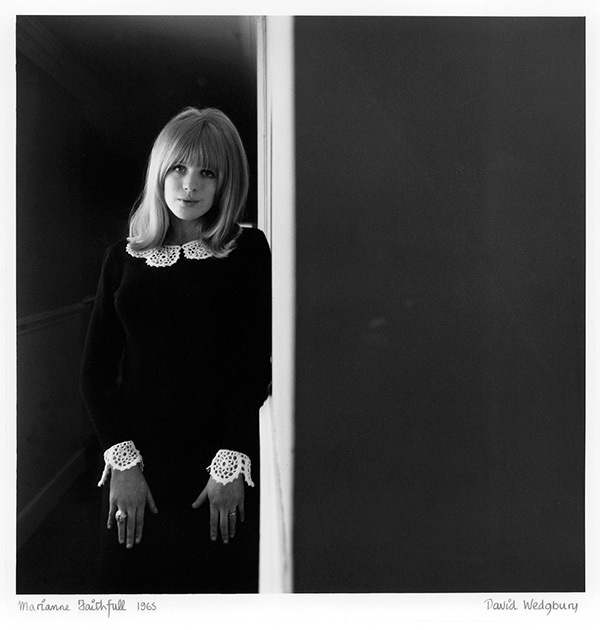
Photo by David Wedgbury, 1965
The productive exploration of electronic music, which was heralded by Broken English, was something which she would return to throughout her career. Consider 1995's A Secret Life, a greatly underrated album. Secret Life was a collaboration with Angelo Badalamenti, whose soundtrack background gave tracks such as "The Stars Line Up" a quasi-film noir vibe. Other songs, including "The Wedding," have a funkier feel. In 1999, Faithfull released Vagabond Ways, a deeply personal, occasionally difficult journey through her life. (Mining life experience for music was something she would often do; perhaps that's why after her death, so many journalists chose to focus on those experiences and not her music.) On Vagabond Ways, overwrought emotion sometimes gets in the way—but persist; it's worth the effort. The standout track is "Marathon Kiss," with Emmylou Harris sharing vocals. It's a lovely song.
Faithfull was not one to shy away from trying new things, or collaborating with younger musicians. She achieved considerable success with Kissin' Time, from 2002, where she used collaborations to explore different styles: jerky art-rock with Beck on "Sex with Strangers"; an updated '60s sound on "Wherever I Go," aided by Smashing Pumpkins' Billy Corgan; the title track with Blur, which sounds just like Blur but with Faithfull on lead vocals. Kissin' Time is a hugely enjoyable set of songs.
I won't be the first to point out the echoes between Faithfull and Marlene Dietrich.
On her 1996 live album 20th Century Blues, Faithfull sings "Falling in Love Again" by Friedrich Holländer, which was first performed by Dietrich in the German film Der Blaue Engel; it became her (Dietrich's) anthem. On the same album, Faithfull sings "Want to Buy Some Illusions," also first sung by Dietrich, in the 1948 Billy Wilder film A Foreign Affair. Faithfull herself described her persona on Dreamin' My Dreams as "country-western Marlene Dietrich."