After ignominious dismissal from Metallica shortly before that band's debut recording, guitarist Dave Mustaine could have easily become a Greg Walls–esque footnote in metal history. But his seething anger, easily audible in his subsequent discography, led him to retaliate by forming Megadeth, which, if not as lucrative as Metallica, was just as influential.
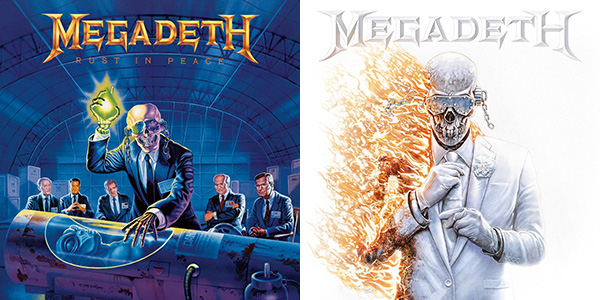
Nearly 40 years after Megadeth's first release, Mustaine, who hits retirement age this fall while suffering from Dupuytren's contracture, has released his 17th and final album, titled, simply, Megadeth. This occasions a retrospective of his output, which lurches from brilliance to banality.
Though some heavy metal artists have recorded under their own name—Ozzy Osbourne, Yngwie Malmsteen—the genre mostly presents as collective music. Yet Mustaine is Megadeth in its totality: founder, main songwriter, singer, decider.
1985's Killing Is My Business... and Business Is Good! was a confident statement from Megadeth's first iteration, with guitarist Chris Poland, bassist Dave Ellefson, and drummer Gar Samuelsson. Mustaine's composing—crucial to early Metallica—immediately distinguished Megadeth from other thrash bands, and their almost-punk sonics made for a debut brimming with causticity. 1986's Peace Sells... but Who's Buying?, released during metal's apogee year, was more polished compositionally and aurally; it's positively frothy from its opener ("Wake Up Dead") to its closer ("My Last Words"). These dates were also notable for Mustaine's sense of humor, via covers of Nancy Sinatra and Willie Dixon. That sense of humor hasn't been seen since.
Then the upheaval that would mark Mustaine as a bandleader began, with Poland and Samuelsson leaving. After a strong opening ("Into the Lungs of Hell," "Set the World Afire"), 1988's So Far, So Good ... So What! sags in the middle, including a silly Sex Pistols cover, before closing strong ("Liar," "Hook in Mouth").
It isn't surprising that that lineup didn't last. What is surprising is that the new personnel on 1990's Rust in Peace—guitarist Marty Friedman (half of Cacophony) and drummer Nick Menza (son of jazz saxophonist Don)—yielded such immediately stirring results. Rust is not just Megadeth's best album; it is arguably thrash metal's finest moment, relentless from the strafing of "Holy Wars ... The Punishment Due" to the smoking crater left behind by "Rust in Peace ... Polaris." Engineer Mike Clink helped craft a precise, dry sound that allows every nuance, of which there are many, to be appreciated fully.
It is hard to improve on perfection and often best not to try. The metallic landscape had begun to change at the close of the 1980s. Rust in Peace's lineup stayed together for three more albums, yet Megadeth declined again. Then came pandering to the rise of groove metal, metal with harmonica and strings, and singing in French. Cryptic Writings, from 1997, was a waste of talented musicians, more Mötley Crüe than Megadeth.
Things did not improve for the next two dates, despite or because of personnel changes. 1999's Risk was Megadeth's nadir. Producers from the softer side of metal and rock introduced a lusher sound, when grit was what was needed.
To paraphrase Mr. Potter from It's a Wonderful Life, if Dave Mustaine was a common, ordinary musician, these albums would have been fine. But Dave Mustaine is not a common, ordinary musician. He's the same intelligent, ambitious man who produced Rust in Peace.
In 2002, Mustaine suffered a career-threatening arm injury, shuttered Megadeth, got sober, and became a born-again Christian. He returned in 2004 with The System Has Failed, which brought back Poland for lead work and brought in versatile session bassist Jimmie Lee Sloas (mostly country, rock, and gospel) and drummer Vinnie Colaiuta (a Frank Zappa alum). Not Rust in Peace to be sure, but far better than anything from 1992 on: The opener, "Blackmail the Universe," was an instant classic.
Rejuvenated, Megadeth's next two albums, 2007's United Abominations and 2009's Endgame, were solid efforts, the latter getting the edge with great energy and a real ensemble sound.
Mustaine could not leave well enough alone, backsliding for the follow-ups into ill-conceived and poorly executed attempts at mass appeal. He had been written off before before getting the last laugh. He must have absolutely cackled over 2016's Dystopia, whose title track netted his sole Grammy win out of 13 nominations. He should have won in 1990 for Rust in Peace, but Megadeth had finally shed the fat and was back in fighting shape. Closing with a Fear cover was a nifty touch.
2022's The Sick, the Dying ... and the Dead!—Mustaine loves ellipses—was a commendable and consistent follow-up, made extra special by Ice-T's guest vocals on "Night Stalkers."
Which brings us to the final release. The band draws its lineup from earlier albums but with a wildcard: a second guitarist, Teemu Mäntysaari, who is a quarter-century younger. Mäntysaari co-wrote most of the material with Mustaine. As such, it's an odd coda to Mustaine's career. Mäntysaari gets nearly twice the number of solos, while Mustaine's leads display discernible degeneration. The music sounds less like Megadeth than like someone trying to sound like Megadeth, missing the flourishes and twists that marked its best music, with lyrics more resigned than raging. The last two pieces—the moving, autobiographical "The Last Note" and a credible reworking of the title track to Metallica's Ride the Lightning, which Mustaine co-wrote—provide some redemption, as does top-notch engineering.
If another Megadeth album was forthcoming, this would be a good first step toward another strong lineup. Absent that comfort, we are left with Mustaine's final lyrics:
They gave me gold, they gave me a name
But every deal was signed in blood and flames?
So here's my last will, my final testament, my sneer
I came, I ruled, now I disappear.