Phono Preamps/Moving-Coil Step-up Devices:
A+:
CH Precision P1 Phono Stage: from $31,000. As reviewed, $48,500 ★
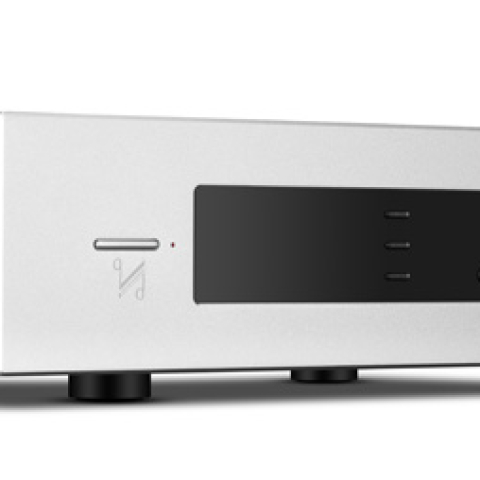
Built with a sleek aluminum-alloy case with no screws visible on any of its surfaces, the Swiss-made CH Precision P1 is no less sophisticated inside. This solid state phono preamplifier offers multiple inputs, two of which address current-amplification circuits—an approach that, according to Michael Fremer, produces “the best signal/noise ratios” and does not require cartridge loading to achieve flat response. For use with its voltage-amplification inputs, the P1 offers a menu-driven “wizard” that analyzes the entire record-playing system and calculates and applies the optimal load. Beyond that, as Fremer points out, the user can manually test the P1’s entire loading range of 20 ohms to 100k ohms, selectable in 500 steps: “load fetishists, knock yourselves out!” Used with its optional X1 outboard power supply ($17,000), the P1 provided Mikey with tonal neutrality and an ultralow noisefloor: “Some products have me up all night, pulling out record after record; some don’t. The P1 did, and gave me an exciting and fully pleasurable sonic ride every time.” In the June 2017 Stereophile, Fremer refocused his attention on the X1 power supply, observing that, “with the X1 off, the P1’s image solidity and pile-driver–like rhythmic certainty … were somewhat diminished”—and noted that he’d purchased the CH Precision combo for his own enjoyment. In August 2018, Fremer wrote about his experiences with a double P1/X1 combo—something that seems to have been done by more than one hobbyist of immodest means. Thus connected, these four high-tech boxes know what has happened and behave accordingly—but while “the four-box version was even more dynamic” and possessed of “a more relaxed and supple midrange,” Mikey could not countenance a $96,000 phono preamp. In his July 2023 report, Michael Trei discussed his auditioning of the two-box P1/X1 combo, especially using its current-mode input. While noting that the P1 is supremely quiet with both current- and voltage-mode inputs, he wrote that the P1’s characteristic quality “was its uncanny ability to unravel densely packed music and present it with utter clarity.” It offers “resolution and transparency that belies its apparent complexity,” he concluded, though he warned that “it doesn’t offer a rose-tinted view of your record collection.” (Vol.40 Nos.4 & 6, Vol.41 No.8, Vol.46 No.7 WWW) Doshi Audio Evolution Phono: $23,995
The Doshi phono preamplifier’s low-slung main chassis allows only the top half of its six vacuum tubes to peek out from holes in the top surface. Two umbilical cables connect the main chassis to the power supply—separate, independent power supply circuits are used for the moving coil head amplifier and for the rest of the circuit, each with a separate grounding scheme. There are three phono inputs: Input 1 (MC), with RCA and XLR jacks, connects to the JFET head amplifier for a total gain of 72dB but with an option to lower that to 66dB with a simple factory or dealer modification. Input 2 also has RCA and XLR jacks and is tailored for MC use but bypasses the headamp so that a separate step-up transformer can be used. It provides a fixed 10k ohm load and 52dB of gain. Input 3, RCA jacks only, is for moving magnet cartridges, with 52dB of gain, and a fixed, 47k ohm load. Michael Trei used Input 1 for his auditioning with a low-output Ortofon MC 90X cartridge. He immediately noticed how quiet the Doshi was and commented that its presentation had a clear-as-glass quality that made little details easy to follow. With Philip Glass’s soundtrack for the movie Mishima, the Doshi made the tonal richness of each wind chime and drum crystal clear and rode the dynamic contrasts perfectly. “It presented the violins with a sweetness and clarity that sometimes get lost on this digital recording.” Overall, the Doshi phono preamplifier’s clever hybrid circuit manages to combine the vivid tonal color and lucidity of tubes, with the silence and dynamics of the quietest transistor-based phono stages, summed up Trei. (Vol.49 No.2 WWW) Luxman E-07: $7995
This solid state, dual-mono phono preamplifier has three power transformers and four audio-signal step-up transformers, two per channel. It has three selectable inputs: two on RCA and one balanced on XLR. Gain can be set to low or high gain for MC cartridges, and loading can be set to 4.7, 10, 40, 100, 300, and 1k ohms. (Below 100 ohms, the loadings are all dual-mono and transformer coupled.) For MM cartridges DIP switches allow resistive loading to be set between 34k, 47k, 56k, and 100k ohms and capacitive loading between 0, 100, 220, and 320pF. When the unusual Articulator switch is in the On position, record playback demagnetizes the MC cartridge and its associated step-up transformers. Herb Reichert initially auditioned the E-07 with EMT’s JSD 6 moving coil loaded at 100 ohms. With the 24 ohm JSD 6, a Soft Machine album sounded pristine, well sorted, and precisely focused. Dynamic nuance and instrumental textures were highlighted. Tone colors were adequately saturated, but reverb and atmospherics were on the dry, low-energy side. That dull dryness disappeared when he switched the JSD 6 to the E-07’s transformer-coupled 40 ohm tap, when “reverb tails seemed dramatically longer. The album sounded more verb-y vibe-y dynamic-atmospheric and hyper-nuanced.” With the My Sonic Lab Ultra Eminent Ex loaded at 40 ohms the cartridge put on a big-screen Technicolor show. “This was peak analog,” decided Reichert, concluding that the E-07 “is the first phono stage I’ve used that made me feel like I was wringing every drop of performance out of moving coil and moving magnet cartridges.” In John Atkinson’s test lab the Luxman E-07 offered superb measured performance, with extremely accurate RIAA equalization, vanishingly low levels of noise and distortion, and overload-proof input and output stages. “The E-07 is one of the best-measuring phono preamplifiers I have encountered,” he concluded. (Vol.49 No.2 WWW)
Manley Steelhead RC Special Edition Mk II: $10,899
The RC Special Edition Mk II is the result of a collaboration between Manley and Los Angeles–area audio retailer, tube dealer, and importer Upscale Audio. It differs from the original Steelhead, reviewed by Paul Bolin and Michael Fremer in 2001 and 2003, by offering different loading settings for the autoformer that also serves as the MC step-up, and two cryogenically treated 6922 tubes. The review sample substituted Tungsram PCC88s. (The other tubes are four American-made military-spec 7044 dual triodes.) It still has two inputs for MC cartridges, one input for MM cartridges, a volume control, a remote control, a tape loop, an outboard power supply, and buttons for muting, lowering the volume by 20dB, activating a line-level input, summing the channels for mono playback, and entering standby mode. Listening at length to a John Prine LP, Alex Halberstadt wrote: “The Manley rendered the band in holographic high relief; Mike Leech’s electric bass sounded more thunderous and better defined than I’d heard it. Every wisp of reverb around Bobby Emmons’s organ became obvious. The tone colors of the band bloomed like wildflowers in an Appalachian meadow. But what captivated me most was how relentlessly the Manley zeroed in on the flow and emotional meaning of Prine’s songs.” He decided that the Manley phono stage “sounded more detailed, refined, and coherent than most of the step-up transformers I’ve heard, and more colorful, textured, and vivid than most of the solid state preamps.” (Vol.46 No.1 WWW) Mola Mola Lupe: $11,140
This versatile solid state preamp has three pairs of inputs using single-ended RCA jacks and one with balanced XLRs, each with its own grounding post. There are single-ended and balanced outputs, which may be selected individually or together, and two entirely separate phono sections for MC and MM cartridges. Four front-panel buttons allow users to set each input, adjusting gain, input impedance, polarity, subsonic filter, stereo/mono, and equalization. For the last, the Lupe offers 72 permutations of its three basic EQ variables: bass turnover, rolloff, and low shelf. A downloadable app, Mola Mola Control, available for both iOS and Android, talks directly to the Lupe over Bluetooth, and provides access to all the preamp’s many adjustments. Michael Trei was concerned that all these bells and whistles might distract people from the Lupe’s main plus point: its extraordinary performance and its ability to breathe fresh life into pretty much every record he played through it. “This is not a warm, fuzzy-sounding phono stage,” he wrote, “but it is exceptional in its ability to take all the information a cartridge throws at it and sort it into a sound that’s coherent and detailed, and it never sounds bright or hard.” (Vol.47 No.3 WWW) Pass Labs XP-27: $13,282.50 in silver, $14,032.50 in black ★
The versatile, two-chassis XP-27 offers two single-ended inputs, both of which can be used with moving magnet or moving coil cartridges. Rotary controls on the front panel allow gain, input impedance, and input capacitance to be optimized (though the capacitance range is optimized for MM cartridges). There are balanced and single-ended outputs; the gain from the former was close to the nominal values; that from the latter was, as expected, 6dB lower. There is also a Mute button on the front panel, as well as a switchable rumble filter. Jim Austin used three low-output moving coils to audition the XP-27: an Ortofon Windfeld Ti (0.3mV nominal output); an Ortofon Verismo (0.2mV); and a Lyra Etna λ Lambda (0.56mV). With all three cartridges, with the XP-27’s highest gain setting and the volume on his preamp set 20dB higher than his usual listening level, Austin heard no noise even with his ears against the speakers. “This is a quiet phono preamp,” he wrote, which was confirmed on the test bench. “It is mostly literal, but there may be a hint of added warmth,” Austin commented, adding that bass was deep and solid but not exaggerated. Overall, “the Pass Laboratories XP-27 is a high-achieving component both technically and musically.” As well as the very low noise, John Atkinson noted the superbly accurate RIAA correction, subjectively innocuous harmonic distortion, and an output stage that handles low impedances with aplomb. The only aspect of the XP-27’s measured performance that raised his eyebrows was the limited overload margin at the top of the audioband at the lowest gain setting. (Vol.47 No.9 WWW)
Sutherland Engineering Dos Locos: $11,000/pair
The latest and most ambitious in Sutherland’s phono preamps, the Dos Locos is a transimpedance design. The cartridge is connected across a short circuit, with the resultant input signal current converted to an output voltage. Because the load is effectively zero ohms, there are no loading options. Twin RCA inputs allow two phono cartridges to be connected simultaneously, but only one can be played at a time. Sutherland says that the Dos Locos is compatible with cartridges having a source impedance below 20 ohms, which rules out Benz Micro’s range and the Denon DL-103. Inside the chassis is a three-position jumper to adjust the output gain in approximate 6dB steps. Michael Trei used the middle gain position with a Lyra Atlas λ Lambda (4.2 ohms) and a Dynavector DRT XV-1s (6 ohms). He concluded that “paired with the right cartridge, the Dos Locos is an extraordinary performer. Its tone has the purity of fresh snow, and it manages to sound highly resolved yet, at the same time, unstressed and relaxed.” Listening to a track from Big Thief’s 2023 LP Dragon New Warm Mountain I Believe in You with My Sonic Lab and SPU cartridges, Alex Halberstadt found that the Dos Locos rendered Adrianne Lenker’s singing and Buck Meek’s electric guitar with so much life force that he sat up on the couch and stared at the space between the speakers. “What I heard was a huge dynamic envelope and unexpectedly vivid tone colors,” he wrote, concluding that the Dos Locos is an astoundingly musical piece of gear, capable of providing hours of fun, engagement, and insight. “Better yet, it offers the dedicated mono listener a great-sounding, no-hassle solution that also cuts the price in half.” (Vol.47 No.9, Vol.48 No.1 WWW) Westminster Lab Monologue: $15,900 with one card; additional cards cost $5200
The review sample of this Hong Kong–manufactured phono preamp was fitted with a credit card–sized module optimized for use with DS Audio’s optical cartridges. (Other modules are available, but only one can be fitted at a time.) A pair of internal DIP switches on the optical board tailor the low-frequency rolloff. Michael Trei left this filter bypassed and auditioned the Monologue with a DS Audio W3 (see Phono Cartridges). Playing a familiar LP of Vivaldi Lute Concertos, he noted that “the overall tonal signature is neutral; it was the Monologue’s ability to flesh out the body and delicate richness of the lute that most captured my attention. This harmonic resolution is what allows you to hear subtle details: the difference between one maker’s instrument and another’s, or the difference in touch and the resulting tone between two musicians.” The Monologue’s optical card was doing a superb job of drawing out the strengths of DS Audio’s very special cartridges, he decided. (Vol.48 No.9 WWW) A: Allnic H-7000: $19,800
This tubed phono preamp features two transformer-coupled active gain stages with output transformers. It uses no fewer than nine tubes: four for gain, four for voltage regulation, and a rectifier, all drawn from a new-old-stock mix originating in the US and the former Soviet Union. The H-7000 offers two moving magnet inputs, which provide 40dB of gain, and two moving coil inputs, which rely on step-up transformers. Those can be switched between four taps that offer a total of 62, 66, 68, and 72dB of gain. As reviewed the sample included the optional silver-wired step-up transformers, which increase the price to $21,300. Alex Halberstadt used the Allnic with Ortofon SPU Royal N, Koetsu Urushi Vermilion, and Dynavector DRT XV-1s cartridges and noted wideband response and ample information. The H-7000 also turned out to be remarkably, consistently quiet, which lent the copious sonic detail extracted from Halberstadt’s records a suitably serene backdrop against which to unfold. Transient response was also superb, portraying music in a quicksilver manner that never impeded its flow. The soundstage was finely layered and, when called for, both wide and deep. (Vol.49 No.8 WWW)
Audio Note AN-S4/L step-up transformer: $8746.50
Herb Reichert used this silver-wired, Super Mumetal 250-cored transformer with Audio Note’s IO II moving coil cartridge. (See Phono Cartridges.) There are four versions available; the review sample was optimized for cartridges with an internal impedance of 1 ohm, like the IO II. The best thing about the IO II used with Audio Note’s AN-S4/L SUT, wrote Reichert, was how straightforward it sounded: “Nothing ever seemed exaggerated.” Compared with other SUTs, Reichert found the S4 sounded “wetter, darker, denser, and deeper, with more atmospherics and an emphasis on force and energy movement.” (Vol.49 No.9 WWW) Austin Audio Works Black Swan: $1649 $$$
Designed by veteran engineer Barry Thornton—SAE, Parasound, Adcom, and Hegeman (and Jethro Tull!)—the Black Swan has front-panel switches for gain, and resistive and capacitive loading, with different ranges of both offered for moving magnet and moving coil cartridges. There are two MM and one MC inputs and balanced and single-ended outputs. Using an Audio Note IQ3 moving magnet cartridge loaded at 50k ohms and 68pF, Michael Trei was impressed by how the Black Swan made it possible to hear through the recording to the music. With a Lyra Delos moving coil loaded at 150 ohms, he heard an improved level of transparency and overall detail but the same clear, relaxed sound. “The Black Swan makes it very easy to listen to records for hour after hour without becoming fatigued,” Trei wrote; he concluded that “the Black Swan can be optimized for just about any setup while delivering a musical performance that is easy and rewarding to listen to.” (Vol.47 No.8 WWW) Belleson Brilliance: $8500
This versatile phono preamp offers balanced and single-ended inputs and outputs. Unusually, it has no controls other than a power button and a recessed button on the rear panel to select between balanced and unbalanced modes. Instead, its built-in Wi-Fi transceiver allows its input, MM or MC mode, loading options, and gain to be selected with an Android tablet included in the price. (The tablet can communicate directly with the preamp, or the preamp can also be connected to the user’s Wi-Fi network and be controlled by a Web browser.) Gain options are 30, 36, 44, or 50dB for MM cartridges; 50, 56, 64, or 70dB for MCs. Resistive loading options are 20, 65, 110, 260, 350, 400, and 47k ohms. Input capacitance can be adjusted from 0pF to 750pF in 50pF steps. Tom Fine found that his Hana SL MK II low-output MC cartridge sounded best loaded with 260 ohms. He also tried MM cartridges from Shure, Ortofon, and LP Gear, as well as a high-output MC from Denon. The Brilliance is quiet: Fine noted that there was no hiss using MM cartridges with 44dB gain and volume set at a comfortable, high listening level. With the Hana MC cartridge at 64dB gain, he heard a faint hiss at the listening seat, not enough to interfere with music listening and way below the surface noise of LPs. Even when he cranked the system volume to the max, he heard no hum with either input. “Impressive!” He felt that the Brilliance was fundamentally neutral: “Because it imposes so little of its own character on music, it allowed the character of each cartridge to shine through.” He summed up his auditioning by writing that the Belleson Brilliance is a “modern, wireless-connected device that gives just about any cartridge a chance to sound great. Its mission seems in service of the cartridge: enable its best sound and then give it life through clean gain and accurate RIAA de-emphasis.” On John Atkinson’s test bench, the Brilliance did offer impressive RIAA equalization, with superb channel matching and excellent channel separation. Noise and distortion were both very low in level. (Vol.48 No.9 WWW)
Belleson Radiance: $3250
This “smart” phono stage’s input RCA sockets can be used either as a normal single-ended input or with a floating balanced connection. Its gain and resistive and capacitive loading can be adjusted with a Wi-Fi–connected app, which also has a mute switch. Michael Trei wished there had been mono and phase-invert switches, but once he became familiar with the Radiance’s functionality, he was impressed by how quiet the Radiance’s output was, even though there was both a switched-mode power supply and a Wi-Fi transmitter sitting inside the same box as the highly sensitive gain circuits. He wrote that the Belleson Radiance is a superb-sounding phono preamp that combines “the detailed texture and tonal richness of a fine tube preamp with powerful dynamic punch, taut, textured bass, and ultralow noise more often found in solid state designs.” He concluded that its performance is especially impressive when you consider the Radiance’s reasonable price. (Vol.48 No.11 WWW) Bob’s Devices Sky 20-S step-up transformer: $1650
This 1:20 SUT uses Bob Sattin’s latest core material: 80% nickel mu-metal laminations. Playing a single-microphone recording with Etsuro Urushi’s Cobalt Blue cartridge, Herb Reichert noted that the new Sky 20-S showcased vibrance, impact, and considerably more presence and sparkle than he remembered from the original that he reviewed in 2022, plus more saturated tone and finer resolution—“a definite upgrade.” (Vol.49 No.7 WWW) Consolidated Audio “Monster Can” step-up transformer: €3110 with copper wire; €3950 with silver
Berlin-based Consolidated Audio offers choices of core material (nanocrystalline or mu metal, which the manufacturer calls Hi-Nickel); primary inductance (high, medium, low, or extra-low, the choice of which depends on your cartridge’s internal impedance); turns ratio (1:10, 1:15, and 1:20 are standard, though others are available); and wire (copper or silver). As well as single-ended inputs and outputs, a third pair of RCA jacks allows for resistive loading options. (Optional balanced XLR jacks add €1300 to the price.) The review samples both had low primary inductance, a 1:20 turns ratio (which presents the cartridges with a load of 118 ohms), and used Cardas copper wire (a €200 premium over regular copper); one sample had a nanocrystalline core, the other Hi-Nickel. Using an Ortofon SPU Royal N cartridge, Alex Halberstadt found that the Hi-Nickel Monster Can lacked the nanocrystalline-core unit’s beguiling liquidity and its intricately illuminated textures, but something about it kept him listening and engrossed. It placed slightly less emphasis on the high frequencies, he noted. Overall, Halberstadt was impressed by the sensational way the Monster Can handled scale and was struck by its liquidity; “maybe effortlessness is a more precise description,” he wrote, and concluded that the Monster Can “generalizes less than any SUT I’ve heard, retrieving scads of information that it presents, unlike certain digital components, in a natural and unfatiguing way, never truncating the notes’ decay.” (Vol.48 No.3 WWW)
DS Audio EQ-W3: $11,000
See Phono Cartridges. (Vol.47 No.4 WWW) EM/IA 103 step-up transformer: $1500 ★
This copper-wired, nickel-cored step-up transformer is designed specifically for use with Denon’s DL-103 MC and has a hard-wired cable leadout. The review sample was supplied with a denuded DL-103 anchored with epoxy to a brass plate with threaded holes and a 3D-printed apron ($300), and a black wood headshell ($100). Compared to pricy moving coils, the chief limits Herb Reichert noticed with the denuded Denon were subtler than he expected: “less microdetail, more generalized spatial mapping. The DL-103 was never challenged on tone or tunefulness. It can sing and dance with the best.” With the Denon-EM/IA combo feeding a Schiit Stjarna, Reichert experienced high-clarity, F2-Dragster–type sonics: “The traction was there. The revs were up. And the 103’s spherical diamond was drifting through some really tight corners.” He concluded that the denuded 103 with the EM/IA SUT “conveys maximum human sentiment with the least mechanical distraction.” (Vol.48 No.9 WWW) EM/IA Phono step-up transformer, with copper transformer wire: $3375
with silver wire: $7350 ★
Dave Slagle, whose radically rebuilt Quad ESL loudspeakers have astounded more than a few listeners, winds his own step-up transformers and sells them under the brand name EM/IA—a collaborative design and manufacturing effort with Jeffrey Jackson, who specializes in tube amplification and horn loudspeakers. The EM/IA Phono transformer, which is housed in a steel box with solid walnut top and bottom plates, is unpotted and has a fairly large core with 80% nickel content. In addition to one pair each of RCA input and output jacks—multiple primary coils aren’t available—the EM/IA Phono has a third pair of jacks, wired in parallel with the primary and intended for use with resistive plugs (supplied), for cartridges that might need such things. The EM/IA is available with copper or silver windings; Art Dudley spent some quality time with a copper-wire version wound with a 15:1 ratio and his EMT TSD 15 and Denon DL-103 cartridges. He described the EM/IA as offering “an immense sense of drive” with his EMT as well as “texture and tone in spades. In buckets. In tanker holds.” All in all, Dudley found the EM/IA to sound “clean, clear, rich, detailed, and, above all, musically exciting—all for approximately half the price of the deservedly well-regarded Hommage T2,” the latter transformer being his longtime reference. Herb Reichert found that the EM/IA sounded delicious and played “butter-smooth” with his Koetsu Rosewood Signature Platinum. Although Alex Halberstadt was not a fan of silver conductors, he found that the silver-wired EM/IA sounded nothing like the silver wire he remembered. It provided “an addictively smooth, highly resolving facsimile of my music. While it wasn’t quite as punchy as the Auditorium 23, it produced a little more detail and a lot more space as well as deeper, more precise bass.” (Vol.40 No.8, Vol.44 No.11, Vol.45 No.11 WWW) EMM Labs DS-EQ1 optical equalizer: $13,400
The DS-EQ1 was designed by Ed Meitner for use with DS Audio’s optical phono cartridges. Comparing it with DS Audio’s own DS-W3 equalizer—see Phono Cartridges—Michael Trei heard an uncanny sense of layering and depth. The DS-W3’s tonal balance was slightly richer and darker, with a tad more punch behind drums. The differences between the EMM and DS Audio equalizers are more in their different flavors than in overall performance, Trei wrote; it was the EMM’s ability to deliver sonic images with palpable depth and height that he found the most striking. (Vol.47 No.5 WWW)
Lab12 Melto2: $4995
A tubed phono preamplifier that allows users to fine-tune resistance (2.5k–47k ohms for MM cartridges, 25–100 ohms plus High for MC cartridge), capacitance (100–300pF for MM cartridges), and gain (38dB, 58dB, 64dB) to create maximally effective loads for both moving coil and moving magnet cartridges, the Melto2 also offers Columbia, Decca, and RIAA equalization curves. The three RCA inputs can be set to MM or MC—Lundahl transformers are used for the MC setting. Herb Reichert wrote that the Lab12 Melto2 coaxed the tiniest, most delicate subtleties from every cartridge he tried. “It put the Tzar in a tuxedo. It made the Ortofon 2M Black LVB 250 moving magnet sound like a top-shelf moving coil. It made the Nagaoka MP-200 sound like a Koetsu. It forced all my other phono stages to hide under the bed.” (Vol.49 No.3 WWW) Lejonklou Entity: $3190 ★
The original Entity was a utilitarian-looking, solid state MC-only design from Sweden. It used transistors, wire, solder—even the washers used in the component’s casework—that had all been obsessively selected by designer Fredrik Lejonklou after hundreds of comparative listening tests. Out of the box, the Entity sounded bleached, felt Alex Halberstadt, but after about 50 hours of use, the preamp “began to sing with its authentic voice,” sounding neutral, extended, transparent, fast, and resolving. Halberstadt found that the Entity was at its best with unbalanced Linn Silver interconnects ($452/1.2m pair), when it sounded more refined, dimensional, controlled, and tonally richer. In the test lab, the Lejonklou’s RIAA correction featured a very slight plateau in the midrange, coupled with excellent channel separation, low noise, and very low distortion. Overload margins were very good in the bass and midrange but less so at the top of the audioband, meaning that the Entity will be best used with low-output moving coil cartridges. Halberstadt subsequently auditioned the Entity 1.2 with his Garrard 301 turntable, Schick 12" tonearm, and a variety of low-output moving coil cartridges. “What it did better than all but a few hi-fis I’ve heard is present the music’s rhythm and pace, and what Art Dudley used to call touch, with relentless insight,” he wrote. (Vol.45 No.7, Entity, Vol.49 No.4, Entity 1.2 WWW) Lundahl LL 1931Ag SUT: $2800 assembled
Lundahl’s LL1931 Ag transformer is made with the company’s “finest amorphous cobalt uncut strip core” and wound with pure silver wire. With the LL 1931Ag, the Ortofon X40—see Phono Cartridges—displayed near-perfect timbre, fronting oceans of detail, gently displayed, wrote Herb Reichert. In this combination, the X40’s sound was softish, smooth, and slippery—more colorful and moody than with the Robyatt MC-3. Also see Gramophone Dreams #106 in Vol.49 No.3. (Vol.48 No.12 WWW)
Manley Labs Oasis: $3999
The Oasis replaces Manley’s well-regarded Chinook. The gain and RIAA circuitry, based on FETs and 6922 dual triodes, remain largely unchanged, but there is now a switch-mode power supply designed by Bruno Putzeys. DIP switches set the phono stage’s capacitive loading (8 settings from 0 to 350pF), resistive loading (32 settings from 26 ohms to 47k ohms), and gain (4 settings from 45 to 65dB). Alex Halberstadt found that the Oasis sounded more even-handed, polished, and sonically neutral than the Chinook, though sometimes he missed the Chinook’s more “colored” approach, which struck him as slightly more embodied and emotive. Overall, he concluded, “the Manley Oasis pulls off the rather difficult trick of combining terrific performance and a beautifully judged tonal balance with compulsive listenability and class-leading versatility, all at person-with-a-job price. Enthusiastically recommended.” (Vol.48 No.1 WWW) Mobile Fidelity Electronics MasterPhono: $5999
The solid state MasterPhono’s front panel is dominated by a pair of VU meters, flanked by two knobs. One knob selects Gain: 40dB, 50dB, 60dB, or 70dB. The second knob chooses one of 10 MC cartridge loads: 15, 30, 50, 75, 100, 500, 1k, 10k, 47k ohm, or “OPT,” which allows the use of custom load values made via resistor-equipped RCA plug-ins. There is also a high-pass/subsonic filter button, a mono button, a knob for dimming the meter display, and a remote control. Hold the Meter button down for a few seconds, and the MasterPhono offers two test modes that allow the meters to be calibrated and the cartridge’s azimuth setting to be optimized for maximum channel separation. There are three pairs of inputs: regular single-ended RCA; balanced XLR; and a current-drive input that gives users a choice of either single-ended or balanced connection. Like the tubed PrimaLuna EVO 100, Herb Reichert found that it took three full days for the MasterPhono to lose the gray flatness it showed out of the box. It then never sounded “transistory” (hard, shallow, gray), instead walking a narrow line between hard and soft, dry and wet, warm and cool—leaning maybe 10% towards wet and warm on the most atmospheric recordings. “It did not attenuate reverberation or diminish atmosphere,” wrote Reichert, who never consciously wished for tube treats he wasn’t getting. Using a Dynavector XX-2 moving coil, Reichert found the current-drive input eliminated a faint haze that he had noticed in the top octaves in voltage mode. “What was preserved, and perhaps even enhanced,” he decided, “was the XX-2’s dynamics.” (Vol.47 No.1 WWW) Moonriver 505: $6595
This Swedish preamplifier includes connections for up to four tonearms and gain and adjustable loading appropriate for moving coil and moving magnet cartridges. Each of the four inputs can be adjusted independently, and the settings are recalled automatically each time that input is selected. Input 1 has both single-ended and balanced connectors, while 2–4 are single-ended only. There are three pairs of outputs, one balanced and two single ended. A switch allows you to select the Decca curve instead of standard RIAA. The moving magnet input offers six gain settings, three resistive loads, and five capacitive loading options from 100pF to 680pF, which make the Moonriver a good match for difficult-to-match cartridges, including Grado and SoundSmith moving iron cartridges. With the Benz Micro LP-S cartridge, Michael Trei heard an excellent dynamic envelope, a neutral tonal balance, and a transparent midrange. The Moonriver 505 “looks elegant, is built to last, and most importantly, sounds wonderful,” he concluded. (Vol.47 No.11 WWW)
Musical Fidelity Nu-Vista Vinyl S: $6999
At nearly 40 lb, the Vinyl S is a “beast,” wrote Michael Trei. It offers four cartridge inputs—two balanced using XLR input connectors and two single-ended with RCAs—and the internal circuitry is entirely differential from input to output. The circuit uses three discrete gain stages with a split passive RIAA EQ curve tucked between gain stages. The eight nuvistor tubes—four per channel—are used to buffer the output section, endowing the presentation with some thermionic color and richness. In addition to the standard RIAA EQ curve, there are Decca and Columbia curves, selectable with either a remote control or with front-panel buttons. The moving magnet mode offers four gain options between 40 and 49dB, and capacitive load adjustable in eight steps from 50 to 400pF. The MC mode boosts the gain to between 60 and 69dB, with nine resistive load options from 5 ohms to 47k ohms. Two bass-rolloff (rumble) filters are available. “Right out of the gate, the Vinyl S gave me the kind of bold and powerful sound that made me want to crank up the volume,” wrote Trei. “The Musical Fidelity Nu-Vista Vinyl S will extract the best from your chosen cartridge with verve, color, and vividness,” he concluded. (Vol.49 No.5 WWW) PrimaLuna EVO 100 V2 Tube Phono: $4495
The EVO 100 features dual-mono 5AR4 tube rectification; dual-mono choke-input EL34-regulated power supplies; two 12AX7 twin triodes per channel for the RIAA stage; and one 6922 twin triode per channel for its moving coil input stage, which sits in its own shielded, cushioned box. The gain choices are 40dB for MM, 52, 56, and 60dB for MC, and there are five MC loading choices—50, 100, 200, 500, and 1000 ohms. PrimaLuna distributor Kevin Deal warns that the EVO needs three days powered on to sound its best, following which Herb Reichert commented that the PrimaLuna “completely eliminated the EMT JSD 6’s tendency to sound tight and analytical, giving me instead a cartridge–phono stage combination that was both lush and heart-pounding fun.” Reichert subsequently compared the EVO 100 with the MoFi MasterPhono, noting that with the PrimaLuna, he preferred the Denon DL-103 with a very heavy, 50 ohm load rather than the much higher impedances he liked with the MasterPhono. When Alex Halberstadt auditioned the EVO 100, he found that it was the quietest one he’d heard, “ever.” Following 100 hours of warm-up, Halberstadt wrote that the music “pulsed and shimmered on a huge soundstage and had a liquid, luminous character I associate with great tube circuits.” He then replaced one pair of the 12AX7s with early-1960s RCAs and the stock 6922s with Amperex Bugle Boys. “While this substitution made the EVO 100 slightly noisier,” he wrote, “it also got rid of the glassiness and, tonally speaking, thickened the sauce.” In late 2024 the EVO 100 was subject to a parts upgrade and circuit tweak—free of charge to owners, other than shipping, if the customer bought their EVO 100 at a dealer. The first and biggest thing Reichert noticed about the upgrade was deeper, cleaner, more natural bass. He subsequently found that the new EVO sounded perkier and prettier and maybe danced better than before. “The more I used it, the more it seemed the upgraded EVO 100 had become slightly less visible—more invisible, if that is possible,” he decided. (Vol.46 No.12, Vol.47 Nos.1 & 11 WWW) Pro-Ject Phono Box RS2: $1999 in Black or Silver $$$ ★
The full-featured, fully balanced, dual-mono RS2 has unbalanced (RCA) and balanced (XLR) inputs and outputs. Gain ranges from 40dB to 70dB in eight steps, four each for MM and MC. Resistive loading for MC cartridges is continuously variable from 10 to 1000 ohms, plus 47k ohms and variable capacitive loading for MM cartridges. There’s also a switchable rumble filter, RIAA and Decca/ffrr equalization, and a balance control. Julie Mullins auditioned the RS2 both with its standard switch-mode supply and with the optional Power Box Robert Schryer Uni 4-Way linear power supply ($799). Her first impressions with the standard supply and a Clearaudio Talisman V2 MC were that the RS2 seemed neutral to slightly cool, detailed, and lively: “It sounded clean, almost pristine, on the lighter side in terms of body and heft.” With her MoFi UltraTracker MM, the sound was more midrange-focused, with good detail and musicality. Experimenting with resistive loading in MC mode, Mullins found that with the optimal loading “the degree of detail seemed to increase, as did realism and clarity. The musicians’ placement seemed to grow more spacious and specific.” Mullins felt that with the Schryer Uni supply, backgrounds became more silent and sustains and decays seemed to linger longer. Writing from his test lab, John Atkinson was impressed by the superbly accurate RIAA deemphasis, the extremely low distortion and noise, and the high overload margins. Peculiarly, he found that the RS2’s superb measured performance with the linear Power Box became even better when he substituted the standard switch-mode supply. Tom Fine echoed Mullins’s recommendation and commented on how useful he found the RS2’s output-balance control and the options for adjusting capacitive and resistive loading. He concluded that while this preamp is the opposite of set-it-and-forget-it, “if you have a few cartridges in rotation and you want to spend some time dialing in a favorite sound profile, it’s a great option.” He bought one. (Vol.44 No.9, Vol.45 No.3 WWW)
Robyatt Audio MC-2 SUT: $995 (stereo)
Robyatt Audio MC-3 SUT: $1095 (stereo)
The two Robyatt SUTs use Bud Industries chassis—$195 for mono, $275 for stereo—into which are plugged heavy, apparently well-shielded transformers designed by Mike Mazurs. The transformers have gold pins that squeeze tightly into the chassis’s octal tube sockets. The transformers’ step-up ratios are not specified but Herb Reichert found that the MC-2 sounded like it had a 1:20 turns ratio, or 400× gain. Playing an RCA Victrola Swan Lake LP, the Ortofon X40—see Phono Cartridges—sounded quieter, less hi-fi, more relaxed, more tactile, more spacious, with more natural timbres, but less brightly lit with the Robyatt Audio MC-2 than via the MoFi MasterPhono’s voltage-amplifier input. The MC-3 transformer seemed to deliver a darker, deeper, wetter soundspace than the MC-2, with more dramatic separation of the orchestra parts. (Vol.48 No.12 WWW) Sutherland Engineering SUTZ: $4300
The SUTZ looks exactly the same, inside and out, as Sutherland’s Little Loco. Inside, it sports the same three jumper-activated gain settings (to be upgraded in production to five), but it lacks RIAA correction, instead using a transimpedance circuit with solid state devices to convert an MC’s output current to a sufficiently high voltage to feed a conventional phono preamp’s MM input. Herb Reichert decided that the Sutherland’s current-drive input was passing on more information from Dynavector’s XX-2 MKII MC, with less noise and IM distortion, than other phono preamps. Using the SUTZ to feed a Tavish Adagio phono equalizer, he concluded that Ron Sutherland’s headamp “let me add my own choice of tube glories to the quiet steadiness of virtual short loading.” (Vol.46 No.3 WWW) Tron Electric Convergence Signature: $5000
Alex Halberstadt auditioned the moving coil version of this bare-bones preamp, which has single-ended inputs and outputs, a ground-lift switch, and 68dB of gain. Inside, a pair of potted step-up transformers precede three Russian tubes—a pair of 12AX7s and a 12AU7. “This British phono stage sounds clear, fast, and articulate,” he wrote, “never losing track of the music’s heartbeat.” “Fortunately,” he added “this burnished, rich sound doesn’t include bloated bass, slow transients, or the other sonically gooey artifacts associated with some vintage-style tube circuits.” Compared with the Manley Steelhead RC, the Tron produced richer, more colorful images and simply sounded more beautiful. But it omitted some of the ambient information and long decays that the considerably more expensive Manley extracted from Halberstadt’s records. (Vol.47 No.1 WWW)
B:
Kitsuné LCR-1 MK5: $1598–$2498, depending on options ★
The made-in-Korea, two-chassis, solid state KTE LCR-1 MK5 is unusual in that it uses inductors in its equalization networks. Four DIP switches allow users to set gain at any of 13 levels between 40dB and 72dB and resistive loading at any of 12 values from 14 ohms to 47k ohms. In his system, Herb Reichert found that with various MC cartridges, the KTE LCR-1 sounded its most polished and exciting when driven by high-quality step-up transformers. “On its own, with its 63.5dB gain, it did not sound as smooth, refined, or ‘correct’” as the twice-as-expensive Parasound Halo JC3+ phono stage, he wrote, though he decided that “the LCR-1’s tone, solidity, and vigor” was preferable to the Musical Surroundings Nova III’s “more laid-back, slightly gray refinement.” “The Kitsuné KTE LCR-1 has become my daily-driver solid state phono equalizer,” concluded Reichert. He subsequently compared the Kitsuné with Music Hall’s Analogue A3 phono preamp, writing that the performers sounded farther from their microphones with the A3 and that its presentation “was less dramatically dynamic and less physical sounding” than that of the LCR-1. In his February 2026 report, Reichert admitted that despite its conspicuously natural sonics, the KTE LCR-1 had fallen out of his system because he did not enjoy removing it from his rack every time he had to change cartridge loading with the DIP switches on the chassis bottom. However, as most phonophiles do not change cartridges twice a day like he does, Reichert took another listen: “With every cartridge I tried, the LCR-1 presented recordings with a fluid, Ektachrome-like transparency that made other solid state RC stages sound dull and staid,” he wrote. (Vol.44 No.7, Vol.45 No.10, Vol.49 No.2 WWW) Lounge Audio LCR Mk.III: $495 $$$ ★
Lounge Audio Copla: $495 $$$ ★
Lounge Audio Silver Wire Copla: $695
The solid state LCR Mk.III is named for the type of circuit chosen for its RIAA equalization stage: a zero-feedback inductor-capacitor-resistor (L-C-R) circuit. That stage is constructed with discrete components—remarkable for a US-made product selling for only $340—and combined with class-A biased op-amps for a total gain of 40dB. Power is supplied by an 18V wall wart. Herb Reichert has logged literally hundreds of hours with his LCR Mk.III review sample, both on its own for use with MM cartridges, and, for MC cartridges, in tandem with Lounge Audio’s Copla, a JFET-powered step-up device that does the same job as a phono transformer, only electronically. In both setups, the Lounge rewarded Reichert with “full-bodied, accurately toned” sound, and enough emotional impact that a favorite Doc Watson song had him weeping. Referring to the $26,000, Class A–rated Ypsilon VPS-100, Reichert wrote: “Could the Ypsilon make me cry 86.7 times easier? I doubt it.” Reichert returned to the Copla in March 2023, using Dynavector’s XX-2 MC and feeding the Copla to either SunValley or Tavish Adagio phono equalizers. “The Copla made recordings sound charged and vivid in the extreme but also lucid and relaxed,” he wrote, concluding that it “behaved like someone forgot a zero on its price tag.” Writing about the more expensive Silver Wire Copla, which looks exactly like the regular Copla, except on the bottom of the chassis, where Lounge Audio founder Robert Morin has tagged and signed it, Reichert said that the Silver Wire Copla intensifies energy delivery and texturizes harmonics to a degree that makes the extra $130 seem trivial. “Coupled to a Denon DL-103, this is the highest-value phonography I know of,” he enthused. (Vol.41 No.2, Vol.46 Nos.3 & 9 WWW) Parks Audio Waxwing: $500 $$$
The diminutive Waxwing converts the analog signal coming from the cartridge to 24/96 PCM digital, then uses DSP to apply the equalization and various filters and effects before the signal is converted back to analog. (There are also optical and coaxial digital outputs.) There are no controls on the box—everything is adjusted with an iOS or Android Bluetooth app. There are just two resistive load settings, 47k ohms and 200 ohms, and a fixed capacitive load of 60pF. The gain is adjustable from –4dB, for line-level sources, up to 72dB for very low-output moving coil cartridges. RIAA equalization is standard, but you also get a flat setting for line-level sources, and 10 presets for early LPs and 78s. You can custom-tune the EQ using turnover and bass-shelving settings, as well as Bass and Treble controls, a single-band parametric equalizer, and various presets, including one that adds a touch of second-harmonic distortion to simulate the signature of a 300B tube amplifier. Michael Trei mostly used the internal DAC for his auditioning but also connected its optical digital output to his Denafrips Terminator DAC. Sonically the Waxwing punches way above its weight, he decided, adding that the Waxwing demonstrates what a fertile mind can create when let loose with DSP. Trei concluded that it “sounds like a good analog source, and you don’t have to sell your soul to the Devil to enjoy it.” (Vol.49 No.7 WWW)
C:
Hagerman Audio Labs Piccolo Zero: $289 $$$
This inexpensive transimpedance head amp is equivalent to a step-up transformer for moving coil cartridges and is intended to be used in front of a moving magnet phono preamp. Herb Reichert used the Piccolo Zero with Dynavector’s XX-2 moving coil, which has an internal impedance specified at 6 ohms. Once he had optimized the head amp’s gain, he noted that the Zero’s most defining trait “was the quick, raw, dynamic force it put behind everything it amplified, especially piano.” Reichert commented that the Zero preserved current drive’s core beauty, “which resides in how it quiets the space around instruments, which in turn makes images appear more fleshed out and 3D.” “A ridiculously good value,” he concluded. (Vol.47 No.6 WWW) Deletions
Schiit Audio Stjarna, discontinued. Paradoxpulse Phono 70 Signature, Parasound Halo JC3+, Sculpture A Mini Nano transformer, Sunvalley Audio SV-EQ1616D, SW1X LPU III Balanced, Nobala step-up transformer, not auditioned in a long time.
Built with a sleek aluminum-alloy case with no screws visible on any of its surfaces, the Swiss-made CH Precision P1 is no less sophisticated inside. This solid state phono preamplifier offers multiple inputs, two of which address current-amplification circuits—an approach that, according to Michael Fremer, produces “the best signal/noise ratios” and does not require cartridge loading to achieve flat response. For use with its voltage-amplification inputs, the P1 offers a menu-driven “wizard” that analyzes the entire record-playing system and calculates and applies the optimal load. Beyond that, as Fremer points out, the user can manually test the P1’s entire loading range of 20 ohms to 100k ohms, selectable in 500 steps: “load fetishists, knock yourselves out!” Used with its optional X1 outboard power supply ($17,000), the P1 provided Mikey with tonal neutrality and an ultralow noisefloor: “Some products have me up all night, pulling out record after record; some don’t. The P1 did, and gave me an exciting and fully pleasurable sonic ride every time.” In the June 2017 Stereophile, Fremer refocused his attention on the X1 power supply, observing that, “with the X1 off, the P1’s image solidity and pile-driver–like rhythmic certainty … were somewhat diminished”—and noted that he’d purchased the CH Precision combo for his own enjoyment. In August 2018, Fremer wrote about his experiences with a double P1/X1 combo—something that seems to have been done by more than one hobbyist of immodest means. Thus connected, these four high-tech boxes know what has happened and behave accordingly—but while “the four-box version was even more dynamic” and possessed of “a more relaxed and supple midrange,” Mikey could not countenance a $96,000 phono preamp. In his July 2023 report, Michael Trei discussed his auditioning of the two-box P1/X1 combo, especially using its current-mode input. While noting that the P1 is supremely quiet with both current- and voltage-mode inputs, he wrote that the P1’s characteristic quality “was its uncanny ability to unravel densely packed music and present it with utter clarity.” It offers “resolution and transparency that belies its apparent complexity,” he concluded, though he warned that “it doesn’t offer a rose-tinted view of your record collection.” (Vol.40 Nos.4 & 6, Vol.41 No.8, Vol.46 No.7 WWW) Doshi Audio Evolution Phono: $23,995
The Doshi phono preamplifier’s low-slung main chassis allows only the top half of its six vacuum tubes to peek out from holes in the top surface. Two umbilical cables connect the main chassis to the power supply—separate, independent power supply circuits are used for the moving coil head amplifier and for the rest of the circuit, each with a separate grounding scheme. There are three phono inputs: Input 1 (MC), with RCA and XLR jacks, connects to the JFET head amplifier for a total gain of 72dB but with an option to lower that to 66dB with a simple factory or dealer modification. Input 2 also has RCA and XLR jacks and is tailored for MC use but bypasses the headamp so that a separate step-up transformer can be used. It provides a fixed 10k ohm load and 52dB of gain. Input 3, RCA jacks only, is for moving magnet cartridges, with 52dB of gain, and a fixed, 47k ohm load. Michael Trei used Input 1 for his auditioning with a low-output Ortofon MC 90X cartridge. He immediately noticed how quiet the Doshi was and commented that its presentation had a clear-as-glass quality that made little details easy to follow. With Philip Glass’s soundtrack for the movie Mishima, the Doshi made the tonal richness of each wind chime and drum crystal clear and rode the dynamic contrasts perfectly. “It presented the violins with a sweetness and clarity that sometimes get lost on this digital recording.” Overall, the Doshi phono preamplifier’s clever hybrid circuit manages to combine the vivid tonal color and lucidity of tubes, with the silence and dynamics of the quietest transistor-based phono stages, summed up Trei. (Vol.49 No.2 WWW) Luxman E-07: $7995
This solid state, dual-mono phono preamplifier has three power transformers and four audio-signal step-up transformers, two per channel. It has three selectable inputs: two on RCA and one balanced on XLR. Gain can be set to low or high gain for MC cartridges, and loading can be set to 4.7, 10, 40, 100, 300, and 1k ohms. (Below 100 ohms, the loadings are all dual-mono and transformer coupled.) For MM cartridges DIP switches allow resistive loading to be set between 34k, 47k, 56k, and 100k ohms and capacitive loading between 0, 100, 220, and 320pF. When the unusual Articulator switch is in the On position, record playback demagnetizes the MC cartridge and its associated step-up transformers. Herb Reichert initially auditioned the E-07 with EMT’s JSD 6 moving coil loaded at 100 ohms. With the 24 ohm JSD 6, a Soft Machine album sounded pristine, well sorted, and precisely focused. Dynamic nuance and instrumental textures were highlighted. Tone colors were adequately saturated, but reverb and atmospherics were on the dry, low-energy side. That dull dryness disappeared when he switched the JSD 6 to the E-07’s transformer-coupled 40 ohm tap, when “reverb tails seemed dramatically longer. The album sounded more verb-y vibe-y dynamic-atmospheric and hyper-nuanced.” With the My Sonic Lab Ultra Eminent Ex loaded at 40 ohms the cartridge put on a big-screen Technicolor show. “This was peak analog,” decided Reichert, concluding that the E-07 “is the first phono stage I’ve used that made me feel like I was wringing every drop of performance out of moving coil and moving magnet cartridges.” In John Atkinson’s test lab the Luxman E-07 offered superb measured performance, with extremely accurate RIAA equalization, vanishingly low levels of noise and distortion, and overload-proof input and output stages. “The E-07 is one of the best-measuring phono preamplifiers I have encountered,” he concluded. (Vol.49 No.2 WWW)
The RC Special Edition Mk II is the result of a collaboration between Manley and Los Angeles–area audio retailer, tube dealer, and importer Upscale Audio. It differs from the original Steelhead, reviewed by Paul Bolin and Michael Fremer in 2001 and 2003, by offering different loading settings for the autoformer that also serves as the MC step-up, and two cryogenically treated 6922 tubes. The review sample substituted Tungsram PCC88s. (The other tubes are four American-made military-spec 7044 dual triodes.) It still has two inputs for MC cartridges, one input for MM cartridges, a volume control, a remote control, a tape loop, an outboard power supply, and buttons for muting, lowering the volume by 20dB, activating a line-level input, summing the channels for mono playback, and entering standby mode. Listening at length to a John Prine LP, Alex Halberstadt wrote: “The Manley rendered the band in holographic high relief; Mike Leech’s electric bass sounded more thunderous and better defined than I’d heard it. Every wisp of reverb around Bobby Emmons’s organ became obvious. The tone colors of the band bloomed like wildflowers in an Appalachian meadow. But what captivated me most was how relentlessly the Manley zeroed in on the flow and emotional meaning of Prine’s songs.” He decided that the Manley phono stage “sounded more detailed, refined, and coherent than most of the step-up transformers I’ve heard, and more colorful, textured, and vivid than most of the solid state preamps.” (Vol.46 No.1 WWW) Mola Mola Lupe: $11,140
This versatile solid state preamp has three pairs of inputs using single-ended RCA jacks and one with balanced XLRs, each with its own grounding post. There are single-ended and balanced outputs, which may be selected individually or together, and two entirely separate phono sections for MC and MM cartridges. Four front-panel buttons allow users to set each input, adjusting gain, input impedance, polarity, subsonic filter, stereo/mono, and equalization. For the last, the Lupe offers 72 permutations of its three basic EQ variables: bass turnover, rolloff, and low shelf. A downloadable app, Mola Mola Control, available for both iOS and Android, talks directly to the Lupe over Bluetooth, and provides access to all the preamp’s many adjustments. Michael Trei was concerned that all these bells and whistles might distract people from the Lupe’s main plus point: its extraordinary performance and its ability to breathe fresh life into pretty much every record he played through it. “This is not a warm, fuzzy-sounding phono stage,” he wrote, “but it is exceptional in its ability to take all the information a cartridge throws at it and sort it into a sound that’s coherent and detailed, and it never sounds bright or hard.” (Vol.47 No.3 WWW) Pass Labs XP-27: $13,282.50 in silver, $14,032.50 in black ★
The versatile, two-chassis XP-27 offers two single-ended inputs, both of which can be used with moving magnet or moving coil cartridges. Rotary controls on the front panel allow gain, input impedance, and input capacitance to be optimized (though the capacitance range is optimized for MM cartridges). There are balanced and single-ended outputs; the gain from the former was close to the nominal values; that from the latter was, as expected, 6dB lower. There is also a Mute button on the front panel, as well as a switchable rumble filter. Jim Austin used three low-output moving coils to audition the XP-27: an Ortofon Windfeld Ti (0.3mV nominal output); an Ortofon Verismo (0.2mV); and a Lyra Etna λ Lambda (0.56mV). With all three cartridges, with the XP-27’s highest gain setting and the volume on his preamp set 20dB higher than his usual listening level, Austin heard no noise even with his ears against the speakers. “This is a quiet phono preamp,” he wrote, which was confirmed on the test bench. “It is mostly literal, but there may be a hint of added warmth,” Austin commented, adding that bass was deep and solid but not exaggerated. Overall, “the Pass Laboratories XP-27 is a high-achieving component both technically and musically.” As well as the very low noise, John Atkinson noted the superbly accurate RIAA correction, subjectively innocuous harmonic distortion, and an output stage that handles low impedances with aplomb. The only aspect of the XP-27’s measured performance that raised his eyebrows was the limited overload margin at the top of the audioband at the lowest gain setting. (Vol.47 No.9 WWW)
The latest and most ambitious in Sutherland’s phono preamps, the Dos Locos is a transimpedance design. The cartridge is connected across a short circuit, with the resultant input signal current converted to an output voltage. Because the load is effectively zero ohms, there are no loading options. Twin RCA inputs allow two phono cartridges to be connected simultaneously, but only one can be played at a time. Sutherland says that the Dos Locos is compatible with cartridges having a source impedance below 20 ohms, which rules out Benz Micro’s range and the Denon DL-103. Inside the chassis is a three-position jumper to adjust the output gain in approximate 6dB steps. Michael Trei used the middle gain position with a Lyra Atlas λ Lambda (4.2 ohms) and a Dynavector DRT XV-1s (6 ohms). He concluded that “paired with the right cartridge, the Dos Locos is an extraordinary performer. Its tone has the purity of fresh snow, and it manages to sound highly resolved yet, at the same time, unstressed and relaxed.” Listening to a track from Big Thief’s 2023 LP Dragon New Warm Mountain I Believe in You with My Sonic Lab and SPU cartridges, Alex Halberstadt found that the Dos Locos rendered Adrianne Lenker’s singing and Buck Meek’s electric guitar with so much life force that he sat up on the couch and stared at the space between the speakers. “What I heard was a huge dynamic envelope and unexpectedly vivid tone colors,” he wrote, concluding that the Dos Locos is an astoundingly musical piece of gear, capable of providing hours of fun, engagement, and insight. “Better yet, it offers the dedicated mono listener a great-sounding, no-hassle solution that also cuts the price in half.” (Vol.47 No.9, Vol.48 No.1 WWW) Westminster Lab Monologue: $15,900 with one card; additional cards cost $5200
The review sample of this Hong Kong–manufactured phono preamp was fitted with a credit card–sized module optimized for use with DS Audio’s optical cartridges. (Other modules are available, but only one can be fitted at a time.) A pair of internal DIP switches on the optical board tailor the low-frequency rolloff. Michael Trei left this filter bypassed and auditioned the Monologue with a DS Audio W3 (see Phono Cartridges). Playing a familiar LP of Vivaldi Lute Concertos, he noted that “the overall tonal signature is neutral; it was the Monologue’s ability to flesh out the body and delicate richness of the lute that most captured my attention. This harmonic resolution is what allows you to hear subtle details: the difference between one maker’s instrument and another’s, or the difference in touch and the resulting tone between two musicians.” The Monologue’s optical card was doing a superb job of drawing out the strengths of DS Audio’s very special cartridges, he decided. (Vol.48 No.9 WWW) A: Allnic H-7000: $19,800
This tubed phono preamp features two transformer-coupled active gain stages with output transformers. It uses no fewer than nine tubes: four for gain, four for voltage regulation, and a rectifier, all drawn from a new-old-stock mix originating in the US and the former Soviet Union. The H-7000 offers two moving magnet inputs, which provide 40dB of gain, and two moving coil inputs, which rely on step-up transformers. Those can be switched between four taps that offer a total of 62, 66, 68, and 72dB of gain. As reviewed the sample included the optional silver-wired step-up transformers, which increase the price to $21,300. Alex Halberstadt used the Allnic with Ortofon SPU Royal N, Koetsu Urushi Vermilion, and Dynavector DRT XV-1s cartridges and noted wideband response and ample information. The H-7000 also turned out to be remarkably, consistently quiet, which lent the copious sonic detail extracted from Halberstadt’s records a suitably serene backdrop against which to unfold. Transient response was also superb, portraying music in a quicksilver manner that never impeded its flow. The soundstage was finely layered and, when called for, both wide and deep. (Vol.49 No.8 WWW)
Herb Reichert used this silver-wired, Super Mumetal 250-cored transformer with Audio Note’s IO II moving coil cartridge. (See Phono Cartridges.) There are four versions available; the review sample was optimized for cartridges with an internal impedance of 1 ohm, like the IO II. The best thing about the IO II used with Audio Note’s AN-S4/L SUT, wrote Reichert, was how straightforward it sounded: “Nothing ever seemed exaggerated.” Compared with other SUTs, Reichert found the S4 sounded “wetter, darker, denser, and deeper, with more atmospherics and an emphasis on force and energy movement.” (Vol.49 No.9 WWW) Austin Audio Works Black Swan: $1649 $$$
Designed by veteran engineer Barry Thornton—SAE, Parasound, Adcom, and Hegeman (and Jethro Tull!)—the Black Swan has front-panel switches for gain, and resistive and capacitive loading, with different ranges of both offered for moving magnet and moving coil cartridges. There are two MM and one MC inputs and balanced and single-ended outputs. Using an Audio Note IQ3 moving magnet cartridge loaded at 50k ohms and 68pF, Michael Trei was impressed by how the Black Swan made it possible to hear through the recording to the music. With a Lyra Delos moving coil loaded at 150 ohms, he heard an improved level of transparency and overall detail but the same clear, relaxed sound. “The Black Swan makes it very easy to listen to records for hour after hour without becoming fatigued,” Trei wrote; he concluded that “the Black Swan can be optimized for just about any setup while delivering a musical performance that is easy and rewarding to listen to.” (Vol.47 No.8 WWW) Belleson Brilliance: $8500
This versatile phono preamp offers balanced and single-ended inputs and outputs. Unusually, it has no controls other than a power button and a recessed button on the rear panel to select between balanced and unbalanced modes. Instead, its built-in Wi-Fi transceiver allows its input, MM or MC mode, loading options, and gain to be selected with an Android tablet included in the price. (The tablet can communicate directly with the preamp, or the preamp can also be connected to the user’s Wi-Fi network and be controlled by a Web browser.) Gain options are 30, 36, 44, or 50dB for MM cartridges; 50, 56, 64, or 70dB for MCs. Resistive loading options are 20, 65, 110, 260, 350, 400, and 47k ohms. Input capacitance can be adjusted from 0pF to 750pF in 50pF steps. Tom Fine found that his Hana SL MK II low-output MC cartridge sounded best loaded with 260 ohms. He also tried MM cartridges from Shure, Ortofon, and LP Gear, as well as a high-output MC from Denon. The Brilliance is quiet: Fine noted that there was no hiss using MM cartridges with 44dB gain and volume set at a comfortable, high listening level. With the Hana MC cartridge at 64dB gain, he heard a faint hiss at the listening seat, not enough to interfere with music listening and way below the surface noise of LPs. Even when he cranked the system volume to the max, he heard no hum with either input. “Impressive!” He felt that the Brilliance was fundamentally neutral: “Because it imposes so little of its own character on music, it allowed the character of each cartridge to shine through.” He summed up his auditioning by writing that the Belleson Brilliance is a “modern, wireless-connected device that gives just about any cartridge a chance to sound great. Its mission seems in service of the cartridge: enable its best sound and then give it life through clean gain and accurate RIAA de-emphasis.” On John Atkinson’s test bench, the Brilliance did offer impressive RIAA equalization, with superb channel matching and excellent channel separation. Noise and distortion were both very low in level. (Vol.48 No.9 WWW)
This “smart” phono stage’s input RCA sockets can be used either as a normal single-ended input or with a floating balanced connection. Its gain and resistive and capacitive loading can be adjusted with a Wi-Fi–connected app, which also has a mute switch. Michael Trei wished there had been mono and phase-invert switches, but once he became familiar with the Radiance’s functionality, he was impressed by how quiet the Radiance’s output was, even though there was both a switched-mode power supply and a Wi-Fi transmitter sitting inside the same box as the highly sensitive gain circuits. He wrote that the Belleson Radiance is a superb-sounding phono preamp that combines “the detailed texture and tonal richness of a fine tube preamp with powerful dynamic punch, taut, textured bass, and ultralow noise more often found in solid state designs.” He concluded that its performance is especially impressive when you consider the Radiance’s reasonable price. (Vol.48 No.11 WWW) Bob’s Devices Sky 20-S step-up transformer: $1650
This 1:20 SUT uses Bob Sattin’s latest core material: 80% nickel mu-metal laminations. Playing a single-microphone recording with Etsuro Urushi’s Cobalt Blue cartridge, Herb Reichert noted that the new Sky 20-S showcased vibrance, impact, and considerably more presence and sparkle than he remembered from the original that he reviewed in 2022, plus more saturated tone and finer resolution—“a definite upgrade.” (Vol.49 No.7 WWW) Consolidated Audio “Monster Can” step-up transformer: €3110 with copper wire; €3950 with silver
Berlin-based Consolidated Audio offers choices of core material (nanocrystalline or mu metal, which the manufacturer calls Hi-Nickel); primary inductance (high, medium, low, or extra-low, the choice of which depends on your cartridge’s internal impedance); turns ratio (1:10, 1:15, and 1:20 are standard, though others are available); and wire (copper or silver). As well as single-ended inputs and outputs, a third pair of RCA jacks allows for resistive loading options. (Optional balanced XLR jacks add €1300 to the price.) The review samples both had low primary inductance, a 1:20 turns ratio (which presents the cartridges with a load of 118 ohms), and used Cardas copper wire (a €200 premium over regular copper); one sample had a nanocrystalline core, the other Hi-Nickel. Using an Ortofon SPU Royal N cartridge, Alex Halberstadt found that the Hi-Nickel Monster Can lacked the nanocrystalline-core unit’s beguiling liquidity and its intricately illuminated textures, but something about it kept him listening and engrossed. It placed slightly less emphasis on the high frequencies, he noted. Overall, Halberstadt was impressed by the sensational way the Monster Can handled scale and was struck by its liquidity; “maybe effortlessness is a more precise description,” he wrote, and concluded that the Monster Can “generalizes less than any SUT I’ve heard, retrieving scads of information that it presents, unlike certain digital components, in a natural and unfatiguing way, never truncating the notes’ decay.” (Vol.48 No.3 WWW)
See Phono Cartridges. (Vol.47 No.4 WWW) EM/IA 103 step-up transformer: $1500 ★
This copper-wired, nickel-cored step-up transformer is designed specifically for use with Denon’s DL-103 MC and has a hard-wired cable leadout. The review sample was supplied with a denuded DL-103 anchored with epoxy to a brass plate with threaded holes and a 3D-printed apron ($300), and a black wood headshell ($100). Compared to pricy moving coils, the chief limits Herb Reichert noticed with the denuded Denon were subtler than he expected: “less microdetail, more generalized spatial mapping. The DL-103 was never challenged on tone or tunefulness. It can sing and dance with the best.” With the Denon-EM/IA combo feeding a Schiit Stjarna, Reichert experienced high-clarity, F2-Dragster–type sonics: “The traction was there. The revs were up. And the 103’s spherical diamond was drifting through some really tight corners.” He concluded that the denuded 103 with the EM/IA SUT “conveys maximum human sentiment with the least mechanical distraction.” (Vol.48 No.9 WWW) EM/IA Phono step-up transformer, with copper transformer wire: $3375
with silver wire: $7350 ★
Dave Slagle, whose radically rebuilt Quad ESL loudspeakers have astounded more than a few listeners, winds his own step-up transformers and sells them under the brand name EM/IA—a collaborative design and manufacturing effort with Jeffrey Jackson, who specializes in tube amplification and horn loudspeakers. The EM/IA Phono transformer, which is housed in a steel box with solid walnut top and bottom plates, is unpotted and has a fairly large core with 80% nickel content. In addition to one pair each of RCA input and output jacks—multiple primary coils aren’t available—the EM/IA Phono has a third pair of jacks, wired in parallel with the primary and intended for use with resistive plugs (supplied), for cartridges that might need such things. The EM/IA is available with copper or silver windings; Art Dudley spent some quality time with a copper-wire version wound with a 15:1 ratio and his EMT TSD 15 and Denon DL-103 cartridges. He described the EM/IA as offering “an immense sense of drive” with his EMT as well as “texture and tone in spades. In buckets. In tanker holds.” All in all, Dudley found the EM/IA to sound “clean, clear, rich, detailed, and, above all, musically exciting—all for approximately half the price of the deservedly well-regarded Hommage T2,” the latter transformer being his longtime reference. Herb Reichert found that the EM/IA sounded delicious and played “butter-smooth” with his Koetsu Rosewood Signature Platinum. Although Alex Halberstadt was not a fan of silver conductors, he found that the silver-wired EM/IA sounded nothing like the silver wire he remembered. It provided “an addictively smooth, highly resolving facsimile of my music. While it wasn’t quite as punchy as the Auditorium 23, it produced a little more detail and a lot more space as well as deeper, more precise bass.” (Vol.40 No.8, Vol.44 No.11, Vol.45 No.11 WWW) EMM Labs DS-EQ1 optical equalizer: $13,400
The DS-EQ1 was designed by Ed Meitner for use with DS Audio’s optical phono cartridges. Comparing it with DS Audio’s own DS-W3 equalizer—see Phono Cartridges—Michael Trei heard an uncanny sense of layering and depth. The DS-W3’s tonal balance was slightly richer and darker, with a tad more punch behind drums. The differences between the EMM and DS Audio equalizers are more in their different flavors than in overall performance, Trei wrote; it was the EMM’s ability to deliver sonic images with palpable depth and height that he found the most striking. (Vol.47 No.5 WWW)
A tubed phono preamplifier that allows users to fine-tune resistance (2.5k–47k ohms for MM cartridges, 25–100 ohms plus High for MC cartridge), capacitance (100–300pF for MM cartridges), and gain (38dB, 58dB, 64dB) to create maximally effective loads for both moving coil and moving magnet cartridges, the Melto2 also offers Columbia, Decca, and RIAA equalization curves. The three RCA inputs can be set to MM or MC—Lundahl transformers are used for the MC setting. Herb Reichert wrote that the Lab12 Melto2 coaxed the tiniest, most delicate subtleties from every cartridge he tried. “It put the Tzar in a tuxedo. It made the Ortofon 2M Black LVB 250 moving magnet sound like a top-shelf moving coil. It made the Nagaoka MP-200 sound like a Koetsu. It forced all my other phono stages to hide under the bed.” (Vol.49 No.3 WWW) Lejonklou Entity: $3190 ★
The original Entity was a utilitarian-looking, solid state MC-only design from Sweden. It used transistors, wire, solder—even the washers used in the component’s casework—that had all been obsessively selected by designer Fredrik Lejonklou after hundreds of comparative listening tests. Out of the box, the Entity sounded bleached, felt Alex Halberstadt, but after about 50 hours of use, the preamp “began to sing with its authentic voice,” sounding neutral, extended, transparent, fast, and resolving. Halberstadt found that the Entity was at its best with unbalanced Linn Silver interconnects ($452/1.2m pair), when it sounded more refined, dimensional, controlled, and tonally richer. In the test lab, the Lejonklou’s RIAA correction featured a very slight plateau in the midrange, coupled with excellent channel separation, low noise, and very low distortion. Overload margins were very good in the bass and midrange but less so at the top of the audioband, meaning that the Entity will be best used with low-output moving coil cartridges. Halberstadt subsequently auditioned the Entity 1.2 with his Garrard 301 turntable, Schick 12" tonearm, and a variety of low-output moving coil cartridges. “What it did better than all but a few hi-fis I’ve heard is present the music’s rhythm and pace, and what Art Dudley used to call touch, with relentless insight,” he wrote. (Vol.45 No.7, Entity, Vol.49 No.4, Entity 1.2 WWW) Lundahl LL 1931Ag SUT: $2800 assembled
Lundahl’s LL1931 Ag transformer is made with the company’s “finest amorphous cobalt uncut strip core” and wound with pure silver wire. With the LL 1931Ag, the Ortofon X40—see Phono Cartridges—displayed near-perfect timbre, fronting oceans of detail, gently displayed, wrote Herb Reichert. In this combination, the X40’s sound was softish, smooth, and slippery—more colorful and moody than with the Robyatt MC-3. Also see Gramophone Dreams #106 in Vol.49 No.3. (Vol.48 No.12 WWW)
The Oasis replaces Manley’s well-regarded Chinook. The gain and RIAA circuitry, based on FETs and 6922 dual triodes, remain largely unchanged, but there is now a switch-mode power supply designed by Bruno Putzeys. DIP switches set the phono stage’s capacitive loading (8 settings from 0 to 350pF), resistive loading (32 settings from 26 ohms to 47k ohms), and gain (4 settings from 45 to 65dB). Alex Halberstadt found that the Oasis sounded more even-handed, polished, and sonically neutral than the Chinook, though sometimes he missed the Chinook’s more “colored” approach, which struck him as slightly more embodied and emotive. Overall, he concluded, “the Manley Oasis pulls off the rather difficult trick of combining terrific performance and a beautifully judged tonal balance with compulsive listenability and class-leading versatility, all at person-with-a-job price. Enthusiastically recommended.” (Vol.48 No.1 WWW) Mobile Fidelity Electronics MasterPhono: $5999
The solid state MasterPhono’s front panel is dominated by a pair of VU meters, flanked by two knobs. One knob selects Gain: 40dB, 50dB, 60dB, or 70dB. The second knob chooses one of 10 MC cartridge loads: 15, 30, 50, 75, 100, 500, 1k, 10k, 47k ohm, or “OPT,” which allows the use of custom load values made via resistor-equipped RCA plug-ins. There is also a high-pass/subsonic filter button, a mono button, a knob for dimming the meter display, and a remote control. Hold the Meter button down for a few seconds, and the MasterPhono offers two test modes that allow the meters to be calibrated and the cartridge’s azimuth setting to be optimized for maximum channel separation. There are three pairs of inputs: regular single-ended RCA; balanced XLR; and a current-drive input that gives users a choice of either single-ended or balanced connection. Like the tubed PrimaLuna EVO 100, Herb Reichert found that it took three full days for the MasterPhono to lose the gray flatness it showed out of the box. It then never sounded “transistory” (hard, shallow, gray), instead walking a narrow line between hard and soft, dry and wet, warm and cool—leaning maybe 10% towards wet and warm on the most atmospheric recordings. “It did not attenuate reverberation or diminish atmosphere,” wrote Reichert, who never consciously wished for tube treats he wasn’t getting. Using a Dynavector XX-2 moving coil, Reichert found the current-drive input eliminated a faint haze that he had noticed in the top octaves in voltage mode. “What was preserved, and perhaps even enhanced,” he decided, “was the XX-2’s dynamics.” (Vol.47 No.1 WWW) Moonriver 505: $6595
This Swedish preamplifier includes connections for up to four tonearms and gain and adjustable loading appropriate for moving coil and moving magnet cartridges. Each of the four inputs can be adjusted independently, and the settings are recalled automatically each time that input is selected. Input 1 has both single-ended and balanced connectors, while 2–4 are single-ended only. There are three pairs of outputs, one balanced and two single ended. A switch allows you to select the Decca curve instead of standard RIAA. The moving magnet input offers six gain settings, three resistive loads, and five capacitive loading options from 100pF to 680pF, which make the Moonriver a good match for difficult-to-match cartridges, including Grado and SoundSmith moving iron cartridges. With the Benz Micro LP-S cartridge, Michael Trei heard an excellent dynamic envelope, a neutral tonal balance, and a transparent midrange. The Moonriver 505 “looks elegant, is built to last, and most importantly, sounds wonderful,” he concluded. (Vol.47 No.11 WWW)
At nearly 40 lb, the Vinyl S is a “beast,” wrote Michael Trei. It offers four cartridge inputs—two balanced using XLR input connectors and two single-ended with RCAs—and the internal circuitry is entirely differential from input to output. The circuit uses three discrete gain stages with a split passive RIAA EQ curve tucked between gain stages. The eight nuvistor tubes—four per channel—are used to buffer the output section, endowing the presentation with some thermionic color and richness. In addition to the standard RIAA EQ curve, there are Decca and Columbia curves, selectable with either a remote control or with front-panel buttons. The moving magnet mode offers four gain options between 40 and 49dB, and capacitive load adjustable in eight steps from 50 to 400pF. The MC mode boosts the gain to between 60 and 69dB, with nine resistive load options from 5 ohms to 47k ohms. Two bass-rolloff (rumble) filters are available. “Right out of the gate, the Vinyl S gave me the kind of bold and powerful sound that made me want to crank up the volume,” wrote Trei. “The Musical Fidelity Nu-Vista Vinyl S will extract the best from your chosen cartridge with verve, color, and vividness,” he concluded. (Vol.49 No.5 WWW) PrimaLuna EVO 100 V2 Tube Phono: $4495
The EVO 100 features dual-mono 5AR4 tube rectification; dual-mono choke-input EL34-regulated power supplies; two 12AX7 twin triodes per channel for the RIAA stage; and one 6922 twin triode per channel for its moving coil input stage, which sits in its own shielded, cushioned box. The gain choices are 40dB for MM, 52, 56, and 60dB for MC, and there are five MC loading choices—50, 100, 200, 500, and 1000 ohms. PrimaLuna distributor Kevin Deal warns that the EVO needs three days powered on to sound its best, following which Herb Reichert commented that the PrimaLuna “completely eliminated the EMT JSD 6’s tendency to sound tight and analytical, giving me instead a cartridge–phono stage combination that was both lush and heart-pounding fun.” Reichert subsequently compared the EVO 100 with the MoFi MasterPhono, noting that with the PrimaLuna, he preferred the Denon DL-103 with a very heavy, 50 ohm load rather than the much higher impedances he liked with the MasterPhono. When Alex Halberstadt auditioned the EVO 100, he found that it was the quietest one he’d heard, “ever.” Following 100 hours of warm-up, Halberstadt wrote that the music “pulsed and shimmered on a huge soundstage and had a liquid, luminous character I associate with great tube circuits.” He then replaced one pair of the 12AX7s with early-1960s RCAs and the stock 6922s with Amperex Bugle Boys. “While this substitution made the EVO 100 slightly noisier,” he wrote, “it also got rid of the glassiness and, tonally speaking, thickened the sauce.” In late 2024 the EVO 100 was subject to a parts upgrade and circuit tweak—free of charge to owners, other than shipping, if the customer bought their EVO 100 at a dealer. The first and biggest thing Reichert noticed about the upgrade was deeper, cleaner, more natural bass. He subsequently found that the new EVO sounded perkier and prettier and maybe danced better than before. “The more I used it, the more it seemed the upgraded EVO 100 had become slightly less visible—more invisible, if that is possible,” he decided. (Vol.46 No.12, Vol.47 Nos.1 & 11 WWW) Pro-Ject Phono Box RS2: $1999 in Black or Silver $$$ ★
The full-featured, fully balanced, dual-mono RS2 has unbalanced (RCA) and balanced (XLR) inputs and outputs. Gain ranges from 40dB to 70dB in eight steps, four each for MM and MC. Resistive loading for MC cartridges is continuously variable from 10 to 1000 ohms, plus 47k ohms and variable capacitive loading for MM cartridges. There’s also a switchable rumble filter, RIAA and Decca/ffrr equalization, and a balance control. Julie Mullins auditioned the RS2 both with its standard switch-mode supply and with the optional Power Box Robert Schryer Uni 4-Way linear power supply ($799). Her first impressions with the standard supply and a Clearaudio Talisman V2 MC were that the RS2 seemed neutral to slightly cool, detailed, and lively: “It sounded clean, almost pristine, on the lighter side in terms of body and heft.” With her MoFi UltraTracker MM, the sound was more midrange-focused, with good detail and musicality. Experimenting with resistive loading in MC mode, Mullins found that with the optimal loading “the degree of detail seemed to increase, as did realism and clarity. The musicians’ placement seemed to grow more spacious and specific.” Mullins felt that with the Schryer Uni supply, backgrounds became more silent and sustains and decays seemed to linger longer. Writing from his test lab, John Atkinson was impressed by the superbly accurate RIAA deemphasis, the extremely low distortion and noise, and the high overload margins. Peculiarly, he found that the RS2’s superb measured performance with the linear Power Box became even better when he substituted the standard switch-mode supply. Tom Fine echoed Mullins’s recommendation and commented on how useful he found the RS2’s output-balance control and the options for adjusting capacitive and resistive loading. He concluded that while this preamp is the opposite of set-it-and-forget-it, “if you have a few cartridges in rotation and you want to spend some time dialing in a favorite sound profile, it’s a great option.” He bought one. (Vol.44 No.9, Vol.45 No.3 WWW)
Robyatt Audio MC-3 SUT: $1095 (stereo)
The two Robyatt SUTs use Bud Industries chassis—$195 for mono, $275 for stereo—into which are plugged heavy, apparently well-shielded transformers designed by Mike Mazurs. The transformers have gold pins that squeeze tightly into the chassis’s octal tube sockets. The transformers’ step-up ratios are not specified but Herb Reichert found that the MC-2 sounded like it had a 1:20 turns ratio, or 400× gain. Playing an RCA Victrola Swan Lake LP, the Ortofon X40—see Phono Cartridges—sounded quieter, less hi-fi, more relaxed, more tactile, more spacious, with more natural timbres, but less brightly lit with the Robyatt Audio MC-2 than via the MoFi MasterPhono’s voltage-amplifier input. The MC-3 transformer seemed to deliver a darker, deeper, wetter soundspace than the MC-2, with more dramatic separation of the orchestra parts. (Vol.48 No.12 WWW) Sutherland Engineering SUTZ: $4300
The SUTZ looks exactly the same, inside and out, as Sutherland’s Little Loco. Inside, it sports the same three jumper-activated gain settings (to be upgraded in production to five), but it lacks RIAA correction, instead using a transimpedance circuit with solid state devices to convert an MC’s output current to a sufficiently high voltage to feed a conventional phono preamp’s MM input. Herb Reichert decided that the Sutherland’s current-drive input was passing on more information from Dynavector’s XX-2 MKII MC, with less noise and IM distortion, than other phono preamps. Using the SUTZ to feed a Tavish Adagio phono equalizer, he concluded that Ron Sutherland’s headamp “let me add my own choice of tube glories to the quiet steadiness of virtual short loading.” (Vol.46 No.3 WWW) Tron Electric Convergence Signature: $5000
Alex Halberstadt auditioned the moving coil version of this bare-bones preamp, which has single-ended inputs and outputs, a ground-lift switch, and 68dB of gain. Inside, a pair of potted step-up transformers precede three Russian tubes—a pair of 12AX7s and a 12AU7. “This British phono stage sounds clear, fast, and articulate,” he wrote, “never losing track of the music’s heartbeat.” “Fortunately,” he added “this burnished, rich sound doesn’t include bloated bass, slow transients, or the other sonically gooey artifacts associated with some vintage-style tube circuits.” Compared with the Manley Steelhead RC, the Tron produced richer, more colorful images and simply sounded more beautiful. But it omitted some of the ambient information and long decays that the considerably more expensive Manley extracted from Halberstadt’s records. (Vol.47 No.1 WWW)
The made-in-Korea, two-chassis, solid state KTE LCR-1 MK5 is unusual in that it uses inductors in its equalization networks. Four DIP switches allow users to set gain at any of 13 levels between 40dB and 72dB and resistive loading at any of 12 values from 14 ohms to 47k ohms. In his system, Herb Reichert found that with various MC cartridges, the KTE LCR-1 sounded its most polished and exciting when driven by high-quality step-up transformers. “On its own, with its 63.5dB gain, it did not sound as smooth, refined, or ‘correct’” as the twice-as-expensive Parasound Halo JC3+ phono stage, he wrote, though he decided that “the LCR-1’s tone, solidity, and vigor” was preferable to the Musical Surroundings Nova III’s “more laid-back, slightly gray refinement.” “The Kitsuné KTE LCR-1 has become my daily-driver solid state phono equalizer,” concluded Reichert. He subsequently compared the Kitsuné with Music Hall’s Analogue A3 phono preamp, writing that the performers sounded farther from their microphones with the A3 and that its presentation “was less dramatically dynamic and less physical sounding” than that of the LCR-1. In his February 2026 report, Reichert admitted that despite its conspicuously natural sonics, the KTE LCR-1 had fallen out of his system because he did not enjoy removing it from his rack every time he had to change cartridge loading with the DIP switches on the chassis bottom. However, as most phonophiles do not change cartridges twice a day like he does, Reichert took another listen: “With every cartridge I tried, the LCR-1 presented recordings with a fluid, Ektachrome-like transparency that made other solid state RC stages sound dull and staid,” he wrote. (Vol.44 No.7, Vol.45 No.10, Vol.49 No.2 WWW) Lounge Audio LCR Mk.III: $495 $$$ ★
Lounge Audio Copla: $495 $$$ ★
Lounge Audio Silver Wire Copla: $695
The solid state LCR Mk.III is named for the type of circuit chosen for its RIAA equalization stage: a zero-feedback inductor-capacitor-resistor (L-C-R) circuit. That stage is constructed with discrete components—remarkable for a US-made product selling for only $340—and combined with class-A biased op-amps for a total gain of 40dB. Power is supplied by an 18V wall wart. Herb Reichert has logged literally hundreds of hours with his LCR Mk.III review sample, both on its own for use with MM cartridges, and, for MC cartridges, in tandem with Lounge Audio’s Copla, a JFET-powered step-up device that does the same job as a phono transformer, only electronically. In both setups, the Lounge rewarded Reichert with “full-bodied, accurately toned” sound, and enough emotional impact that a favorite Doc Watson song had him weeping. Referring to the $26,000, Class A–rated Ypsilon VPS-100, Reichert wrote: “Could the Ypsilon make me cry 86.7 times easier? I doubt it.” Reichert returned to the Copla in March 2023, using Dynavector’s XX-2 MC and feeding the Copla to either SunValley or Tavish Adagio phono equalizers. “The Copla made recordings sound charged and vivid in the extreme but also lucid and relaxed,” he wrote, concluding that it “behaved like someone forgot a zero on its price tag.” Writing about the more expensive Silver Wire Copla, which looks exactly like the regular Copla, except on the bottom of the chassis, where Lounge Audio founder Robert Morin has tagged and signed it, Reichert said that the Silver Wire Copla intensifies energy delivery and texturizes harmonics to a degree that makes the extra $130 seem trivial. “Coupled to a Denon DL-103, this is the highest-value phonography I know of,” he enthused. (Vol.41 No.2, Vol.46 Nos.3 & 9 WWW) Parks Audio Waxwing: $500 $$$
The diminutive Waxwing converts the analog signal coming from the cartridge to 24/96 PCM digital, then uses DSP to apply the equalization and various filters and effects before the signal is converted back to analog. (There are also optical and coaxial digital outputs.) There are no controls on the box—everything is adjusted with an iOS or Android Bluetooth app. There are just two resistive load settings, 47k ohms and 200 ohms, and a fixed capacitive load of 60pF. The gain is adjustable from –4dB, for line-level sources, up to 72dB for very low-output moving coil cartridges. RIAA equalization is standard, but you also get a flat setting for line-level sources, and 10 presets for early LPs and 78s. You can custom-tune the EQ using turnover and bass-shelving settings, as well as Bass and Treble controls, a single-band parametric equalizer, and various presets, including one that adds a touch of second-harmonic distortion to simulate the signature of a 300B tube amplifier. Michael Trei mostly used the internal DAC for his auditioning but also connected its optical digital output to his Denafrips Terminator DAC. Sonically the Waxwing punches way above its weight, he decided, adding that the Waxwing demonstrates what a fertile mind can create when let loose with DSP. Trei concluded that it “sounds like a good analog source, and you don’t have to sell your soul to the Devil to enjoy it.” (Vol.49 No.7 WWW)
This inexpensive transimpedance head amp is equivalent to a step-up transformer for moving coil cartridges and is intended to be used in front of a moving magnet phono preamp. Herb Reichert used the Piccolo Zero with Dynavector’s XX-2 moving coil, which has an internal impedance specified at 6 ohms. Once he had optimized the head amp’s gain, he noted that the Zero’s most defining trait “was the quick, raw, dynamic force it put behind everything it amplified, especially piano.” Reichert commented that the Zero preserved current drive’s core beauty, “which resides in how it quiets the space around instruments, which in turn makes images appear more fleshed out and 3D.” “A ridiculously good value,” he concluded. (Vol.47 No.6 WWW) Deletions
Schiit Audio Stjarna, discontinued. Paradoxpulse Phono 70 Signature, Parasound Halo JC3+, Sculpture A Mini Nano transformer, Sunvalley Audio SV-EQ1616D, SW1X LPU III Balanced, Nobala step-up transformer, not auditioned in a long time.