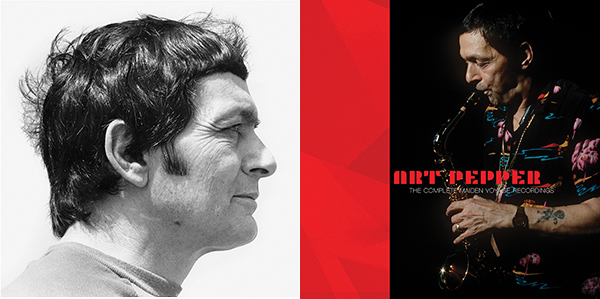
Art Pepper Photo by Laurie Pepper
That title must have gotten your attention. Not the part about Art Pepper but the part about the CD. Nobody has anything good to say about the compact disc anymore (footnote 1). CD sales suck. Streaming and downloads rule the world. Vinyl (an album format that warps, scratches, and has to be flipped every 22 minutes) now outsells CDs.
But the CD still deserves a place in your heart. One reason: box sets. Many of them are worthy of coveting. For example, there is an amazing new project on the Omnivore label, Art Pepper's The Complete Maiden Voyage Recordings. It contains eight hours and 20 minutes of music on seven CDs. Collections that large do not lend themselves to LPs.
Art Pepper was one of the most notorious junkies in the history of jazz. When he was young, he was an alto saxophone virtuoso. In 1951, he finished 16 votes behind Charlie Parker in the Downbeat Readers Poll. In his early 30s, he made classic albums like Art Pepper Meets the Rhythm Section (1957) and Art Pepper + Eleven (1959). But by 1960, heroin had laid him waste. He was incarcerated for much of the next 15 years. He even made the prison big time: San Quentin.
 Two events kept him from falling off the face of the earth. First, he entered Synanon, a drug rehabilitation program in Santa Monica, California. Second, he met Laurie Miller.
Synanon did not turn Pepper into a boy scout. But it altered his substance abuse patterns enough that he was able to function. Methadone maintenance, alcohol, and cocaine remained facts of his life. After they were married in 1974, Laurie Pepper managed Art's life and his career. She even co-wrote his critically praised autobiography, Straight Life, published in 1979. Since his death, she has managed his legacy. Laurie co-produced this new set (with Cheryl Pawelski of Omnivore) and provided fascinating liner notes that could only come from someone who had been by Pepper's side, every day, for his final, wild ride.
The Complete Maiden Voyage Recordings comes from three nights (August 13–15, 1981) at a large Los Angeles club. The place has faded into history, but it was an important stop on the West Coast jazz circuit between 1979 and 1983. The package for this set contains many vivid photographs (including gig shots) and memorabilia such as reproductions of the backs of the original tape boxes. It also contains an illuminating historical document: pages from a notebook in which Pepper logged his impressions when he first listened to the tapes of these three nights. (He could be a harsh critic. After hearing a somewhat ragged but scorching take of Charlie Parker's "Donna Lee," he wrote, "This isn't to be used until long after my death.")
Two events kept him from falling off the face of the earth. First, he entered Synanon, a drug rehabilitation program in Santa Monica, California. Second, he met Laurie Miller.
Synanon did not turn Pepper into a boy scout. But it altered his substance abuse patterns enough that he was able to function. Methadone maintenance, alcohol, and cocaine remained facts of his life. After they were married in 1974, Laurie Pepper managed Art's life and his career. She even co-wrote his critically praised autobiography, Straight Life, published in 1979. Since his death, she has managed his legacy. Laurie co-produced this new set (with Cheryl Pawelski of Omnivore) and provided fascinating liner notes that could only come from someone who had been by Pepper's side, every day, for his final, wild ride.
The Complete Maiden Voyage Recordings comes from three nights (August 13–15, 1981) at a large Los Angeles club. The place has faded into history, but it was an important stop on the West Coast jazz circuit between 1979 and 1983. The package for this set contains many vivid photographs (including gig shots) and memorabilia such as reproductions of the backs of the original tape boxes. It also contains an illuminating historical document: pages from a notebook in which Pepper logged his impressions when he first listened to the tapes of these three nights. (He could be a harsh critic. After hearing a somewhat ragged but scorching take of Charlie Parker's "Donna Lee," he wrote, "This isn't to be used until long after my death.")
Footnote 1: But see Steven Wilson's comments on the CD in this month's music feature, which starts on p.106.