Over the course of Rush's five-decade career, the Canadian prog-rock trio never released much music from the vaults. When vaunted studio albums such as 1980's Permanent Waves and 1981's Moving Pictures were reissued in expanded form, in multidisc anniversary box sets, the bonus material has consisted of previously unreleased live recordings from the era—never any of their oft-whispered-about studio outtakes.
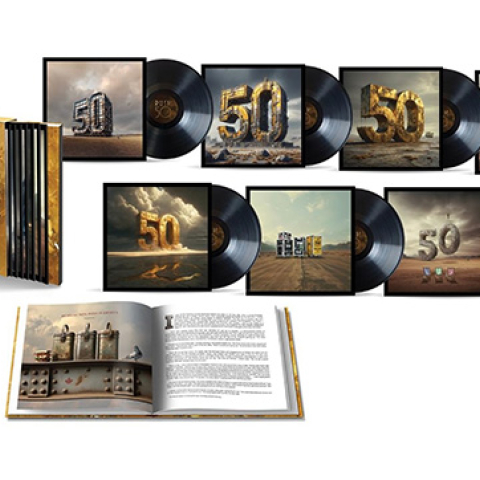
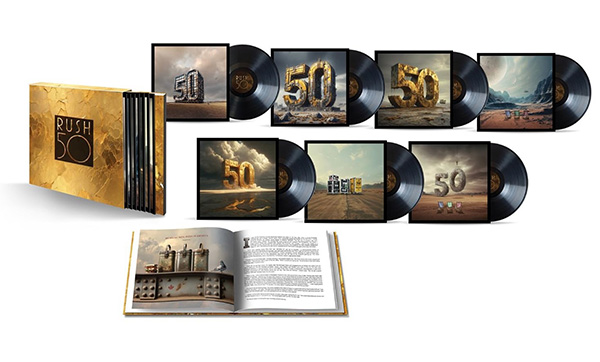
That changes with the new, career-spanning box set, Rush 50 (Ume/Mercury/Anthem), the first time the band has pulled back the curtain to share previously unreleased and highly sought-after tracks, alternate takes, and live rarities alongside other notable studio and live classics that traverse the band's fertile 1973–2015 lifespan. The hefty, 50-song, seven-LP Rush 50 Deluxe Edition is pricey, at $250 (footnote 1), but the content and lavish packaging—including tip-on jackets and a 104-page hardback book with 29 new song-inspired illustrations by Hugh Syme, the band's longtime creative director—back up the freight. If you're a member of Rush's passionate fanbase, it's a must-have.
"It's hard to put something together for such a monumental anniversary, but Rush 50 is really about the listener. It's about Rush fans," guitarist Alex Lifeson told me in an interview. "We were always about progression. As you know, because we've spoken so many times over the years, Rush was very focused on moving forward, experimenting, and trying different things to redefine ourselves. This box set is a great way to mark all those changes and follow our development."
One way this is achieved is with the inclusion of at least one track—"Fly by Night"; "Closer to the Heart"; "The Spirit of Radio"; "Tom Sawyer," and so on—from all 20 official Rush studio albums (including the Feedback EP).
Rare studio and live material from the formative years 1973–74 fill both sides of Rush 50's first LP, starting with both sides of Rush's debut single, "Not Fade Away" and "You Can't Fight It," both remastered last year (footnote 2). The pair of live gems that open side 2 are from a performance at the Agora Ballroom in Cleveland, August 26, 1974; it's the first appearance on a Rush recording of drummer Neil Peart: "Bad Boy" and "Garden Road"; neither track has been previously (officially) released. These live cuts underwent restoration last year, the liner notes say, mastered from the original tapes by John Polito. The stereo separation is markedly better than it is on myriad bootlegs.
"From a mixing perspective, the approach was to not reinvent the wheel but to keep the mixes vintage-y and era-accurate," Richard Chycki, a veteran Rush production/engineering associate tasked with mixing two key studio rarities, told me in an interview. "Working Man (Vault Edition)," previously only available as a 2013 digital single, sports Lifeson's wah-inflected, alternate-take guitar solo. "The debut Rush album"—that's 1974's Rush—"was recorded to 8-track 1" tape and transferred into ProTools," Chycki said. "Apparently, [original Rush producer] Terry Brown made copies of the multitrack master and had Alex do different solo takes on each copy. It's refreshing to hear a new approach to a solo I've heard so many times."
Even more striking is the never-before-released "The Trees (Vault Edition)," transferred from 24-track 2" analog tape to ProTools. "For Hemispheres, I believe the band was playing together for all the takes," Chycki noted; that 1978 album contains this song's original version. "You can hear Alex's cranked amps bleeding into Neil's drum mikes when the kit is soloed out." This replanted "Trees" branches out. "Neil's varied woodblocks approach in the break is the true teller that this is a different take," he continued. "Usually, outtakes don't have overdubs and are left incomplete. But for some reason, the band went ahead and completed the lead vocals, solos, and keys for this track. The subtle nuancing in their collective performance makes it a refreshing listen."
Rush 50 walks a skinny tightrope, balancing studio and live selections that chronicle the modifications of the band's sound from decade to decade through ever-shifting arrangements, alternating time signatures, varying song lengths, and the ways the musicians adapted after upgrading their gear. "The band sounded different at different times," Lifeson said. "We were listening to live stuff from the '70s, and both Geddy [Lee] and I commented, 'What were we thinking?' It's one thing to have the name Rush, but we were playing like maniacs! Everything was so fast! But then, I was listening to something from R40 Live (footnote 3), and that one sounds very different because the tempos are different. We really changed a lot over the years."
With the passing of Peart in January 2020, the book of Rush officially and forever closed. Listening to all 50 of these songs chronologically on 14 sides of vinyl gives you a sense of Rush's clever, challenging live dynamics ("La Villa Strangiato"; "Manhattan Project") and relentless studio acumen ("Test for Echo"; "Headlong Flight"). "What you notice is the variety of content," Lifeson observed. "Rush had a very long career with a lot of records and a lot of different music. The '70s music of Rush is very different from the '80s, which is also different from our '90s period. That outfit did a lot of interesting stuff, and you can feel the evolution."
Rush 50 is a fitting aural epitaph for a band that always found vital new ways to hit that mean, mean stride
Footnote 1: The companion Rush 50 Deluxe Edition four-CD box set goes for $100, while the seven-LP/four-CD Super Deluxe set costs $375. Footnote 2: Released as a standalone single in 1973 on Moon Records, "Not Fade Away" and "You Can't Fight It" both feature John Rutsey, Neil Peart's predecessor, on drums.
Footnote 3: R40 Live (Anthem/Zoë) was recorded June 17–19, 2015, at Air Canada Centre in Toronto on Rush's final tour.
Footnote 1: The companion Rush 50 Deluxe Edition four-CD box set goes for $100, while the seven-LP/four-CD Super Deluxe set costs $375. Footnote 2: Released as a standalone single in 1973 on Moon Records, "Not Fade Away" and "You Can't Fight It" both feature John Rutsey, Neil Peart's predecessor, on drums.