Sidebar 3: TJN'S In-Room Measurements
To provide a picture of what the Concept 500s sounded like in my room. I ran a number of in-room measurements on the Q Acoustics Concept 500s using the OmniMic test system from Parts Express. I took all of these at my main listening seat, with the speakers positioned as they were auditioned.
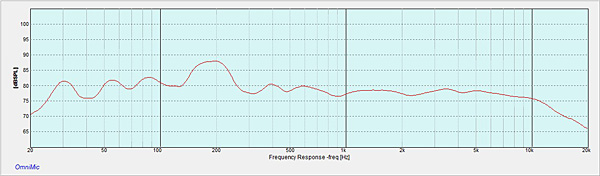
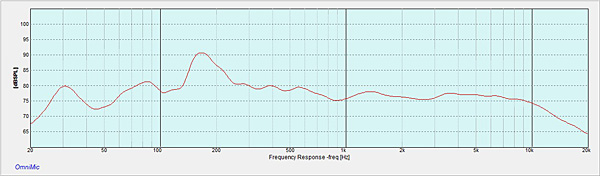
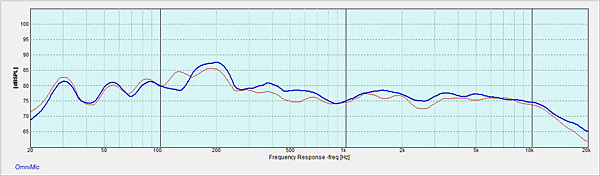
Figs. 1 and 2 show the left- and right-channel responses of the Concept 500s, taken at an average of 10 positions around the height of my ears when I'm seated, and with the speakers' HF jumpers set to "+". All results shown here were 1?6-octave smoothed. The anomalies, particularly in the deep bass, are common to most in-room speaker measurements, though the details significantly vary with the room.
 None of the listening observations in the main review were made using any room EQ or tone controls, apart from the speaker's own rear-panel HF jumpers.—Thomas J. Norton
Fig.1 Q Acoustics Concept 500, left channel, spatially averaged, 1/6-octave response in TJN's listening room.
Fig.2 Q Acoustics Concept 500, right channel, spatially averaged, 1/6-octave response in TJN's listening room.
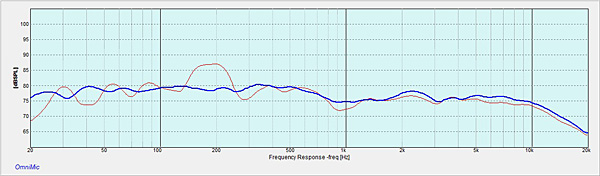
The peak at around 150Hz was far less audible than it looks, though it might have added a little warmth to the sound. The dip at just under 50Hz likely kept the bass from being as weighty as it might have been. Note the similar deviations in the Monitor Audio Silver 10 (fig.3) measured in the same position. The Silver 10 does show roughly 2dB more output in the deep bass. This might not look significant, but while the ear is relatively insensitive to the lowest bass, it's more sensitive to small differences in that region.
Fig.3 Q Acoustics Concept 500, response at TJN's head position (blue), and of Monitor Audio Silver 10 (red).
As an experiment, I made use of two features in the Marantz AV8805 pre-pro: its Audyssey room equalization and its Bass control. I first ran a full-range Audyssey routine. When I then determined that the bass, while now far more uniform and balanced in both channels than before, was a bit lower in level than is desirable, I also used the Bass control to raise the low-frequency output by 4dB. Interestingly and usefully, the Marantz's Bass control raised the entire bass region more or less linearly. I also changed the high-frequency adjustment jumpers on the Concept 500s' rear panels to their "0" position (though the difference between "0" and "+" was only about 0.5dB).
Fig.4 shows the result for the left channel (the improvement in the right channel was equally impressive). The EQ'd response is shown in blue, the non-EQ'd result in red. (The results shown in figs. 3 and 4 are from a single reading taken directly at my head position rather than the 10-point average in figs. 1 and 2.)
Fig.4 Q Acoustics Concept 500, response at TJN's head position with EQ (blue), and without EQ (red).
The result was a dramatic improvement in the Concept 500's bass response, although, apart from the elimination of the peak near 200Hz, this may not be obvious from the curves. But the apparent near-flatness of response down to 20Hz shouldn't be taken too literally, since it was measured at less than 80dB spl. Yes, the bass reach from the equalized Concept 500s was now as potent as any I've heard from a subwooferless speaker in my room. But pushing the EQ'd speakers too hard with deep-bass material in such a large room did cause them to show signs of distress, if only rarely—so I didn't pursue this too far. If you want clean, powerful, deep bass at realistic levels from most full-range speakers, use one or more subwoofers.
The point of this experiment was not to specifically recommend room equalization, which anyway isn't widely available in two-channel preamps and integrated amps. I don't use Audyssey often, and not at all for reviews (except for special digressions such as this). I used it here to try to simulate the bass room gain you might experience naturally with the Concept 500s in a listening space smaller than mine.