The source was a Marantz UD7007 universal BD player, connected to the Marantz pre-pro with a coaxial digital link for CD playback. (All recordings mentioned in this review were on CD.) The wiring was Kimber Kable AGDL digital coaxial from source to pre-pro, Cardas Hexlink interconnects from pre-pro to power amp, and AudioQuest Rocket 88 from amp to speakers.
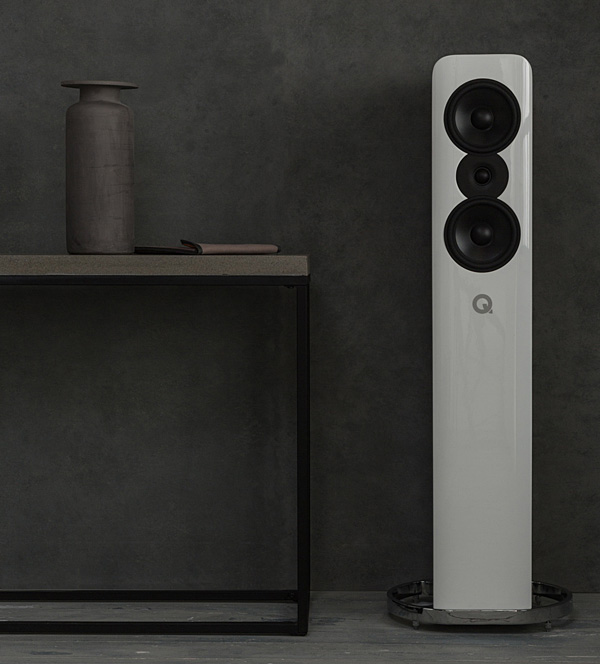
The Concept 500s were positioned about 9' apart and 11' from the main listening seat, toed in to aim directly at it. The front baffles were about 5' out from the front wall, and the tweeters were 36" above the floor. While the latter isn't far different from the ear height of a typical listener sitting in a comfortably upholstered chair, my seat puts me a couple inches higher. And because there are hardwood floors under the area rugs, I didn't use the speakers' spikes.
Listening
It's long been my opinion that symphonic orchestral music is the most difficult to record and play back—perhaps one reason for its drop in popularity in recent decades. Multichannel recording and playback is typically more convincing than two-channel stereo on such material, perhaps because it can better reproduce the ambience of the recording space, thus at least partially compensating for the fact that no home audio system can reproduce the full power of a symphony orchestra at full concert levels.
 But there are well-recorded two-channel exceptions, and some of the best I've heard have been film soundtracks, which is odd because most modern soundtracks have been recorded in multichannel sound. However, there's an art to mixing down multichannel to two channels, which is one reason many original-soundtrack albums sound far worse than they do on the same film's video release. The latter hasn't been mixed down, nor is it a victim of the current fetish for compressing the life out of recordings—its soft passages can't be allowed to overwhelm the dialogue or the effects!
One of these exceptional recordings is Harry Gregson-Williams's score for Kingdom of Heaven (CD, Sony Classical SK 94419), which deftly combines orchestra and chorus and was one of my 2019 picks for "Records to Die For." It sounded superb through the Concept 500s, with excellent imaging, convincing depth, and a remarkable sense of space and openness surrounding the performers, particularly the chorus.
The late James Horner's score for Sneakers (CD, Columbia CK 53146), one of my R2D4 selections for 1995, was recorded by Shawn Murphy, who's been responsible for some of the best-sounding orchestral soundtracks of the past 30 years. Murphy has recorded virtually every John Williams film score since the mid-1980s (and used to use Wilson Audio WATT/Puppy speakers as his studio monitors). He's also worked extensively with film composer James Newton Howard. Horner's soundtrack for 1989's Glory has long been an audiophile favorite, and Sneakers is another special recording but a hidden gem—it was composed for a long-forgotten box-office fizzle. My favorite track is "Playtronics Break-In," a 10-minute tone poem featuring orchestra, wordless chorus, and soft passages punctuated by abrupt dynamics, all presented on a deep, wide, realistic acoustic space.
From ambience to dynamics, the Concept 500s captured it all beautifully. Their bass impact wasn't quite as punchy, powerful, and deep as I've heard from a few other speakers in my room, but it was never less than satisfying. A subwoofer or two (which I did try) will of course add a bit more bottom-end impact, but with anything less than big pipe organs, savagely huge drums, or the most challenging electronic pop, this was rarely a concern—and might not be one at all in a room of more average size.
Classical or jazz double bass, and bass guitar, were reproduced with similar effectiveness. Unless I turned up the volume too high, making those inevitable room modes more audible, the Concept 500s' bass rarely sounded woolly or boomy. When I tried heavy deep-bass material with the speakers' magnetically attached grilles in place, they rattled—but this wasn't a problem, as I typically leave the grilles off.
Comparisons
But there are well-recorded two-channel exceptions, and some of the best I've heard have been film soundtracks, which is odd because most modern soundtracks have been recorded in multichannel sound. However, there's an art to mixing down multichannel to two channels, which is one reason many original-soundtrack albums sound far worse than they do on the same film's video release. The latter hasn't been mixed down, nor is it a victim of the current fetish for compressing the life out of recordings—its soft passages can't be allowed to overwhelm the dialogue or the effects!
One of these exceptional recordings is Harry Gregson-Williams's score for Kingdom of Heaven (CD, Sony Classical SK 94419), which deftly combines orchestra and chorus and was one of my 2019 picks for "Records to Die For." It sounded superb through the Concept 500s, with excellent imaging, convincing depth, and a remarkable sense of space and openness surrounding the performers, particularly the chorus.
The late James Horner's score for Sneakers (CD, Columbia CK 53146), one of my R2D4 selections for 1995, was recorded by Shawn Murphy, who's been responsible for some of the best-sounding orchestral soundtracks of the past 30 years. Murphy has recorded virtually every John Williams film score since the mid-1980s (and used to use Wilson Audio WATT/Puppy speakers as his studio monitors). He's also worked extensively with film composer James Newton Howard. Horner's soundtrack for 1989's Glory has long been an audiophile favorite, and Sneakers is another special recording but a hidden gem—it was composed for a long-forgotten box-office fizzle. My favorite track is "Playtronics Break-In," a 10-minute tone poem featuring orchestra, wordless chorus, and soft passages punctuated by abrupt dynamics, all presented on a deep, wide, realistic acoustic space.
From ambience to dynamics, the Concept 500s captured it all beautifully. Their bass impact wasn't quite as punchy, powerful, and deep as I've heard from a few other speakers in my room, but it was never less than satisfying. A subwoofer or two (which I did try) will of course add a bit more bottom-end impact, but with anything less than big pipe organs, savagely huge drums, or the most challenging electronic pop, this was rarely a concern—and might not be one at all in a room of more average size.
Classical or jazz double bass, and bass guitar, were reproduced with similar effectiveness. Unless I turned up the volume too high, making those inevitable room modes more audible, the Concept 500s' bass rarely sounded woolly or boomy. When I tried heavy deep-bass material with the speakers' magnetically attached grilles in place, they rattled—but this wasn't a problem, as I typically leave the grilles off.
Comparisons
I did briefly compare the Concept 500s to my Monitor Audio Silver 10s. The now-discontinued Silver 10 costs less than half the price of the Q 500, so this comparison, however interesting, wasn't entirely fair to the Monitors. I kept the levels matched as closely as possible (though this is dicey at best with speakers that aren't absolutely flat in-room—and no speakers are). I played the same tracks, and set up only one pair of speakers at a time in the same positions, which added an unavoidable delay of about 10 minutes while I swapped speakers. The Silver 10s, with their dual 8" woofers (but smaller, lighter cabinets than the Concept 500s), did have slightly more explosive bass and harder-hitting transients. But the latter were likely helped by the Monitors' marginally brighter top, as it's the higher frequencies that define edge clarity, even with abrupt bass transients: The sound of a drumstick or mallet striking a drumhead, or the rush of air through organ pipes, can affect how we judge the overall sound—bass isn't inherently "fast," but its accompanying overtones are. Neither speaker could challenge a good subwoofer, but the Silver 10s did provide a bit more subjective grunt in my room.
 One complicating factor in this comparison was that I preferred the AudioQuest speaker cables with the Concept 500s, and usually prefer an older pair of slightly softer-sounding Monster Cables with the Monitors. But for most of my comparative listening I used the AudioQuests throughout—after all, I was reviewing the Concept 500s, and wanted to keep the unavoidable delay in switching speakers as short as possible. This may have put the Monitors at a slight disadvantage, as their brighter top end with the AQ cables wasn't necessarily a plus. The more expensive Concept 500s sounded sweeter and smoother on top, but in no way dull.
Back to the Concept 500
One complicating factor in this comparison was that I preferred the AudioQuest speaker cables with the Concept 500s, and usually prefer an older pair of slightly softer-sounding Monster Cables with the Monitors. But for most of my comparative listening I used the AudioQuests throughout—after all, I was reviewing the Concept 500s, and wanted to keep the unavoidable delay in switching speakers as short as possible. This may have put the Monitors at a slight disadvantage, as their brighter top end with the AQ cables wasn't necessarily a plus. The more expensive Concept 500s sounded sweeter and smoother on top, but in no way dull.
Back to the Concept 500
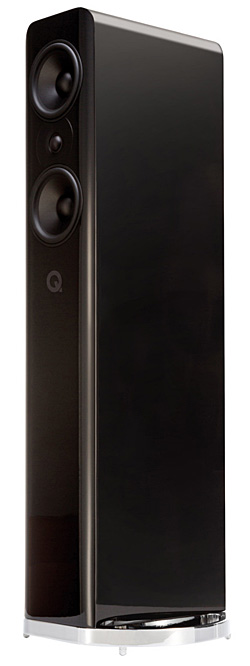
The Q Acoustics speakers continued to impress me with a wide range of music. They were particularly good with voices—much better than I'd expected. A two-way design, the Concept 500 has no dedicated midrange driver, instead relying on its two 6.5" woofers to cover that region until they hand off to the tweeter at 2.5kHz. This does provide the cost savings entailed by a simpler crossover and one fewer driver—money that can be put into the speaker's elaborate cabinet structure while keeping the price down—but it forgoes the theoretical advantages of a separate midrange driver. The latter is typically smaller, offering potentially better performance throughout the entire vocal region. That said, successful designs from well-known brands, including Wilson Audio and Bowers & Wilkins, often use midrange drivers as large as 6". And from my primary listening seat, I heard nothing from the Concept 500s that revealed any boxy, nasal, or unnatural coloration. The balance was neither clearly forward nor recessed. The DALI CD Vol.3, a compilation from the Danish audio manufacturer DALI, has superlative sound quality (footnote 1). Sophie Zelmani's clear, breathy voice in "How It Feels" is crisp and open; and in "These Days," Ane Brun's singing is enhanced by what sounds like artificial reverb. While the Concept 500s made these clear, the effect was subtle, not unnatural. On both tracks the instrumental accompaniment, including the drum kit, wasn't overly powerful, but in this music it doesn't need to be—the speakers did their job by avoiding either excess or leanness.
It had been years since I'd listened to Jay Leonhart's Salamander Pie (CD, DMP CD-442), and I'd forgotten how convincingly this 1983 release reproduces the sound of a jazz duo featuring Leonhart's, um, interesting singing and fine double-bass work, assisted by pianist Mike Renzi. With song lyrics as quirky as in the title track ("Crunchy, munchy, good for you . . .") and "Goodbye Miami" ("The ocean has risen about thirty feet . . ."), it's irresistible. So were the voices of other singers, from Eric Bibb's on A Collection of Cyndee Peters and Eric Bibb (CD, Opus3 CD 7706/03) to Elvis Presley's in "Fever" (on The DALI CD Vol.2). With all of these selections, the Concept 500s did everything right and nothing wrong.
I mustn't fail to mention Annie Lennox's "Into the West," the concluding track of Howard Shore's magnificent score for The Return of the King (CD, Reprise WMG Soundtracks 48521-2). Lennox's vocal, her and Shore's music, and this recording's sound were all sublime through the Q Acoustics. (Note to self: Why haven't you bought any of Lennox's albums? Correct this oversight ASAP.)
All of these selections, and many more, brought out the best in the Concert 500s. It might be presumptuous to say that the Concept 500s also brought out the best in these recordings, but I'm certain that, perhaps apart from the deepest bass—a major challenge for most speakers in my large room—you may have to spend a lot more to do better.
Conclusions
These days, the audio market, and most demonstrations at audio shows, are so dominated by big, expensive speakers that it might seem as if relatively affordable models are disappearing. That's not the case. While the average shopper might think $5999.99 an outrageous amount of money for a pair of speakers, it's actually in the sweet spot for audiophiles willing to squeeze their budgets a bit harder to get something special.
And the Q Acoustics Concept 500 is special. Its only obvious flaw is that you can't go give it a casual listen at that audio shop that used to be just around the corner. The good news is that a home trial of these speakers requires little more than the effort to order them, unpack them, and set them up. If you don't like them, you can ship them back within 30 days at no cost, not even return shipping. But I doubt that, once they've entered your listening room, they'll ever leave.
Footnote 1: This and DALI's three other CDs are available only from the DALI website.
It's long been my opinion that symphonic orchestral music is the most difficult to record and play back—perhaps one reason for its drop in popularity in recent decades. Multichannel recording and playback is typically more convincing than two-channel stereo on such material, perhaps because it can better reproduce the ambience of the recording space, thus at least partially compensating for the fact that no home audio system can reproduce the full power of a symphony orchestra at full concert levels.
But there are well-recorded two-channel exceptions, and some of the best I've heard have been film soundtracks, which is odd because most modern soundtracks have been recorded in multichannel sound. However, there's an art to mixing down multichannel to two channels, which is one reason many original-soundtrack albums sound far worse than they do on the same film's video release. The latter hasn't been mixed down, nor is it a victim of the current fetish for compressing the life out of recordings—its soft passages can't be allowed to overwhelm the dialogue or the effects!
One of these exceptional recordings is Harry Gregson-Williams's score for Kingdom of Heaven (CD, Sony Classical SK 94419), which deftly combines orchestra and chorus and was one of my 2019 picks for "Records to Die For." It sounded superb through the Concept 500s, with excellent imaging, convincing depth, and a remarkable sense of space and openness surrounding the performers, particularly the chorus.
The late James Horner's score for Sneakers (CD, Columbia CK 53146), one of my R2D4 selections for 1995, was recorded by Shawn Murphy, who's been responsible for some of the best-sounding orchestral soundtracks of the past 30 years. Murphy has recorded virtually every John Williams film score since the mid-1980s (and used to use Wilson Audio WATT/Puppy speakers as his studio monitors). He's also worked extensively with film composer James Newton Howard. Horner's soundtrack for 1989's Glory has long been an audiophile favorite, and Sneakers is another special recording but a hidden gem—it was composed for a long-forgotten box-office fizzle. My favorite track is "Playtronics Break-In," a 10-minute tone poem featuring orchestra, wordless chorus, and soft passages punctuated by abrupt dynamics, all presented on a deep, wide, realistic acoustic space.
From ambience to dynamics, the Concept 500s captured it all beautifully. Their bass impact wasn't quite as punchy, powerful, and deep as I've heard from a few other speakers in my room, but it was never less than satisfying. A subwoofer or two (which I did try) will of course add a bit more bottom-end impact, but with anything less than big pipe organs, savagely huge drums, or the most challenging electronic pop, this was rarely a concern—and might not be one at all in a room of more average size.
I did briefly compare the Concept 500s to my Monitor Audio Silver 10s. The now-discontinued Silver 10 costs less than half the price of the Q 500, so this comparison, however interesting, wasn't entirely fair to the Monitors. I kept the levels matched as closely as possible (though this is dicey at best with speakers that aren't absolutely flat in-room—and no speakers are). I played the same tracks, and set up only one pair of speakers at a time in the same positions, which added an unavoidable delay of about 10 minutes while I swapped speakers. The Silver 10s, with their dual 8" woofers (but smaller, lighter cabinets than the Concept 500s), did have slightly more explosive bass and harder-hitting transients. But the latter were likely helped by the Monitors' marginally brighter top, as it's the higher frequencies that define edge clarity, even with abrupt bass transients: The sound of a drumstick or mallet striking a drumhead, or the rush of air through organ pipes, can affect how we judge the overall sound—bass isn't inherently "fast," but its accompanying overtones are. Neither speaker could challenge a good subwoofer, but the Silver 10s did provide a bit more subjective grunt in my room.
One complicating factor in this comparison was that I preferred the AudioQuest speaker cables with the Concept 500s, and usually prefer an older pair of slightly softer-sounding Monster Cables with the Monitors. But for most of my comparative listening I used the AudioQuests throughout—after all, I was reviewing the Concept 500s, and wanted to keep the unavoidable delay in switching speakers as short as possible. This may have put the Monitors at a slight disadvantage, as their brighter top end with the AQ cables wasn't necessarily a plus. The more expensive Concept 500s sounded sweeter and smoother on top, but in no way dull.
Back to the Concept 500The Q Acoustics speakers continued to impress me with a wide range of music. They were particularly good with voices—much better than I'd expected. A two-way design, the Concept 500 has no dedicated midrange driver, instead relying on its two 6.5" woofers to cover that region until they hand off to the tweeter at 2.5kHz. This does provide the cost savings entailed by a simpler crossover and one fewer driver—money that can be put into the speaker's elaborate cabinet structure while keeping the price down—but it forgoes the theoretical advantages of a separate midrange driver. The latter is typically smaller, offering potentially better performance throughout the entire vocal region. That said, successful designs from well-known brands, including Wilson Audio and Bowers & Wilkins, often use midrange drivers as large as 6". And from my primary listening seat, I heard nothing from the Concept 500s that revealed any boxy, nasal, or unnatural coloration. The balance was neither clearly forward nor recessed. The DALI CD Vol.3, a compilation from the Danish audio manufacturer DALI, has superlative sound quality (footnote 1). Sophie Zelmani's clear, breathy voice in "How It Feels" is crisp and open; and in "These Days," Ane Brun's singing is enhanced by what sounds like artificial reverb. While the Concept 500s made these clear, the effect was subtle, not unnatural. On both tracks the instrumental accompaniment, including the drum kit, wasn't overly powerful, but in this music it doesn't need to be—the speakers did their job by avoiding either excess or leanness.
Footnote 1: This and DALI's three other CDs are available only from the DALI website.