Ever since I became interested in—nay, obsessed with—high-quality music reproduction, my goal has been to attain the experience of being at a performance. Some audiophiles target the recreation of the event in their room—a "they are here" experience. Yet, it's obvious that the ensembles, orchestras, and choruses I enjoy would not fit in my room, and so it would be foolish to try to reproduce them as if they were.
In the early days of component hi-fi, all was mono. Not until the emergence of stereo was there any hope of creating the auditory illusion of an acoustic space—a performance venue other than the room I was listening in. Reverberation captured in a mono recording can hint at a space, but the spatial capabilities of stereo are much more extensive. Similarly, multichannel (and "immersive") audio is more effective than stereo at reproducing a performance venue's ambience.
Even so, you can never eliminate the acoustics of the room you're listening in—not completely.
Committed listeners began to pay attention to crucial issues such as speaker placement and acoustics early in the stereo era, yet many continue to find reasons not to do so. Décor and the preferences of nonenthusiasts in the household often stand in the way. A major deterrent is the bulk of most effective treatments, especially those used to tame bass. In the conventional, well-proven approach, the thickness of the material used to absorb sound must be a significant fraction of the wavelength—and the wavelength of a 100Hz soundwave is about 10'.
DSP has exploded and is close to becoming a panacea, especially in multichannel home-theater setups, but many hi-fi purists refuse to accept its alteration of signals whose purity they are so invested in preserving. I'm a DSP advocate, yet I cannot deny that I would prefer to address room acoustics directly via physical treatment and reduce the amount of signal processing that's necessary.
Mid and high frequencies can be managed with panels on the wall and irregular surfaces such as bookcases, record shelves (both for diffraction), stuffed furniture, and carpeting (for absorbing high-frequency energy). Sound energy below the Schroeder ("critical") frequency is distorted by room dimensions, and if passive methods are chosen to correct these distortions, they are necessarily bulky (footnote 1). Due to their wavelength and the timescale of their modal resonances, correcting these frequencies also demands the most intensive DSP.
A novel way to address low-frequency problems is with active, electronically controlled bass traps. These devices incorporate electronics—even speakers—but have no influence on those precious, delicate electrical music signals; these devices are not even in the signal path. They just sit in the corner and do their things.
Over the decades, Stereophile has covered these relatively rare birds a few times, starting with Nelson Pass's large Phantom Acoustics Shadow active low-frequency acoustic control devices in December 1989; that review was followed (almost 20 years later) by the more compact Bag End E-Trap, reviewed in 2008. Each of those devices utilized a built-in microphone, analog electronics, and one or more woofers. Placed in a high-pressure location (typically room corners), they detected LF signals and inverted, amplified, and converted them to soundwaves (via transducers) to acoustically cancel room modes. They required careful tuning to find a sweet spot between doing too little or too much. The result of overuse could be instability or the essentially total loss of low frequencies.
The PSI Audio AVAA C20 offered a totally new approach, which does not introduce new audio-frequency energy into the room. These devices don't necessarily meet with home-decorator approval; though intrigued, I hesitated because I was not happy about adding these blocky black boxes to my room's accumulating clutter. Sound engineer Bob Katz reviewed them almost 10 years ago, in 2016, in his home studio. He presented an excellent technical discussion and expressed his emphatic approval.
 The PSI Audio AVAA C214
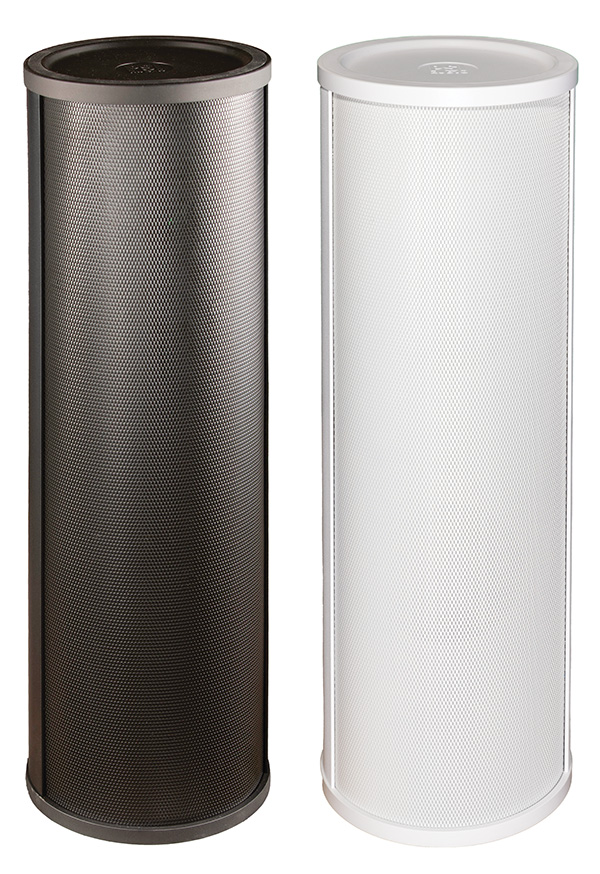
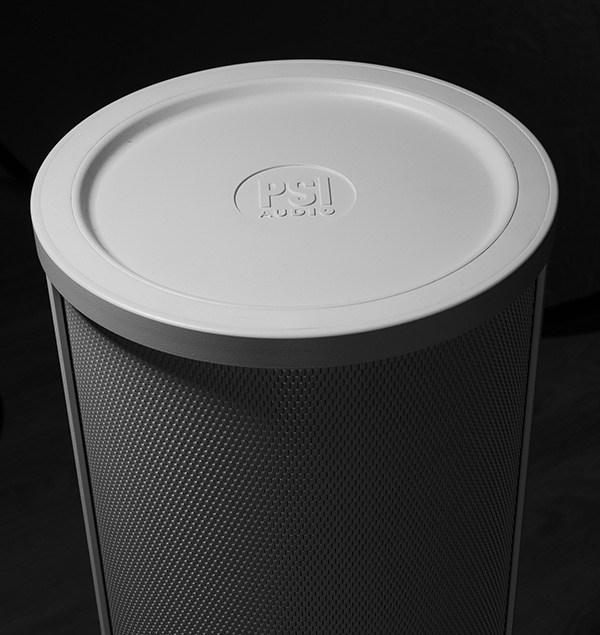
When I saw the new AVAA C214 demonstrated at the 2024 AES in NYC, I didn't hesitate to suggest a review. The C214 is a roughly 2' long (or high, depending on how it's deployed) cylinder about 8" in diameter. It is sturdily constructed of cast aluminum; when standing vertically (as in a corner), it can serve as a stand for a plant or sculpture. Or not. An optional foot ($395 each, only in Black) permits the C214 to be mounted to a wall or attached securely to the floor. AVAA traps work by creating an interior volume in which loudspeaker-like diaphragms move to maintain fixed acoustic impedance. In other words—this is my interpretation—the AVAA responds to increased pressure by retracting the diaphragms to increase space and responds to decreased pressure by extending the diaphragms to decrease space. It does this in real time over a wide range of frequencies, from 15 to 160Hz. The effect, PSI Audio says, is to create a virtual open window in the area of the trap that essentially "short-circuits" room modes. The new C214 differs from the still-current C20 in that it employs DSP in place of analog circuitry, offers adjustable gain, and supports remote control and firmware updates. Perhaps its biggest advance is that it's smaller and lighter than its predecessor—yet claims to be nearly 20% more effective. Unpacking and setup
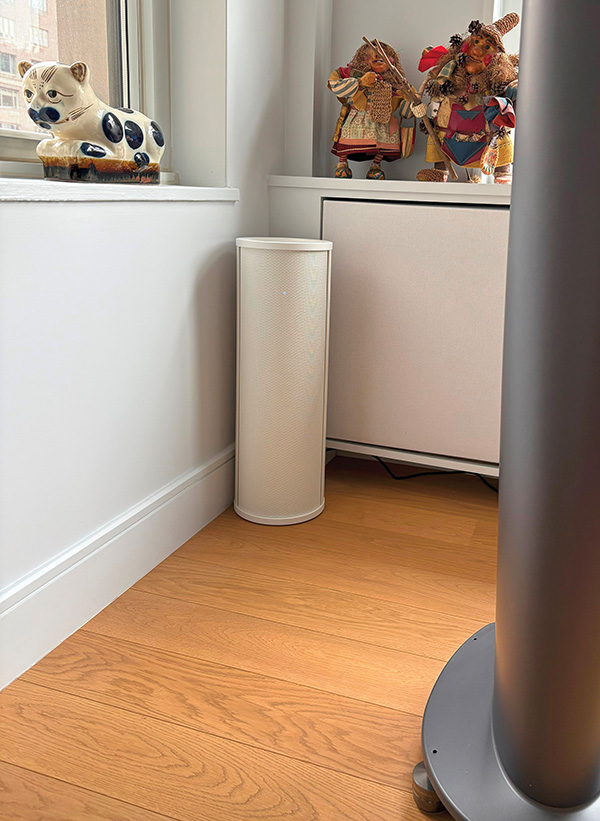
I cannot think of another active, effective component that was as easy to get going as the AVAA C214. I removed the protective foam packing and plastic wrap and placed the C214s in the front corners of my room. I attached the power cables and switched them on. That's it. Done.
A subtle LED on the C214's front indicates its functional status. On the back, in addition to the IEC power port and the power switch, a multicolor LED indicates the gain setting, and a pair of buttons allows you to adjust that gain, switch from manual control to web-based remote control, and enable firmware updates. I played with these but always ended up returning to the factory settings. The C214, then, is trivial to install and needs no further attention once you have decided where to put it.
 You might not even think it was doing anything save for two observations. The first is that it is sensitive to movement. If you reposition it while it's powered up, it might trumpet like a molested swan. The other is the effect it has on music playback and on room acoustics broadly.
These really work!
You might not even think it was doing anything save for two observations. The first is that it is sensitive to movement. If you reposition it while it's powered up, it might trumpet like a molested swan. The other is the effect it has on music playback and on room acoustics broadly.
These really work!
After placing them in the front corners of my room, I sat down in my listening chair: No music, just me and my room, and outside, barely audible noise from early morning traffic on Third Avenue. Using the web app on my iPad, I switched on the C214s. The effect seemed subtle at first, but the more I focused, the more I noticed it. Outside noises seemed more distant but also somewhat clearer and more discrete. This was particularly noticeable with the low frequencies produced by an idling city bus. Switching the C214s on and off, I discovered a Zen-like sense of calm with the AVAAs in operation, which must be due to the reduction of room modes excited by external sources. What else could cause it?
 Then I added piano. The album French Duets (FLAC rip from CD, Hyperion CDA68329), with pianists Steven Osborne and Paul Lewis, has been near the top of my most-played list since its 2021 release, because of the delightful music, the brilliance of the performances, and the clarity and balance of the recording. The performers are recorded up close, and the captured ambiance is not generous. With the AVAA traps in operation, the changes were not huge, but they were significant. First, the soundstage got wider, reaching beyond the left and right speakers, and also seemed a bit lower. Second, the bass was taut and corporeal. I heard this on all tracks, but the effect was especially tangible on the opening of the Poulenc Sonata, where four hands create some powerful chords. Typically, such sounds can only be played so loud in an average-sized domestic room before they begin to seem congested by the room modes they excite. With the AVAAs installed, the chords could be heard clearly as constructed of distinct notes, the lowest notes enhanced by the resonance of the instrument's wooden body. I could play this music as loud or as soft as I wanted to; the piano remained clean and realistic at all levels. There seemed to be no direct effect on the midrange or treble, but these ranges, too, benefited from cleaner bass and reduction of the masking effects of those modal resonances. The impact on the music was eminently satisfying.
I moved on to the pipe organ. I pulled out my old buddy, the Mendelssohn Organ Sonata in F, from Six Organ Sonatas, Op.65, performed by Thomas Murray on the E. & G.G. Hook instrument at the Hook Brothers' home church in Jamaica Plain and on the W.B.D. Simmons organ at the Most Holy Redeemer Church in East Boston (CD, Raven 390, originally from a Sheffield Town Hall LP, S-13). I remember hearing this music for the first time and being thrilled by the power of the bass lines. Some of that thrill was due to the quasi-immersive illusion created by resonances in my playback system and room. Now I can see every pedal tone via the JRiver frequency analyzer, including the lowest fundamental tone from the 16' Grand Open Diapason stop (32Hz) accompanied by a lot of correlated rumblings below. With the AVAAs I heard both unmistakably, regardless of listening level.
An enduring earworm is a recording of "Stand By Me" by Don Shirley on the LP Drown in My Own Tears (Cadence, CLP 25057). Shirley's rendition is mournful and spiritual; a ground of bass fiddle, organ, and cello and tasteful percussion accents anchor Shirley's lead on piano. Unfortunately, the bass on this recording is over-resonant and congested, and all the instruments are cramped together. This was never an audio treat but rather something for the soul.
Then I added piano. The album French Duets (FLAC rip from CD, Hyperion CDA68329), with pianists Steven Osborne and Paul Lewis, has been near the top of my most-played list since its 2021 release, because of the delightful music, the brilliance of the performances, and the clarity and balance of the recording. The performers are recorded up close, and the captured ambiance is not generous. With the AVAA traps in operation, the changes were not huge, but they were significant. First, the soundstage got wider, reaching beyond the left and right speakers, and also seemed a bit lower. Second, the bass was taut and corporeal. I heard this on all tracks, but the effect was especially tangible on the opening of the Poulenc Sonata, where four hands create some powerful chords. Typically, such sounds can only be played so loud in an average-sized domestic room before they begin to seem congested by the room modes they excite. With the AVAAs installed, the chords could be heard clearly as constructed of distinct notes, the lowest notes enhanced by the resonance of the instrument's wooden body. I could play this music as loud or as soft as I wanted to; the piano remained clean and realistic at all levels. There seemed to be no direct effect on the midrange or treble, but these ranges, too, benefited from cleaner bass and reduction of the masking effects of those modal resonances. The impact on the music was eminently satisfying.
I moved on to the pipe organ. I pulled out my old buddy, the Mendelssohn Organ Sonata in F, from Six Organ Sonatas, Op.65, performed by Thomas Murray on the E. & G.G. Hook instrument at the Hook Brothers' home church in Jamaica Plain and on the W.B.D. Simmons organ at the Most Holy Redeemer Church in East Boston (CD, Raven 390, originally from a Sheffield Town Hall LP, S-13). I remember hearing this music for the first time and being thrilled by the power of the bass lines. Some of that thrill was due to the quasi-immersive illusion created by resonances in my playback system and room. Now I can see every pedal tone via the JRiver frequency analyzer, including the lowest fundamental tone from the 16' Grand Open Diapason stop (32Hz) accompanied by a lot of correlated rumblings below. With the AVAAs I heard both unmistakably, regardless of listening level.
An enduring earworm is a recording of "Stand By Me" by Don Shirley on the LP Drown in My Own Tears (Cadence, CLP 25057). Shirley's rendition is mournful and spiritual; a ground of bass fiddle, organ, and cello and tasteful percussion accents anchor Shirley's lead on piano. Unfortunately, the bass on this recording is over-resonant and congested, and all the instruments are cramped together. This was never an audio treat but rather something for the soul.
 I no longer listen to vinyl records, so instead I return to this recording via a reissue (FLAC CD ripped from Don Shirley–Golden Classics, Collectable Records, COL-5746). With the installed AVAA traps, there's finally a realistic, intimate (which is to say rather small) soundstage with each instrument clearly in its place. Balance is restored: As the bass and cello carry the pleading melody, Shirley comments and embellishes, rolling us to an abrupt, inevitable end.
Bob Katz found that using three of the original AVAA C20s had a substantial, constructive impact on frequency response. His figure 2 shows how the original AVAAs "broadly improve the 90–110Hz range by about 1dB, including the dip near 120Hz." "The AVAAs smoothly and effectively attenuate the 29Hz peak at the listening position by an amazing 2dB, ... effectively flatten the 25–55Hz range within 1dB, ... fill in the 45Hz dip by a significant 1.5dB," and "attenuate the 70Hz peak by 1.25dB."
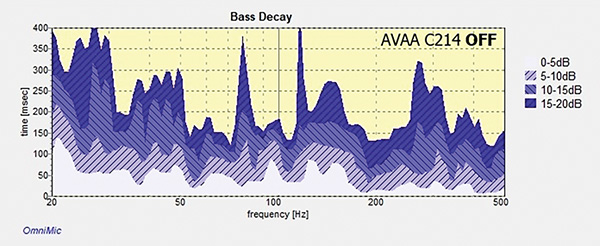
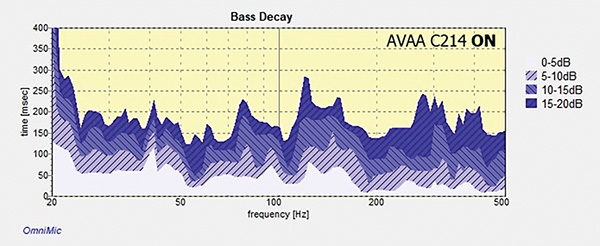
My frequency-response measurements (not shown) are similar to Bob's, though with peaks and troughs at different frequencies. Yet, from the start, I felt that the real salience of the AVAA traps was in the time domain, since much of the energy they absorbed—the most important part—arrived after the direct sound, reflected from room boundaries.
I no longer listen to vinyl records, so instead I return to this recording via a reissue (FLAC CD ripped from Don Shirley–Golden Classics, Collectable Records, COL-5746). With the installed AVAA traps, there's finally a realistic, intimate (which is to say rather small) soundstage with each instrument clearly in its place. Balance is restored: As the bass and cello carry the pleading melody, Shirley comments and embellishes, rolling us to an abrupt, inevitable end.
Bob Katz found that using three of the original AVAA C20s had a substantial, constructive impact on frequency response. His figure 2 shows how the original AVAAs "broadly improve the 90–110Hz range by about 1dB, including the dip near 120Hz." "The AVAAs smoothly and effectively attenuate the 29Hz peak at the listening position by an amazing 2dB, ... effectively flatten the 25–55Hz range within 1dB, ... fill in the 45Hz dip by a significant 1.5dB," and "attenuate the 70Hz peak by 1.25dB."
My frequency-response measurements (not shown) are similar to Bob's, though with peaks and troughs at different frequencies. Yet, from the start, I felt that the real salience of the AVAA traps was in the time domain, since much of the energy they absorbed—the most important part—arrived after the direct sound, reflected from room boundaries.
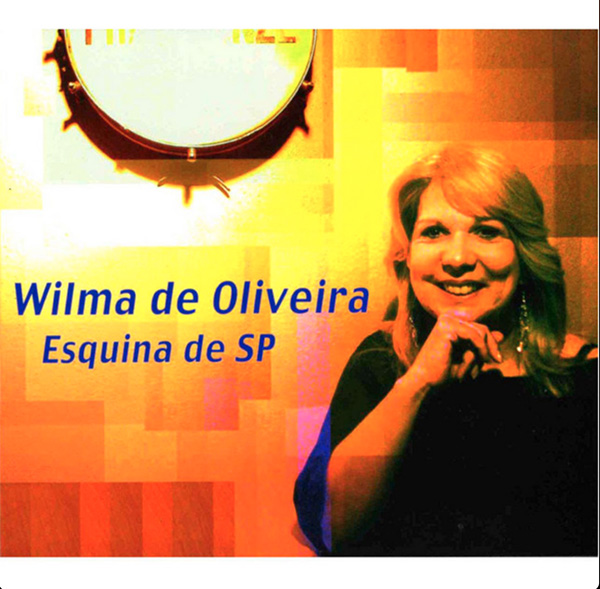
The extra musical and ambient information with multichannel audio makes listening room acoustics somewhat less important. However, the room is still there, and there are good reasons to think that anything that improves acoustics would benefit stereo, multichannel, or even live music. I've found a great example in a recording made by Seigén Ono at Praça Onze in Tokyo before a live (and lively) audience: Esquina de SP by Wilma de Oliveira (SACD, Saidera Records SD1027H). The atmosphere is tight and intense, the performances of classic bossa nova irresistible, but the multichannel playback has long filled my room with a pulsing sound cloud.
When I switched in the AVAA traps, space expanded in all dimensions. The crowd was still raucous, but now it was mostly behind me and to my sides. The performers, still up front, were now spread wider than my room, and their individual contributions (voices, guitar, drums) were distinct and full. Finally, I was able to experience the electricity of this event fully and appreciate Seigén Ono's reputation.
 Ever since my listening room was renovated and my new speakers installed, I've noticed a very slight imbalance favoring the left side. It is most obvious, to no surprise, with recordings to which I have the tightest connection. Yet measurements of each speaker and subwoofer (as well as DiracLive EQ) demonstrate that they were all matched in output. I've had many guests, and none have commented about any asymmetry. Maybe they were just being tactful and kind, or maybe it's that my guests are not as familiar with the recordings. Still, I hear what I hear.
The best example of this is a 5.0, DSD256 recording of Teresa Carreño's Serenade for Strings in E-flat Major for chamber orchestra, performed by A Far Cry (footnote 2). Tom Caulfield, the recording engineer, was kind enough to send me a copy of the original DFF256 master early in 2021, and I am still hooked on it. Lovely, surprising music, beautifully played and recorded with transparency and careful tonal balance. However, after the opening tutti, as the melody passes to the upper strings on the left, I sense something of a void on the right.
I listened to this recording soon after the AVAA traps were installed. The soundstage extended wide, and all the lower strings were better defined. That void on the right was now filled by the lower strings of the cellos and bass fiddles! The fault was not in the recording or my system but in my room. The bass was always there but obscured. Now it was resolved.
Ever since my listening room was renovated and my new speakers installed, I've noticed a very slight imbalance favoring the left side. It is most obvious, to no surprise, with recordings to which I have the tightest connection. Yet measurements of each speaker and subwoofer (as well as DiracLive EQ) demonstrate that they were all matched in output. I've had many guests, and none have commented about any asymmetry. Maybe they were just being tactful and kind, or maybe it's that my guests are not as familiar with the recordings. Still, I hear what I hear.
The best example of this is a 5.0, DSD256 recording of Teresa Carreño's Serenade for Strings in E-flat Major for chamber orchestra, performed by A Far Cry (footnote 2). Tom Caulfield, the recording engineer, was kind enough to send me a copy of the original DFF256 master early in 2021, and I am still hooked on it. Lovely, surprising music, beautifully played and recorded with transparency and careful tonal balance. However, after the opening tutti, as the melody passes to the upper strings on the left, I sense something of a void on the right.
I listened to this recording soon after the AVAA traps were installed. The soundstage extended wide, and all the lower strings were better defined. That void on the right was now filled by the lower strings of the cellos and bass fiddles! The fault was not in the recording or my system but in my room. The bass was always there but obscured. Now it was resolved.
 The lowdown
I now spend part of my days eagerly re-auditioning my recordings to hear how they sound with the AVAA traps. In every instance (stereo or multichannel, with or without DiracLive) and with almost every music selection, the effect of the AVAA C214s is beneficial, though in most cases (despite all that I have written) it is subtle. If your listening room has more serious issues, you may not even notice their contribution. On the other hand, there was never a downside. I heard only improvements. I'll end with a list of the consistent benefits. With the AVAA traps installed:
Footnote 1: The now-discontinued MSR SpringTrap came closest to offering both effective treatment and acceptable appearance. Footnote 2: This wonderful recording has not been released to the public, and there are no commercially available recordings of the Serenade. However, I have had similar experience with another recording by A Far Cry and recorded by Tom Caulfield: Britten's Variations on a Theme by Frank Bridge on Crier Records CR1801 "Visions and Variations" (available in many formats from NativeDSD).
The PSI Audio AVAA C214When I saw the new AVAA C214 demonstrated at the 2024 AES in NYC, I didn't hesitate to suggest a review. The C214 is a roughly 2' long (or high, depending on how it's deployed) cylinder about 8" in diameter. It is sturdily constructed of cast aluminum; when standing vertically (as in a corner), it can serve as a stand for a plant or sculpture. Or not. An optional foot ($395 each, only in Black) permits the C214 to be mounted to a wall or attached securely to the floor. AVAA traps work by creating an interior volume in which loudspeaker-like diaphragms move to maintain fixed acoustic impedance. In other words—this is my interpretation—the AVAA responds to increased pressure by retracting the diaphragms to increase space and responds to decreased pressure by extending the diaphragms to decrease space. It does this in real time over a wide range of frequencies, from 15 to 160Hz. The effect, PSI Audio says, is to create a virtual open window in the area of the trap that essentially "short-circuits" room modes. The new C214 differs from the still-current C20 in that it employs DSP in place of analog circuitry, offers adjustable gain, and supports remote control and firmware updates. Perhaps its biggest advance is that it's smaller and lighter than its predecessor—yet claims to be nearly 20% more effective. Unpacking and setup
I cannot think of another active, effective component that was as easy to get going as the AVAA C214. I removed the protective foam packing and plastic wrap and placed the C214s in the front corners of my room. I attached the power cables and switched them on. That's it. Done.
You might not even think it was doing anything save for two observations. The first is that it is sensitive to movement. If you reposition it while it's powered up, it might trumpet like a molested swan. The other is the effect it has on music playback and on room acoustics broadly.
These really work!After placing them in the front corners of my room, I sat down in my listening chair: No music, just me and my room, and outside, barely audible noise from early morning traffic on Third Avenue. Using the web app on my iPad, I switched on the C214s. The effect seemed subtle at first, but the more I focused, the more I noticed it. Outside noises seemed more distant but also somewhat clearer and more discrete. This was particularly noticeable with the low frequencies produced by an idling city bus. Switching the C214s on and off, I discovered a Zen-like sense of calm with the AVAAs in operation, which must be due to the reduction of room modes excited by external sources. What else could cause it?
Then I added piano. The album French Duets (FLAC rip from CD, Hyperion CDA68329), with pianists Steven Osborne and Paul Lewis, has been near the top of my most-played list since its 2021 release, because of the delightful music, the brilliance of the performances, and the clarity and balance of the recording. The performers are recorded up close, and the captured ambiance is not generous. With the AVAA traps in operation, the changes were not huge, but they were significant. First, the soundstage got wider, reaching beyond the left and right speakers, and also seemed a bit lower. Second, the bass was taut and corporeal. I heard this on all tracks, but the effect was especially tangible on the opening of the Poulenc Sonata, where four hands create some powerful chords. Typically, such sounds can only be played so loud in an average-sized domestic room before they begin to seem congested by the room modes they excite. With the AVAAs installed, the chords could be heard clearly as constructed of distinct notes, the lowest notes enhanced by the resonance of the instrument's wooden body. I could play this music as loud or as soft as I wanted to; the piano remained clean and realistic at all levels. There seemed to be no direct effect on the midrange or treble, but these ranges, too, benefited from cleaner bass and reduction of the masking effects of those modal resonances. The impact on the music was eminently satisfying.
I moved on to the pipe organ. I pulled out my old buddy, the Mendelssohn Organ Sonata in F, from Six Organ Sonatas, Op.65, performed by Thomas Murray on the E. & G.G. Hook instrument at the Hook Brothers' home church in Jamaica Plain and on the W.B.D. Simmons organ at the Most Holy Redeemer Church in East Boston (CD, Raven 390, originally from a Sheffield Town Hall LP, S-13). I remember hearing this music for the first time and being thrilled by the power of the bass lines. Some of that thrill was due to the quasi-immersive illusion created by resonances in my playback system and room. Now I can see every pedal tone via the JRiver frequency analyzer, including the lowest fundamental tone from the 16' Grand Open Diapason stop (32Hz) accompanied by a lot of correlated rumblings below. With the AVAAs I heard both unmistakably, regardless of listening level.
An enduring earworm is a recording of "Stand By Me" by Don Shirley on the LP Drown in My Own Tears (Cadence, CLP 25057). Shirley's rendition is mournful and spiritual; a ground of bass fiddle, organ, and cello and tasteful percussion accents anchor Shirley's lead on piano. Unfortunately, the bass on this recording is over-resonant and congested, and all the instruments are cramped together. This was never an audio treat but rather something for the soul.
I no longer listen to vinyl records, so instead I return to this recording via a reissue (FLAC CD ripped from Don Shirley–Golden Classics, Collectable Records, COL-5746). With the installed AVAA traps, there's finally a realistic, intimate (which is to say rather small) soundstage with each instrument clearly in its place. Balance is restored: As the bass and cello carry the pleading melody, Shirley comments and embellishes, rolling us to an abrupt, inevitable end.
Bob Katz found that using three of the original AVAA C20s had a substantial, constructive impact on frequency response. His figure 2 shows how the original AVAAs "broadly improve the 90–110Hz range by about 1dB, including the dip near 120Hz." "The AVAAs smoothly and effectively attenuate the 29Hz peak at the listening position by an amazing 2dB, ... effectively flatten the 25–55Hz range within 1dB, ... fill in the 45Hz dip by a significant 1.5dB," and "attenuate the 70Hz peak by 1.25dB."
My frequency-response measurements (not shown) are similar to Bob's, though with peaks and troughs at different frequencies. Yet, from the start, I felt that the real salience of the AVAA traps was in the time domain, since much of the energy they absorbed—the most important part—arrived after the direct sound, reflected from room boundaries.
Fig.1 AVAA OFF: Bass decay spectrograms from OmniMic V2 showing frequency (x-axis) vs decay time (y-axis) with the color code indicating the relative magnitude of the decay over time. This graph [AVAA OFF] shows numerous peaks of high magnitude and long decay time (in darkest purple), which correspond to modal resonances.
Fig.2 AVAA ON: This graph shows a dramatic reduction at those peak frequencies. Note, too, that lower magnitude and shorter decay activity (in white), which includes direct and short latency sound, is relatively unaffected by the AVAA traps. The activity in the 20Hz region is random street noise.
Figs.1 and 2 show the decay of bass sweeps fed to my left speaker and subwoofer before and after activation of the two C214 traps. What's striking from the figures is how much faster these bass modes decay with the traps engaged.
Does it work in multichannel?The extra musical and ambient information with multichannel audio makes listening room acoustics somewhat less important. However, the room is still there, and there are good reasons to think that anything that improves acoustics would benefit stereo, multichannel, or even live music. I've found a great example in a recording made by Seigén Ono at Praça Onze in Tokyo before a live (and lively) audience: Esquina de SP by Wilma de Oliveira (SACD, Saidera Records SD1027H). The atmosphere is tight and intense, the performances of classic bossa nova irresistible, but the multichannel playback has long filled my room with a pulsing sound cloud.
Ever since my listening room was renovated and my new speakers installed, I've noticed a very slight imbalance favoring the left side. It is most obvious, to no surprise, with recordings to which I have the tightest connection. Yet measurements of each speaker and subwoofer (as well as DiracLive EQ) demonstrate that they were all matched in output. I've had many guests, and none have commented about any asymmetry. Maybe they were just being tactful and kind, or maybe it's that my guests are not as familiar with the recordings. Still, I hear what I hear.
The best example of this is a 5.0, DSD256 recording of Teresa Carreño's Serenade for Strings in E-flat Major for chamber orchestra, performed by A Far Cry (footnote 2). Tom Caulfield, the recording engineer, was kind enough to send me a copy of the original DFF256 master early in 2021, and I am still hooked on it. Lovely, surprising music, beautifully played and recorded with transparency and careful tonal balance. However, after the opening tutti, as the melody passes to the upper strings on the left, I sense something of a void on the right.
The lowdownI now spend part of my days eagerly re-auditioning my recordings to hear how they sound with the AVAA traps. In every instance (stereo or multichannel, with or without DiracLive) and with almost every music selection, the effect of the AVAA C214s is beneficial, though in most cases (despite all that I have written) it is subtle. If your listening room has more serious issues, you may not even notice their contribution. On the other hand, there was never a downside. I heard only improvements. I'll end with a list of the consistent benefits. With the AVAA traps installed:
Bass below 200Hz was cleaner, with more detail. Localization of bass instruments was sharper. The ambiance of the recording venues captured was more characterful and distinctive. The soundstage was wider and more consistent.At $7900/pair, the C214s are more expensive than some home hi-fi systems. Even if your budget can swallow the cost, the best advice might be to start with traditional, physical room treatments and capable room EQ software. The C214s will work best in a room that's already very good. And remember that they deal only with low frequencies. On the other hand, if you have a pretty good room with decent acoustics but space or aesthetic constraints, the AVAA option could work well, as it did for me. Even if you think you have already done a good job with your room and you even use room EQ—maybe especially then—the AVAA traps might surprise you as they surprised me.
Footnote 1: The now-discontinued MSR SpringTrap came closest to offering both effective treatment and acceptable appearance. Footnote 2: This wonderful recording has not been released to the public, and there are no commercially available recordings of the Serenade. However, I have had similar experience with another recording by A Far Cry and recorded by Tom Caulfield: Britten's Variations on a Theme by Frank Bridge on Crier Records CR1801 "Visions and Variations" (available in many formats from NativeDSD).