Sidebar 3: Measurements
I measured the Pass Laboratories XA25 with my Audio Precision SYS2722 system (see the January 2008 As We See It"). Before performing any tests, I ran it at one-third its clipping power (see later) into 8 ohms for an hour. At the end of that time, the top panel was warm, at 102.3°F (39°C), and the heatsink fins were hotter, at 122.2°F (50.1°C). The gain at the speaker terminals was to spec at 20.4dB, and the output preserved absolute polarity (ie, was non-inverting).
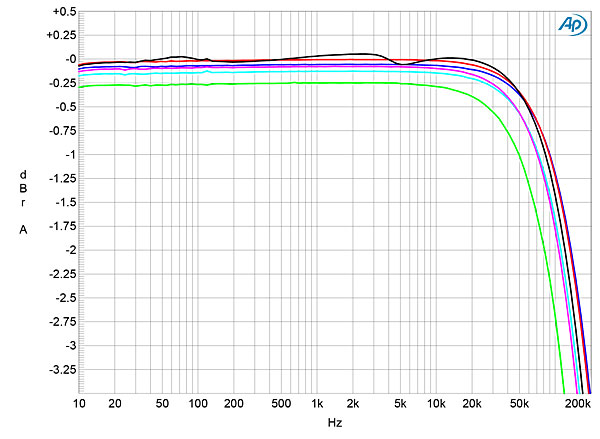
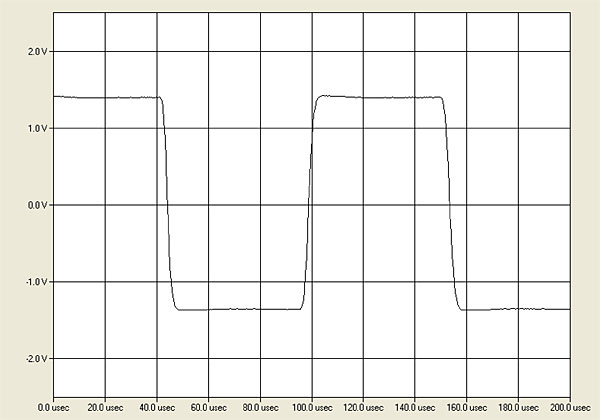
The XA25's unbalanced input impedance was the specified 47k ohms at low and middle frequencies, dropping inconsequentially to 34k ohms at the top of the audioband. The output impedance (including 6' of speaker cable) was low, at 0.08 ohm at 20Hz and 1kHz, rising very slightly to 0.1 ohm at 20kHz. As a result, the variation in frequency response into our standard simulated loudspeaker was small: less than ±0.1dB (fig.1, gray trace). Fig.1 shows that the XA25's frequency response is wide, with a –3dB point at almost 200kHz. The amplifier's reproduction of a 10kHz squarewave therefore has very short risetimes (fig.2), and there is no overshoot or ringing.
 Overall, the XA25 performed well on the test bench, as I've come to expect from Pass Labs.—John Atkinson
Fig.1 Pass Labs XA25, frequency response at 2.83V into: simulated loudspeaker load (gray), 8 ohms (left channel blue, right red), 4 ohms (left cyan, right magenta), 2 ohms (green) (0.5dB/vertical div.).
Fig.2 Pass Labs XA25, small-signal, 10kHz squarewave into 8 ohms.
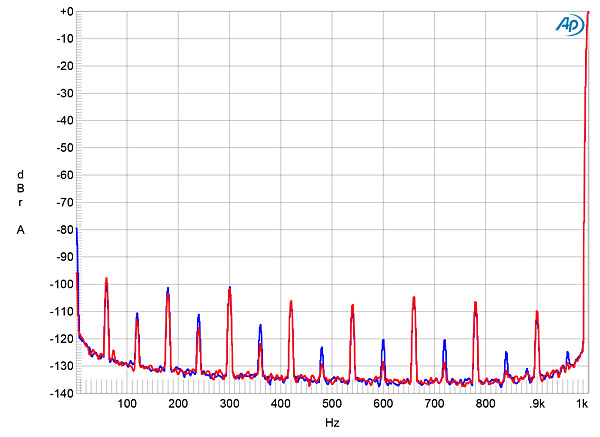
Channel separation (not shown) was >90dB in both directions below 3kHz, decreasing to 76dB at 20kHz, and with its lower-than-usual gain, the XA25's unweighted, wideband signal/noise ratios were correspondingly superb, at 91.2dB left and 88.4dB right. Both ratios increased to 94.6dB when the measurement bandwidth was restricted to the audioband, and to 97.3dB when A-weighted. Fig.3 reveals that the primary source of noise is spuriae at the AC wall frequency of 60Hz and its odd-order harmonics, these presumably due to magnetic interference from the power transformer.
Fig.3 Pass Labs XA25, spectrum of 1kHz sinewave, DC–1kHz, at 1W into 8 ohms (linear frequency scale).
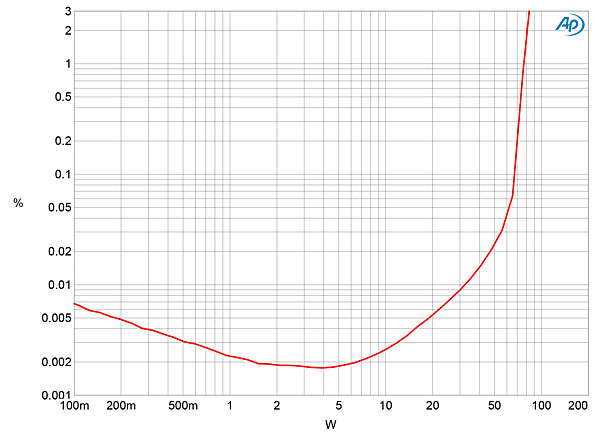
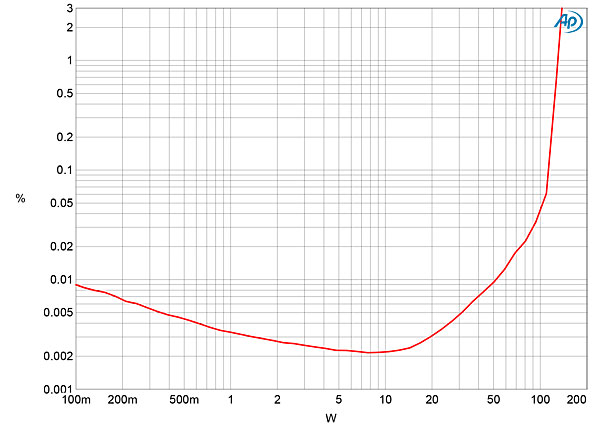
Pass Labs specifies the XA25's output power as 25Wpc into 8 ohms and 50Wpc into 4 ohms (both equivalent to 14dBW). However, as you can see in figs. 4 and 5, the amplifier exceeded its specified power output at the clipping point, which we define as when the THD+noise equals 1%. At that THD+N percentage the XA25 delivered 80Wpc into 8 ohms (19dBW) and 130Wpc into 4 ohms (18.1dBW). It appears from the shape of the traces in these graphs that Pass specifies the XA25's power as when the THD+N is close to 0.01%.
Fig.4 Pass Labs XA25, distortion (%) vs 1kHz continuous output power into 8 ohms.
Fig.5 Pass Labs XA25, distortion (%) vs 1kHz continuous output power into 4 ohms.
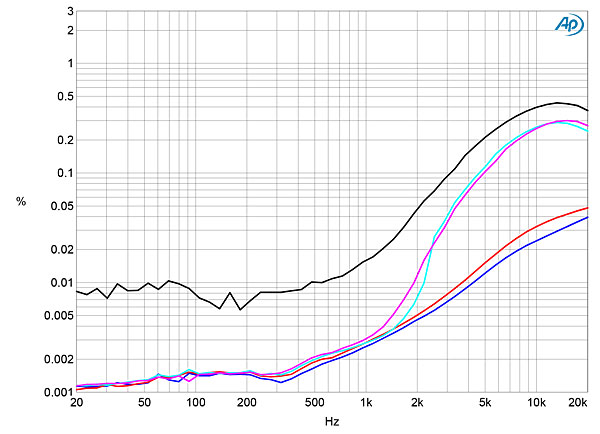
At moderate powers the XA25 offered low levels of distortion, but as you can see in fig.6, which plots the THD+N percentage against frequency at 8.9V—equivalent to 10W into 8 ohms, 20W into 4 ohms, and 40W into 2 ohms—the distortion did rise at higher frequencies, especially into lower impedances. This graph suggests that the XA25 not be used with loudspeakers with an impedance that drops below 4 ohms in the treble.
Fig.6 Pass Labs XA25, THD+N (%) vs frequency at 8.9V into: 8 ohms (left channel blue, right red), 4 ohms (left cyan, right magenta), 2 ohms (left gray).
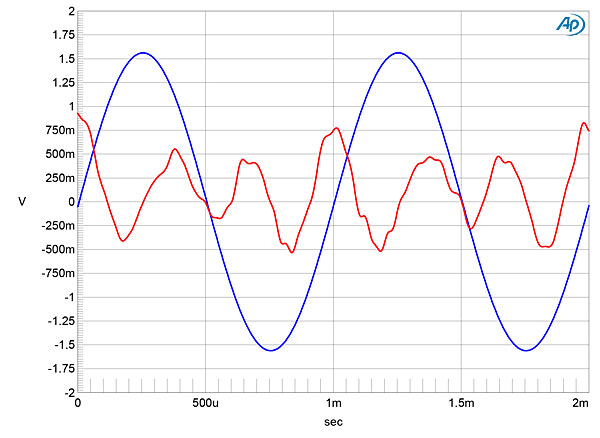
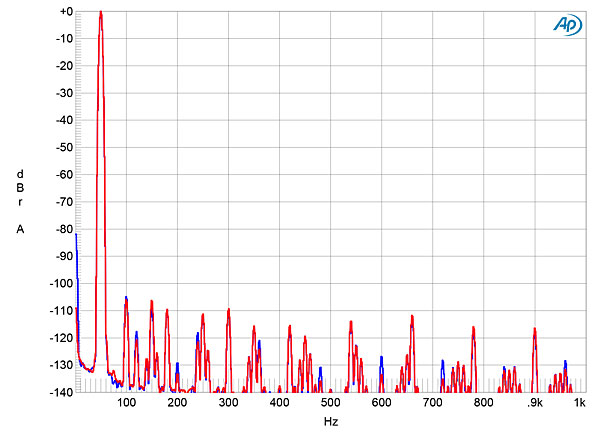
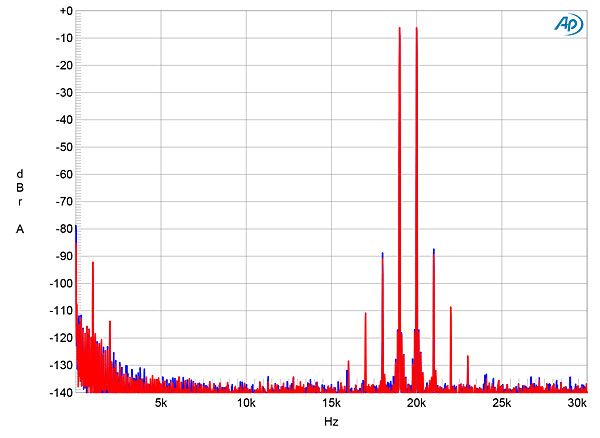
Fortunately, the distortion in the midrange was predominantly the relatively innocuous third harmonic (fig.7), though at low frequencies the second harmonic was equal in level to the third (fig.8). But note the very low level of all distortion harmonics in this graph! Nelson Pass had warned me that measuring the XA25's intermodulation distortion with my usual twin-tone test signal would be problematic: "The bias circuit we are using interprets continuous high-power, high-frequency tones as a fault. If you want to do high-power, high-frequency IM test tones, you will need to do them quickly or you will get falsely high readings." In my spectral analyses, I usually average 32 readings to ensure that the distortion products are not obscured by noise; for the XA25 I averaged just four readings, not turning on the test signal until I was ready to take the reading. At a moderate power level into 8 ohms, the intermodulation distortion was very low (fig.9), the IM products all lying close to –90dB ref. the peak signal level. When I tried to repeat this test into 4 ohms, the amplifier's protection circuit kicked in as soon as I turned on the signal generator.
Fig.7 Pass Labs XA25, 1kHz waveform at 10W into 8 ohms, 0.0027% THD+N (blue); distortion and noise waveform with fundamental notched out (red, not to scale).
Fig.8 Pass Labs XA25, spectrum of 50Hz sinewave, DC–1kHz, at 20W into 4 ohms (linear frequency scale).
Fig.9 Pass Labs XA25, HF intermodulation spectrum, DC–30kHz, 19+20kHz at 10W peak into 8 ohms (linear frequency scale).