Stereophile's enduringly healthy circulation suggests widespread support for the multiplicity of voices in our pages, and virtually every month that notion is confirmed by letters from our readers. Most of our reviewers have their fans and their detractors, and although it's been a long time since I've seen a letter demanding the head of this or that reviewer, we still occasionally hear from readers who want us to know they trust Herb or John or me or Mikey or Kal or someone else above all others.
Because the quest for wisdom is not a zero-sum game, it's possible for Stereophile to print, in a single issue, a review by Jason Victor Serinus (who relies exclusively on digital sources) alongside a review by me (who relies primarily on analog sources) without having to worry they'll cancel each other out, like those old married couples who vote for different political parties. Indeed, although it's always nice when someone writes in to say they agree with an opinion we've published, nothing makes me happier than letters from readers who declare their fondness for Stereophile writers with whom they disagree, or whose tastes in music or gear they find repellent. And, with apologies for what seems like boasting, we get letters like that all the time.
Look at it this way: Online and in print, Stereophile has a large readership. When someone writes in and says they never read my column, I don't put slightly less work—that reader's share—into the next one. Tempting though that may be. People who harbor a dislike of flutes tend not to avoid orchestral music because of it. At least the rational ones don't.
Does that mean Stereophile is willing to publish any old bullshit? Not at all. We make a living by gathering, packaging, and selling opinions, and we—the editorial we—have another overarching point of view: You deserve not to be insulted. So we're not going to give voice to people who would have you believe there's no difference between the sound of a battery-powered IC and a well-designed amplifier made from discrete parts. And at the same time, we're not going to tell you that putting a photograph of Pope Francis in your freezer will make your hi-fi sound better. Which is actually more like batshit.
Who gets to decide what is and is not bullshit? We do. Just as Supreme Court justices are paid to know pornography and hate speech when they see it, Jim and John and I are paid to know antimusic, antiscience, antiaudiophile nonsense when we see it. And we welcome your comments on how we might up our game, if and when need be. But I warn you: Speaking only for myself, there is one more type of bullshit, in addition to the ones listed above, that I refuse to abide, and that is anti-fun bullshit, as practiced by pedantic, unimaginative killjoys, and which is actually more like pigshit. If you want a magazine from which all wonder, joy, angst, love, awe, frustration, and fun have been leached, and in which the writing voices—not to mention the opinions—of all the contributors are indistinguishable from one another, then Stereophile is not your bitch. Trust me, you'll have no trouble finding other English-language magazines, albeit small-circulation ones, in which it is impossible to tell one writer from the other.
Social lubricant
Identifying various types of barnyard ordure isn't our only job. The number one job of any editor is a tie between making sure we're telling readers things in which most of them are interested, and telling things that are true.
With regard to the first of those, a good editor and a good teacher have one thing in common: They are both skilled at discerning what it is their audience is ignorant of but needs to know, and then taking responsibility for presenting that information with the utmost clarity and thoroughness, preferably in an entertaining and memorable fashion.
 I have worked as a teacher and I have worked as an editor. And I am here to tell you, not only are half the people in those professions utter failures, but more than half don't even understand those most fundamental of their job requirements. In education, most practitioners are interested only in encouraging their charges to express their innermost feelings in as self-centered a fashion as possible—that and "leading them to learning" or some such dewy-eyed nonsense. Actual teaching, as a skill, is all but extinct. The world of editing is even worse off—present company obviously excepted. But that's a rant for another day.
As for our responsibility to tell the truth, that simple directive doesn't go far enough: We must convey the whole truth of the matter—the latter a concern that leads us, from time to time, to the sorts of experiences I describe in my review of the Rethm Maarga loudspeaker, elsewhere in this issue.
Our next-most important responsibility: When telling stories that have been given to us by someone else—usually a manufacturer or a distributor or a retailer—as opposed to stories that originate with us, we must make sure we are telling them right. That requires the right blend of letting the teller say what they have to say—quote them accurately, don't stifle them—with healthy skepticism as required. We can't get so wrapped up in a good yarn that we do not, from time to time, say something like "Are you sure you had time to stop and help a little old lady across the street between cleaning those stables and holding the world on your shoulders?" Or, "Precisely how do you know that that footer of yours turns vibrations into heat? Have you measured it?"
And finally: When an editor gets something essentially, profoundly, crazily wrong —and believe me, just like accountants and carpenters and wedding photographers and nurses and surveyors and clergy and baristas and teachers and bus drivers and captains of industry, we editors fuck up from time to time —it's usually because we didn't apply due diligence to one of those maxims. This weighs on me because in recent months I have been guilty of a lack of skepticism —this in my September 2019 column about an expensive replacement bearing for the Garrard 301, called the Buddha Bearing, in which I wrote: Unless they've been holed up in a storage unit somewhere, perfect-condition [original] Garrard bearings no longer exist, and common sense dictates that samples still in use are compromised by both the wear they have undergone and the practical limitations of the machine tools in use at the time of their manufacture.
Although neither the manufacturer nor its distributor suggested I should write any such thing, I got carried away with my enthusiasm for the new bearing and, well, extemporized. But in time, it occurred to me that my statement was haunted, Turn of the Screw–like, by the one thing that never made an appearance in my text: the word probably. Fact is, without at least making some effort to measure the presumed wear in my original Garrard grease bearing, I had no business suggesting an excess of such wear existed in my own bearing.
Good Catholic that I am, I was overcome with guilt, and my guilt compelled me to disassemble, clean, and reassemble the old bearing and see if I could detect any play—both the least I could do and, in this case, all I could do, since I lack the dial calipers and jigs needed to quantify my findings. This I did, and I'm here to tell you: I detected no play whatsoever.
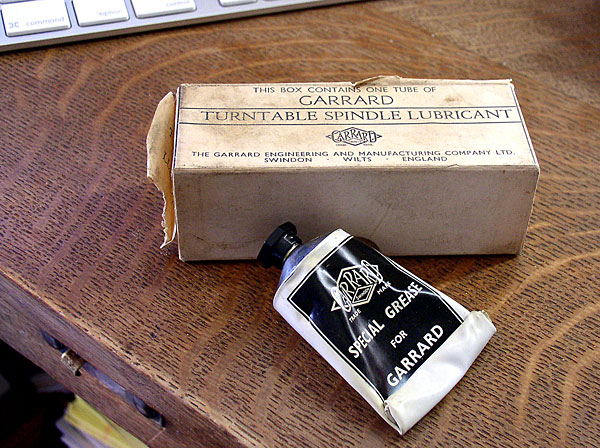
There's a happy ending: Having now reassembled my old grease bearing and found it good, I decided to fill it with grease and return it to at least occasional duty. But I no longer had faith in the integrity of my tube of Garrard bearing grease, which was originally supplied with my 301: Bearings may not always exhibit drastic wear, but petroleum products do break down over time—and hell, that grease is more or less as old as I am. Luckily, at around the same time, I received a very kind note from reader and fellow Garrard owner Al Simon, who advised me to try a product called Phil Wood Waterproof Grease, which he uses on his own 1956 grease-bearing 301. As Simon wrote, the Phil Wood grease, which is designed for use with the company's own high-performance bicycle bearings, is "not too thick and not too thin: It's a 'Goldilocks' product. I've been using it in my 301 for close to three years with superb results. When properly applied it allows the strobe speed of my deck to be set just about in the center of the scale day in and day out during all four seasons in the calendar."
I ordered a 3oz tube of Phil Wood Waterproof Grease —it's available from philwood.com for $11.55, plus tax and shipping —which turns out to be green (in color as opposed to techno-karma, although for all I know the latter is true as well). It's also a lot thicker than the stuff I had in there before, making it rather more difficult to apply. (The grease fitting that allows the user to replenish the well's supply of grease is also now more difficult to turn.) Having now been (self-)chastened for an excess of enthusiasm, and having absolutely zero interest in conducting a bearing-grease shootout either now or at any time in the future, I will limit my comments to: With the Phil Wood grease, my bearing functions properly and shows no signs of overheating—and my 301 sounds magnificent.
I have worked as a teacher and I have worked as an editor. And I am here to tell you, not only are half the people in those professions utter failures, but more than half don't even understand those most fundamental of their job requirements. In education, most practitioners are interested only in encouraging their charges to express their innermost feelings in as self-centered a fashion as possible—that and "leading them to learning" or some such dewy-eyed nonsense. Actual teaching, as a skill, is all but extinct. The world of editing is even worse off—present company obviously excepted. But that's a rant for another day.
As for our responsibility to tell the truth, that simple directive doesn't go far enough: We must convey the whole truth of the matter—the latter a concern that leads us, from time to time, to the sorts of experiences I describe in my review of the Rethm Maarga loudspeaker, elsewhere in this issue.
Our next-most important responsibility: When telling stories that have been given to us by someone else—usually a manufacturer or a distributor or a retailer—as opposed to stories that originate with us, we must make sure we are telling them right. That requires the right blend of letting the teller say what they have to say—quote them accurately, don't stifle them—with healthy skepticism as required. We can't get so wrapped up in a good yarn that we do not, from time to time, say something like "Are you sure you had time to stop and help a little old lady across the street between cleaning those stables and holding the world on your shoulders?" Or, "Precisely how do you know that that footer of yours turns vibrations into heat? Have you measured it?"
And finally: When an editor gets something essentially, profoundly, crazily wrong —and believe me, just like accountants and carpenters and wedding photographers and nurses and surveyors and clergy and baristas and teachers and bus drivers and captains of industry, we editors fuck up from time to time —it's usually because we didn't apply due diligence to one of those maxims. This weighs on me because in recent months I have been guilty of a lack of skepticism —this in my September 2019 column about an expensive replacement bearing for the Garrard 301, called the Buddha Bearing, in which I wrote: Unless they've been holed up in a storage unit somewhere, perfect-condition [original] Garrard bearings no longer exist, and common sense dictates that samples still in use are compromised by both the wear they have undergone and the practical limitations of the machine tools in use at the time of their manufacture.
Although neither the manufacturer nor its distributor suggested I should write any such thing, I got carried away with my enthusiasm for the new bearing and, well, extemporized. But in time, it occurred to me that my statement was haunted, Turn of the Screw–like, by the one thing that never made an appearance in my text: the word probably. Fact is, without at least making some effort to measure the presumed wear in my original Garrard grease bearing, I had no business suggesting an excess of such wear existed in my own bearing.
Good Catholic that I am, I was overcome with guilt, and my guilt compelled me to disassemble, clean, and reassemble the old bearing and see if I could detect any play—both the least I could do and, in this case, all I could do, since I lack the dial calipers and jigs needed to quantify my findings. This I did, and I'm here to tell you: I detected no play whatsoever.
There's a happy ending: Having now reassembled my old grease bearing and found it good, I decided to fill it with grease and return it to at least occasional duty. But I no longer had faith in the integrity of my tube of Garrard bearing grease, which was originally supplied with my 301: Bearings may not always exhibit drastic wear, but petroleum products do break down over time—and hell, that grease is more or less as old as I am. Luckily, at around the same time, I received a very kind note from reader and fellow Garrard owner Al Simon, who advised me to try a product called Phil Wood Waterproof Grease, which he uses on his own 1956 grease-bearing 301. As Simon wrote, the Phil Wood grease, which is designed for use with the company's own high-performance bicycle bearings, is "not too thick and not too thin: It's a 'Goldilocks' product. I've been using it in my 301 for close to three years with superb results. When properly applied it allows the strobe speed of my deck to be set just about in the center of the scale day in and day out during all four seasons in the calendar."
I ordered a 3oz tube of Phil Wood Waterproof Grease —it's available from philwood.com for $11.55, plus tax and shipping —which turns out to be green (in color as opposed to techno-karma, although for all I know the latter is true as well). It's also a lot thicker than the stuff I had in there before, making it rather more difficult to apply. (The grease fitting that allows the user to replenish the well's supply of grease is also now more difficult to turn.) Having now been (self-)chastened for an excess of enthusiasm, and having absolutely zero interest in conducting a bearing-grease shootout either now or at any time in the future, I will limit my comments to: With the Phil Wood grease, my bearing functions properly and shows no signs of overheating—and my 301 sounds magnificent.
Identifying various types of barnyard ordure isn't our only job. The number one job of any editor is a tie between making sure we're telling readers things in which most of them are interested, and telling things that are true.
I have worked as a teacher and I have worked as an editor. And I am here to tell you, not only are half the people in those professions utter failures, but more than half don't even understand those most fundamental of their job requirements. In education, most practitioners are interested only in encouraging their charges to express their innermost feelings in as self-centered a fashion as possible—that and "leading them to learning" or some such dewy-eyed nonsense. Actual teaching, as a skill, is all but extinct. The world of editing is even worse off—present company obviously excepted. But that's a rant for another day.
As for our responsibility to tell the truth, that simple directive doesn't go far enough: We must convey the whole truth of the matter—the latter a concern that leads us, from time to time, to the sorts of experiences I describe in my review of the Rethm Maarga loudspeaker, elsewhere in this issue.