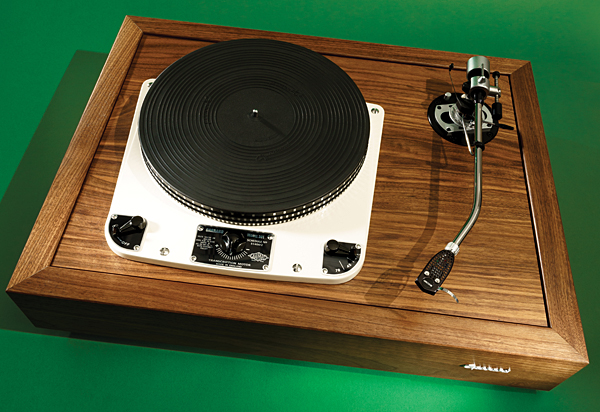
The 301 fastens to the plinth with four bolts that pass down through its cast-aluminum chassis; the chassis is isolated from the plinth with thick, pliant washers, both above and below the wooden slab—here is the explanation why, in all the photos we've seen of the new 301, there appears to be a slight gap between the motor unit and the top surface of the plinth—and the bolts are secured from beneath with thicker-than-average nuts, just as I've seen on most original Garrards. I wasn't surprised to note that those nuts were scarcely more than finger tight, given my own observations that the 301 sounds much better when those and other of its fasteners are not over-torqued. I was mildly surprised not to see threaded inserts embedded in the plinth—such as I would have built into the homemade plinth for my own 301, had I the means (not to mention the skill) to lay them out with the requisite precision. Perhaps SME feels there's a sonic advantage to doing things their way.
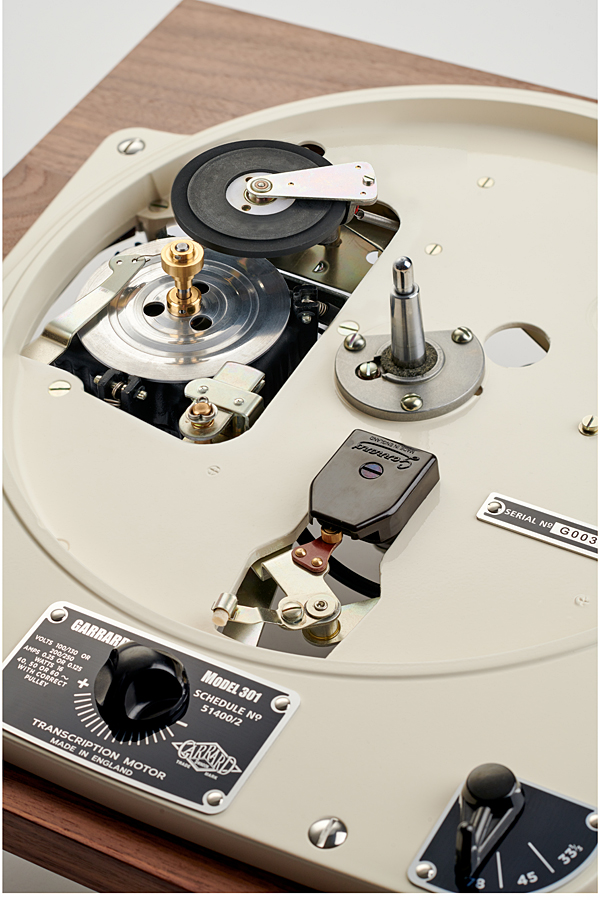
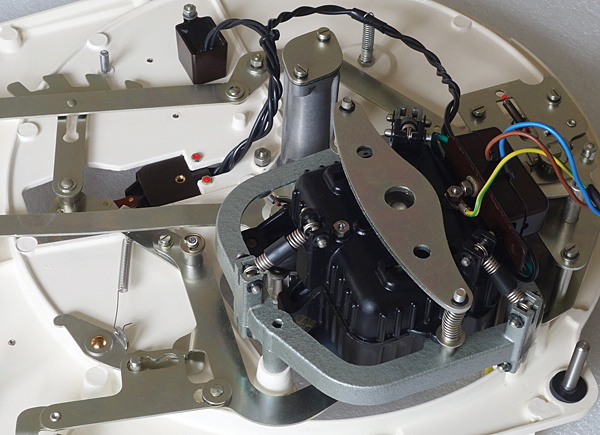 With the new motor unit freed from its surroundings, I noted a number of details of interest to hardcore 301 fanatics and restorers. Although SME claims that the motors in all of their new 301s have been rebuilt to original specs—the motor in my review sample appeared even stronger than that in my own Garrard, so I'm certain that's true—I was surprised to see that the retainer plate for the motor's lower bearing was reinstalled with rivets rather than by tapping the housing for a new set of miniature bolts. (Upon disassembly for servicing, the original rivets must be drilled out.) The motor unit's below-deck switch wiring was isolated from the underside of the chassis by a purpose-made spring. (On virtually every old 301 I've seen, this element has been in such poor condition that the original intent is hard to divine.)
As on the originals, the wiring housing that's bolted to the motor—within are the links that allow switching between 120V and 240V operation—was made of Bakelite: God's own favorite thermoplastic. A thick felt washer, something that wants a drop of oil every now and then, was in place at the rim of the platter-bearing well.
With the new motor unit freed from its surroundings, I noted a number of details of interest to hardcore 301 fanatics and restorers. Although SME claims that the motors in all of their new 301s have been rebuilt to original specs—the motor in my review sample appeared even stronger than that in my own Garrard, so I'm certain that's true—I was surprised to see that the retainer plate for the motor's lower bearing was reinstalled with rivets rather than by tapping the housing for a new set of miniature bolts. (Upon disassembly for servicing, the original rivets must be drilled out.) The motor unit's below-deck switch wiring was isolated from the underside of the chassis by a purpose-made spring. (On virtually every old 301 I've seen, this element has been in such poor condition that the original intent is hard to divine.)
As on the originals, the wiring housing that's bolted to the motor—within are the links that allow switching between 120V and 240V operation—was made of Bakelite: God's own favorite thermoplastic. A thick felt washer, something that wants a drop of oil every now and then, was in place at the rim of the platter-bearing well.
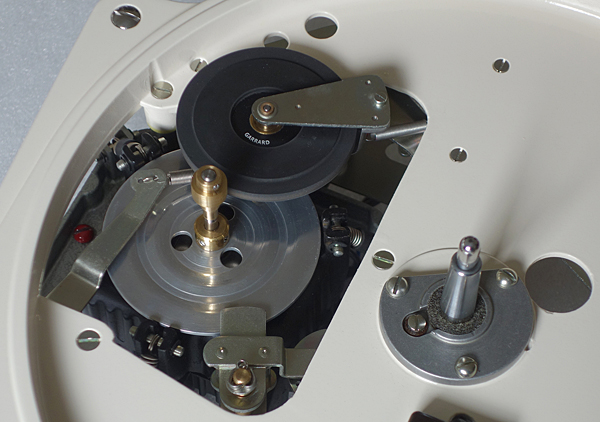 There were also a couple of details I couldn't see, and which Ajay Shirke kindly chased down for me: The platter bearing's thrust pad, which I believe is made of sintered bronze, is flat rather than domed, and the bearing spindle's taper, where it meets the bore or the platter, is 2.2 degrees; I believe both specs are characteristic of stock, post-1957 Garrard 301s. (I was once told that the latter specification changed with the introduction of the Garrard 401, but the source was someone whose expertise I have, in recent months, come to question.)
A few observations are in order regarding the newly manufactured (if not newly designed) SME M2-12R tonearm. Its design is outwardly similar to that of various vintage SMEs. The M2-12R, though, is built with precision-made ball-and-race bearings rather than the knife-edge bearings of yore. I was surprised to learn that this arm has been in production since 2008; during a recent visit to my home, Technical Editor John Atkinson expressed the same degree of surprise. John assumed, as I did, that the M2-12R was a recently introduced vintage reissue, not unlike the 301 itself. The ability to keep secrets is in many ways an admirable quality, but I can't quite fathom why SME has not spent the last 11 years crowing about this well-made and evidently fairly priced product—especially in light of the recent success accorded various vintage-vibe transcription-length tonearms from Schick, EMT, et al.
The M2-12R incorporates a J-shaped armtube made from thin-walled (0.010") stainless-steel tubing. It has a detachable headshell that uses the pin layout SME pioneered decades ago, which hobbyists now refer to as the international pattern, and a two-piece tungsten counterweight. Like virtually all its stablemates in the SME line, the M2-12R is eminently adjustable: The user can easily alter spindle-to-pivot distance (and thus lateral tracking angle) and arm height (and thus vertical tracking angle). With only slightly more effort, the user can adjust cartridge azimuth. (Adjusting azimuth requires applying a small screwdriver, not supplied, to a miniature screw on the underside of the armtube.) A falling-weight antiskating system is supplied for those who feel such a thing is necessary. (Given that most of my preferred cartridges track at downforces higher than 3gm, I don't consider this necessary, but your mileage may vary.) Perhaps most impressive of all is the calibration of the arm's downforce mechanics: When set for 4gm, my review loaner provided precisely 4gm.
There were also a couple of details I couldn't see, and which Ajay Shirke kindly chased down for me: The platter bearing's thrust pad, which I believe is made of sintered bronze, is flat rather than domed, and the bearing spindle's taper, where it meets the bore or the platter, is 2.2 degrees; I believe both specs are characteristic of stock, post-1957 Garrard 301s. (I was once told that the latter specification changed with the introduction of the Garrard 401, but the source was someone whose expertise I have, in recent months, come to question.)
A few observations are in order regarding the newly manufactured (if not newly designed) SME M2-12R tonearm. Its design is outwardly similar to that of various vintage SMEs. The M2-12R, though, is built with precision-made ball-and-race bearings rather than the knife-edge bearings of yore. I was surprised to learn that this arm has been in production since 2008; during a recent visit to my home, Technical Editor John Atkinson expressed the same degree of surprise. John assumed, as I did, that the M2-12R was a recently introduced vintage reissue, not unlike the 301 itself. The ability to keep secrets is in many ways an admirable quality, but I can't quite fathom why SME has not spent the last 11 years crowing about this well-made and evidently fairly priced product—especially in light of the recent success accorded various vintage-vibe transcription-length tonearms from Schick, EMT, et al.
The M2-12R incorporates a J-shaped armtube made from thin-walled (0.010") stainless-steel tubing. It has a detachable headshell that uses the pin layout SME pioneered decades ago, which hobbyists now refer to as the international pattern, and a two-piece tungsten counterweight. Like virtually all its stablemates in the SME line, the M2-12R is eminently adjustable: The user can easily alter spindle-to-pivot distance (and thus lateral tracking angle) and arm height (and thus vertical tracking angle). With only slightly more effort, the user can adjust cartridge azimuth. (Adjusting azimuth requires applying a small screwdriver, not supplied, to a miniature screw on the underside of the armtube.) A falling-weight antiskating system is supplied for those who feel such a thing is necessary. (Given that most of my preferred cartridges track at downforces higher than 3gm, I don't consider this necessary, but your mileage may vary.) Perhaps most impressive of all is the calibration of the arm's downforce mechanics: When set for 4gm, my review loaner provided precisely 4gm.
 A casual appraisal of the arm's bearing quality revealed a commendable lack of play and a no-less-praiseworthy lack of friction, combined with a rare sense of poise, for want of a better word: In its movements, the arm behaved as though it were naturally well-damped—naturally, that is, in contrast to those systems that require the messy, environmentally unsound, and altogether silly solution of freighting the armtube with a paddle that's dragged through a trough of silicone goop; I'm damned if I can understand why anyone would consider such a thing elegant or even good engineering. But never mind that: The point is, during my testing, the M2-12R armtube always moved without resistance, yet remained poised and unperturbed in even the most daunting grooves.
How I made my list
A casual appraisal of the arm's bearing quality revealed a commendable lack of play and a no-less-praiseworthy lack of friction, combined with a rare sense of poise, for want of a better word: In its movements, the arm behaved as though it were naturally well-damped—naturally, that is, in contrast to those systems that require the messy, environmentally unsound, and altogether silly solution of freighting the armtube with a paddle that's dragged through a trough of silicone goop; I'm damned if I can understand why anyone would consider such a thing elegant or even good engineering. But never mind that: The point is, during my testing, the M2-12R armtube always moved without resistance, yet remained poised and unperturbed in even the most daunting grooves.
How I made my list
Unfortunately, I was prevented from testing just the new 301—which is to say, I couldn't substitute it for my original 301, in my plinth and with my reference EMT 997 tonearm—by the above-mentioned wire link for the AC motor: Its plug wouldn't fit through the AC-cord channel on my home-made plinth, and in any event I lacked the corresponding socket required to make the connection. And I wasn't comfortable changing out the wiring within, or otherwise modifying, the review loaner: I'm funny that way. So my listening tests are based on my use of the Garrard 301 package as supplied. Vladimir Horowitz's 1960 recording of Beethoven's F minor piano sonata, "Appasionata" (RCA LSC-2366), was the first record I tried—only because it was out of its jacket, having only recently been bought and washed and then played on my own 301. I can't say it's a bad record: The recording quality is pretty good, if slightly bereft of bottom-end power compared to the best piano recordings of the day (ie, Decca's), and apart from some passages in which Horowitz sacrifices artistry in favor of bored-sounding displays of technical virtuosity, the performance is often riveting.
My own 301, in its homemade stacked-plywood plinth, mated with my EMT 997 tonearm and the lingering review sample of Ortofon's remarkable SPU Century pickup head, sounded amazing. The new 301, in its own plinth and with the SME M2-12R arm—to which I transferred the SPU—sounded even better: The new 301 delivered even more of the qualities that have earned my loyalty to that model, especially its relentless sense of musical momentum and drive and its success in conveying the sheer physicality of the forces exerted by musicians in the playing of their instruments. This wasn't the pallid, smeary tinkle that consigns most piano playback to background-music status—this was physical, palpable, and undeniably human pianism. Additionally (and remarkably) the new turntable allowed longer, fuller, and more relaxed note sustains—"relaxed" inasmuch as each note rang out more clearly, yet with no tomfoolery of pitch.
 On the 1964 recording of Benjamin Britten's Serenade for Tenor, Horn and Strings, performed by Peter Pears, Barry Tuckwell, and members of the London Symphony Orchestra, conducted by the composer (Decca SXL 6110), Tuckwell's solo horn in the introduction sounded more whole than via my own 301, with not only surer pitch but also surer meaning: This phrase, with its stark setting and its odd, unexpected sharps, took on more of the qualities of a musical statement rather than just a string of notes.
And perhaps best of all, on that same recording, pizzicato strings had tremendous force and physicality. While noting that I've never had in my system any of the classic and long-extinct EMT turntables that are also praised for those qualities, in my experience, no other motor unit equals a Garrard 301/401 at allowing plucked strings to sound plucked—not even close—and this new sample was the best I've heard so far. By no means did the SME-produced 301 kick my own player to the curb in this or any other regard: There were more similarities than differences between the two players in those and other regards—tonal balance, transparency/lack of noise, extension at the frequency extreme, spatial performance. Even with a plinth and tonearm that were new to me, the new 301 sounded like a 301—which is a very good thing indeed—albeit one with still more punch.
With record after record, the new 301 package presented a sound that was without obvious tonal colorations, wide in frequency range, wide in dynamic range, superb at recovering subtle recorded details, and spatially big, and played music with all of the traditional Garrard 301 strengths—drive, impact, crazily convincing musical momentum—and then some. It was every inch a Garrard 301, and indeed was the best, most effective sample of it that I've ever had in my home.
The last special
On the 1964 recording of Benjamin Britten's Serenade for Tenor, Horn and Strings, performed by Peter Pears, Barry Tuckwell, and members of the London Symphony Orchestra, conducted by the composer (Decca SXL 6110), Tuckwell's solo horn in the introduction sounded more whole than via my own 301, with not only surer pitch but also surer meaning: This phrase, with its stark setting and its odd, unexpected sharps, took on more of the qualities of a musical statement rather than just a string of notes.
And perhaps best of all, on that same recording, pizzicato strings had tremendous force and physicality. While noting that I've never had in my system any of the classic and long-extinct EMT turntables that are also praised for those qualities, in my experience, no other motor unit equals a Garrard 301/401 at allowing plucked strings to sound plucked—not even close—and this new sample was the best I've heard so far. By no means did the SME-produced 301 kick my own player to the curb in this or any other regard: There were more similarities than differences between the two players in those and other regards—tonal balance, transparency/lack of noise, extension at the frequency extreme, spatial performance. Even with a plinth and tonearm that were new to me, the new 301 sounded like a 301—which is a very good thing indeed—albeit one with still more punch.
With record after record, the new 301 package presented a sound that was without obvious tonal colorations, wide in frequency range, wide in dynamic range, superb at recovering subtle recorded details, and spatially big, and played music with all of the traditional Garrard 301 strengths—drive, impact, crazily convincing musical momentum—and then some. It was every inch a Garrard 301, and indeed was the best, most effective sample of it that I've ever had in my home.
The last special
That's the good news. Now for a bit of disappointing news: The new Garrard 301, with SME M2-12R tonearm and custom plinth, carries a retail price of $23,500, freight additional. By comparison, secondhand original-issue 301s are routinely available for between $2000 and $3000, with full rebuild services ranging between $500 and $1500. Plinth prices are all over the map, from $400 to $4000 and beyond. Judged on the basis of complexity of construction and luxuriousness of finish, SME's new plinth has some very serious competition from the likes of Woodsong Audio, Artisan Fidelity, LignoLab, and others. And while I've no doubt that its custom-made Crystal Cable signal link is an expensive item, this new one is by no means a five-figure plinth, or anything even remotely close. For its part, the SME M2-12R tonearm strikes me as a quite decent value at $3100: It's a well-engineered, well-finished product. As to whether the rest of this package is worth $20,400, I can't answer as swiftly or as surely.
It seems to me the greatest thing the new Garrard has going for it is ease: not just its sense of ease and imperturbability when reproducing music's most climatic storms, but ease of ownership. Speaking only for myself, if I were a retailer whose business it was to sell gear that I believed in, by now I would be damn sick and tired of saying to prospective buyers, "If you want the most involving LP playback experience, go find yourself an old 301 and take it someplace for a rebuild and a smart new plinth": I'd be telling the truth, as I see it, but I'd also be denying myself the profits I might need to stay in business.
If I were that dealer, I'd love to be able to offer something like the new 301 package. But according to Ajay Shirke, it's available only factory direct. That said, the new 301 is covered by a two-year warranty, and Shirke says that in every market a service advisor will be available for installation help and after-sales consulting.
At one end of the spectrum lies the not-unreasonable, not-ignoble optimism that, thanks to the efforts of concerned scientists, the woolly mammoth is coming back. At the other end lies the reality that, when it happens, each one will cost millions to make, thus limiting their distribution to the private zoos of the ultrawealthy. That doesn't mean the thing shouldn't be done, but it does mean that that spectrum will never shrink in size: The outcome doesn't quite match the ideal, no matter how hard we pretend.
This is a bit like that.
Garrard is back. The new owners have not only bought the name but have also earned the right to use it (from here on there'll be no more SME this and Cadence Group that when writing about the contemporary 301), and their flagship product is as heroically good as I'd hoped. I wish it were also as affordable as I'd presumed it might be. Apart from the fact that I could never afford such a thing, I suppose my disappointment has something to do with nostalgia—in this case, for a time when well-engineered, high-quality products were the norm, not luxury goods—but there's nothing nostalgic about my belief in the rightness of this product.
With the new motor unit freed from its surroundings, I noted a number of details of interest to hardcore 301 fanatics and restorers. Although SME claims that the motors in all of their new 301s have been rebuilt to original specs—the motor in my review sample appeared even stronger than that in my own Garrard, so I'm certain that's true—I was surprised to see that the retainer plate for the motor's lower bearing was reinstalled with rivets rather than by tapping the housing for a new set of miniature bolts. (Upon disassembly for servicing, the original rivets must be drilled out.) The motor unit's below-deck switch wiring was isolated from the underside of the chassis by a purpose-made spring. (On virtually every old 301 I've seen, this element has been in such poor condition that the original intent is hard to divine.)
As on the originals, the wiring housing that's bolted to the motor—within are the links that allow switching between 120V and 240V operation—was made of Bakelite: God's own favorite thermoplastic. A thick felt washer, something that wants a drop of oil every now and then, was in place at the rim of the platter-bearing well.
There were also a couple of details I couldn't see, and which Ajay Shirke kindly chased down for me: The platter bearing's thrust pad, which I believe is made of sintered bronze, is flat rather than domed, and the bearing spindle's taper, where it meets the bore or the platter, is 2.2 degrees; I believe both specs are characteristic of stock, post-1957 Garrard 301s. (I was once told that the latter specification changed with the introduction of the Garrard 401, but the source was someone whose expertise I have, in recent months, come to question.)
A few observations are in order regarding the newly manufactured (if not newly designed) SME M2-12R tonearm. Its design is outwardly similar to that of various vintage SMEs. The M2-12R, though, is built with precision-made ball-and-race bearings rather than the knife-edge bearings of yore. I was surprised to learn that this arm has been in production since 2008; during a recent visit to my home, Technical Editor John Atkinson expressed the same degree of surprise. John assumed, as I did, that the M2-12R was a recently introduced vintage reissue, not unlike the 301 itself. The ability to keep secrets is in many ways an admirable quality, but I can't quite fathom why SME has not spent the last 11 years crowing about this well-made and evidently fairly priced product—especially in light of the recent success accorded various vintage-vibe transcription-length tonearms from Schick, EMT, et al.
The M2-12R incorporates a J-shaped armtube made from thin-walled (0.010") stainless-steel tubing. It has a detachable headshell that uses the pin layout SME pioneered decades ago, which hobbyists now refer to as the international pattern, and a two-piece tungsten counterweight. Like virtually all its stablemates in the SME line, the M2-12R is eminently adjustable: The user can easily alter spindle-to-pivot distance (and thus lateral tracking angle) and arm height (and thus vertical tracking angle). With only slightly more effort, the user can adjust cartridge azimuth. (Adjusting azimuth requires applying a small screwdriver, not supplied, to a miniature screw on the underside of the armtube.) A falling-weight antiskating system is supplied for those who feel such a thing is necessary. (Given that most of my preferred cartridges track at downforces higher than 3gm, I don't consider this necessary, but your mileage may vary.) Perhaps most impressive of all is the calibration of the arm's downforce mechanics: When set for 4gm, my review loaner provided precisely 4gm.
A casual appraisal of the arm's bearing quality revealed a commendable lack of play and a no-less-praiseworthy lack of friction, combined with a rare sense of poise, for want of a better word: In its movements, the arm behaved as though it were naturally well-damped—naturally, that is, in contrast to those systems that require the messy, environmentally unsound, and altogether silly solution of freighting the armtube with a paddle that's dragged through a trough of silicone goop; I'm damned if I can understand why anyone would consider such a thing elegant or even good engineering. But never mind that: The point is, during my testing, the M2-12R armtube always moved without resistance, yet remained poised and unperturbed in even the most daunting grooves.
How I made my listUnfortunately, I was prevented from testing just the new 301—which is to say, I couldn't substitute it for my original 301, in my plinth and with my reference EMT 997 tonearm—by the above-mentioned wire link for the AC motor: Its plug wouldn't fit through the AC-cord channel on my home-made plinth, and in any event I lacked the corresponding socket required to make the connection. And I wasn't comfortable changing out the wiring within, or otherwise modifying, the review loaner: I'm funny that way. So my listening tests are based on my use of the Garrard 301 package as supplied. Vladimir Horowitz's 1960 recording of Beethoven's F minor piano sonata, "Appasionata" (RCA LSC-2366), was the first record I tried—only because it was out of its jacket, having only recently been bought and washed and then played on my own 301. I can't say it's a bad record: The recording quality is pretty good, if slightly bereft of bottom-end power compared to the best piano recordings of the day (ie, Decca's), and apart from some passages in which Horowitz sacrifices artistry in favor of bored-sounding displays of technical virtuosity, the performance is often riveting.
On the 1964 recording of Benjamin Britten's Serenade for Tenor, Horn and Strings, performed by Peter Pears, Barry Tuckwell, and members of the London Symphony Orchestra, conducted by the composer (Decca SXL 6110), Tuckwell's solo horn in the introduction sounded more whole than via my own 301, with not only surer pitch but also surer meaning: This phrase, with its stark setting and its odd, unexpected sharps, took on more of the qualities of a musical statement rather than just a string of notes.
And perhaps best of all, on that same recording, pizzicato strings had tremendous force and physicality. While noting that I've never had in my system any of the classic and long-extinct EMT turntables that are also praised for those qualities, in my experience, no other motor unit equals a Garrard 301/401 at allowing plucked strings to sound plucked—not even close—and this new sample was the best I've heard so far. By no means did the SME-produced 301 kick my own player to the curb in this or any other regard: There were more similarities than differences between the two players in those and other regards—tonal balance, transparency/lack of noise, extension at the frequency extreme, spatial performance. Even with a plinth and tonearm that were new to me, the new 301 sounded like a 301—which is a very good thing indeed—albeit one with still more punch.
That's the good news. Now for a bit of disappointing news: The new Garrard 301, with SME M2-12R tonearm and custom plinth, carries a retail price of $23,500, freight additional. By comparison, secondhand original-issue 301s are routinely available for between $2000 and $3000, with full rebuild services ranging between $500 and $1500. Plinth prices are all over the map, from $400 to $4000 and beyond. Judged on the basis of complexity of construction and luxuriousness of finish, SME's new plinth has some very serious competition from the likes of Woodsong Audio, Artisan Fidelity, LignoLab, and others. And while I've no doubt that its custom-made Crystal Cable signal link is an expensive item, this new one is by no means a five-figure plinth, or anything even remotely close. For its part, the SME M2-12R tonearm strikes me as a quite decent value at $3100: It's a well-engineered, well-finished product. As to whether the rest of this package is worth $20,400, I can't answer as swiftly or as surely.