FollowUp, from Stereophile June 2024 (Vol.47 No.6):
When I measured the Linn Klimax Solo 800 for Jason Victor Serinus's review in the May 2024 issue of Stereophile, I was very impressed by what I found. I concluded, "The Linn Klimax Solo 800's measured performance is one of the best I have encountered, offering very high power with extremely low levels of noise and distortion. Wow!"
However, as you can read in their Manufacturer's Comment, Linn felt that, as good as the measurements were, the Solo 800 should have measured even better. They sent me some graphs that the company's senior electronic design engineer, Nina Roscoe, had taken on a current production sample. These graphs did indeed indicate that there was something amiss with my measurements. I felt it appropriate, therefore, to repeat my measurements on a new sample.
Linn shipped me the same amplifier, serial number 1601491, that Ms. Roscoe had measured, along with the test load she had used for her testing. I used my Audio Precision SYS2722 system for the measurements; then, as this amplifier's performance was at the limit of the SYS2722's resolving power, I repeated the testing with the magazine's higher-resolution APx555. I used both my test load and Linn's for the tests, with the balanced input. Following Ms. Roscoe's procedure, I shorted the single-ended input to ground, though this didn't make a difference to my results.


As impressed as I had been by the original Linn Klimax 800's measured performance, this new sample sets a record for extraordinarily low distortion at very high powers. Again, wow!—John Atkinson
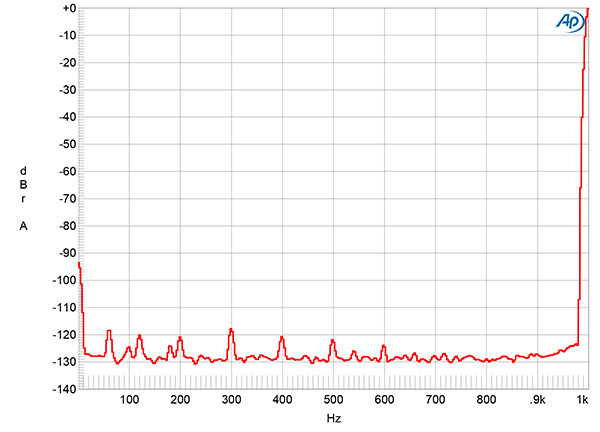
Fig.1 Linn Klimax Solo 800, spectrum of 1kHz sinewave, DC–1kHz, at 1W into 8 ohms (linear frequency scale).
The new amplifier's voltage gain, input impedance, and frequency response were all identical to those published in the May issue. The output impedance, including the series impedance of 6' of spaced-pair cable, was lower, at 0.13 ohms at 20Hz and 1kHz, rising slightly to 0.15 ohms at 20kHz. (Linn's specified impedance is 0.1 ohm at 1kHz.) The unweighted, wideband signal/noise ratio (ref. 1W into 8 ohms) was 72.1dB, which is 6dB greater than the original's, this due to a lower level of ultrasonic noise. Spectral analysis of the low-frequency noisefloor while the Linn drove a 1kHz tone at 1W into 8 ohms revealed a very low level both of random noise and of AC supply–related spuriae (fig.1), similar to that of the original sample.
The differences between my original measurements and Linn's concerned the level of distortion at high powers. Though these levels were extremely low, Linn's graphs had indicated even less distortion.
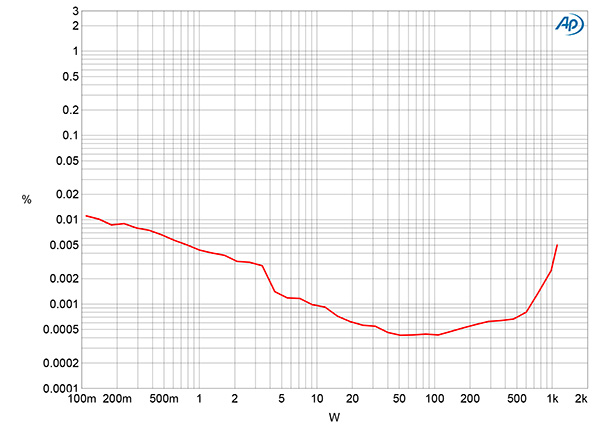
Fig.2 Linn Klimax Solo 800, distortion (%) vs 1kHz continuous output power into 8 ohms.
Fig.2 shows how the THD+noise varied with power into 8 ohms in the new amplifier's output. This graph is basically identical to that supplied by Linn, and the downward slope of the trace below 200W indicates that the actual distortion lies beneath the noisefloor. The THD+N at this power was just 0.0002%, and it had risen to the specified 0.0004% at the onset of waveform clipping. The actual clipping power, which we define as when the THD+noise reaches 1%, was the same 410W (26.1dBW) as the original sample's.
Fig.3 Linn Klimax Solo 800, distortion (%) vs 1kHz continuous output power into 4 ohms.
Fig.4 Linn Klimax Solo 800, distortion (%) vs 1kHz continuous output power into 2 ohms.
Fig.3 repeats this test with the amplifier driving 4 ohms. The THD+N is still extraordinarily low up to waveform clipping, though the clipping power is inconsequentially lower than the specified 800W, at 790W (25.2dBW). When I repeated this test into 2 ohms, the amplifier's protection circuit operated at 1.1kW (fig.4, 24.4dBW), which is just 0.6dB below the specified maximum power into this load, and the front-panel display turned red.
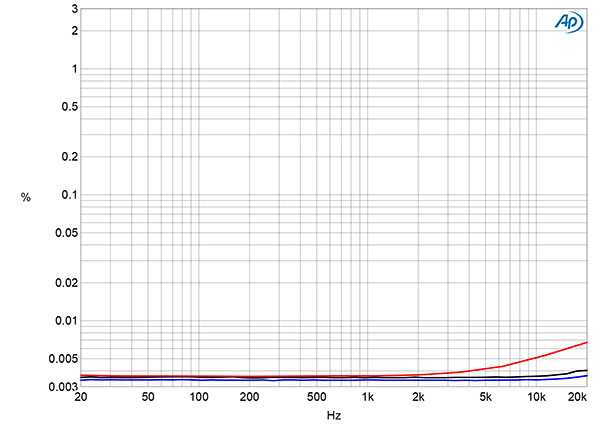
Fig.5 Linn Klimax Solo 800, THD+N (%) vs frequency at 20V into: 8 ohms (blue), 4 ohms (gray), and 2 ohms (red).
I powered down the Solo 800 and waited a few minutes before turning it on again. All appeared okay, and I examined how the THD+N percentage varied with frequency at the same 20V I had used for my earlier testing. This voltage is equivalent to 50W into 8 ohms, 100W into 4 ohms, and 200W into 2 ohms; the THD+N was very low into all three impedances (fig.5), except in the top two audio octaves into 2 ohms (red trace), where the percentage rose very slightly.
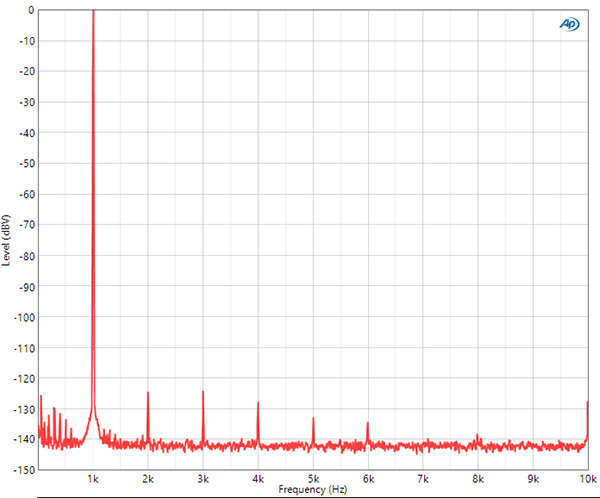
Fig.6 Linn Klimax Solo 800, spectrum of 1kHz sinewave, DC–10kHz, at 20W into 8 ohms (linear frequency scale).
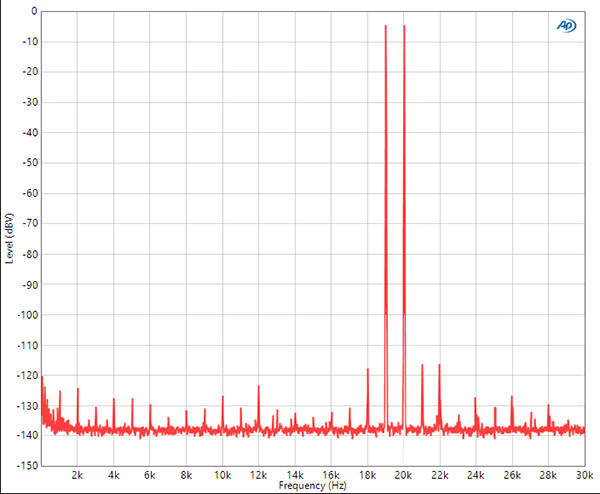
Fig.7 Linn Klimax Solo 800, HF intermodulation spectrum, DC–30kHz, 19+20kHz at 40W peak into 4 ohms (linear frequency scale).
The new amplifier's distortion harmonics (fig.6) were all at least 20dB lower than those of the original sample, and intermodulation distortion with an equal mix of 19 and 20kHz tones was also extremely low (fig.7).