 Setup and other considerations
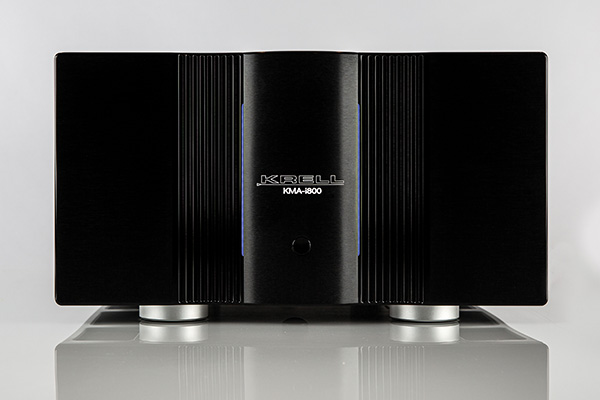
With the invaluable assistance of my husband and my friend Scott Campbell, I positioned the 145lb Krell flagship monoblocks atop Grand Prix Monza amp stands, with Wilson Audio Pedestals as supports. The amps may be heavy, but their rear handles and lack of sharp external cooling fins makes them somewhat easier to handle than many amps of similar weight. The KMA-i800s require 20A power cables. I used two Nordost Odin 2 cables with 20A connectors and drew power through AudioQuest wall outlets fed by a carefully optimized dedicated line. All front-end components in the music room received battery power from a Stromtank S 2500 Quantum MK II power generator, which was plugged into a separate circuit on the dedicated line. The first part of my streaming chain, located far away on the second floor of the main house, drew power from an AudioQuest Niagara 7000 power conditioner that did battle with an undedicated line that defiantly declared, "Dimmers and appliance noise are my friends!" Three cheers for the Niagara 7000, a noise-defeating fiberoptic interface, and the recent addition of high-quality Nordost and Sonore linear power supplies to the start of my streaming chain. The outstanding visual feature on the Krell KMA-i800's handsome, understated front panel is two slim vertical indicator lights, 6" or so in height; these lights frame a curved, extended front section that displays the Krell logo and model designation. The vertical lights radiate green in standby/idle and pleasing (to my eyes) blue when the Idle / On button situated below the logo is engaged. The amplifier draws less than 1W at idle, while "On" raises consumption to 260W with no music playing. Dave thrice assured me that only 25 minutes of warm-up was necessary to get the amps singing optimally. I resolved to leave them on idle until a half-hour before listening sessions began.
True to the promise of iBias, the two KMA-i800s ran sufficiently cool as to require turning on the heat during the Pacific Northwest's late fall (footnote 5). As Dave Goodman had claimed, the sound was noticeably warm, full, and well-controlled.
 Of all the many listening sessions I spent with these monoblocks, the most revealing was my last. My guest, noted jazz and rock photographer Rey Alvarado, had just returned from a multiday shoot of jazz guitarist Mike Stern, who played with Blood, Sweat & Tears, Billy Cobham, and Miles Davis before launching his award-winning solo career. Rey arrived with a well-considered playlist that began with the Tomasz Stańko Quintet's "So Nice" from Dark Eyes (16/44.1 FLAC, ECM/Qobuz). The sound was lovely, airy, and quite warm. The piano's high notes rang convincingly, and cymbals were clear and realistically depicted in three-dimensional space.
 Given how many of these performers Rey knew personally, I eagerly awaited his next selection, Charlie Hunter & Pound for Pound's "Huggy Bear," from the illicitly titled album Return of the Candyman (16/44.1 FLAC, Blue Note/Qobuz). Shortly after the music began, Rey muttered: "Jesus."
"When you spend as much time with jazz recordings as I do," Rey explained after the track ended, "there's an anticipation that's as emotional as it is physical. On Stefon Harris's vibes, I could hear the sound travel across the soundstage as he moved up and down the scale. Most of the time, except when the vibe player is a front man like Lionel Hampton or Gary Burton, it's rare that anyone records vibes so front-of-stage that a pair of microphones picks up the player's movement. But Charlie Hunter is particularly generous with his sidemen; he always plays to the greater good of the song. He's the kind of cat who will bring in someone like Kurt Elling to sing on one of his tracks. I've never before heard vibes sound so rich on a recording. Tonight, I've also heard tonalities, overlaps, and fade outs that I've never heard before."
Given how many of these performers Rey knew personally, I eagerly awaited his next selection, Charlie Hunter & Pound for Pound's "Huggy Bear," from the illicitly titled album Return of the Candyman (16/44.1 FLAC, Blue Note/Qobuz). Shortly after the music began, Rey muttered: "Jesus."
"When you spend as much time with jazz recordings as I do," Rey explained after the track ended, "there's an anticipation that's as emotional as it is physical. On Stefon Harris's vibes, I could hear the sound travel across the soundstage as he moved up and down the scale. Most of the time, except when the vibe player is a front man like Lionel Hampton or Gary Burton, it's rare that anyone records vibes so front-of-stage that a pair of microphones picks up the player's movement. But Charlie Hunter is particularly generous with his sidemen; he always plays to the greater good of the song. He's the kind of cat who will bring in someone like Kurt Elling to sing on one of his tracks. I've never before heard vibes sound so rich on a recording. Tonight, I've also heard tonalities, overlaps, and fade outs that I've never heard before."
 We followed up with vocals: Shirley Horn's title track from Travelin' Light (16/44.1 FLAC, Impulse!/Qobuz), suggested by my friend Scott Campbell; Patricia Barber's Jim Anderson–engineered "The Thrill Is Gone," from Café Blue (16/44.1 FLAC, Premonition/Qobuz), picked by Rey. Even in Red Book, Anderson's mastery of air, space, and openness came through gloriously. "The upright bass sounds so realistic!" Rey exclaimed. "I know that Tony Banda's bass on Sanchez's 'One Mint Julep' is electric. I've seen the band, I've photographed the band, and I've been there when they performed this track. But the bass resonated so realistically through the Krells that one could easily and comfortably mistake it for Mingus's acoustic instrument that Stanley Clarke now owns. It sounded that beautiful!"
 A minute later, we both sat enthralled as I turned off the lights and Maria Callas sang a chilling "Una macchia è qui tuttora," the "sleepwalking scene," from Verdi's Macbeth, superbly recorded in wide-stage stereo in September 1958 with Nicola Rescigno and the Philharmonia Orchestra (24/96 MQA, Warner/Tidal). I've played this recording countless times; each listen awakens me anew to Callas's multiple revelations of Lady Macbeth's blood-stained subconscious thought, horror, and guilt. No voice has transmitted Lady Macbeth's cold-as-ice heart and cunning on record as explicitly as Callas's. Though her anything-but-pure voice sounded considerably warmer than it is customarily reproduced, its emotional import came through clearly.
The next day, Rey told me that while Callas is anything but his go-to music, it was all he could talk about when he got home.
A minute later, we both sat enthralled as I turned off the lights and Maria Callas sang a chilling "Una macchia è qui tuttora," the "sleepwalking scene," from Verdi's Macbeth, superbly recorded in wide-stage stereo in September 1958 with Nicola Rescigno and the Philharmonia Orchestra (24/96 MQA, Warner/Tidal). I've played this recording countless times; each listen awakens me anew to Callas's multiple revelations of Lady Macbeth's blood-stained subconscious thought, horror, and guilt. No voice has transmitted Lady Macbeth's cold-as-ice heart and cunning on record as explicitly as Callas's. Though her anything-but-pure voice sounded considerably warmer than it is customarily reproduced, its emotional import came through clearly.
The next day, Rey told me that while Callas is anything but his go-to music, it was all he could talk about when he got home.
I greatly enjoyed my time with the Krell KMA-i800 monoblock power amplifiers. While I doubt I used more than a fraction of the amplifiers' 1600W into 4 ohms, they delivered sound whose fullness, dynamic range, speed, clarity, and resolution rivaled that of the finest amplifiers I've been privileged to review. Without question, they are a top-rank product. For audiophiles with a sufficient budget who love to wrap themselves in a warm envelope of detailed sound and revel in the glories that fine artists can create and capture on a recording, they are a must hear.
Footnote 5: In normal operation, the heat put out by the KMA-i800 is modest. It is interesting to note, just for the Wow Factor, that operating at full power into 4 ohms, each amp would put out nearly 11,000BTU—information provided by Krell in their specifications. Of course, the amp will almost never use that much power, and then only very briefly.—Jim Austin