Sidebar 4: Measurements
I performed a complete set of measurements on one of the Krell KMAi800s (serial number 32623090006) with my Audio Precision SYS2722 system. I preconditioned the amplifier by following the CEA's recommendation, running it at one-eighth the specified power into 8 ohms for 30 minutes. At the end of that time, the temperature of the top panel was 110.9°F (43.9°C) and that of the heatsinks on the side panels was 137.3°F (58.5°C). This amplifier needs plenty of room around it.
The KMA-i800's single-ended and balanced inputs preserved absolute polarity, ie, the XLR jack is wired with pin 2 positive, and the voltage gain was slightly higher than the specified 26dB for both types of input, at 26.75dB. The balanced input impedance was the specified 28k ohms at 20Hz and 1kHz, dropping inconsequentially to 22.6k ohms at 20kHz. As expected, the single-ended input impedance was lower, at 12.4k ohms at 20Hz and 1kHz, 10k ohms at 20kHz.
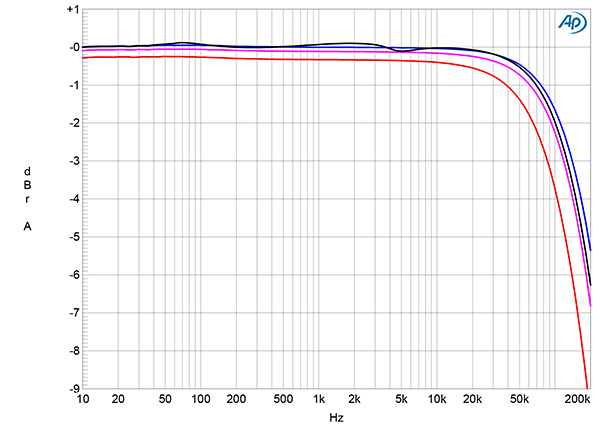
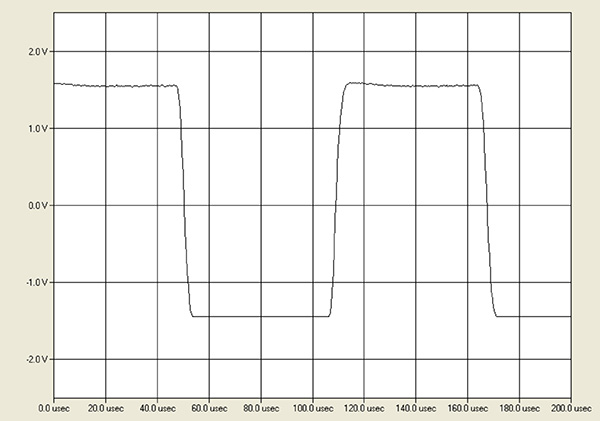
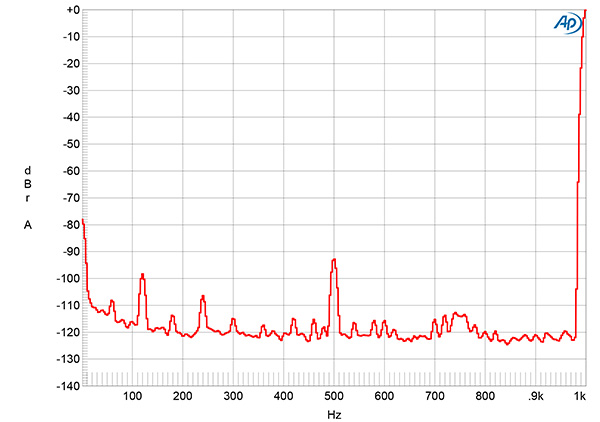
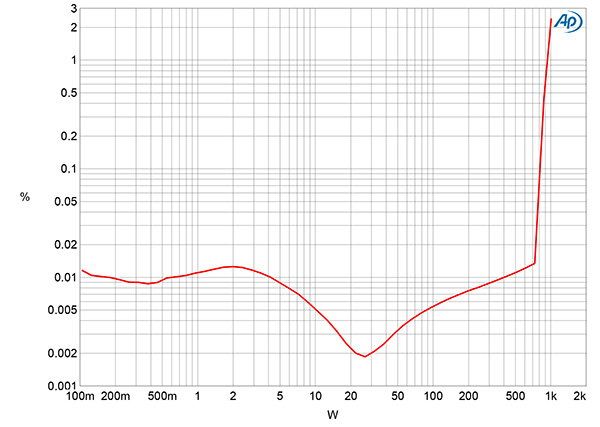
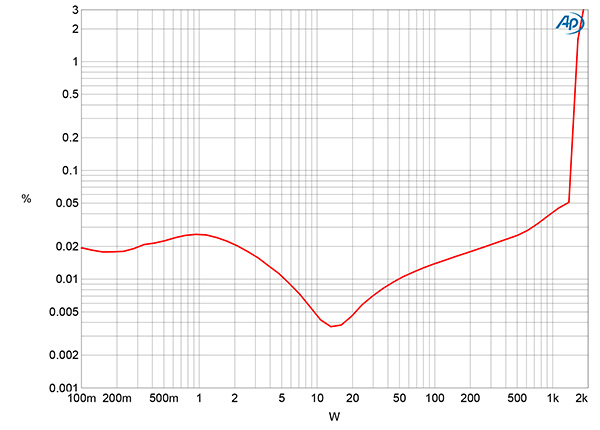
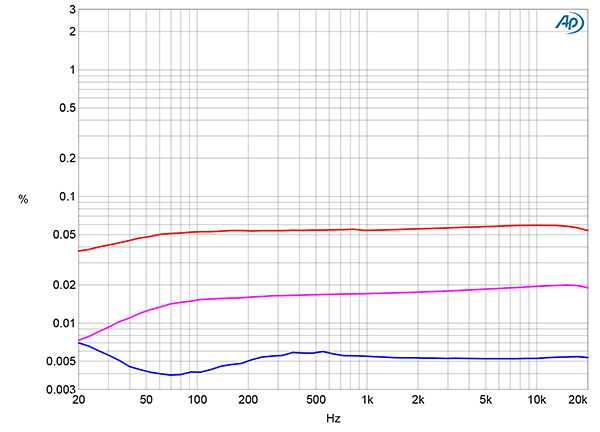
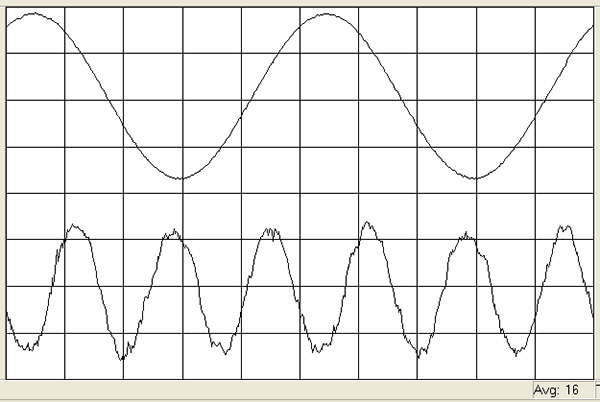
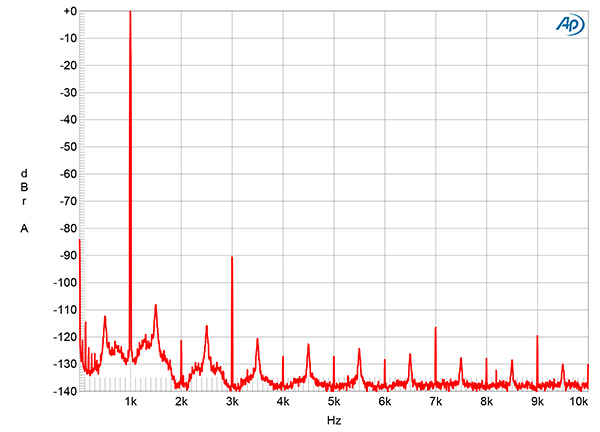
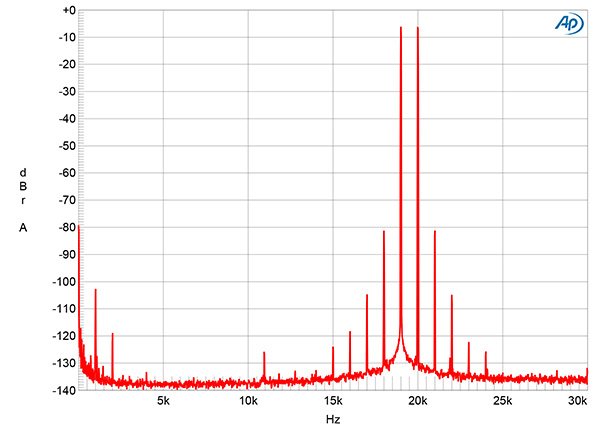
Fig.1 Krell KMA-i800, frequency response at 2.83V into: simulated loudspeaker load (gray), 8 ohms (blue), 4 ohms (magenta), and 2 ohms (red) (1dB/vertical div.).
Fig.2 Krell KMA-i800, small-signal 10kHz squarewave into 8 ohms.
Krell specifies the KMA-i800's output impedance at 1kHz as a very low 0.018 ohm. My estimate, including the series impedance of 6' of spaced-pair cable, which I have measured as 0.04 ohm, was higher, at 0.17 ohms at 20Hz and 1kHz, and 0.2 ohms at 20kHz. Nevertheless, the variation in the frequency response with our standard simulated loudspeaker (fig.1, gray trace) was minimal, at ±0.1dB. This amplifier has a wide small-signal bandwidth, the response into 8 ohms (blue trace) not rolling off by 3dB until 135kHz. As a result, the Krell's reproduction of a 10kHz squarewave into 8 ohms (fig.2) featured very short risetimes and no overshoot or ringing.
Fig.3 Krell KMA-i800, spectrum of 1kHz sinewave, DC–1kHz, at 1W into 8 ohms (linear frequency scale).
The unweighted, wideband signal/noise ratio (ref. 1W into 8 ohms), taken with the single-ended input shorted to ground, was an excellent 80.4dB. This ratio improved to 89.2dB when the measurement bandwidth was restricted to the audioband and to 92.4dB when A-weighted. Spectral analysis of the low-frequency noisefloor while the Krell drove a 1kHz tone at 1W into 8 ohms (fig.3) revealed a low level of random noise, with spuriae at 120Hz and 240Hz at or below –100dB. However, a 500Hz tone was present, and further investigation revealed a tone at 1.5kHz; both lay at a negligible –93dB ref. 1W (0.0025%). The fact that they are harmonically related to the signal being amplified suggests that they might be associated with the circuitry used to correlate the output stage bias with the signal level.
Fig.4 Krell KMA-i800, THD+N (%) vs 1kHz continuous output power into 8 ohms.
Fig.5 Krell KMA-i800, THD+N (%) vs 1kHz continuous output power into 4 ohms.
Krell specifies the KMA-i800's maximum power as an enormous 800W into 8 ohms and 1.6kW into 4 ohms, both equivalent to 29dBW. Stereophile defines an amplifier's clipping power as being when the THD+noise reaches 1%. With that criterion, the KMA-i800 exceeded its specified power into 8 ohms, clipping at 930W into 8 ohms (29.7dBW, fig.4), even though the wall voltage had dropped from 118.2V with the amplifier idling to 113.3V with it clipping. The amplifier fell slightly short of its specified power into 4 ohms, clipping at 1.5kW (28.75dBW, fig.5), though the wall voltage had now dropped to 110V—the reason, no doubt, for the shortfall. Krell specifies the KMA-i800's maximum power into 2 ohms as 3.2kW; I found that the amplifier clipped at a massive 2.6kW into that load (28.1dBW)! The wall voltage at that power had sagged to 109V.
Fig.6 Krell KMA-i800, THD+N (%) vs frequency at 28.28V into: 8 ohms (blue), 4 ohms (magenta), and 2 ohms (red).
I examined how the THD+N percentage varied with frequency at 28.28V, equivalent to 100W into 8 ohms, 200W into 4 ohms, and 400W into 2 ohms (fig.6). The distortion increased with each halving of the load impedance but remained very low. It also didn't increase at high frequencies, which suggests that the amplifier has a commendably wide open-loop bandwidth.
Fig.7 Krell KMA-i800, 1kHz waveform at 50W into 8 ohms, 0.0035% THD+N (top); distortion and noise waveform with fundamental notched out (bottom, not to scale).
Fig.8 Krell KMA-i800, spectrum of 1kHz sinewave, DC–1kHz, at 50W into 8 ohms (linear frequency scale).
In JVS's interview with Krell engineer Dave Goodman in the main review text, Goodman said that they had worked hard to reduce the level of second-harmonic distortion so that the third harmonic was predominant though still at a very low level. This was confirmed by the THD+N waveform with a 1kHz signal at 50W into 8 ohms (fig.7) and by the spectrum of the amplifier's output at the same power (fig.8). This graph indicates that all harmonics other than the third are vanishingly low in level, with the second harmonic below –120dB. The sidebands at ±500Hz that I mentioned earlier can be seen, albeit now close to –110dB ref. 50W (0.0003%).
Fig.9 Krell KMA-i800, HF intermodulation spectrum, DC–30kHz, 19+20kHz at 200W peak into 4 ohms (linear frequency scale).
Even at a peak power of 200W into 4 ohms, the second-order difference product at 1kHz with an equal mix of 19 and 20kHz tones lay at an extremely low –104dB (0.0006%, fig.9).
The Krell KMA-i800 offers very high power, even into low impedances, with very low levels of noise and distortion.—John Atkinson