Sidebar 3: Measurements
I measured one of the Karan POWERa Mono amplifiers that JVS auditioned, serial number 005. Because the amplifier was too wide to fit through the door from my listening room to the corridor that leads to the test lab, I performed the measurements in my listening room. To ensure that this very powerful amplifier wasn't starved of wall current, I ran two long, heavy-duty extension cords to the Karan from the 20A circuit in the test lab. I measured the amplifier using my Audio Precision SYS2722 system, plugged into one of the extension cords. Following distributor Wynn Wong's recommendation, I performed the measurements with the DC filter on the amplifier's rear panel switched on; however, I didn't measure any differences with this filter on or off. (I live in a lightly populated—for New York City at least—residential neighborhood, and DC is rarely present in the mains voltage here.) Other than voltage gain, polarity, and input impedance, all the measurements were performed using the balanced input. When testing the single-ended input, I followed the manual's recommendation of shorting pins 1 and 3 of the XLR jack.
Out of its crate, the amplifier was ice-cold from its air trip from Washington State, so I ran the Karan at a few watts into 8 ohms for two hours before examining its measured performance. I then followed the CEA's recommendation of operating it at one-eighth the specified power of 2.1kW (!) into 8 ohms for 30 minutes. At the end of that time, the ventilation holes on the top panel over the internal heatsinks were very hot, at 124.4°F (51.4°C). The side panels were even hotter, at 144.6°F (62.6°C). However, when I repeated some of the tests the next day without the preconditioning, I noted that amplifier ran very cool to the touch even after driving 1W into 8 ohms for an hour.
The POWERa Mono's voltage gain was 34.7dB for both the balanced and unbalanced inputs, which is higher than usual. The Karan preserved absolute polarity (ie, was non-inverting) with both input types. (The XLR jack is wired with pin 2 hot.) The specified input impedance is 30k ohms for both input types. I measured 29.6k ohms from 20Hz to 20kHz for the balanced input, half that value for the unbalanced input.
The Karan POWERa Mono amplifier's measured behavior reveals that it copes well with low impedance and offers extremely high power, though the level of distortion at moderately high powers was not as low as I was expecting.—John Atkinson
Footnote 1: Observant folks will notice that even though it's below the amplifier's specified maximum power, 2.5kW is more power than a single 120V, 20A service should be able to supply. But the Audio Precision's procedure raises the input voltage quickly before terminating the input signal the moment the distortion reaches a pre-established target, in this case 3%. It takes a while for a circuit breaker to trip, so presumably, the current from the wall exceeded 20A momentarily—too briefly to trip the breaker.—Jim Austin
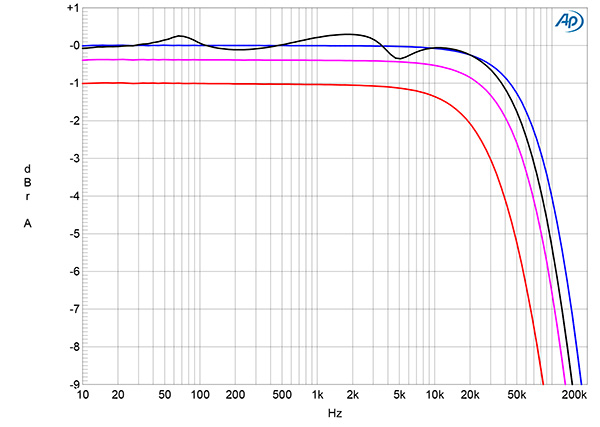
Fig.1 Karan POWERa Mono, frequency response at 2.83V into: simulated loudspeaker load (gray), 8 ohms (blue), 4 ohms (magenta), 2 ohms (red) (1dB/vertical div.).
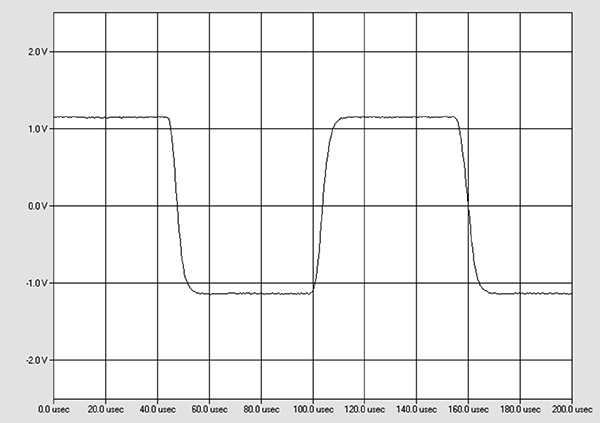
Fig.2 Karan POWERa Mono, small-signal 10kHz squarewave into 8 ohms.
The Karan's output impedance was 0.5 ohm at 20Hz and 1kHz increasing to 0.67 ohm at 20kHz. (These figures include the series impedance of 6' of spaced-pair loudspeaker cable.) These impedances are higher than I expected from a solid state design, presumably because the output comprises two amplifier stages in series, a topology used to obtain the POWERa's very high specified power. The modulation of the amplifier's frequency response, due to the Ohm's law interaction between this source impedance and the impedance of our standard simulated loudspeaker, was ±0.25dB (fig.1, gray trace). The response into an 8 ohm resistive load (fig.1, blue trace) was down by 3dB at 81kHz, a lower frequency than the specified –3dB at 300kHz. The increased output impedance at 20kHz means that the –3dB frequency was somewhat lower into 4 ohms (magenta) and 2 ohms (red). However, the POWERa Mono's reproduction of a 10kHz squarewave into 8 ohms (fig.2) was superb, with no overshoot or ringing.
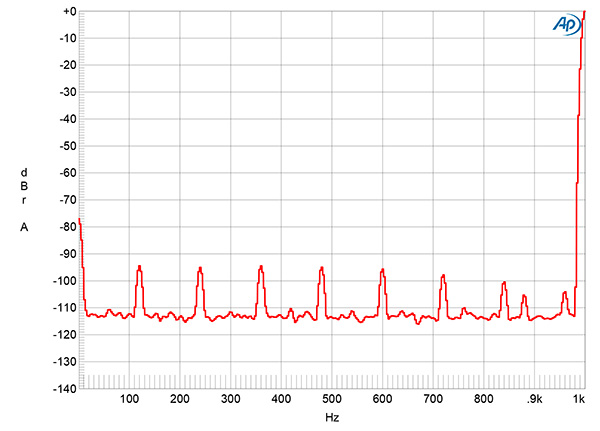
Fig.3 Karan POWERa Mono, spectrum of 1kHz sinewave, DC–1kHz, at 1W into 8 ohms (linear frequency scale).
Measured with either the unbalanced input or the balanced input shorted to ground, the Karan amplifier's unweighted, wideband signal/noise ratio was a very good 71.8dB ref. 1W into 8 ohms. This ratio improved to 79dB when the measurement bandwidth was restricted to 22Hz–22kHz and to 81.3dB when A-weighted. While even-order harmonics of the 60Hz power-supply frequency were present in the Karan's noisefloor (fig.3), these were very low in level, at –94dB and below ref. 1W into 8 ohms.
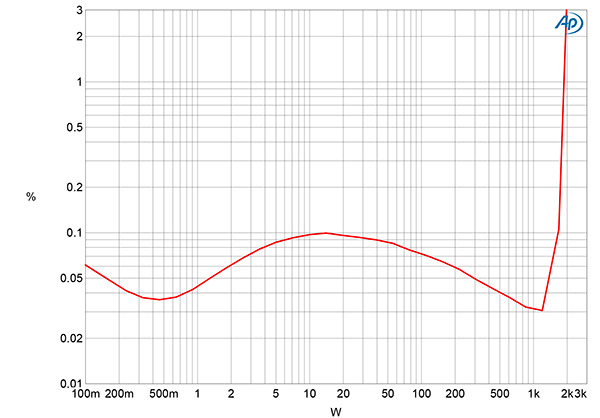
Fig.4 Karan POWERa Mono, distortion (%) vs 1kHz continuous output power into 8 ohms.
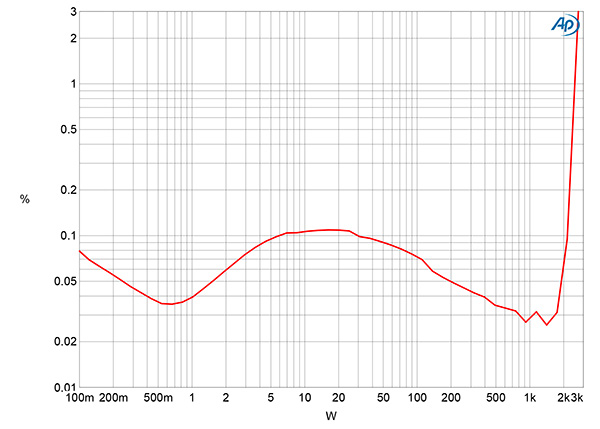
Fig.5 Karan POWERa Mono, distortion (%) vs 1kHz continuous output power into 4 ohms.
When I tested the POWERa Mono's maximum power into 8 ohms, the THD+noise reached 1% (our standard definition of clipping) at 1.85kW into 8 ohms (fig.4, 32.67dBW). While this is lower than the specified 2.1kW into this load (33.22dBW), the AC wall voltage had dropped from 120.6V with the amplifier idling to 114.5V with the amplifier clipping. The Karan's maximum power into 4 ohms is specified as 3.6kW (32.55dBW). I measured 2.5kW into 4 ohms at 1% THD+N (fig.5, 31.0dBW). Again, the wall voltage had dropped by several volts at the clipping power (footnote 1). I didn't test the maximum power into 2 ohms because this would have tripped the wall supply's circuit breaker.)
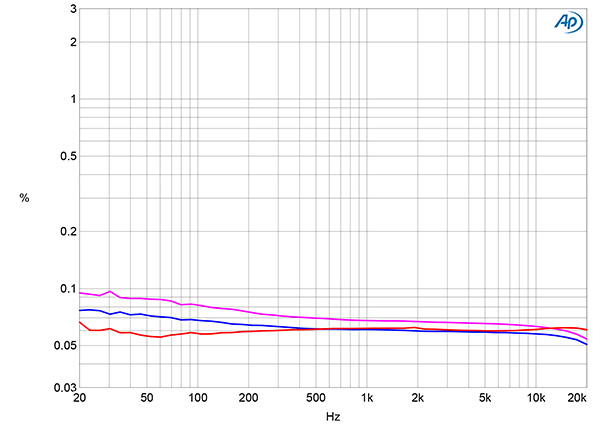
Fig.6 Karan POWERa Mono, THD+N (%) vs frequency at 12.67V into: 8 ohms (blue), 4 ohms (magenta), 2 ohms (red).
Figs.4 & 5 indicate that actual distortion lies beneath the noisefloor below 1W, rising to a maximum around 20W then dropping again, reaching a minimum value just before actual waveform clipping. I therefore examined how the percentage of THD+N changed with frequency at 12.67V, which is equivalent to 20W into 8 ohms, 40W into 4 ohms, and 80W into 2 ohms (fig.6). The distortion remained below 0.1% into all three impedances and was lowest in level at low frequencies into 2 ohms (red trace). Commendably, the distortion doesn't rise at high frequencies.
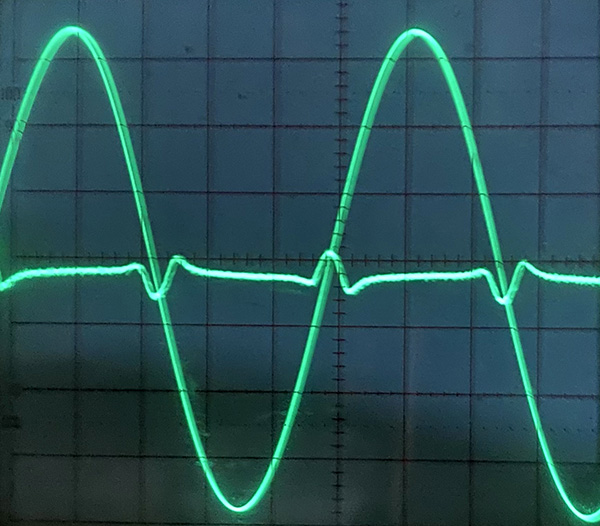
Fig.7 Karan POWERa Mono, 1kHz waveform at 100W into 8 ohms, 0.051% THD+N; distortion and noise waveform with fundamental notched out (not to scale).
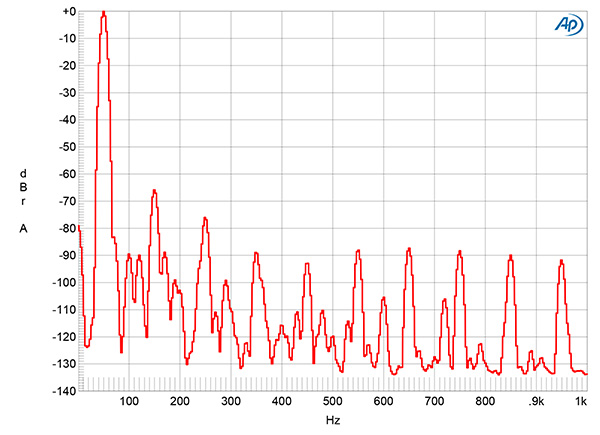
Fig.8 Karan POWERa Mono, spectrum of 50Hz sinewave, DC–1kHz, at 200W into 4 ohms (linear frequency scale).
I was having some issues with my digital oscilloscope at very high sample rates, so fig.7 shows my analog oscilloscope's screen with the POWERa Mono driving 1kHz at 100W into 8 ohms. This photo reveals that the distortion at high powers occurs at the waveform's zero-crossing points. This will be due to the output stage lacking sufficient bias at this power, perhaps as a result of the sliding bias mechanism. While the third harmonic is the highest in level, at –66dB (0.05%, fig.8), the crossover distortion is, as always, accompanied by higher odd-order harmonics.
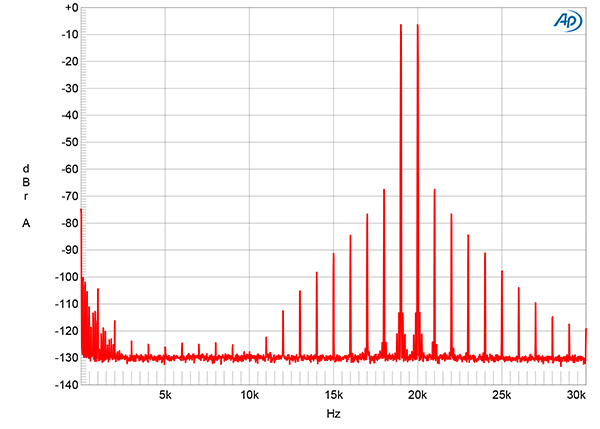
Fig.9 Karan POWERa Mono, HF intermodulation spectrum, DC–24kHz, 19+20kHz at 100W peak into 8 ohms (linear frequency scale).
When the POWERa Mono drove an equal mix of 19 and 20kHz tones with a peak level of 100W into 8 ohms (fig.9), the second-order difference product at 1kHz lay at a very low –106dB (0.0005%), though higher-order intermodulation products are higher in level. These products dropped by around 3dB at the same peak voltage level into 4 ohms.
Footnote 1: Observant folks will notice that even though it's below the amplifier's specified maximum power, 2.5kW is more power than a single 120V, 20A service should be able to supply. But the Audio Precision's procedure raises the input voltage quickly before terminating the input signal the moment the distortion reaches a pre-established target, in this case 3%. It takes a while for a circuit breaker to trip, so presumably, the current from the wall exceeded 20A momentarily—too briefly to trip the breaker.—Jim Austin