>
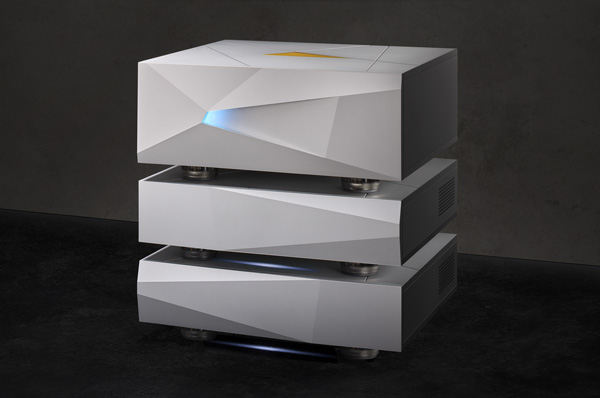
The complete Innuos Nazaré stack.
Further inquiry
Would it have been possible to incorporate the functions of the NET and FLOW into the Nazaré rather than putting them in separate boxes? "It wouldn't work as well," Vitorino said. "Unless you want to have three power cables in the same box, you will always have some ground contamination. This is why two mono power amplifiers are better than a single stereo amp with dual mono configuration."
Similarly, the reason the Nazaré does not have a separate outboard power supply has to do with impedance. Once you separate the power supply from the server, current must travel through an external umbilical cable, more connectors, and more internal cabling until it reaches the regulators. Each additional connector can raise impedance and introduce noise into the system. Instead, Innuos houses everything in a single chassis, and employs SmartStack material to damp vibration from the toroidal transformers and a CNC-machined bracket to separate transformers from electronics.
"This has allowed us to have the best of both worlds," Vitorino said. "We don't have vibration issues with the toroidal transformers, and we can use shorter, higher gauge internal cabling to reduce impedance."
At present, the NazaréNET's four RJ45 ports pass signal at the speed of 1Gbps. By fall's end—perhaps by the time you read this—Innuos will release a software upgrade for its SENSE app that will enable NazaréNET users to switch the speed of each RJ45 port from 1Gbps, which is optimal for loading files into the Nazaré streamer-server's storage, to the quieter 100Mbps that's ideal for music playback.
At conversation's end, Vitorino mentioned something I had already intuited. Part of the NazaréFLOW's unique impact on system performance lies in the potential of its optional modules to connect to specific DACs via their proprietary links. While my DAC system, the
dCS Varèse, employs the proprietary ACTUS interface, which carries audio, control, and clock data between Varèse components, no FLOW module for Varèse exists yet.
Hence, I wrote dCS Managing Director David Steven. He responded, "We have not yet developed an ACTUS interface between Varèse and non-dCS components such as the Nazaré. ACTUS cables are now being developed by various cable manufacturers, and there are integration projects underway between dCS and leading server manufacturers such as Innuos."
Because I could not hear the impact that a Varèse-specific NazaréFLOW module might have on system performance, I could not assess the FLOW's full potential. If and when an integration effort between dCS and Innuos bears fruit, I shall write a short follow-up.
Setup and sound
Anyone with a standard-sized audio rack (or shelving) can easily install the NET and FLOW. But due to the width of my room, the shelves on my rack and amp stands are intentionally a bit smaller than standard. This enables me to step carefully behind and around my amps, reach behind my double rack, lean over at ungodly angles, and access rear-panel connections 1000 times per month without risk of electrocution or decapitation (footnote 3).
The only way I could fit the NET and FLOW on my rack was by installing them sideways, on separate shelves, one above the other. I couldn't enjoy their attractively sculpted front panels, but I could easily access inputs and outputs and quickly change cables.
The only issue that arose concerned syncing the NET and FLOW with the Nazaré. Eventually I discovered that if I turned off all the units, waited 30 seconds, and then slowly turned them back on in the order of signal transfer—NET, Nazaré, FLOW—everything proceeded smoothly. Occasionally it was also necessary to restart the five-box Varèse. It took a few minutes, but it was easy.
My fiber-based streaming network uses two Small Green Computer/Sonore opticalModule Deluxe units, powered, respectively, by Sonore and Nordost QSource linear power supplies, to send signal from my router in the second-floor office of our house to the detached music room a significant distance away. For this review, I intended to retain the opticalModule in the office but replace the second opticalModule and the discontinued Innuos PhoenixNET switch in the music room with the NazaréNET. Doing so required moving one of the Avago multimode SFP (footnote 4) modules I'd been using from the music room opticalModule to the NazaréNET.
Not so fast. While, on the recommendation of fiber specialist Sean Tan, I'd used Avago AFBR-5718PZ 1GB SX-SFP, Gen 5 multimode SFP modules for years, Innuos insists that single-mode SFP modules are less error-prone and sound better than multimode. Innuos specifically recommends Finisar single-mode SFP modules.
With ample time to devote to single-mode/multimode comparisons during my recovery from open-heart surgery, I ordered two ATGBICS AFCT-5710PZ-C single-mode fiber optic (SFP) modules (footnote 5). These were the closest single-mode equivalent to the Avago multimode SFP modules I had been using (footnote 6).
Next, I used the familiar opticalModule Deluxes to compare the sound of the two sets of SFP modules. Without question, in my system the ATGBICS single-mode modules sounded more detailed, transparent, and musically accurate.
I would have liked to compare the sound of the ATGBICS single-mode modules to the Finisar single-mode modules Vitorino prefers, but I was only sent one of them. I did try an ATGBICS on one end and the Finisar on the other; I also reversed which came first. No go. While I initially found the extra warmth seductive, the loss of bass was dismaying.
Once I switched to ATGBICS AFCT-5710PZ-C single-mode fiber optic (SFP) modules, I installed the second SFP module in the NazaréNET, attached my fiber, and sent signal from the NazaréNET to the Nazaré via Ethernet.
I suppose I should have initially evaluated the NazaréNET by itself and left the NazaréFLOW warmed up but unattached. But Mr. Eager Beaver in Port Townsend—that's me in case you're not following—could not resist listening to everything all at once. Hence, I ran one Nordost Valhalla 2 USB cable from the Nazaré to the NazaréFLOW and a second one from the FLOW to the
dCS Varèse Core. Then, using Innuos's SENSE app, I cued up familiar music and hit Play.
That's when my mouth opened wide and unprintable exclamations of holy disbelief emerged.
The "Whoa" moment
This is when I find myself grasping for some novel combination of words and metaphors that will painlessly pierce the veils of cynicism and disbelief that chain the imaginations of too many audiophiles. The only viable analogy that comes to mind is my experience shortly after cataract surgery, when the newly vibrant colors of everything within eyesight left me feeling as though I had crossed a bridge from the gray mundane to a glistening new world.
The word "better" falls short of describing what I heard. The entire paradigm of what I thought possible from my system shifted. Old measures of transparency, vividness, and believability fell by the wayside. It was as though an omnipresent veil had lifted and I was hearing music as I had never expected to hear it through my system.
I'd felt this way only once before, when I went from the
dCS Vivaldi DAC system to
dCS Varèse. Now, I'd experienced another major qualitative transition. I felt that everything I had hoped to hear from my system was now audible, and levels of listening previously thought beyond my reach had suddenly opened themselves to me. Augmenting the wonderful
Nazaré music streamer-server with the NazaréNET and NazaréFLOW has taken everything more than one giant step further. This was a major reset.
In retrospect, it's clear I've spent the last two years building up to this moment. The dCS Varèse, Innuos Nazaré, and additional room treatment from Artnovion and Nihon Onkyo Engineering, combined with
Wilson Audio Alexia V speaker repositioning and the change in SFP modules, have enabled me to move closer to recorded music than ever before.
Once I moved beyond my initial reverie, I remembered that I was writing a review. I could not simply state that the improvements I heard were far greater than the sum of their unquestionably great parts. After numerous joyful listening sessions to music new and familiar, I needed to hunker down alone, return to step one, and dissect what was responsible for what.
 Parsing the improvements
To keep things fresh, I chose a track from a recording I had never played before: the first of Manuel de Falla's beloved
Tres danzas from
El sombrero de tres picos, Suite No.2—the first of the Three Dances from
The Three-Cornered Hat—performed by the Simón Bolívar Symphony Orchestra of Venezuela, conducted by Gustavo Dudamel, on the 2026 recording
Alma y Fuego (24/96 WAV, pre-release download on Platoon, no catalog number). Falla assembled his suite from his score for the Léonide Massine–choreographed
Three-Cornered Hat ballet that was premiered by the Ballets Russes on July 22, 1919, in London's Alhambra Theatre, under the direction of Ernest Ansermet, with set, costumes, and stage curtain by Picasso.
When I saw that my friend, Grammy Award winner Dmitriy Lipay, had served as both producer and one of the recording engineers, I sensed it boded well for the sound I was about to hear. With the NET and FLOW engaged as designed and the music room's opticalModule and PhoenixNET bypassed, I noted how vibrant and up close the music sounded, how beautifully the soundstage spread between my speakers, how effortless everything sounded.
Then, I retained the FLOW but replaced the NET with my opticalModule and PhoenixNET combination of old. The signal path was now fiber to opticalModule > Ethernet to PhoenixNET > Ethernet to Nazaré > USB to NazaréFLOW > USB to dCS Varèse Core. The sound was now more recessed, as in distant, and significant detail was smeared. All in all, the sound was flatter, less lively, and surprisingly veiled.
When I removed the NazaréFLOW, essentially restoring my system to its pre-NET and FLOW state—fiber to opticalModule > Ethernet to PhoenixNET > Ethernet to Nazaré > USB to dCS Core—the sound was notably less subtle, and double basses were a bit muffled. The change wasn't huge. It was clear that the entry-level PhoenixNET was simply not good enough to enable me to hear the FLOW's full potential.
Next, I reattached fiber to the NazaréNET but removed the NazaréFLOW. That left the signal path as fiber to NazaréNET > Ethernet to Nazaré > USB to dCS Varèse Core. In this configuration, the soundstage remained recessed but the sound was clearer and considerably more colorful and dynamic. It was clear how much greater a difference the NazaréNET made when I attached fiber directly to it.
What if I retained the FLOW but took a big step backward? Keeping fiber in the opticalModule, I connected to the NazaréNET by Ethernet rather than fiber and restored the NazaréFLOW to the system. In that configuration—fiber to opticalModule > Ethernet to NazaréNET > Ethernet to Nazaré > USB to NazaréFLOW > USB to dCS Varèse Core—sound was still a bit recessed, but the addition of the FLOW helped flesh out instrumental color and palpability.
Once I bypassed the opticalModule and reinserted fiber directly into the NET, every aspect of the sound became more tangible, vibrant, immediate, and filled with life. "No barrier," I scribbled in my notes. "This is a whole new world." Except for my handwriting, which remained execrable.
Following Innuos's suggestion and connecting fiber directly to the NazaréNET was the best way to go, but I continued to feel that I had not heard the FLOW's full potential. Whenever Innuos develops an ACTUS-specific module for the dCS Varèse, I'll have more to say on that score. Meanwhile, I repeat what Vitorino said to me during our interview: "Part of the NazaréFLOW's unique impact on system performance lies in the capacity of its optional modules to connect to specific DACs via their proprietary links."
 Final thoughts
In my forthcoming review of the Audio Research Reference 20 preamplifier (footnote 7), I describe the reactions of two guests in my music room who listened through the Audio Research REF20 and
Reference 330M mono amplifiers. What I did not mention, because I had yet to review them, was that the NazaréNET and NazaréFLOW were also in the system.
As gorgeous and complete as the Audio Research duo sounded—it is some of the most beautiful-sounding full-range amplification I've ever reviewed—the Innuos NazaréNET and NazaréFLOW played a major part in delivering music so colorful and seemingly true to the source that it brought one visitor to tears. The music responsible was J.S. Bach's
Toccata and Fugue in D Minor for organ, BWV 565, from the album
J.S. Bach: Toccata and Fugue in D Minor (24/192 FLAC, Nordic Sounds/Qobuz). It wasn't the system's bass response per se, which through
Wilson Alexia V speakers +
LōKē subwoofers is solid and perfectly integrated with midrange and treble but far less impactful than through Wilsons with larger drivers. Rather, it was the palpability of the experience—the sense that he had been transported to the recording session in Nidaros Cathedral in Trondheim, Norway—which, along with the sheer beauty of the sound, moved him to tears.
For my part, I sat mesmerized as I heard countertenor David Daniels, from
Serenade with Martin Katz (16/44.1 FLAC, Virgin Classics/Qobuz), sound as fresh and timbre true as he sounded in a Cal Performances recital at UC Berkeley back in 2008. I'd waited 18 years for that experience.
The NazaréNET and NazaréFLOW are anything but simple add-ons at a very high price. If you hear them in a good system, you will discover what an enormous difference they make. Innuos's game-changing duo commands and receives my highest recommendation.
Footnote 3: Thank goodness for power walking, weight lifting, stretching, yoga, and enough supplements to sustain a small village.
Footnote 4: An SFP is a compact small form-factor pluggable transceiver that plugs into network switches or routers and translates electrical signals into light.
Footnote 5: My gratitude to Sean Tan, for locating these for me and assisting in my experiments, is unbounded.
Footnote 6: I tried the best-sounding Finisar multimode modules I could find before switching to the Avago AFBR.
Footnote 7: The Reference 20 preamplifier review is scheduled for the November issue.