 Cyrille's Farm
The next time I stood in front of that Polish newsstand, I ended up at a
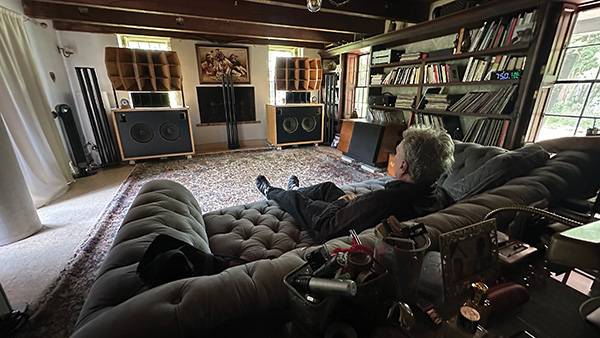
different country palace. This one I call the French Farm. All I knew when I climbed in was that we were scheduled to visit a "a French person" with a full, made-in-Japan Onken horn system and some fancy chickens. There might be a gang meetup, and possibly snacks.
This country palace was a restored brick farmhouse of modest proportions, built in 1789, with a wood stove or fireplace in every room. It had heavy wood floors like the Stick Palace but only 7' ceilings, with exposed beams. The kitchen had this full-charm Chardin still-life aesthetic, where a peach could be elevated to a sacred object. Outside was a landscape painting in every direction. My favorite view was of the two-acre pond with a lone duck patrolling the edge of a vast continent of duckweed near a strong bubbler.
The snacks, elegantly served in the shade of a weeping willow, were gourmet. I hadn't seen it or heard it yet, but the second I tasted those deviled eggs with caviar, the sound of our host Cyrille's system got sweeter and more savory.
The reason we made this pilgrimage was to experience a complete, methodically curated, four-way Onken horn system (footnote 3). This is extremely rare and beautiful stuff that I've only seen in pictures in the back of
MJ Audio Technology magazines.
Cyrille's system was topped by an Onken OM 5000 T tweeter, crossed in at 8kHz. Under that was an Onken MS 500–455es high-mid driver operating between 1.2kHz and 8kHz. Below that was a beautifully fashioned MS 200–255es, a sand-filled plywood multicell low-mid horn covering 250Hz–1.2kHz. Then there was the Onken bass cabinet with two Altec 416A-16 woofers. The crossover was a Goto EPH-4002.
I want to stress how it could take years, possibly a lifetime, to find all these matching components in as perfect, patinaed shape as Cyrille's.
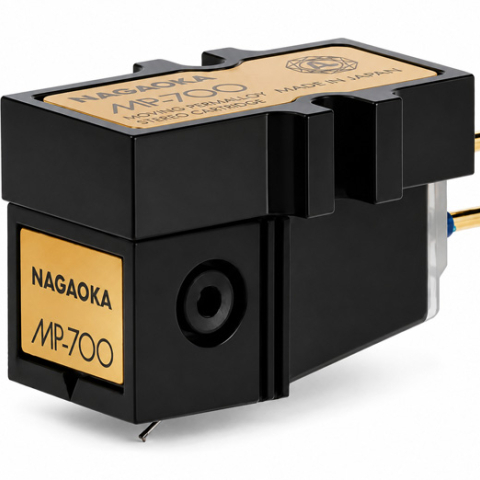
A couple of minutes into the first demo disc, I started bouncing on the couch raving about the boogie-PRaT factor. "That little thread pulls some heavy rhythms!" The turntable was one of my eternal favorites: a Platine Verdier (which uses a thread for a belt) with a Morch DP tonearm and a Kondo IO silver moving coil. Its output was stepped up by a Kondo SFz SUT into a Kondo M7 phono stage. By anyone's measure, that's an exotic analog source. The line-level preamp was a Kondo M7. Digital was enabled via a Laufer Teknik Memory Player, a Berkeley USB interface, and a
Denafrips Terminator Plus DAC. Our host said the cables were mainly Duelund, Xangsane, and Kondo. This quad-amplified horn assemblage was powered by three single-ended J. C. Verdier 45 tube amps with a Kaneda 225 for the bass.
I listened to this system with my friends Beau, Michael Trei, and Steve Guttenberg, and as I've done countless times before, I watched their body language as one recording led into next. Each appeared to respond to Cyrille's system according to their expectations and experience, just like I did. As usual, Beau sat still off to the side, most likely comparing the unobtanium Onken to those rare RCA LC-1As he heard at the Stick Palace. (He's got a mind to acquire a pair like Vern's.) Steve, who's heard thousands of high-end systems, moved around the room nervously, I presumed looking for that nonexistent spot where the Onkens would focus like the Voxativ full-range drivers in his Pure Audio Project open-baffle speakers. As usual, Trei was difficult to assess. Michael's the most left-brain of this group. He uses
Quad 57s with subs, but as a turntable setter-upper, he was familiar with the sound of the Platine Verdier TT and the Audio Note phono bits. His day job is working on systems of this caliber, so he displayed a practiced nonchalance.
I'm the opposite. I move around the room like a phantom, listening in corners and behind speakers and to each driver separately. I like to touch stuff, and chatter too much. We all heard what we were prepared to listen for. And we all noticed different things.
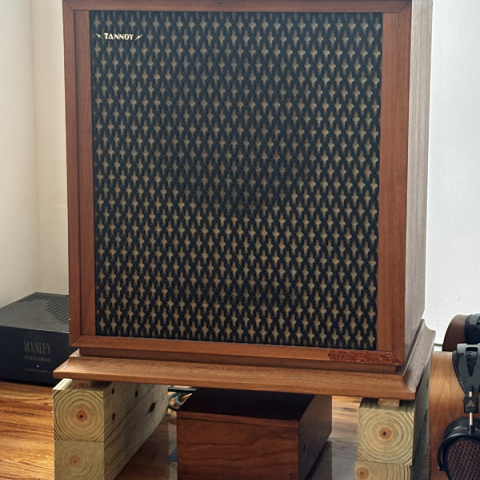
Dear Reader, I presume you noticed how dramatically different these systems are. One is a large paper cone with a coaxially mounted paper tweeter, the other a full-range horn system. That $20 Audio-Technica AT10 cartridge on Vern's direct-drive Rotel is a ruckus kitten compared to the roaring lion Kondo IO on Cyrille's Platine Verdier. But not once while listening to either system did I pause and consider the cost of anything, except to note that neither the RCA nor Onken speakers were free and would have required serious efforts and cash from their owners to acquire them. But sitting behind those collectable old loudspeakers were two thoughtfully curated audio systems that did exactly what they were engineered to do: keep everybody excited about the sounds of famous musicians being projected into the room.
Making audio pilgrimages and listening in groups is not about opportunities for passing judgment, assigning value, or casting aspersions. Aspirants must check those needs at the door. It's about continuing education, being a member of a fraternal order, worshipping at a new altar, meeting new monks, and noshing.
 SIT-4
SIT-4
My June was dominated by gardening and pilgrimages plus my work reviewing
Musical Fidelity's A1 amplifier and my first auditions of the new,
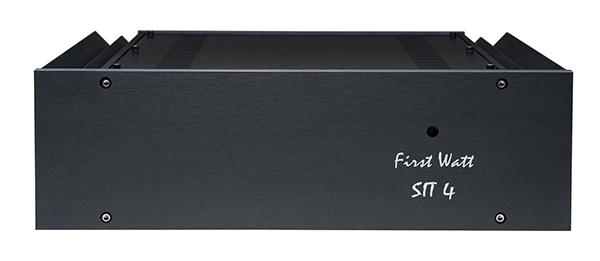
Nelson Pass–designed First Watt SIT-4 stereo amplifier, which uses a new (for audio) high-power transistor that makes a SIT amp with a new kind of sound.
I've reported excitedly in these pages about First Watt's
J2,
SIT-3, and
F8 amplifiers (footnote 4), but when townspeople asked, I could only recommend each amp for specific speakers that I already knew danced well with that model. The SIT-3, for example, felt most clear and awake with speakers averaging 6 ohms nominal; 4 ohms minimum, and 8 ohms maximum. In other words,
Harbeth's P3 was a perfect match with Nelson's SIT-3.
Nelson's latest, the $5000 SIT-4, is rated at 10W into 8 ohms and 5W into 4 ohms. Sounds upside down—right?
A SIT is a type of field-effect transistor with a vertical structure. Its unique characteristics are its ability to operate at high currents and voltages and the similarity of its I-V characteristic to a triode vacuum tube.
Pass's SIT-1 and SIT-2 used new old stock static induction transistors from SemiSouth, "but SemiSouth went bankrupt, and we used up our inventory of unique parts," Nelson told me. Not ready to abandon his SIT explorations, Nelson commissioned a huge run of new, built-from-scratch SITs that he used in the SIT-3. The SIT-4 ups the SIT project one more step with a higher-power industrial-grade SIT.
According to Nelson, "The SIT-1/2/3 gain transistors were rated at a few amps and about 50 watts dissipation. The SIT-4 uses a Tokin THF-51S rated at 600 watts, 30 amps, and 400 watts. As a practical matter, the limitations of the SIT-4 circuit are the size of the heatsinks (footnote 5). And this big JFET manages a bandwidth of 50 megahertz. ... The circuit of the SIT-4 is simple. Q1 is a new old stock Toshiba 2SK170, which drives the Gate of the Q2 SIT, whose output is biased by a mu-follower current source, Q3."
In my studio, amp-speaker matching comes down to this: Do the amp and speaker dance like they're on a hot date? If they are not glued at the hips, the sound sounds boring. Or annoying.
During my history with low-power amplifiers, my ears have become tuned to noticing when an amp is struggling to follow big signals or losing small signals at the speaker terminals. I detected none of that with the SIT-4 driving my 10 ohm
DeVore O/93s or my 15 ohm
Falcon Gold Badge LS3/5a's.
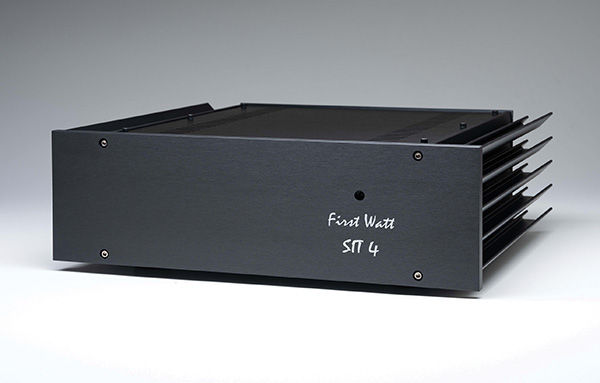
Musically, the SIT-4 moved and grooved with a jaunty perkiness that added charm to both speakers' personalities. My view through those speakers indicated that the SIT-4's intrinsic character leans towards precise, organized, feet-on-the-ground, and fun! Not hi-fi at all.
With the SIT-4 driving the Gold Badges,
The Complete Recordings of Robert Johnson (Columbia 2-CDs 2CK 46222) seemed so adeptly and faithfully recorded—so high in fidelity, so fully clear and expressive—it was, as "they" say, "like hearing them for the first time."
It felt like the
TEAC VRDS-701T transport feeding
HoloAudio's Spring 3 DAC and
Serene preamp were letting the CD's entire signal through. And it felt like the SIT-4 driving my LS3/5a's might be tracing that signal more accurately than any amplifier had done previously. The SIT-4 came across as more rugged and expressive than my
Elekit TU-8900, which presents recordings more
aesthetically, with more micro-delicacy than this First Watt.
Best of all, the SIT-4's chief good trait was how it encouraged my Falcon Gold Badges to sound lusty and glamorous, traits BBC monitors are not famous for.
I questioned Nelson about why the SIT-4 sounds this way, and he laughed while explaining. "With the SIT-4, it's as if the amp holds a conversation with the speaker, saying, 'Have it your way.' Other amplifiers tell the speaker, 'Have it my way.' Some amps tell some speakers, 'Your way does not exist!'"
I hate amps that argue with speakers. But I love amps that dance close to the cones.
Footnote 3: See onken.info/ms-200-wood.
Footnote 4: See firstwatt.com/products. First Watt/Pass Laboratories, 13395 New Airport Rd., Suite G Auburn, CA 95602. Tel: (530) 878-5350. Web: passlabs.com
Footnote 5: Because of this heatsink issue, First Watt will soon be releasing monoblock versions of the SIT-4.