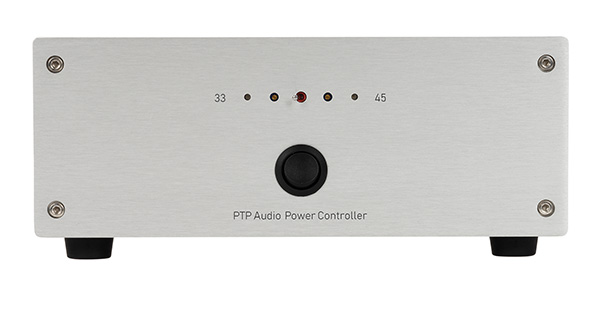
Unless you buy the Solid9's optional electrical controller (above), changing speeds is a purely mechanical, "gearbox" operation: Move the stainless steel rod on the right side of the platter's edge outward, away from the platter and its bolted-down 33rpm stop and toward its 45rpm stop. How many turntables do you know that lock in the correct rotational speed with a steel bar, a cap screw, and a wrench?
Fortunately for Peter Reinders and his customers, Lenco sold millions of turntables, and the design of their motor changed little over time. So there are plenty of 'tables out there for him to improve. Lenco motors are interchangeable among models. If I were a Lenco or a PTP Audio owner, I would not be worried about my motor dying before I do.
PTP Audio's basic, $2950 Solid9 comes with a completely rebuilt Lenco motor and a restored drive mechanism attached to two thick, stainless steel plates fashioned by Peter Reinders and flush-mounted in a 20" wide × 16" deep × 2" high Corian plinth. No tonearm is provided, but PTP Audio can supply almost any tonearm; arms from the
Wand,
Thomas Schick, Frank Schröder, and Sorane, plus the Audio Creative Groovemaster are popular choices.
My review sample came with PTP Audio's optional outboard Audio Power Controller, which costs $1100. The PTP Audio website says, "The Power Controller creates a new, clean and totally stable sinewave to drive the motor, independent of the quality of your mains. As a result, the motor runs noticeably quieter and with less vibration." Peter adds, "It's important to note that this is not a mains filter; it is a new mains creator."
Lenco turntables use a four-pole AC-induction motor that keeps its speed synchronized with the powerline frequency. With the Power Controller in use, voltage slumps and surges seem to have little or no effect on the rotational stability of Lenco's 8.8lb diecast-aluminum platter. Reinders explains, "To avoid introducing new pollution into the signal, everything in the controller is done with entirely analog, linear circuitry. No digitally synthesized wave form, class-D amp, or switch-mode supply is used. As a result, the motor runs quieter and with less vibration."
My Solid9 review sample came with the $350 Solid Bearing upgrade, which I strongly recommend (a platter bearing can never be
too good) and the optional, $250 SCC feet, a trio of high-quality, height-adjustable supports that make leveling the heavy plinth easy and precise. Total price as tested: $4650.
When the new optional bearing is
not selected, an "original Lenco bearing is cleaned, rebuilt, and filled with special, low-viscosity oil. If necessary, the bearings get a new ball, thrust plate and/or bushings to guarantee perfectly quiet running."
On the first day, after a few hours of warming up, I examined the plinth, armboard, and tonearm-bearing housing with a stethoscope and found it to be quieter than the Dr. Feickert, but not quieter than my Linn Sondek LP12.
Part of the Solid9's plinth-quietness, I suspect, is due to Reinders's newly fashioned mounting plates, which improve on the original by providing a more stable support for the motor (which hangs on springs), and the refurbished drive mechanism. According to Reinders, "The idler wheel is cleaned, checked, and lubricated. The idler arm is coated to damp ringing. Finally, the whole assembly is realigned and attached to two 4mm stainless steel plates (with a separate motor plate for maximum isolation)." Reinders adds three thick, rubber O-rings to dampen the perimeter of Lenco's polished aluminum platter.
As delivered, PTP's Solid9 record player is Model A–Ford simple, Farmall-tractor sturdy, and, to my taste, as high-hipster cool as an Indian Larry chopper.
Lenco turntable users and idler-drive turntable enthusiasts are legion, constituting a substantial global community of mellow-spirited alternative-audio folk who meet and share their DIY and engineering knowhow at international get-togethers and at a massive online forum called Lenco Heaven (lencoheaven.net). If what I am describing sounds interesting, I recommend poking around the Lenco Heaven forums. Heaven members are smart and well-mannered, eschewing boorish, know-it-all attitudes.
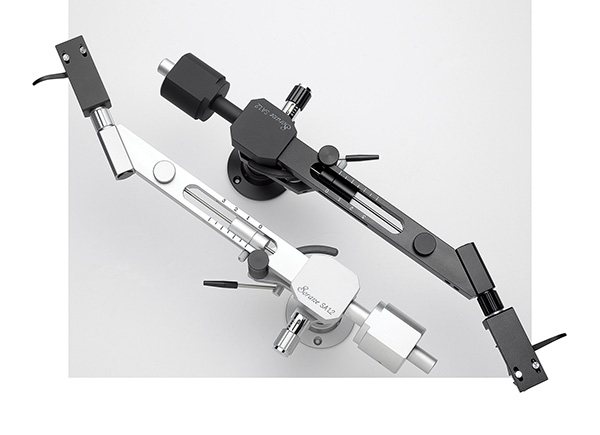 Sorane SA-1.2 Tonearm
When they were introduced in 2015, I purchased an
Abis SA-1.2 tonearm from Phillip Holmes at Mockingbird Distribution. It's the same arm as the Sorane SA1.2 being sold by Mockingbird today; only the name has changed (footnote 5).
I purchased this 9", medium-to-high–mass arm to replace the low-mass
SME 3009 that came on my
Thorens TD 124. Its manufacturer told me that the Abis arm was created, in Japan, to mate well with medium-to-low–compliance moving coils, and that it worked especially well with Denon DL-103s and Ortofon SPUs. I already owned a gang of DL-103s and an EMIA SUT wound specifically for the 103, so it seemed sensible to use an arm designed for one of my all-time favorite cartridges.
The Abis SA-1.2, which I reviewed in
Gramophone Dreams #9, is a four-piece, diecast-aluminum arm with a broad, rectangular cross-section and a jutting offset, securing an H4 bayonet-mount headshell. Inside its cutaway midsection, there's a sliding weight on a rod, intended as a calibrated mechanism for setting VTF (after zero-balancing the arm with the rear-mounted counterweight). After trying a variety of cartridges with a range of compliances, I realized I could use the Abis's rear counterweight to set tracking force (using a stylus pressure gauge) and the sliding midarm weight to adjust the SA-1.2's effective mass. This nifty trick, in concert with the use of lighter or heavier headshells, allows the Abis to adapt to a wide range of cartridge weights and compliances. This adaptability, plus the satiny feel of its dual radial bearings, made the SA-1.2 my top choice for long-haul, daily driver use.
Art Dudley wrote, "For LP enthusiasts who prize tone, touch, and timing above all else, I'd put the combination of Abis SA-1.2 and Denon DL-103 up against all but their priciest competitors; and for delivering the most of those performance characteristics for the least amount of money, it has few competitors." Obviously, I agree.
Easy listening
I'll try not to repeat myself, but the Solid9– Abis tonearm–DL-103 record playing system never distracted me from what was happening in the music. That's as high praise as I can give.
With this setup, I watched myself as I followed rhythms and noticed beats—much more than usual. While playing records with dance-inducing movements, like Antonio Vivaldi's
Mandolinen music (Acanta LP 40.22.539), it was impossible not to first admire the fine instrumental tone then to bounce along, surfing those rousing Vivaldi tempos.

My brain was stuck on time'n'tempo, so it was only natural for me to pull out a top R&B instrumental, "Time Is Tight" (7" 45rpm single, Stax STA 0028) by Booker T. & the M.G.'s. Ten seconds in, I thought,
if Art Dudley heard this, he'd be crying. Talk about "touch." At first I felt I could touch the M.G.'s phenomenal drummer, Al Jackson. Then I felt like I
was him. I started waving my arms. This is not like listening for the third whistle at the back of the orchestra. This was mainlining the best rhythm section of the 1960s.
The system was simple:
TAD CE1TX loudspeakers, driven by a
Parasound A 21+ amplifier. The Solid9 had it pushing out Al Jackson, Duck Dunn, and Steve Cropper's rhythms in a way that made Booker T.'s B3 sound like a Navy jet landing on a carrier. Behind this roaring sound, the PTP deck was quiet in a deep, silent way that my idler-wheel–plus–belt-drive Thorens TD 124 never was. With the Solid9, my large-hole 45s showed more tactility and less scratchy surface noise than they did on the direct-drive
Music Hall Stealth with the same Denon DL-103.
1960s 45s should sound like they're coming out of a jukebox in a bar or punching their way through a radio speaker; they're EQd to engage listeners' feelings and set feet dancing. And that's what this turntable did: Patsy Cline's "Heartaches" on a Decca 45 (Decca 31429) never sounded this jukebox-real before.
For fun, I checked the Solid9's speed with my RPM phone app; it came through at 44.9rpm. PTP's optional controller made fine speed adjustments a quicker, less tedious process than the all-mechanical wrench-and–steel-bar method without the controller.
Blue Note 78
I know that more than a few readers have never played a 78rpm record in their own homes. I also know that these same people would be playing 78s often when their friends came over if they realized how dramatically 78s put solid-body artists in your room with you. 78s sound raw and close-up direct to an extent that, by comparison, makes microgroove LPs sound distant and overly refined.
Playing electrically recorded "shellacs" (78rpm gramophone discs) is always a dramatically "louder," more emotionally charged experience than playing microgroove LPs (331/3 long-playing records). When electric recordings replaced acoustic recordings, in 1925, consumers felt that the new electric records sounded quicker-paced, more immediate, rhythmic, and wide-range dynamic than the previous, acoustic technology (footnote 6).
Because LPs (starting in 1948; footnote 7) were almost always recorded on magnetic tape and not direct to the master disc, their trifecta of narrower, shallower grooves; smoother, less grainy-sounding vinyl; and quieter recording equipment made microgroove recordings feel slower, gentler, less dynamic and pacey, and more finely detailed—better suited to classical music played by full orchestras.
In my house, electric recording's noisy but emotionally charged effect was never more obvious than it was playing Blue Note's sixth release: the Sidney Bechet Quintet playing George Gershwin's "Summertime" (Blue Note 78 G M 533-14), from 1939. I used a Grado 78e moving iron cartridge, which fed the 47k ohm MM input of SunValley's SV EQ1616D phono stage—the same one Yale uses with his EMT 930 rig. "Summertime" on the Solid9 sounded quieter, more easy-flowing and 1939 dreamy than it did on my Dr. Feickert belt drive or Music Hall Stealth direct drive.
Each form of recording and playback technology has its own
feel, its own menu of excitements, pleasures, and vices. Our job, as we continue our analog journey, is to explore as many technological variations as we can and see which ones excite us and suit our temperament. I'm with Yale and Art: Idler-wheel turntables
are close to god.
Footnote 5: Abis/Sibatech Inc. Room 1301, 8-25-22 Higashi-Suna Koto-ku, Tokyo 136-0074, Japan Tel: (81) 3-3645-1646. Web: sibatech.co.jp. US distributor: Mockingbird Distribution Van Alstyne, TX. Tel: (214) 668-2509. Web: mockingbirddistribution.com
Footnote 6: Many early-record enthusiasts believe that those earlier, acoustically recorded discs cannot be beat when it comes to immediacy and raw there-ness.—
Jim Austin
Footnote 7: Magnetic tape recording started out in Germany before and during WWII. The first commercially important magnetic-tape recordings in the US were made in 1947, for Bing Crosby's radio show. The first LPs, which from the very first were cut from magnetic tape, debuted the following year, with the release on Columbia of Nathan Milstein playing Mendelssohn's Concerto in E-minor for Violin and Orchestra (12" LP, ML 4001). The first 10" LP,
The Voice of Frank Sinatra (10" LP, MC 6001), was released a week later.—
Jim Austin