Sidebar 3: Measurements
JVS's sample of the Dan D'Agostino Relentless could not be shipped to me in time for my test results to be published in this issue. I therefore performed the measurements on a different sample of the Relentless, serial number 1035, at Manhattan dealer Innovative Audio. (My thanks to Innovative's Elliot Fishkin and Chris Forman.) I examined the performance with my Audio Precision SYS2722 system (see the January 2008 "As We See It").
The Relentless preserved absolute polarity (ie, was noninverting) and with the volume control set to the maximum of "99," the gain was inconsequentially higher than the specified 6dB, at 6.28dB. (This was the gain setting Innovative had been using; I didn't test the preamplifier with its maximum gain set to the alternative of 10dB.) The volume control operated in approximate 0.2–0.3dB steps; a volume control setting of "79" reduced the gain by 4.47dB, a setting of "69" reduced it by 9.8dB, and a setting of "49" reduced it by 19.9dB. I performed most of my testing with the control set to "65," which was equivalent to a gain of –5.64dB ref. unity gain.
D'Agostino doesn't specify the Relentless's balanced input impedance (footnote 1). I estimate input impedance by noting the voltage drop when I change the Audio Precision's balanced source impedance from 40 ohms to 600 ohms. This method becomes increasingly inaccurate for values greater than 100k ohms, but my measurements indicated that the Relentless's input impedance was close to 1M ohms at low and middle frequencies and still 600k ohms at the top of the audioband. The preamplifier's output impedance was an extraordinarily low 1.6 ohms at 20Hz and 1kHz, and still 2 ohms at 20kHz.
Overall, the Relentless offered excellent measured performance, better than that of the D'Agostino Momentum HD preamplifier JVS reviewed in February 2020, with very low levels of noise and distortion, even into low impedances!—John Atkinson
Footnote 1: Jason heard from D'Agostino that the input impedance "exceeds 1M ohm."—Jim Austin Footnote 2: Subsequent investigation after I returned home from Innovative showed that this wasn't the case, the noisefloor of the Audio Precision SYS2722's analog/digital-converted inputs lying below –140dB ref. 1kHz at 4V.
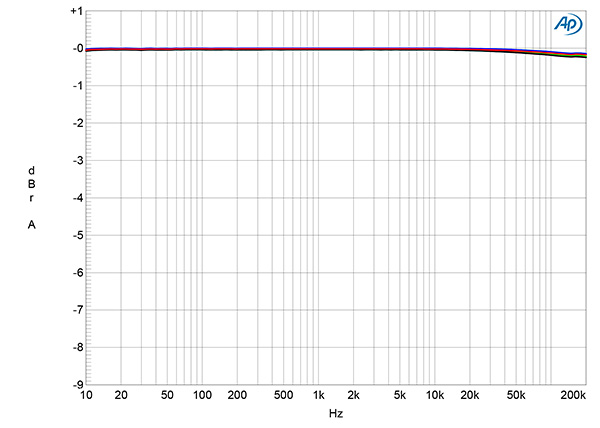
Fig.1 Dan D'Agostino Relentless, frequency response with volume control set to "99" at 1V into: 100k ohms (left channel blue, right red), 600 ohms (left green, right gray) (1dB/vertical div.).
The preamplifier's frequency response was flat from 10Hz to 100kHz into both 100k ohms (fig.1, blue and red traces) and 600 ohms (green, gray traces), with the output at 200kHz down by just 0.15dB. Fig.1 was taken with the Relentless's volume control set to the maximum. Both the frequency response and the superb channel matching were preserved at lower settings of the control.
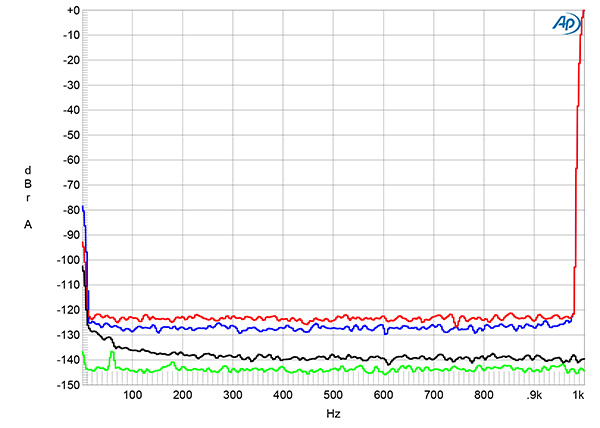
Fig.2 Dan D'Agostino Relentless, spectrum of 1kHz sinewave, DC–1kHz, at 4V (left channel blue, right red) and 0V into 100k ohms (left green, right gray) (linear frequency scale).
As I expected from the use of separate chassis for each channel, the D'Agostino preamp's crosstalk was superbly low, at –130dB in both directions below 2kHz, decreasing to –114dB at the top of the audioband (not shown). The Relentless offered extremely low noise; the wideband, unweighted signal/noise ratio, measured with the input shorted to ground but the volume control set to its maximum, was a high 83dB ref. 2V output (average of both channels, which were very similar). Restricting the measurement bandwidth to the audioband increased the S/N ratio to an excellent 94dB; switching an A-weighting filter into circuit further improved this ratio, to 98dB. There were no power supply–related spuriae in the Relentless's output with 1kHz reproduced at 4V into 100k ohms (fig.2, blue and red traces). The levels of the random noise components in this graph were a little higher than I was expecting, so I repeated the spectral analysis with the Audio Precision's output turned off and without changing the volume control setting. The random noise dropped by 15dB (green and gray traces). It might be possible, therefore, that the blue and red noisefloor spectrum is due in part to the resolution of the SYS2722's A/D converter (footnote 2); I would have liked to repeat these spectral analyses with the magazine's higher-resolution APx500 analyzer, but I hadn't taken it and its host Windows 10 PC to Innovative Audio.
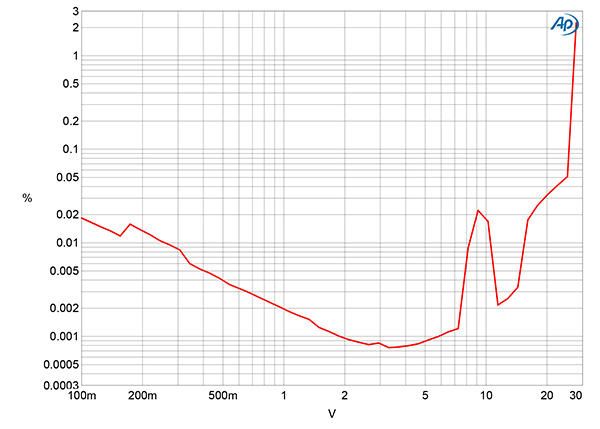
Fig.3 Dan D'Agostino Relentless, THD+N (%) vs 1kHz output voltage into 100k ohms.
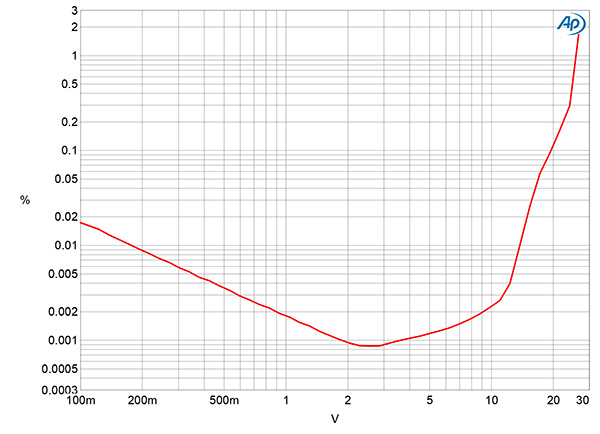
Fig.4 Dan D'Agostino Relentless, THD+N (%) vs 1kHz output voltage into 600 ohms.
Fig.3 plots the percentage of THD+noise in the Relentless's balanced output against the output voltage into 100k ohms. The downward slope of the trace below 4V in this graph is due to the reading being dominated by noise; distortion starts to rise out of the noise at voltages >4V. However, the THD is extremely low below 7.1V, where there is a sudden rise to a still-low 0.02% before dropping again. The actual clipping voltage, defined as the voltage at which the THD+N reaches 1%, is 27V, which is 10 times the voltage that will drive the D'Agostino M400 MxV monoblock power amplifiers JVS used for his auditioning into clipping. Fig.4 plots the THD+N percentage against the Relentless's output voltage into 600 ohms. The distortion starts to rise above the noise at 3V but is almost as low as it had been into 100k ohms. The discontinuity in fig.3 is absent, and the preamplifier clips at an extremely high 25V into this punishing load.
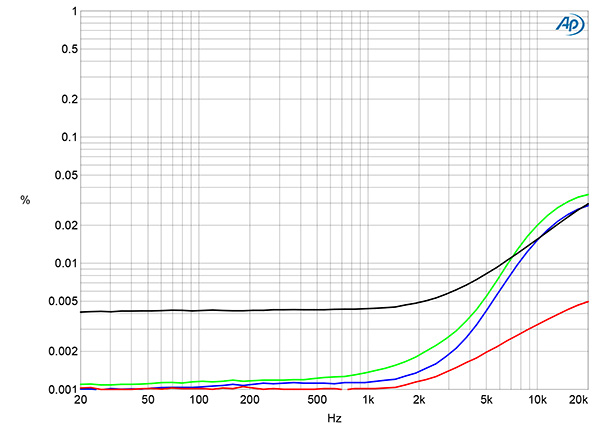
Fig.5 Dan D'Agostino Relentless, THD+N (%) vs frequency at 4V into: 100k ohms (left channel blue, right red), 600 ohms (left green, right gray).
To be sure that the reading was not dominated by noise, I measured how the Relentless's THD+N changed with frequency at 4V. The distortion percentage was extremely low throughout the audioband into 100k ohms (fig.5, blue and red traces), though with an increase in the top two audio octaves, more in the left channel (blue) than the right (red). The left channel behaved similarly into 600 ohms (green trace), but the right channel's THD+N (gray) was four times higher than the left's. It was still low in absolute terms, however.
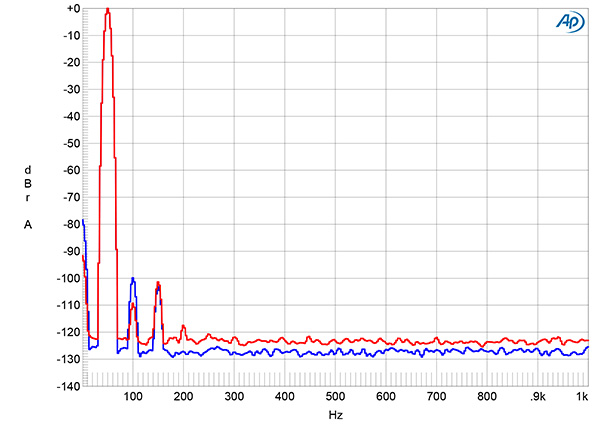
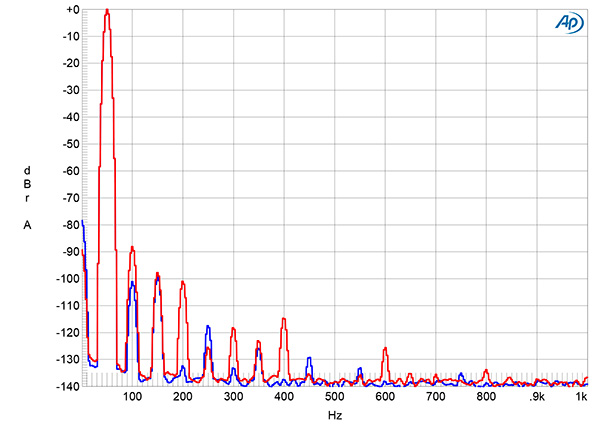
Fig.6 Dan D'Agostino Relentless, spectrum of 50Hz sinewave, DC–1kHz, at 4V into 100k ohms (left channel blue, right red; linear frequency scale).
Fig.7 Dan D'Agostino Relentless, spectrum of 50Hz sinewave, DC–1kHz, at 4V into 600 ohms (left channel blue, right red; linear frequency scale).
The spectrum in fig.6 was taken at 4V into 100k ohms. The third harmonic lies at –101dB (0.0009%) in both channels, with the second harmonic close to the same level in the left channel (blue trace). Repeating this analysis at the same level into 600 ohms (fig.7), the third harmonic remained at the same level in both channels, as did the second harmonic in the left channel, but the second harmonic in the right channel rose to –89dB (0.003%, red) and was joined by the fourth harmonic at –100dB. Peculiarly, the noisefloor in fig.7 is 12–15dB lower than it is in fig.6, a result I found repeatable. Neither the differences in the two channels' distortion signatures nor the noisefloor differences into different loads will have any effect on sound quality.
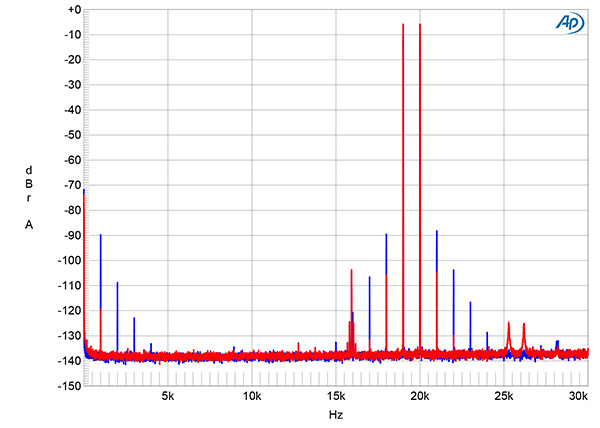
Fig.8 Dan D'Agostino Relentless, HF intermodulation spectrum, DC–30kHz, 19+20kHz at 2V into 600 ohms (left channel blue, right red; linear frequency scale).
Tested for intermodulation distortion with an equal mix of 19 and 20kHz tones at a peak level of 2V into 600 ohms (fig.8), the second-order difference product (at 1kHz) lay at a superbly low –120dB (0.0001%) in the right channel (red trace). It lay at –90dB in the left channel (0.003%, blue trace), as did the higher-order products—still a very low level of intermodulation distortion, especially taking into consideration that this is with the preamplifier driving 600 ohms.
Footnote 1: Jason heard from D'Agostino that the input impedance "exceeds 1M ohm."—Jim Austin Footnote 2: Subsequent investigation after I returned home from Innovative showed that this wasn't the case, the noisefloor of the Audio Precision SYS2722's analog/digital-converted inputs lying below –140dB ref. 1kHz at 4V.