All photographs: Thomas R. Horrall
Hosted by Stereophile's John Marks, on Saturday February 4, the Connecticut Audio Society and the Boston Audio Society held a joint meeting in Providence, Rhode Island at The First Baptist Church in America. The Third Meeting House of the Church (1774–1775) is a US National Historical Landmark. The Auditorium retains almost all of its original 1775-vintage horsehair plaster, which contributes to its excellent acoustics.
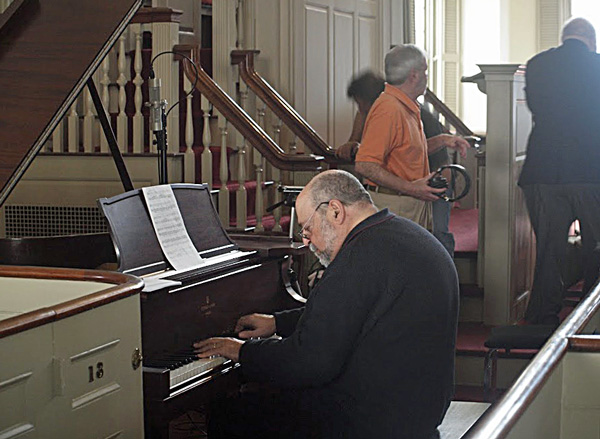
The event was a Workshop on "Making Good Recordings in a Church." Those so interested were invited to bring their own recording gear to the Church; the 48 attendees brought everything from shirt-pocket recorders to imposing surround-sound arrays. Before the formal start of the workshop, those in attendance were invited to participate in a Mid-Side Microphone Technique "Petting Zoo." Minister of Music Stephen T. Martorella, featured in the opening photo, played a Scriabin Prelude on a Steinway grand piano as a sound source.
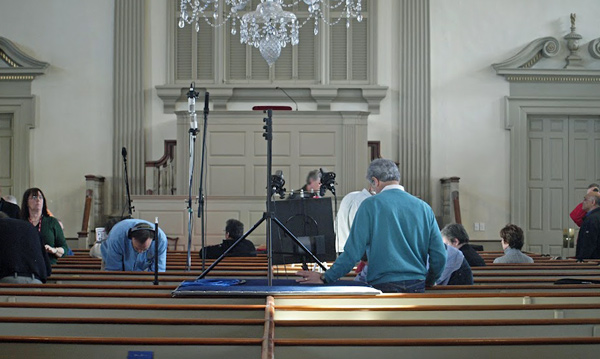
A Coles 4050 stereo mike array consisting of two figure-of-eight ribbon microphones was set up in the Mid-Side configuration, which uses a sum-and-difference matrix to derive two "virtual microphones." By varying the balance of the Mid and Side channels in the matrix, the width of the virtual microphone array (and therefore the amount of ambience it captures) varies.
The photograph above shows the microphone array; John Marks is in the orange polo shirt; the figure to the right with his back to the camera is loudspeaker designer Winslow Burhoe.
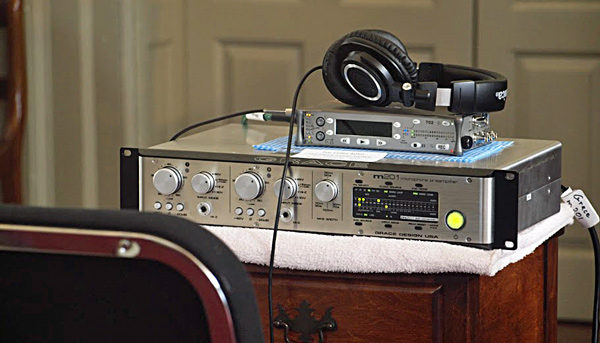
Grace Design's m201 combination microphone preamplifier and analog-to-digital converter (pictured below) provided the M-S matrix function; a Sound Devices 702 was the high-resolution digital recorder. Attendees could listen to the live piano over Audio-Technica M50 headphones and use the Grace m201's M-S Width control to experiment with the Mid-Side technique. (John Marks thanks Independent Audio for the loan of the Coles stereo mike kit and Grace Design for the loan of the m201, as well as thanking the Church for its hospitality.)
 The formal part of the program started with a talk by John Marks on the history of the Church and its Third Meeting House, the physics of pure-pressure versus velocity microphones and what that means for microphone placement and techniques, and some guidelines about recording organs and choirs in a church.
John prepared two handouts; the first consisting of a "cheat sheet" of references and resources, which also included a copy of John Atkinson's 1986 article Stereo & the Soundstage; the second handout was John Marks's article for Early Music America magazine's audience of academics and musicians, Gear for Your Gig.
At the conclusion of John's talk, Steve Martorella had the Church's 1834 Hook/2000 Foley-Baker pipe organ play back via Peterson MIDI (a system similar to Yamaha's Disklavier player pianos) several previously-performed demonstration tracks including Otto Olsson's Jul (of Cantate Domino LP and CD fame); Duruflé's Toccata on "Veni Creator Spiritus"; and Ralph Vaughan Williams's Preludes Founded on Welsh Hymn Tunes Bryn Calfaria and Hyfrydol. To supply that missing element of audience participation, John handed out Blake's lyrics to Parry's Jerusalem and suggested, no, ordered everyone to sing along with the organ the second time around.
For a live encore Steve played what John Marks introduced as "an ancient English melody" but what was in reality Steve's version of Procol Harum's A Whiter Shade of Pale.
The formal part of the program started with a talk by John Marks on the history of the Church and its Third Meeting House, the physics of pure-pressure versus velocity microphones and what that means for microphone placement and techniques, and some guidelines about recording organs and choirs in a church.
John prepared two handouts; the first consisting of a "cheat sheet" of references and resources, which also included a copy of John Atkinson's 1986 article Stereo & the Soundstage; the second handout was John Marks's article for Early Music America magazine's audience of academics and musicians, Gear for Your Gig.
At the conclusion of John's talk, Steve Martorella had the Church's 1834 Hook/2000 Foley-Baker pipe organ play back via Peterson MIDI (a system similar to Yamaha's Disklavier player pianos) several previously-performed demonstration tracks including Otto Olsson's Jul (of Cantate Domino LP and CD fame); Duruflé's Toccata on "Veni Creator Spiritus"; and Ralph Vaughan Williams's Preludes Founded on Welsh Hymn Tunes Bryn Calfaria and Hyfrydol. To supply that missing element of audience participation, John handed out Blake's lyrics to Parry's Jerusalem and suggested, no, ordered everyone to sing along with the organ the second time around.
For a live encore Steve played what John Marks introduced as "an ancient English melody" but what was in reality Steve's version of Procol Harum's A Whiter Shade of Pale.
 John Marks has uploaded to his Public Dropbox the following items, which readers may download:
A large MP3 file of his talk (which lasts about 40 minutes).
Handout #1, the "cheat sheet" and JA's Stereo & the Soundstage article.
Handout #2, JM's Early Music America article.
An MP3 compilation of excerpts of the organ pieces (of approximately one minute's duration each, in order to stay within the "Fair Use" safe harbor for copyrighted compositions).
John Marks has uploaded to his Public Dropbox the following items, which readers may download:
A large MP3 file of his talk (which lasts about 40 minutes).
Handout #1, the "cheat sheet" and JA's Stereo & the Soundstage article.
Handout #2, JM's Early Music America article.
An MP3 compilation of excerpts of the organ pieces (of approximately one minute's duration each, in order to stay within the "Fair Use" safe harbor for copyrighted compositions).
The formal part of the program started with a talk by John Marks on the history of the Church and its Third Meeting House, the physics of pure-pressure versus velocity microphones and what that means for microphone placement and techniques, and some guidelines about recording organs and choirs in a church.
John Marks has uploaded to his Public Dropbox the following items, which readers may download:
A large MP3 file of his talk (which lasts about 40 minutes).
Handout #1, the "cheat sheet" and JA's Stereo & the Soundstage article.
Handout #2, JM's Early Music America article.
An MP3 compilation of excerpts of the organ pieces (of approximately one minute's duration each, in order to stay within the "Fair Use" safe harbor for copyrighted compositions).