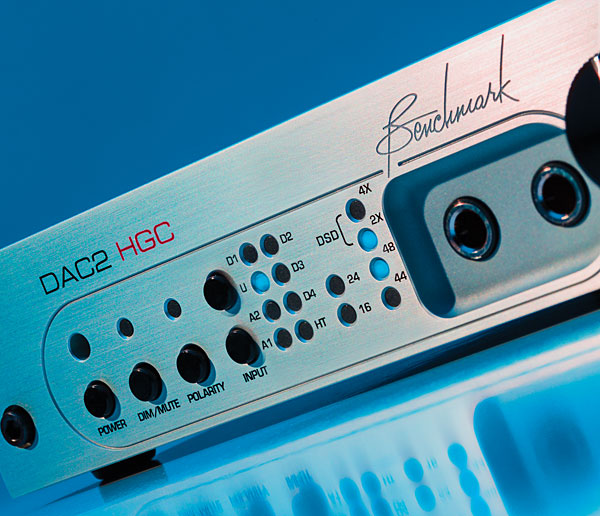
In particular, the DAC2 HGC's treble performance seemed a big step forward from that of the DAC1 and DAC1 HDR, both of which I've used extensively. My impression was that the DAC2's treble was far more silky and smooth than the earlier Benchmarks. To confirm this, I compared the DAC2 HGC head-to-head with the DAC1 HDR. Sure enough, the DAC2 had slightly cleaner treble performance than the older DAC1 HDR. But surprisingly, the DAC2 offered far more body on the tone, which can be heard as a more solid sonic image, or perhaps a slightly more full-bodied rendering of each sound. The Benchmark DACs of old were sometimes criticized for sounding a bit cold and analytical. The DAC2 didn't editorialize euphonically, but it did seem to have a lot more soul in its music making. It was also noticeably better than the DAC1 HDR at keeping aural images separate, and creating the sense that little to no noise was riding along with the music.
I also compared the DAC2 HGC with the Centrance DACmini. While the DACmini offers supple tones and a laid-back perspective, the DAC2 was all excitement and immediacy. The Benchmark also offered greater image separation, and much better control in the bass. Both DACs played musically, but felt very different in terms of pacing, transient attack, and release. The DAC2 HGC also gets the nod for the perceived resolution of every recording I played. Via the DAC2, I felt I could hear far deeper, and with less effort, into each track.
Get out of my head
Next, I inserted the DAC2 HGC in my audio system, using the Bel Canto e.One CD2 as a front end and connecting the Benchmark directly to my Rogue Audio M-180 monoblocks (with KT120 output tubes). As fall was in full swing in Portland, Oregon, I put on my favorite autumnal album of all time, Beth Gibbons & Rustin Man's Out of Season (CD, Go Beat 66574-2), a side project she did in 2002 with Talk Talk bassist Paul Webb (aka Rustin Man). It sounded great. The DAC2 presented a very up-front and immediate perspective on this album. Gibbons's voice was solidly presented in the mix, with excellent tonal evenness across the audioband.
 Turning to classical music, I played Arvo Pärt's Tabula Rasa, from violinist Gidon Kremer's excellent Silencio, with duo violinist Tatjana Grindenko and Eri Klas leading the Kremerata Baltica (CD, Nonesuch 79582-2). The DAC2 laid out a very quiet background and extraordinarily precise images. With recordings of solo violin, I always listen for the proper balance of the sound of the instrument's body, the bow on the string, and, most important, the way the violin's overtones can light up the acoustic of the space in which it was recorded. There should always be a halo and shimmer in the octave above the written note, with a nice balance of the fifth above the octave of each note complementing the fundamental. In this regard, the DAC2 delivered a convincing depiction of what a real violin sounds like. The DAC2's top-end openness and ability to render treble information without hardness, grain, or etch was excellent. Again, the DAC2 HGC presented this music vividly forward in perspective, with possibly a tiny bit of emphasis on the top octaves, but did so in a very natural way. It also rendered the textures of the prepared piano in Tabula Rasa with an engaging vividness. I sat transfixed by this music as played through the DAC2 HGC.
Twice the price—twice as nice?
Turning to classical music, I played Arvo Pärt's Tabula Rasa, from violinist Gidon Kremer's excellent Silencio, with duo violinist Tatjana Grindenko and Eri Klas leading the Kremerata Baltica (CD, Nonesuch 79582-2). The DAC2 laid out a very quiet background and extraordinarily precise images. With recordings of solo violin, I always listen for the proper balance of the sound of the instrument's body, the bow on the string, and, most important, the way the violin's overtones can light up the acoustic of the space in which it was recorded. There should always be a halo and shimmer in the octave above the written note, with a nice balance of the fifth above the octave of each note complementing the fundamental. In this regard, the DAC2 delivered a convincing depiction of what a real violin sounds like. The DAC2's top-end openness and ability to render treble information without hardness, grain, or etch was excellent. Again, the DAC2 HGC presented this music vividly forward in perspective, with possibly a tiny bit of emphasis on the top octaves, but did so in a very natural way. It also rendered the textures of the prepared piano in Tabula Rasa with an engaging vividness. I sat transfixed by this music as played through the DAC2 HGC.
Twice the price—twice as nice?
As Benchmark has improved on their DACs over the years, their prices have risen. At $1995, the DAC2 HGC costs twice as much as the basic DAC1 ($995). Over the years, as I compared the DAC1 to more expensive offerings from other companies, it usually fared well. But there was always the catch: the DAC1 was really still a budget DAC. With the DAC2 HGC, Benchmark has entered more rarified company. Although my Bel Canto e.One DAC3.5 VBS ($4985 with power supply) costs more than twice as much, and I've found it to sound better than many better-known and more costly DACs from other companies, I thought it would be good to pit the DAC2 against my reference. Pärt's Tabula Rasa reminded me why I like the DAC3.5 VBS so much. Through it, the soundstage was a good 30° wider to each side than through the DAC2 HGC, and instruments had greater separation between them. And the front-to-back layering, while very good through the Benchmark, was clearly better through the Bel Canto. In fact, the DAC3.5's ability to leaven and separate the individual elements of the stereo image let me completely rehear what Pärt had composed in Tabula Rasa. Through the DAC3.5, I easily became aware of the dialogue between the two solo violins and the orchestral strings—something I didn't quite catch via the DAC2. Pärt is clearly trying to make the texture of the two solo violins into one homogenous instrument, but I found it fascinating to be able to hear the two violinists weave around each other so skillfully and hauntingly.
I also heard a greater separation of instruments on the Beth Gibbons album via the e.One DAC3.5. With "Sand River," the Bel Canto offered a bit better resolution, control, and texture in the midbass, as well as a wider, more differentiated soundstage. The DAC3.5's perspective was a bit more laid-back overall, and it placed instruments farther back on the soundstage than did the Benchmark. The DAC2 HGC had an up-front immediacy that I very much enjoyed with some tracks, though not quite the Bel Canto's unambiguous front-to-back layering.
What really struck me was how similar the Benchmark and Bel Canto were in terms of tonal balance, treble resolution, and delicacy. Benchmark's various DAC1s had sounded far cooler than Bel Canto's DAC3.5 VBS, with a slight grain and etch in the treble. But the DAC2 HGC was far closer to the Bel Canto's tonal balance and ability to easily render an extended treble. I was very surprised that the Benchmark, at less than half the Bel Canto's price, could so closely compete with it in sound. In fact, aside from the issue of image width, the Benchmark DAC2 was very close to the Bel Canto's performance in most other musically meaningful ways.
Unlike the Bel Canto, the DAC2 HGC offers DSD decoding, though I wasn't able to test that aspect of its performance from either its USB or coaxial inputs. [I compare the Benchmark's sound on DSD with that of the Auralic Vega in my review of the latter elsewhere in this issue.—JA]
Summing Up
The DAC2 HGC is a step forward in every way from Benchmark Media's DAC1 models. It offers easy computer interfacing, a myriad of input options, remote control, and solid build quality, all from a company that has been around a while, and that stands behind its products. More than that, the DAC2 HGC is a fantastic value in terms of its sheer musical ability. It offers fantastic resolution, an even tonal balance, and an engaging, up-front perspective on the music. I can safely predict Benchmark's DAC2 HGC will be a hit.
Next, I inserted the DAC2 HGC in my audio system, using the Bel Canto e.One CD2 as a front end and connecting the Benchmark directly to my Rogue Audio M-180 monoblocks (with KT120 output tubes). As fall was in full swing in Portland, Oregon, I put on my favorite autumnal album of all time, Beth Gibbons & Rustin Man's Out of Season (CD, Go Beat 66574-2), a side project she did in 2002 with Talk Talk bassist Paul Webb (aka Rustin Man). It sounded great. The DAC2 presented a very up-front and immediate perspective on this album. Gibbons's voice was solidly presented in the mix, with excellent tonal evenness across the audioband.
Turning to classical music, I played Arvo Pärt's Tabula Rasa, from violinist Gidon Kremer's excellent Silencio, with duo violinist Tatjana Grindenko and Eri Klas leading the Kremerata Baltica (CD, Nonesuch 79582-2). The DAC2 laid out a very quiet background and extraordinarily precise images. With recordings of solo violin, I always listen for the proper balance of the sound of the instrument's body, the bow on the string, and, most important, the way the violin's overtones can light up the acoustic of the space in which it was recorded. There should always be a halo and shimmer in the octave above the written note, with a nice balance of the fifth above the octave of each note complementing the fundamental. In this regard, the DAC2 delivered a convincing depiction of what a real violin sounds like. The DAC2's top-end openness and ability to render treble information without hardness, grain, or etch was excellent. Again, the DAC2 HGC presented this music vividly forward in perspective, with possibly a tiny bit of emphasis on the top octaves, but did so in a very natural way. It also rendered the textures of the prepared piano in Tabula Rasa with an engaging vividness. I sat transfixed by this music as played through the DAC2 HGC.
Twice the price—twice as nice?As Benchmark has improved on their DACs over the years, their prices have risen. At $1995, the DAC2 HGC costs twice as much as the basic DAC1 ($995). Over the years, as I compared the DAC1 to more expensive offerings from other companies, it usually fared well. But there was always the catch: the DAC1 was really still a budget DAC. With the DAC2 HGC, Benchmark has entered more rarified company. Although my Bel Canto e.One DAC3.5 VBS ($4985 with power supply) costs more than twice as much, and I've found it to sound better than many better-known and more costly DACs from other companies, I thought it would be good to pit the DAC2 against my reference. Pärt's Tabula Rasa reminded me why I like the DAC3.5 VBS so much. Through it, the soundstage was a good 30° wider to each side than through the DAC2 HGC, and instruments had greater separation between them. And the front-to-back layering, while very good through the Benchmark, was clearly better through the Bel Canto. In fact, the DAC3.5's ability to leaven and separate the individual elements of the stereo image let me completely rehear what Pärt had composed in Tabula Rasa. Through the DAC3.5, I easily became aware of the dialogue between the two solo violins and the orchestral strings—something I didn't quite catch via the DAC2. Pärt is clearly trying to make the texture of the two solo violins into one homogenous instrument, but I found it fascinating to be able to hear the two violinists weave around each other so skillfully and hauntingly.
The DAC2 HGC is a step forward in every way from Benchmark Media's DAC1 models. It offers easy computer interfacing, a myriad of input options, remote control, and solid build quality, all from a company that has been around a while, and that stands behind its products. More than that, the DAC2 HGC is a fantastic value in terms of its sheer musical ability. It offers fantastic resolution, an even tonal balance, and an engaging, up-front perspective on the music. I can safely predict Benchmark's DAC2 HGC will be a hit.