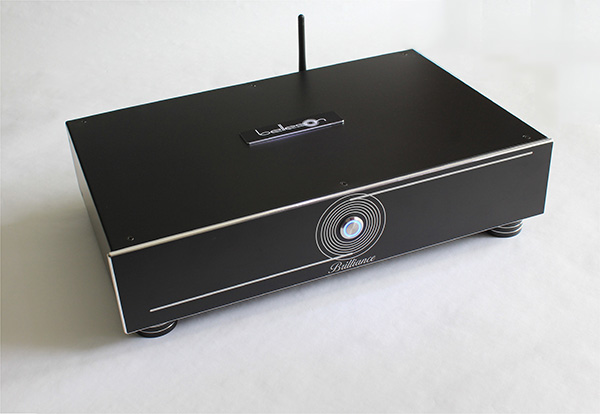
Product photos by Tyler Lo.
My oldest aural memory is my mother singing nursery rhymes to send me off to sleep. After that, it's vinyl records. Being the third child, I benefited from a constant stream of audio-related hand-me-downs, starting with a 1960s kiddie phonograph and a pile of well-worn records from my older brothers. Aside from welding my consciousness and pleasure sensors to recorded sound, those records formed a common reference root for me, my older brothers, and my younger brother, even though our births spanned 11 years. We all spun the same or similar records when we were little kids (footnote 1).
By the time I entered fifth grade, I had a Lafayette starter stereo system that included a BSR turntable that was less than brutal (but hardly gentle) on records, and I had started developing my own musical tastes. Among my first records were some mid-'70s Capitol Beatles platters purchased at the local E.J. Korvette store.
These were not great times for vinyl records. It's true that they were selling by the truckload, but by the late '70s and early '80s, those mass-market records were often paper-thin, warped, and noisy. Sometimes they were pressed off-center, which caused annoying wow. Ironically, this was a time when studio recording techniques and equipment advanced and the art of vinyl mastering improved. In some cases—for instance, the beloved "AB" first pressing of Steely Dan's Aja, or Bob Ludwig's first cut of David Bowie's Let's Dance—the stars aligned and a platter bought at the local department store was well-made and sounded fantastic. In too many cases, though, the quality was ... uneven. The word "terrible" also comes to mind.
The modern LP business model is different from when vinyl was the mainstream medium. A vinyl record is a luxury niche product, with a business model that allows for higher quality. People who buy a record are paying far more than it would cost them to stream that album (assuming that album is one of many streamed over dozens of hours a month with a $10 streaming subscription). Obviously that physical artifact, carrying a mechanical representation of sound, is of high value to the person who buys it.
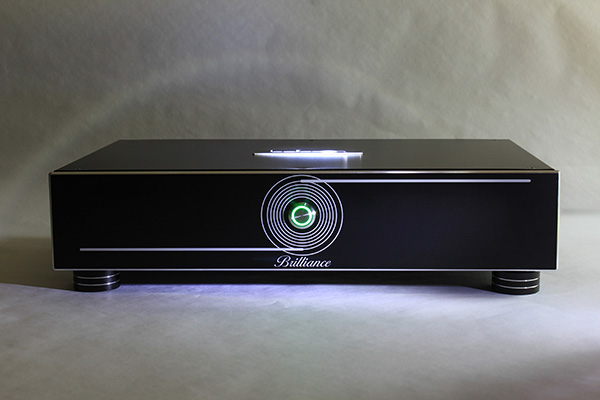 A Wi-Fi–connected phono preamp
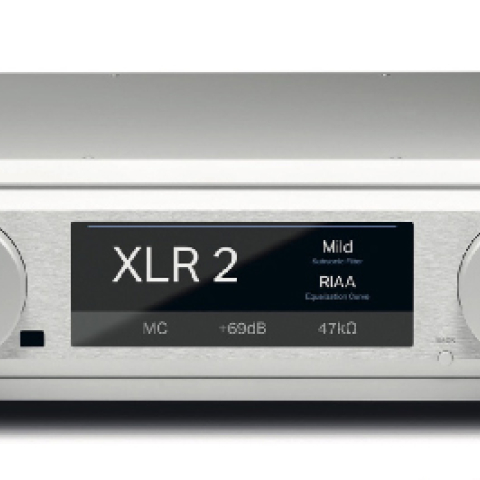
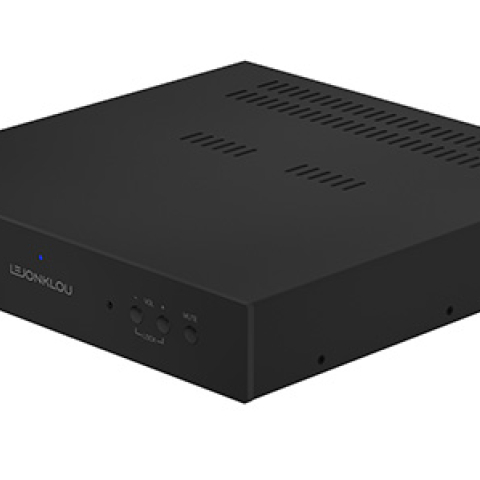
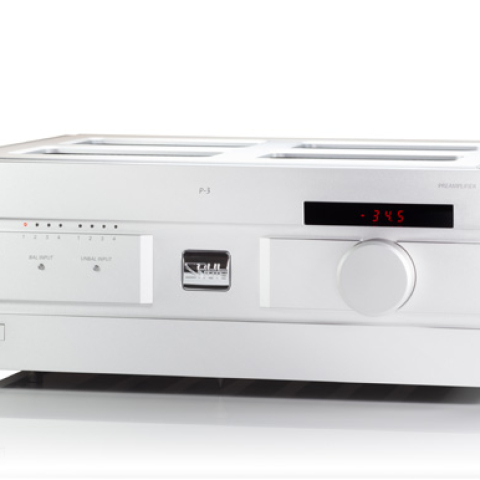
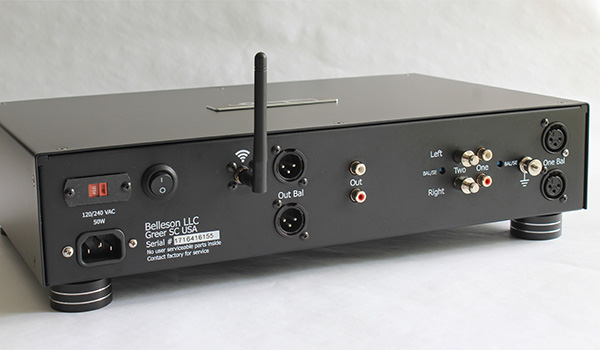
The Belleson Brilliance phono preamp, made in Greer, South Carolina, offers a somewhat unique proposition: all-analog solid state phono preamplification with wireless control of multiple cartridge-loading parameters via a supplied Lenovo tablet or the web browser in your phone, tablet, or computer. This is made possible via a built-in Wi-Fi transceiver, which can establish its own network or connect to the home network. On the preamp itself, there are only two controls: the on/off pushbutton on the front and the balanced/single-ended selection for each of the two rear-panel inputs. You can even switch between those two inputs via wireless remote control. Remote control allowed designer Brian Lowe to go for a handsome, minimalist aesthetic, absent a front panel full of switches and indicator lights, or a complex menu-tree control interface. Two tonearms or turntables may be connected to the Brilliance at once. Input 1 has XLR and RCA connectors; balanced or single-ended is selected by a small pushbutton switch near the RCA sockets. (The user manual suggested using "the wide end of a broken tooth pick to actuate" the switch.) Input 2 is RCA-only but also switchable balanced or single-ended. The manual explains that selecting SE (single-ended), pushing the switches in, "ground(s) the shield side" of the inputs, I assume to mean pin 1 of the XLR and the shield of the RCA connector. The manual further suggests that moving magnet cartridges be switched to SE, moving coil cartridges to BAL(anced). In practice, I found that my Hana SL MK II low-output MC worked best balanced; in the SE mode, there was a slight background hum. There are two output choices, XLR balanced and RCA single-ended outputs. In all-caps, the manual cautions against using both at once.
 Each input may be set for either MM or MC. In MM mode, gain is selectable to 30, 36, 44, or 50dB. I set Input 2 to MM and used 44dB for all the cartridges I connected. Resistance is selectable; I kept it at 47k ohms, consistent with manufacturer recommendations for every MM cartridge I've studied. Capacitance is what matters to the sound of MMs, and there are choices: 0–700pF in 50pF increments. Some MM cartridges, for instance the Ortofon 2M Blue, sound good over a relatively wide range of capacitance. Others, like the Shure V15 Type III or M97xe, need a capacitance in a certain range to sound their best. The capacitance loading of a MM should be dialed in for the most even-sounding upper midrange and low treble. You want to avoid a frequency response bump that makes things sound metallic, fatiguing, or downright weird. You also want to dial in enough capacitance to avoid a frequency response dip that makes the sound washed-out and unexciting.
I set Input 1 for MC and connected my Hana SL MK II, the only low-output MC cartridge I own. The gain options for MC are 50, 56, 64, and 70dB. For MCs, capacitance doesn't matter much; I set it at 100pF. Resistive loading is what's important for MCs, and there are plenty of choices: 20, 65, 110, 150, 260, 350, and 400 ohms, and 47k ohms. The goal of dialing in resistance with a MC cartridge is to get the top end sounding bright enough but not too bright. Go as high as necessary but no higher. To my ears, the Hana sounded best at 260 ohms. Some interwebs clacking fingers recommend a 400 ohm load for the SL MK II; I found the treble as bright as I wanted at 260 ohms, which is already way above the rule-of-thumb 1:10 ratio for this 8 ohm cartridge. More options are better, since everyone hears differently, and every system sounds different from the next.
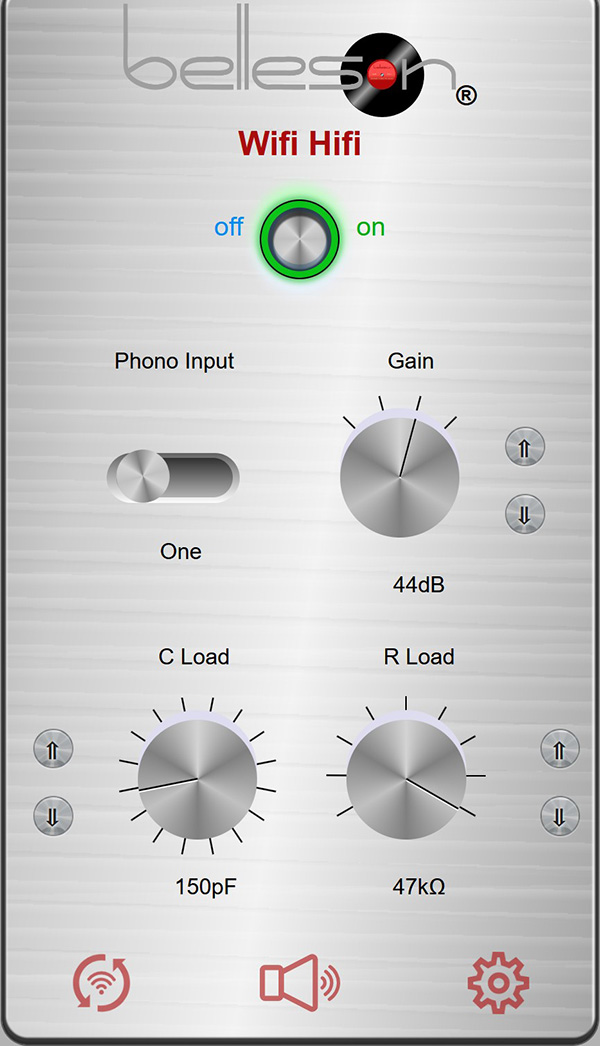
Rather than mate the Belleson's Wi-Fi transceiver to my Wi-Fi network, I kept it self-contained and used the supplied Lenovo tablet and the Belleson's own network. The Lenovo's 6.5" × 4" screen was plenty big enough for Belleson's virtual control panel, which has two screens: the main control panel and a settings panel. The main control panel includes power on/off, input switching, and settings for Gain, C Load (capacitance), and R Load (resistance). At the bottom are virtual pushbuttons to refresh Wi-Fi and mute the Brilliance output, and a gear button to move to the Settings screen.
Each input may be set for either MM or MC. In MM mode, gain is selectable to 30, 36, 44, or 50dB. I set Input 2 to MM and used 44dB for all the cartridges I connected. Resistance is selectable; I kept it at 47k ohms, consistent with manufacturer recommendations for every MM cartridge I've studied. Capacitance is what matters to the sound of MMs, and there are choices: 0–700pF in 50pF increments. Some MM cartridges, for instance the Ortofon 2M Blue, sound good over a relatively wide range of capacitance. Others, like the Shure V15 Type III or M97xe, need a capacitance in a certain range to sound their best. The capacitance loading of a MM should be dialed in for the most even-sounding upper midrange and low treble. You want to avoid a frequency response bump that makes things sound metallic, fatiguing, or downright weird. You also want to dial in enough capacitance to avoid a frequency response dip that makes the sound washed-out and unexciting.
I set Input 1 for MC and connected my Hana SL MK II, the only low-output MC cartridge I own. The gain options for MC are 50, 56, 64, and 70dB. For MCs, capacitance doesn't matter much; I set it at 100pF. Resistive loading is what's important for MCs, and there are plenty of choices: 20, 65, 110, 150, 260, 350, and 400 ohms, and 47k ohms. The goal of dialing in resistance with a MC cartridge is to get the top end sounding bright enough but not too bright. Go as high as necessary but no higher. To my ears, the Hana sounded best at 260 ohms. Some interwebs clacking fingers recommend a 400 ohm load for the SL MK II; I found the treble as bright as I wanted at 260 ohms, which is already way above the rule-of-thumb 1:10 ratio for this 8 ohm cartridge. More options are better, since everyone hears differently, and every system sounds different from the next.
Rather than mate the Belleson's Wi-Fi transceiver to my Wi-Fi network, I kept it self-contained and used the supplied Lenovo tablet and the Belleson's own network. The Lenovo's 6.5" × 4" screen was plenty big enough for Belleson's virtual control panel, which has two screens: the main control panel and a settings panel. The main control panel includes power on/off, input switching, and settings for Gain, C Load (capacitance), and R Load (resistance). At the bottom are virtual pushbuttons to refresh Wi-Fi and mute the Brilliance output, and a gear button to move to the Settings screen.
 The Settings screen allows you to choose the networking mode (Internal or "Your Wifi"), selecting MM or MC for each input, a screen lock on/off, and an arrow to go back to the control panel. Selecting "Your Wifi" activates a drop-down menu to select the network and a box to enter the password. As I said, I did not attempt this at home. If I had, I could have accessed its controls and settings via the web browser of any phone or computer on the network.
Under the hood
The Settings screen allows you to choose the networking mode (Internal or "Your Wifi"), selecting MM or MC for each input, a screen lock on/off, and an arrow to go back to the control panel. Selecting "Your Wifi" activates a drop-down menu to select the network and a box to enter the password. As I said, I did not attempt this at home. If I had, I could have accessed its controls and settings via the web browser of any phone or computer on the network.
Under the hoodThere is a lot going on with the Belleson Brilliance design. Company founder and chief engineer Lowe wrote two articles describing his circuits in audioXpress magazine. Refer to those for a deep dive. Lowe will also provide a white paper about the design if you contact him via the Belleson website. To keep it short and simple: The Brilliance has four inverting gain stages. RIAA deemphasis is split between stages two and three, first the treble cut, then the bass boost. Each gain stage uses a Lowe-designed op-amp, called the Bel-Amp, containing discrete transistors and ICs. The Brilliance contains 18 Bel-Amps: eight per phono input (four per channel), and two to drive the balanced outputs.
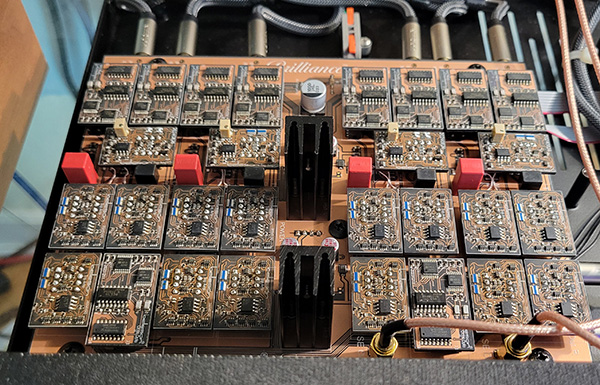 Lowe said the circuit is a combination of current and voltage amplification. "Our circuit is not transimpedance (using current as the input signal). ... Stage 1 is voltage in, current out, transconductance. That output current flows through the stage-2 feedback resistor, generating voltage out of stage 2 (transimpedance). The cool part is, we can get 40+dBV of current gain between Stage 1 in and Stage 2 out with very low distortion." The net result is plenty of headroom and low background noise even at very high gain. In my system, I heard no hiss using MM cartridges with 44dB gain, volume set at comfortable, high listening level. With my MC cartridge at 64dB gain, I heard a faint hiss at the listening seat, not enough to interfere with music listening and way below the surface noise of LPs. Even when I cranked the system volume to the max, I heard no hum with either input. Impressive!
Belleson claims ±0.2dB accuracy to the RIAA curve. I'll let John Atkinson's measurements confirm that (or not) and determine the signal/noise ratio and overload margin. The Brilliance manual lists those specs for just 30dB gain, which almost no cartridge would use. It would be more realistic to know these specs with, say, 44 and 64dB gain, which are appropriate for a wide range of MM and MC cartridges.
Lowe's implementation of remote-controlled switching of inputs, gain, and loading is also somewhat unique. He uses blocks of optical switches, which are made in-house. Switching is silent—no clicking relays. Optical switches also don't have the moving parts of relays, meaning that in theory they are less prone to failure due to corrosion or connection-related problems.
Lowe said the circuit is a combination of current and voltage amplification. "Our circuit is not transimpedance (using current as the input signal). ... Stage 1 is voltage in, current out, transconductance. That output current flows through the stage-2 feedback resistor, generating voltage out of stage 2 (transimpedance). The cool part is, we can get 40+dBV of current gain between Stage 1 in and Stage 2 out with very low distortion." The net result is plenty of headroom and low background noise even at very high gain. In my system, I heard no hiss using MM cartridges with 44dB gain, volume set at comfortable, high listening level. With my MC cartridge at 64dB gain, I heard a faint hiss at the listening seat, not enough to interfere with music listening and way below the surface noise of LPs. Even when I cranked the system volume to the max, I heard no hum with either input. Impressive!
Belleson claims ±0.2dB accuracy to the RIAA curve. I'll let John Atkinson's measurements confirm that (or not) and determine the signal/noise ratio and overload margin. The Brilliance manual lists those specs for just 30dB gain, which almost no cartridge would use. It would be more realistic to know these specs with, say, 44 and 64dB gain, which are appropriate for a wide range of MM and MC cartridges.
Lowe's implementation of remote-controlled switching of inputs, gain, and loading is also somewhat unique. He uses blocks of optical switches, which are made in-house. Switching is silent—no clicking relays. Optical switches also don't have the moving parts of relays, meaning that in theory they are less prone to failure due to corrosion or connection-related problems.
Footnote 1: A favorite LP was Space Songs by Tom Glazer and Dottie Evans, which included "Why Does the Sun Shine?," later covered by They Might Be Giants. See youtu.be/3JdWlSF195Y. Footnote 2: See riaa.com/u-s-sales-database. Footnote 3: See tinyurl.com/5c3fdswh; scroll halfway down the page and click the Tech Talk link.