In preparation for this report, I read a review of the VK-56SE's ancestor, the VK-55SE, by one of my favorite-ever Stereophile writers: the late Wes Phillips, writing in the April 2010 issue. Wes described its sound: "As I listened to Arturo Delmoni's superb disc of solo violin works by Ysaÿe, Kreisler, and Bach (CD, John Marks JMR-14), the character of the BAT was immediately apparent: the sound was vivid, relaxed, and liquid." Those three adjectives also describe my early impressions of the VK-56SE.
A week later, I put on Björk Guðmundsdóttir and the Tríó Guðmundar Ingólfssonar performing the title track of their jazz-inspired album Gling-Gló (24/44.1 FLAC, Bad Taste/One Little Indian/Tidal): "Maybe he's crazy, maybe he's slow / Maybe I'm crazy, maybe I know / Can't help lovin' that man of mine." Before this romantic ditty with the great title finished, I was thinking, I don't know what this BAT amp costs, but it sounds very expensive. I was driving the VK-56SE with the Rogue Audio RP-7 preamp and streaming Tidal through Chord's Qutest DAC; the sound was extremely tactile and analog-like. Speaking of which . . .
In search of higher pleasures, I switched to a goose-bump–inducing recording: a teal-labeled 1966 Argo LP of Vivaldi's Gloria and Pergolesi's Magnificat (Argo ZRG 505) featuring a most star-studded British cast: vocal soloists Elizabeth Vaughan, Janet Baker, Ian Partridge, and Christopher Keyte, accompanied by the Choir of King's College Cambridge, directed by David Willcocks, and the orchestra of the Academy of St Martin-in-the-Fields, led by Neville Marriner, recorded by Kenneth Wilkinson. All that talent was joyously conveyed by a My Sonic Lab Ultra Eminent Ex moving-coil cartridge installed in a Jelco TK-850L tonearm mounted on a Dr. Feickert Analogue Blackbird turntable.
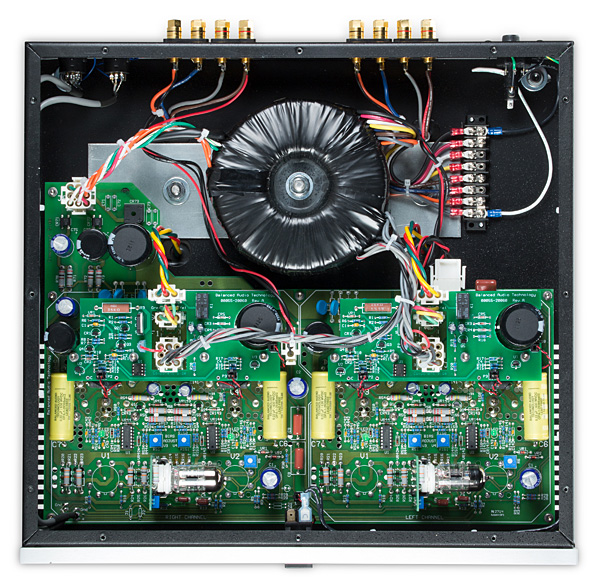
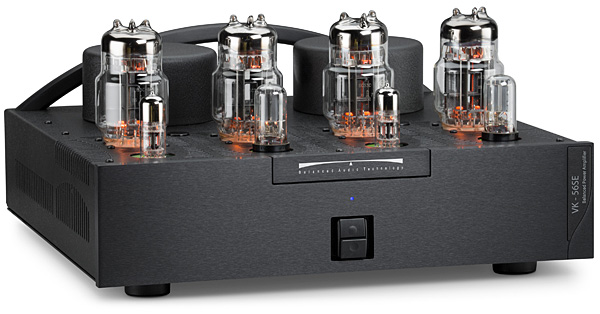 That night, with that convergence of British Decca genius, my life as a reviewer became decidedly transcendent. I bathed in the Wilkinson-captured reverberations of the Chapel of Kings College. The VK-56SE gave me a camera-like focus on every singer in the choir. The splendor of this Argo recording played on this kind of super-fine record machine, with the BAT amp driving the Harbeth speakers, reminded me why we spend so much money on top-shelf audio componentry: so we can breathe relaxed, dream-filled air while admiring the beauty of musical energies invading our chambres noires.
With the VK-56SE, the M30.2s felt more solidly controlled, yet more viscous and flowing, than they have with any of the amps listed in my Associated Equipment sidebar. The words vivid spatiality, intense driving force, and glowing tones dominate my listening notes.
Comparison: Pass Laboratories XA25
That night, with that convergence of British Decca genius, my life as a reviewer became decidedly transcendent. I bathed in the Wilkinson-captured reverberations of the Chapel of Kings College. The VK-56SE gave me a camera-like focus on every singer in the choir. The splendor of this Argo recording played on this kind of super-fine record machine, with the BAT amp driving the Harbeth speakers, reminded me why we spend so much money on top-shelf audio componentry: so we can breathe relaxed, dream-filled air while admiring the beauty of musical energies invading our chambres noires.
With the VK-56SE, the M30.2s felt more solidly controlled, yet more viscous and flowing, than they have with any of the amps listed in my Associated Equipment sidebar. The words vivid spatiality, intense driving force, and glowing tones dominate my listening notes.
Comparison: Pass Laboratories XA25
I thought the most interesting and relevant comparison I could make would be with the extraordinarily vigorous and invisible Pass Laboratories XA25, which I reviewed in February 2018. The XA25 is specified to output only 25Wpc into 8 ohms, but John Atkinson's measurements showed that, at 1% THD+N, the XA25 delivered 80Wpc into 8 ohms and 130Wpc into 4 ohms. In measuring the VK-56SE's predecessor, the VK-55SE, for Wes Phillips's review, JA had found that it generated precisely 55W into 8 ohms at 1% THD+N. Comparing the VK-56SE ($8495) with the XA25 ($4900) seemed like good old-fashioned tubes-vs-solid-state fun.
When I switched to the Pass Labs amp, I'd been listening to the BAT amp driving the Harbeth M30.2 speakers for two straight weeks, and was convinced that the VK-56SE was the most effective and enjoyable amplifier I'd yet tried with Harbeth's medium-size minimonitor. Installing the Pass Labs got me immediately reacquainted with the XA25's bright, distinctively yang transparency. In comparison, the VK-56SE I'd just removed seemed equally transparent but distinctively yin, with a darker, more shadowy soundspace.
I tried both amps while listening to members of the Rodolfus Choir, directed by Ralph Allwood, sing Edward T. Chapman's setting of the English folksong "The Three Ravens" on their collection Time and Its Passing (16/44.1 FLAC, Signum Classics/Tidal). The Pass Labs XA25 was more sharply focused than the VK-56SE, which produced more of that three-dimensional, glowing, slightly generalized tube thing. The Pass was the sun, the BAT was the moon.
 The XA25 delivered Arvo Pärt's super-delicate "Nunc dimittis," also from Time and Its Passing, with a most delectable latticework of choral voices. But these delicate voices seemed more disembodied through the XA25 than through the VK-56SE, which restored to these choristers their bones and flesh and heavy cloth robes.
BAT goes yang
The XA25 delivered Arvo Pärt's super-delicate "Nunc dimittis," also from Time and Its Passing, with a most delectable latticework of choral voices. But these delicate voices seemed more disembodied through the XA25 than through the VK-56SE, which restored to these choristers their bones and flesh and heavy cloth robes.
BAT goes yang
The BAT VK-56SE had a fine talent for pumping bass out of Harbeth's M30.2s, but no one would mistake it for a solid-state amp. With the M30.2s, the VK-56SE's midrange was exceedingly lush and overtly textured. But with Harbeth's smaller P3ESR speakers it sounded distinctly not lush. Driving the mini-Harbeths, the BAT sounded more precisely focused, more like solid-state. Consequently, it made the P3ESRs "disappear" even more than they usually do. Björk's Gling-Gló was depicted with a surprising, bright clarity and a breathy, wide-open effortlessness. The soundstage was big in every direction. Björk was now better described and easier to "see." I noticed less electronic-ness in the space between her and her voice mike. In my room, the BAT amp sounded its absolute best with the little Harbeth P3ESRs. But . . . When I removed the VK-56SE and connected the P3ESRs to First Watt's astute, 25Wpc SIT-3 solid-state amplifier ($4000), which I reviewed in February 2019, I noticed, first, a slight loss in apparent woofer grip, which I perceived as a reduction in image contrast. Punch and drive were also reduced. However, these losses were accompanied by a radical increase in the density of small-scale information. The SIT-3 made trumpets, drums, guitars, and human voices sound more complex—more fully expressed, and microscopically textured. Both amplifiers sounded extremely good with the extremely good Harbeth P3ESRs, but I think I favored the BAT's extra oomph and push.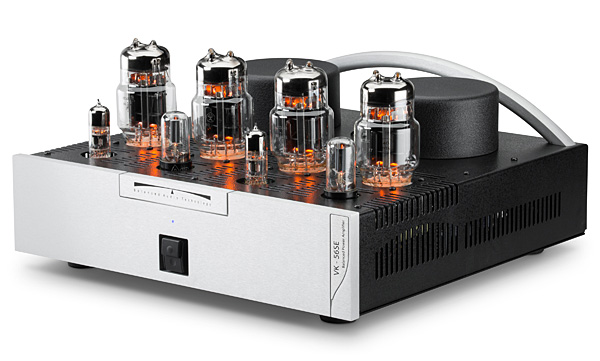 Listening with Magnepan .7s
Even before I listened to the pairing, I was convinced that the VK-56SE would be a perfect match for my beloved Magnepan .7s. I was certain the BAT would handle the Maggies' low sensitivity and hunger for current—and it did. It made the .7s sound sweet, spacious, and nicely detailed. But for almost $9k, I wanted the VK-56SE to generate stronger musical pulse. I wanted it to drive these quasi-ribbons with more bite and certainty than Bel Canto Design's e.One REF600M class-D monoblocks ($4995/pair) or Pass Labs' XA25 ($4900). Alas, the sound was attractively presented but mostly bland, with no boogie.
Conclusions
As of today, Balanced Audio Technology's VK-56SE is the most commanding and satisfying tube amplifier I have used with the Harbeth M30.2 and P3ESR loudspeakers. It is not as tonally neutral, or as finely detailed, as the Rogue Stereo 100 or the Pass Labs XA25. However! The BAT compensates with a force-filled liquid vividosity that presents itself with the scale, detail, and color saturation of 70mm film. The BAT drove my speakers with a subliminal intensity that made recorded music sound more believable and tangible than either the Rogue or the Pass Labs amps. That subliminal intensity is the VK-56SE's greatest strength—a strength that's most likely the result, at least in part, of Victor Khomenko's intelligent repurposing of the 6C33C-B triode. If you already like tubed amplifiers but are not already familiar with Balanced Audio Technology's distinctive version of tube sound, the VK-56SE is an absolute must to audition. Highly recommended.
That night, with that convergence of British Decca genius, my life as a reviewer became decidedly transcendent. I bathed in the Wilkinson-captured reverberations of the Chapel of Kings College. The VK-56SE gave me a camera-like focus on every singer in the choir. The splendor of this Argo recording played on this kind of super-fine record machine, with the BAT amp driving the Harbeth speakers, reminded me why we spend so much money on top-shelf audio componentry: so we can breathe relaxed, dream-filled air while admiring the beauty of musical energies invading our chambres noires.
With the VK-56SE, the M30.2s felt more solidly controlled, yet more viscous and flowing, than they have with any of the amps listed in my Associated Equipment sidebar. The words vivid spatiality, intense driving force, and glowing tones dominate my listening notes.
Comparison: Pass Laboratories XA25I thought the most interesting and relevant comparison I could make would be with the extraordinarily vigorous and invisible Pass Laboratories XA25, which I reviewed in February 2018. The XA25 is specified to output only 25Wpc into 8 ohms, but John Atkinson's measurements showed that, at 1% THD+N, the XA25 delivered 80Wpc into 8 ohms and 130Wpc into 4 ohms. In measuring the VK-56SE's predecessor, the VK-55SE, for Wes Phillips's review, JA had found that it generated precisely 55W into 8 ohms at 1% THD+N. Comparing the VK-56SE ($8495) with the XA25 ($4900) seemed like good old-fashioned tubes-vs-solid-state fun.
The XA25 delivered Arvo Pärt's super-delicate "Nunc dimittis," also from Time and Its Passing, with a most delectable latticework of choral voices. But these delicate voices seemed more disembodied through the XA25 than through the VK-56SE, which restored to these choristers their bones and flesh and heavy cloth robes.
The BAT VK-56SE had a fine talent for pumping bass out of Harbeth's M30.2s, but no one would mistake it for a solid-state amp. With the M30.2s, the VK-56SE's midrange was exceedingly lush and overtly textured. But with Harbeth's smaller P3ESR speakers it sounded distinctly not lush. Driving the mini-Harbeths, the BAT sounded more precisely focused, more like solid-state. Consequently, it made the P3ESRs "disappear" even more than they usually do. Björk's Gling-Gló was depicted with a surprising, bright clarity and a breathy, wide-open effortlessness. The soundstage was big in every direction. Björk was now better described and easier to "see." I noticed less electronic-ness in the space between her and her voice mike. In my room, the BAT amp sounded its absolute best with the little Harbeth P3ESRs. But . . . When I removed the VK-56SE and connected the P3ESRs to First Watt's astute, 25Wpc SIT-3 solid-state amplifier ($4000), which I reviewed in February 2019, I noticed, first, a slight loss in apparent woofer grip, which I perceived as a reduction in image contrast. Punch and drive were also reduced. However, these losses were accompanied by a radical increase in the density of small-scale information. The SIT-3 made trumpets, drums, guitars, and human voices sound more complex—more fully expressed, and microscopically textured. Both amplifiers sounded extremely good with the extremely good Harbeth P3ESRs, but I think I favored the BAT's extra oomph and push.
Listening with Magnepan .7sEven before I listened to the pairing, I was convinced that the VK-56SE would be a perfect match for my beloved Magnepan .7s. I was certain the BAT would handle the Maggies' low sensitivity and hunger for current—and it did. It made the .7s sound sweet, spacious, and nicely detailed. But for almost $9k, I wanted the VK-56SE to generate stronger musical pulse. I wanted it to drive these quasi-ribbons with more bite and certainty than Bel Canto Design's e.One REF600M class-D monoblocks ($4995/pair) or Pass Labs' XA25 ($4900). Alas, the sound was attractively presented but mostly bland, with no boogie.
As of today, Balanced Audio Technology's VK-56SE is the most commanding and satisfying tube amplifier I have used with the Harbeth M30.2 and P3ESR loudspeakers. It is not as tonally neutral, or as finely detailed, as the Rogue Stereo 100 or the Pass Labs XA25. However! The BAT compensates with a force-filled liquid vividosity that presents itself with the scale, detail, and color saturation of 70mm film. The BAT drove my speakers with a subliminal intensity that made recorded music sound more believable and tangible than either the Rogue or the Pass Labs amps. That subliminal intensity is the VK-56SE's greatest strength—a strength that's most likely the result, at least in part, of Victor Khomenko's intelligent repurposing of the 6C33C-B triode. If you already like tubed amplifiers but are not already familiar with Balanced Audio Technology's distinctive version of tube sound, the VK-56SE is an absolute must to audition. Highly recommended.