 Meanwhile, I've enjoyed the Air Force Two's stay here 100%. It performed as a neutral conduit should, allowing the various tonearms, cartridges, and phono preamplifiers I tried with it to assert themselves, without inserting itself into the sound. And this was an exceptionally quiet turntable. Even using a stethoscope, I could hear no noise of any kind, even when I started up the motor. Speaking of which, it takes approximately 15 seconds for the AF2 to reach and lock to the chosen speed, but it's well worth the short wait, and a fluorescent screen at the front of the top panel lets you know when speed lock has been achieved.
The Air Force Two's speed stability was evident with well-pressed, concentric LPs of solo-piano music. One, "D'ombre et de lumière . . . ," a recital of music by Albéniz, Falla, Granados, and Villa-Lobos by the Brazilian pianist Magda Tagliaferro (1893–1986), got numerous late-evening plays (LP, EMI/Electric Recording Company ERC 012; all-tube-mastered, pressed in a limited, numbered edition of 300 copies; £300 each). Precise stability of speed results in far more than an absence of wow and consistent pitch. It also produces delicacy and precision of attacks, as well as solid, insistent sustain that's reminiscent of the real thing.
Meanwhile, I've enjoyed the Air Force Two's stay here 100%. It performed as a neutral conduit should, allowing the various tonearms, cartridges, and phono preamplifiers I tried with it to assert themselves, without inserting itself into the sound. And this was an exceptionally quiet turntable. Even using a stethoscope, I could hear no noise of any kind, even when I started up the motor. Speaking of which, it takes approximately 15 seconds for the AF2 to reach and lock to the chosen speed, but it's well worth the short wait, and a fluorescent screen at the front of the top panel lets you know when speed lock has been achieved.
The Air Force Two's speed stability was evident with well-pressed, concentric LPs of solo-piano music. One, "D'ombre et de lumière . . . ," a recital of music by Albéniz, Falla, Granados, and Villa-Lobos by the Brazilian pianist Magda Tagliaferro (1893–1986), got numerous late-evening plays (LP, EMI/Electric Recording Company ERC 012; all-tube-mastered, pressed in a limited, numbered edition of 300 copies; £300 each). Precise stability of speed results in far more than an absence of wow and consistent pitch. It also produces delicacy and precision of attacks, as well as solid, insistent sustain that's reminiscent of the real thing.
 The AF2's quietness helped deliver generous decays into aural blackness—and, of course, the complex tonal bouquets that this LP can produce were fully expressed, perhaps thanks to the TechDAS's massive, well-isolated, and critically damped chassis. Overdamping a turntable kills sustain and squelches decays, resulting in a deadened sound. Underdamping lets resonances develop that kill detail, interfere with rhythm'n'pace, and can produce gross tonal colorations—probably the most obtrusive and objectionable sins a turntable can commit. This is why turntable design is a combination of the proper application of technology and very careful listening. From what I heard, I'd say that the Air Force Two's designers listened very well indeed: Its overall balance of all of these aspects of sound struck me as ideal.
 Just before deadline I received Gregorio Paniagua and Atrium Musicæ de Madrid's La Spagna: A Tune through Five Centuries (2 LPs, AudioNautes AN-1401), a limited-edition reissue of a classic recording from 1980 long regarded as a sonic spectacular (SACD/CD, BIS 1963). The reissue was one of the late Stan Ricker's final projects, and is a fitting farewell from the second master of lacquer cutting we've lost this year. (The other was Doug Sax; Analogue Productions' Chad Kassem bought Sax's The Mastering Lab and is moving it to Salina, Kansas.)
Ricker cut the lacquers for La Spagna at half-speed from the original analog master tapes, using no noise reduction, equalization, compression, or limiting. It took a dozen tries to get it right, and his work was worth the effort. This ultraspacious, spectacular-sounding recording was made in the Chapel of the Imperial College, Madrid, using two Sennheiser MKH 105 microphones and a ReVox A-77 tape recorder. It's mostly dance music of the 15th and 16th centuries, performed on original instruments—the kind of percussion-laden nightmare no phonograph is supposed to be able to reproduce without smearing transients and/or mistracking. The music will knock you out; if your system can handle it, so will the sound. The transparency, spaciousness, transient clarity, macro- and microdynamic expression, and instrumental three-dimensionality and solidity are absolutely sensational.
Just before deadline I received Gregorio Paniagua and Atrium Musicæ de Madrid's La Spagna: A Tune through Five Centuries (2 LPs, AudioNautes AN-1401), a limited-edition reissue of a classic recording from 1980 long regarded as a sonic spectacular (SACD/CD, BIS 1963). The reissue was one of the late Stan Ricker's final projects, and is a fitting farewell from the second master of lacquer cutting we've lost this year. (The other was Doug Sax; Analogue Productions' Chad Kassem bought Sax's The Mastering Lab and is moving it to Salina, Kansas.)
Ricker cut the lacquers for La Spagna at half-speed from the original analog master tapes, using no noise reduction, equalization, compression, or limiting. It took a dozen tries to get it right, and his work was worth the effort. This ultraspacious, spectacular-sounding recording was made in the Chapel of the Imperial College, Madrid, using two Sennheiser MKH 105 microphones and a ReVox A-77 tape recorder. It's mostly dance music of the 15th and 16th centuries, performed on original instruments—the kind of percussion-laden nightmare no phonograph is supposed to be able to reproduce without smearing transients and/or mistracking. The music will knock you out; if your system can handle it, so will the sound. The transparency, spaciousness, transient clarity, macro- and microdynamic expression, and instrumental three-dimensionality and solidity are absolutely sensational.
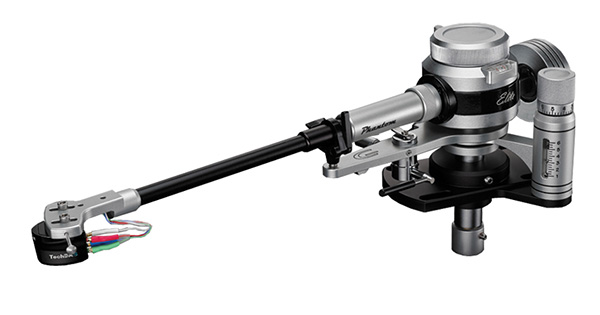
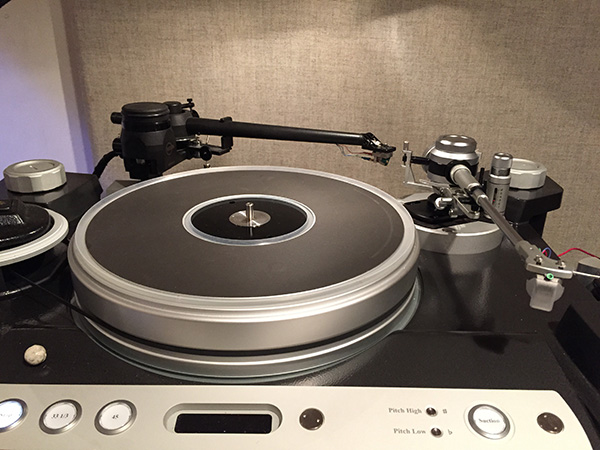 I loved the TechDAS Air Force Two. It's among the very finest turntables that I've reviewed, at any price (especially a "reasonably improved" one). But other contenders are already on the way. (And next time, more on Graham's Phantom Elite tonearm.)
10 Years After: Continuum Audio Labs Caliburn turntable
I loved the TechDAS Air Force Two. It's among the very finest turntables that I've reviewed, at any price (especially a "reasonably improved" one). But other contenders are already on the way. (And next time, more on Graham's Phantom Elite tonearm.)
10 Years After: Continuum Audio Labs Caliburn turntableIt's difficult to believe that 10 years have passed since I first reviewed Continuum Audio Labs' Caliburn turntable, Cobra tonearm, and Castellon turntable stand. Don't let the photo fool you! In the service of someone who reviews audio gear and records, this complex piece of machinery has been beaten up in ways no consumer would ever subject it to, but it has never broken down or presented me with any kind of problem. That's the sort of longevity you should expect from any pricey audio component—especially a record-playing system that costs $200,000—but not all of them deliver. Nonetheless, despite the punishing work schedule I've set the Continuum, it's never troubled me with problems having to do with the motor, speed control, bearing, or vacuum hold-down.
Footnote 1: TechDAS, Stella Inc., 51-10 Nakamarucho. Itabashi-ku Tokyo 173-0026, Japan. Web: www.techdas.jp Footnote 2: I reviewed the Air Force One in April 2013. Footnote 3: Graham Engineering, Inc., 25M Olympia Avenue, Woburn, MA 01801. Tel: (781) 932-8777. Web: www.graham-engineering.com Footnote 4: Broadcast live every Monday at noon EST. Click on the Listen tab, then on Listen Live HD2. By the time you read this, the HD radio channel should be broadcasting and the shows should be archived and available on demand; if not, you can stream them at AnalogPlanet.com.