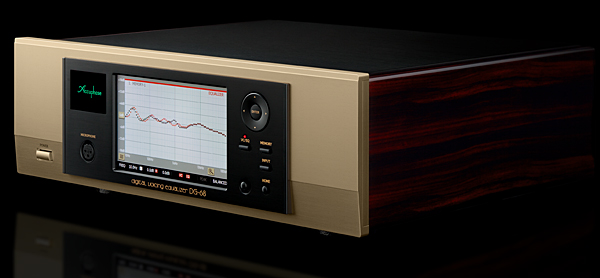
Happily, I own two microphone stands. I placed one directly behind my customary listening position and aligned the microphone with an imaginary line running between my ear canals. With 15 or so feet of cabling to connect the Accuphase's supplied mike to the DG-68, it was easy to sit to one side and measure the room's acoustic. During the course of the review, I managed to travel back and forth between the DG-68 and my room-left listening position more than 40 times without tripping over the microphone cable.
The result
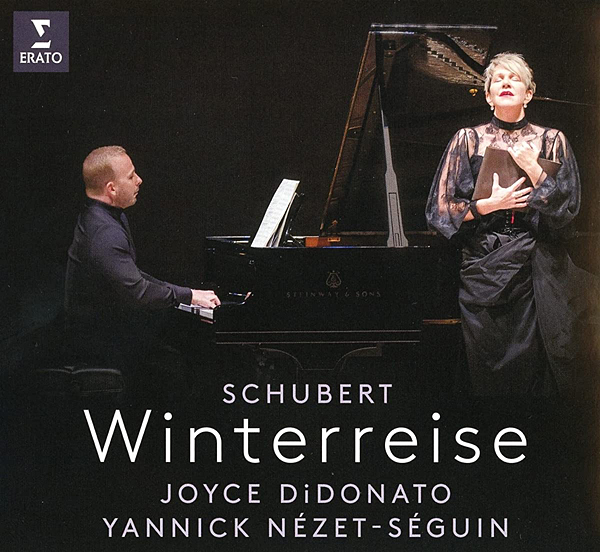
After I'd created my first curves, I put on Rickie Lee Jones's delicious rendition of the Stones' "Sympathy for the Devil" (Tidal, 16/44.1 FLAC), from her album The Devil You Know. With VC/EQ active, guitar strums sounded more realistic, bass was fuller, and the subtle rattle in the right channel was more easily distinguishable. Tonality was superb, and the slightest change in dynamics or emphasis was easy to hear and savor. I don't know if the Devil was looking over Schubert's shoulder when he composed Winterreise, his despairing 24-song cycle of love gone bad in wintertime, but mezzo-soprano Joyce DiDonato and accompanist Yannick Nézet-Séguin have recorded one of the most moving accounts in recent memory (24/96 WAV, Erato 528414). When I first listened to the hi-rez files of this recording, I wondered if the piano's lid was closed halfway during the performance, despite a cover photo showing DiDonato singing before a piano opened to full stick. In fact, the piano lid was fully open, but the engineers gave undue prominence to voice. In evening out the bass response, lowering peaks, and filling in some nulls, the DG-68 fleshed out piano accompaniment that had previously sounded undernourished. On a song as moving as "Gefrorne Tränen" ("Frozen Tears"), this fuller support from the piano helped drive Schubert's music and Heine's poetry deeper into the heart.
 The DG-68 also enabled me to hear more of Carnegie Hall's natural reverberation whenever DiDonato opened up her sound and to better savor the hall's fabled airy acoustic. It was thrilling to experience how every subtle change in dynamics and tonality deepened the music's impact.
The beauty of Yo-Yo Ma, Edgar Meyer, and Chris Thile's Bach Trios (24/96 WAV, Nonesuch 558933) has made it one of my reviewing staples, but I've long mentally compensated for some notes from Meyer's bass that sounded somewhat faint and others a mite overblown. What a joy, then, to discover that with the DG-68 correcting the room's response, Bach's architecture was given its due, every note perfectly articulated and every pitch clear. It was equally lovely to discover Ma's cello sounding as warm-hearted as I'd ever heard it in my system.
The DG-68 also enabled me to hear more of Carnegie Hall's natural reverberation whenever DiDonato opened up her sound and to better savor the hall's fabled airy acoustic. It was thrilling to experience how every subtle change in dynamics and tonality deepened the music's impact.
The beauty of Yo-Yo Ma, Edgar Meyer, and Chris Thile's Bach Trios (24/96 WAV, Nonesuch 558933) has made it one of my reviewing staples, but I've long mentally compensated for some notes from Meyer's bass that sounded somewhat faint and others a mite overblown. What a joy, then, to discover that with the DG-68 correcting the room's response, Bach's architecture was given its due, every note perfectly articulated and every pitch clear. It was equally lovely to discover Ma's cello sounding as warm-hearted as I'd ever heard it in my system.
 I wouldn't use heart-centered adjectives to describe Yello's "Electrified II" from Toy (24/48 WAV, Polydor 4782160), but on this music, whose electronic pulse could devour a cello, bass, and mandolin in a heartbeat, the DG-68 acquitted itself superbly. It did more than bring the bass home; it surrounded Yello's retro electronics and intentionally overhyped vocals with welcome air and space, bringing unexpected dimensionality to a presentation the visceral awesomeness of which I find hard to resist. There is a lot of well-recorded deep-bass music that I could use in my reviews, but I keep returning to this one as much for its humor as for its wow factor. I'm also delighted to discover that it's now streamable on Tidal in 24/48 MQA FLAC.
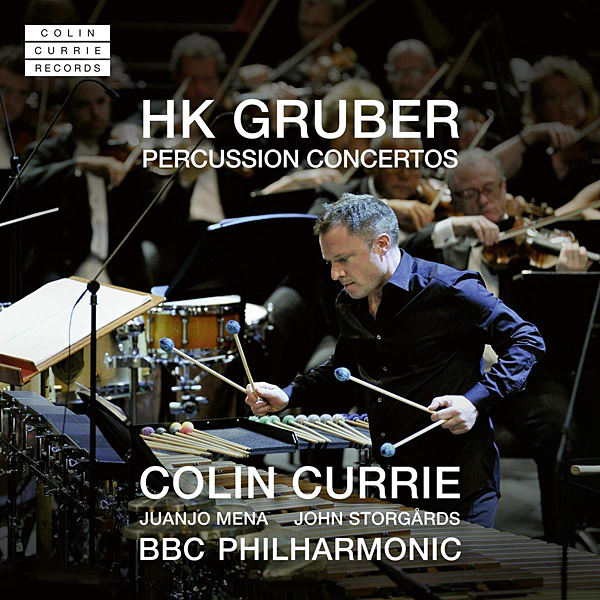 I continue to rely on this track for evaluating bass, but I do spend time rummaging about for bass-focused alternatives to this tried-and-true reference, including a recent recording of HK Gruber's Percussion Concertos (24/44.1 WAV, CCR0004) performed by the phenomenal Colin Currie with the BBC Philharmonic. Gruber's use of percussion is more subtle than Yello's, but his mix of vibraphone, drum set, and orchestra in Rough Music is a lovely little test for a sound system. Far more challenging is Copland's Fanfare for the Common Man in Reference Recordings' famed rendition with Eiji Oue and the Minnesota Orchestra (16.44.1 WAV, RR-93). After cranking up the volume as high as my ears allowed, I was astounded to hear the hugest bass drum thwacks I've encountered on record reproduced with no audible distortion.
After recording engineer Peter McGrath told me how much he'd enjoyed listening to Duruflé's organ music on his Wilson XVX loudspeakers, I cued up Thomas Trotter's recent recording, Duruflé: Complete Organ Works from King's College Cambridge (24/192 WAV, KGS0053), and took a selective listen. With VC/EQ engaged, the organ sounded airier and more focused than before. There was more meat to the notes, and it was significantly easier to follow Duruflé's intersecting lines. On this recording, the "Smooth" curve, which purports to take my speakers into account as it tailors sound, seemed more alluring than the "Flat" curve. On other recordings, I preferred the evenness of "Flat" to the plump ripeness and somewhat tubelike warmth of "Smooth." Both clarified bass lines and transformed romantic haze into notes of well-defined pitch.
As winter has morphed to spring and the political landscape has changed, I've found myself less drawn to Alban Berg's apocalyptic Three Pieces for Orchestra, Op.6. But, eager to discover how another frequently referenced recording would sound in a room corrected by the DG-68, I returned to Berg's cacophonous, strangely beautiful 12-tone intersection of cello, bass, brass, and percussion in the version performed by the San Francisco Symphony under Michael Tilson Thomas (24/192 WAV). Nowhere except in a prime orchestra seat in Davies Symphony Hall have I experienced such riveting clarity amidst complexity as I did when listening to this recording through the DG-68. The same held true for the opening minutes of Anna Thorvaldsdóttir's fascinating Metacosmos, on Sono Luminus's superbly engineered Concurrence (24/352.8 WAV, DSL-92237), where the DG-68 laid bare the most subtle shifts in multiple layers of rumbling bass.
There is a downside to such clarity. Take, for example, the rumble of the New York subway system beneath Carnegie Hall, the faint police siren, and the quiet crash of a loosely held Playbill on DiDonato/Nézet-Séguin's live Winterreise (footnote 5); all provide incongruous counterpoint to this saga composed before the Industrial Revolution began to transform the sounds of the German countryside. If there are things on a recording that you don't want to hear—air conditioning, tape hiss, groove noise, a violinist's bow accidentally striking a music stand—beware the DG-68. It's a truth-teller.
Right before I packed up the Accuphase and sent it to John Atkinson for measurement, my friend Peter Schwartzman and I did a final listen with "VC/EQ" active and then bypassed. Neither of us could detect a difference in transparency. Taking another listen after the unit had been boxed up, we detected a slight change. Whether it was related to cables not having time to settle in, I do not know. Regardless, given all the DG-68 can do, I consider some minimal loss in transparency (if there truly was any) with the DG-68 inserted a small price to pay.
Accuphase's Digital Voicing Equalizer is not the sun and the moon and the stars or an electronic stand-in for J.M. Barrie's Peter Pan (footnote 6). If you've got furnishings that suck out percussive snap and make cymbals sound like crushed velvet, the DG-68 probably won't fix it. If your room is improperly treated, the DG-68 can only do so much. Parting the Red Sea is not in its toolbox. But if you worship at the correct altar, which I did once I freed myself from false room-treatment gods, the DG-68 may leave you feeling like you've reached the Promised Land.
I continue to rely on this track for evaluating bass, but I do spend time rummaging about for bass-focused alternatives to this tried-and-true reference, including a recent recording of HK Gruber's Percussion Concertos (24/44.1 WAV, CCR0004) performed by the phenomenal Colin Currie with the BBC Philharmonic. Gruber's use of percussion is more subtle than Yello's, but his mix of vibraphone, drum set, and orchestra in Rough Music is a lovely little test for a sound system. Far more challenging is Copland's Fanfare for the Common Man in Reference Recordings' famed rendition with Eiji Oue and the Minnesota Orchestra (16.44.1 WAV, RR-93). After cranking up the volume as high as my ears allowed, I was astounded to hear the hugest bass drum thwacks I've encountered on record reproduced with no audible distortion.
After recording engineer Peter McGrath told me how much he'd enjoyed listening to Duruflé's organ music on his Wilson XVX loudspeakers, I cued up Thomas Trotter's recent recording, Duruflé: Complete Organ Works from King's College Cambridge (24/192 WAV, KGS0053), and took a selective listen. With VC/EQ engaged, the organ sounded airier and more focused than before. There was more meat to the notes, and it was significantly easier to follow Duruflé's intersecting lines. On this recording, the "Smooth" curve, which purports to take my speakers into account as it tailors sound, seemed more alluring than the "Flat" curve. On other recordings, I preferred the evenness of "Flat" to the plump ripeness and somewhat tubelike warmth of "Smooth." Both clarified bass lines and transformed romantic haze into notes of well-defined pitch.
As winter has morphed to spring and the political landscape has changed, I've found myself less drawn to Alban Berg's apocalyptic Three Pieces for Orchestra, Op.6. But, eager to discover how another frequently referenced recording would sound in a room corrected by the DG-68, I returned to Berg's cacophonous, strangely beautiful 12-tone intersection of cello, bass, brass, and percussion in the version performed by the San Francisco Symphony under Michael Tilson Thomas (24/192 WAV). Nowhere except in a prime orchestra seat in Davies Symphony Hall have I experienced such riveting clarity amidst complexity as I did when listening to this recording through the DG-68. The same held true for the opening minutes of Anna Thorvaldsdóttir's fascinating Metacosmos, on Sono Luminus's superbly engineered Concurrence (24/352.8 WAV, DSL-92237), where the DG-68 laid bare the most subtle shifts in multiple layers of rumbling bass.
There is a downside to such clarity. Take, for example, the rumble of the New York subway system beneath Carnegie Hall, the faint police siren, and the quiet crash of a loosely held Playbill on DiDonato/Nézet-Séguin's live Winterreise (footnote 5); all provide incongruous counterpoint to this saga composed before the Industrial Revolution began to transform the sounds of the German countryside. If there are things on a recording that you don't want to hear—air conditioning, tape hiss, groove noise, a violinist's bow accidentally striking a music stand—beware the DG-68. It's a truth-teller.
Right before I packed up the Accuphase and sent it to John Atkinson for measurement, my friend Peter Schwartzman and I did a final listen with "VC/EQ" active and then bypassed. Neither of us could detect a difference in transparency. Taking another listen after the unit had been boxed up, we detected a slight change. Whether it was related to cables not having time to settle in, I do not know. Regardless, given all the DG-68 can do, I consider some minimal loss in transparency (if there truly was any) with the DG-68 inserted a small price to pay.
Accuphase's Digital Voicing Equalizer is not the sun and the moon and the stars or an electronic stand-in for J.M. Barrie's Peter Pan (footnote 6). If you've got furnishings that suck out percussive snap and make cymbals sound like crushed velvet, the DG-68 probably won't fix it. If your room is improperly treated, the DG-68 can only do so much. Parting the Red Sea is not in its toolbox. But if you worship at the correct altar, which I did once I freed myself from false room-treatment gods, the DG-68 may leave you feeling like you've reached the Promised Land.
 The final cut
When I told Demian Martin about the DG-68's manual equalizing functions, he spoke truth. "The potential pitfall with a plaything like that is that you can keep adjusting and adjusting and never get around to listening to music." My time with the Accuphase DG-68 Digital Voicing Equalizer was among the most enlightening and consequential I've spent with an audio product. Once I discovered how its Auto Voicing function could compensate for the peaks and dips in my room while simultaneously adjusting for loudspeaker response and character, I began to explore how the curves changed as I made one room or system change after another. The DG-68 gave me the knowledge necessary to bring the sound of my room without electronic correction closer to the glories it delivered with Voicing and Equalization functions engaged. Some will consider the DG-68 anachronistic. When it was first released, in its earliest manifestation (the DG-28), it was something unique. Today, there are other, less expensive ways to achieve similar results—especially with a digital source (footnote 7). But it's hard to imagine those newer methods being as much fun or as simple to use, let alone as foolproof.
I've loved the sound of a lot of the equipment I've reviewed; I've coveted it, to be frank. Yet, I've been able to say goodbye to some truly great gear and move on. I'm finding it harder to bid adieu to the DG-68. Accuphase's Digital Voicing Equalizer has enriched my experience of reproduced music far more than I could have imagined. It is transformational and performs flawlessly, to oft-astounding effect. For those who can afford it, its rich musical dividends may prove essential. Boy, do I hate to see it go.
Footnote 5: Downstairs from Carnegie Hall is Zankel Hall, a much smaller space that hosts pianists and chamber groups. It's a great-sounding hall, but one must get used to the frequent intermittent sounds of the N, W, R, and Q trains that run underneath.—Editor Footnote 6: My reference is not the book but the 1954 musical in which Mary Martin flew into so many of our hearts.
Footnote 7: Note, too, that I didn't use the DG-68 with its digital inputs. Doing so would avoid two unnecessary conversions and so would, presumably, be even more transparent. The downside is that the digital inputs cannot be used with an analog source. Perhaps we'll explore this in the follow-up review.
After I'd created my first curves, I put on Rickie Lee Jones's delicious rendition of the Stones' "Sympathy for the Devil" (Tidal, 16/44.1 FLAC), from her album The Devil You Know. With VC/EQ active, guitar strums sounded more realistic, bass was fuller, and the subtle rattle in the right channel was more easily distinguishable. Tonality was superb, and the slightest change in dynamics or emphasis was easy to hear and savor.
I don't know if the Devil was looking over Schubert's shoulder when he composed Winterreise, his despairing 24-song cycle of love gone bad in wintertime, but mezzo-soprano Joyce DiDonato and accompanist Yannick Nézet-Séguin have recorded one of the most moving accounts in recent memory (24/96 WAV, Erato 528414). When I first listened to the hi-rez files of this recording, I wondered if the piano's lid was closed halfway during the performance, despite a cover photo showing DiDonato singing before a piano opened to full stick. In fact, the piano lid was fully open, but the engineers gave undue prominence to voice. In evening out the bass response, lowering peaks, and filling in some nulls, the DG-68 fleshed out piano accompaniment that had previously sounded undernourished. On a song as moving as "Gefrorne Tränen" ("Frozen Tears"), this fuller support from the piano helped drive Schubert's music and Heine's poetry deeper into the heart.
The DG-68 also enabled me to hear more of Carnegie Hall's natural reverberation whenever DiDonato opened up her sound and to better savor the hall's fabled airy acoustic. It was thrilling to experience how every subtle change in dynamics and tonality deepened the music's impact.
The beauty of Yo-Yo Ma, Edgar Meyer, and Chris Thile's Bach Trios (24/96 WAV, Nonesuch 558933) has made it one of my reviewing staples, but I've long mentally compensated for some notes from Meyer's bass that sounded somewhat faint and others a mite overblown. What a joy, then, to discover that with the DG-68 correcting the room's response, Bach's architecture was given its due, every note perfectly articulated and every pitch clear. It was equally lovely to discover Ma's cello sounding as warm-hearted as I'd ever heard it in my system.
I wouldn't use heart-centered adjectives to describe Yello's "Electrified II" from Toy (24/48 WAV, Polydor 4782160), but on this music, whose electronic pulse could devour a cello, bass, and mandolin in a heartbeat, the DG-68 acquitted itself superbly. It did more than bring the bass home; it surrounded Yello's retro electronics and intentionally overhyped vocals with welcome air and space, bringing unexpected dimensionality to a presentation the visceral awesomeness of which I find hard to resist. There is a lot of well-recorded deep-bass music that I could use in my reviews, but I keep returning to this one as much for its humor as for its wow factor. I'm also delighted to discover that it's now streamable on Tidal in 24/48 MQA FLAC.
I continue to rely on this track for evaluating bass, but I do spend time rummaging about for bass-focused alternatives to this tried-and-true reference, including a recent recording of HK Gruber's Percussion Concertos (24/44.1 WAV, CCR0004) performed by the phenomenal Colin Currie with the BBC Philharmonic. Gruber's use of percussion is more subtle than Yello's, but his mix of vibraphone, drum set, and orchestra in Rough Music is a lovely little test for a sound system. Far more challenging is Copland's Fanfare for the Common Man in Reference Recordings' famed rendition with Eiji Oue and the Minnesota Orchestra (16.44.1 WAV, RR-93). After cranking up the volume as high as my ears allowed, I was astounded to hear the hugest bass drum thwacks I've encountered on record reproduced with no audible distortion.
After recording engineer Peter McGrath told me how much he'd enjoyed listening to Duruflé's organ music on his Wilson XVX loudspeakers, I cued up Thomas Trotter's recent recording, Duruflé: Complete Organ Works from King's College Cambridge (24/192 WAV, KGS0053), and took a selective listen. With VC/EQ engaged, the organ sounded airier and more focused than before. There was more meat to the notes, and it was significantly easier to follow Duruflé's intersecting lines. On this recording, the "Smooth" curve, which purports to take my speakers into account as it tailors sound, seemed more alluring than the "Flat" curve. On other recordings, I preferred the evenness of "Flat" to the plump ripeness and somewhat tubelike warmth of "Smooth." Both clarified bass lines and transformed romantic haze into notes of well-defined pitch.
As winter has morphed to spring and the political landscape has changed, I've found myself less drawn to Alban Berg's apocalyptic Three Pieces for Orchestra, Op.6. But, eager to discover how another frequently referenced recording would sound in a room corrected by the DG-68, I returned to Berg's cacophonous, strangely beautiful 12-tone intersection of cello, bass, brass, and percussion in the version performed by the San Francisco Symphony under Michael Tilson Thomas (24/192 WAV). Nowhere except in a prime orchestra seat in Davies Symphony Hall have I experienced such riveting clarity amidst complexity as I did when listening to this recording through the DG-68. The same held true for the opening minutes of Anna Thorvaldsdóttir's fascinating Metacosmos, on Sono Luminus's superbly engineered Concurrence (24/352.8 WAV, DSL-92237), where the DG-68 laid bare the most subtle shifts in multiple layers of rumbling bass.
The final cutWhen I told Demian Martin about the DG-68's manual equalizing functions, he spoke truth. "The potential pitfall with a plaything like that is that you can keep adjusting and adjusting and never get around to listening to music." My time with the Accuphase DG-68 Digital Voicing Equalizer was among the most enlightening and consequential I've spent with an audio product. Once I discovered how its Auto Voicing function could compensate for the peaks and dips in my room while simultaneously adjusting for loudspeaker response and character, I began to explore how the curves changed as I made one room or system change after another. The DG-68 gave me the knowledge necessary to bring the sound of my room without electronic correction closer to the glories it delivered with Voicing and Equalization functions engaged. Some will consider the DG-68 anachronistic. When it was first released, in its earliest manifestation (the DG-28), it was something unique. Today, there are other, less expensive ways to achieve similar results—especially with a digital source (footnote 7). But it's hard to imagine those newer methods being as much fun or as simple to use, let alone as foolproof.
Footnote 5: Downstairs from Carnegie Hall is Zankel Hall, a much smaller space that hosts pianists and chamber groups. It's a great-sounding hall, but one must get used to the frequent intermittent sounds of the N, W, R, and Q trains that run underneath.—Editor Footnote 6: My reference is not the book but the 1954 musical in which Mary Martin flew into so many of our hearts.