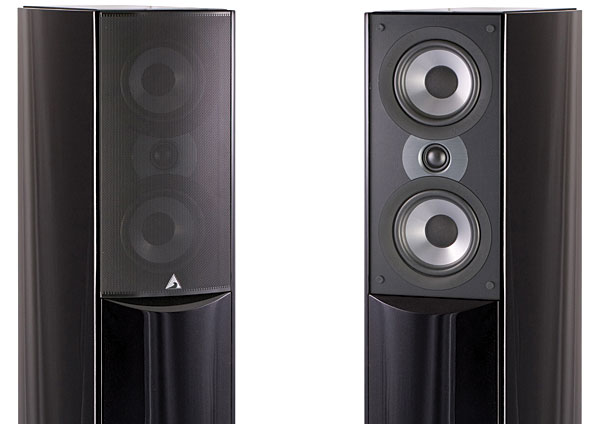
Quad Reference ESL-2805 loudspeaker
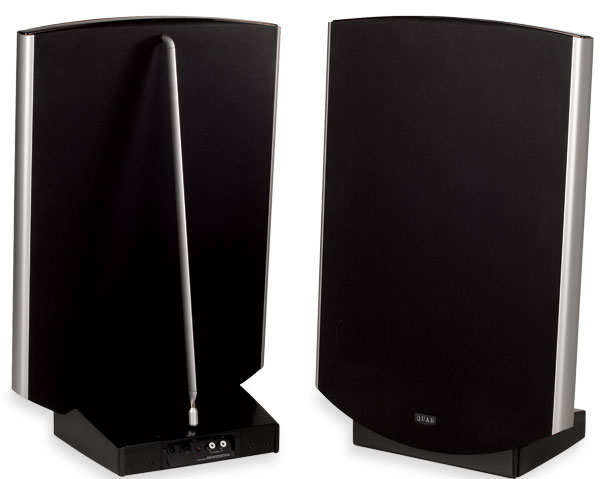
I gasped. An almost perfect 300Hz squarewave had appeared on the oscilloscope screensomething I had never before seen from a loudspeaker.
It was the spring of 1982. John Crabbe, then editor of the British magazine Hi-Fi News & Record Review, and I had driven up to Quad's factory in Huntingdon, England. The ESL-63 electrostatic loudspeaker had been launched the previous summer, and we were to interview its designer, Peter J. Walker, for an article that would appear in the July 1982 issue of HFN/RR. Peter set up a pair of ESL-63s on wooden kitchen chairs, fed one of them a 300Hz squarewave, casually placed a mike before it, and showed us the result on the 'scope. "Of course, why should a speaker being able to reproduce a squarewave matter at all, hmmm?" he rhetorically asked us.

 While I refuse to admit publicly how long I have been sitting on these loudspeakers before doing the report on them, I must say that it is probably a good thing I wasn't in all that of a hurry to get around to it. They did not sound very good in the room where I had initially installed them, and had I written the report on that basis, it would have been lukewarm, to say the least.
I have now had the opportunity to live with the Acoustat 2+2s in my usual listening room, which is more like a typical listening environment (19' by 24' by 9' and moderately padded), and I am more than a little impressed. This is an extremely good speaker, particularly at its price of $2100/pair.
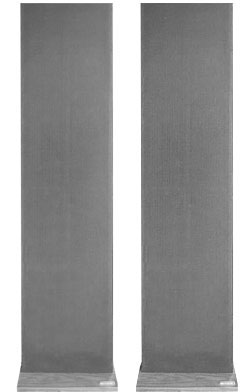
The 2+2 resembles the Model Four in that it contains four of Acoustat's full-range electrostatic panels per side, but differs from it in that two of the panels (per side) are stacked on top of the first pair to produce a radiating surface twice as high and half as wide as that of the Four. The result, particularly in the case of the black-grilled version we tested, bears a startling resemblance to the mysterious obelisk in 2001, A Space Odyssey. The 2+2 system towers almost to the ceiling (and at just under 8' may be too high for some ceilings), and although it is more graceful in appearance than a pair of Fours, it tends to dominate a listening room at least as much.
While I refuse to admit publicly how long I have been sitting on these loudspeakers before doing the report on them, I must say that it is probably a good thing I wasn't in all that of a hurry to get around to it. They did not sound very good in the room where I had initially installed them, and had I written the report on that basis, it would have been lukewarm, to say the least.
I have now had the opportunity to live with the Acoustat 2+2s in my usual listening room, which is more like a typical listening environment (19' by 24' by 9' and moderately padded), and I am more than a little impressed. This is an extremely good speaker, particularly at its price of $2100/pair.
The 2+2 resembles the Model Four in that it contains four of Acoustat's full-range electrostatic panels per side, but differs from it in that two of the panels (per side) are stacked on top of the first pair to produce a radiating surface twice as high and half as wide as that of the Four. The result, particularly in the case of the black-grilled version we tested, bears a startling resemblance to the mysterious obelisk in 2001, A Space Odyssey. The 2+2 system towers almost to the ceiling (and at just under 8' may be too high for some ceilings), and although it is more graceful in appearance than a pair of Fours, it tends to dominate a listening room at least as much.
 When you wish upon a star,
 "No pain; no gain." Thus goes the June 1991 offering from the Cliché-of-the-Month Club(800) MOT-JUSTa saying that seems particularly appropriate for audiophiles with aspirations. High-performance loudspeakers fall into two categories. First are those exasperating thoroughbreds requiring endless Tender Loving Care and fussy attention to system detail to work at all. Take the