Floor Loudspeaker Reviews

Sort By:  Post Date TitlePublish Date

Delaware Acoustics DELAC S10 loudspeaker

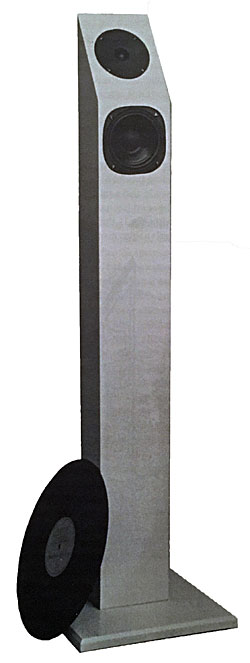
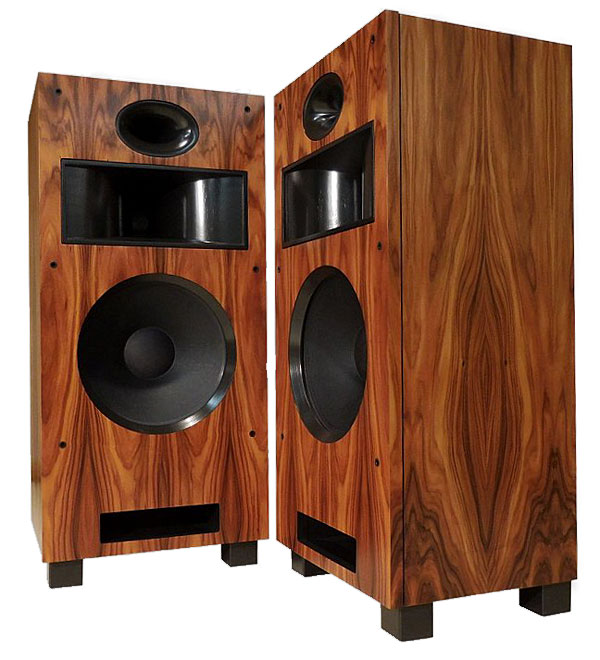
666skinny.promo250.jpgOne of the joys of reviewing loudspeakers is that there are always intriguing aspects of any particular design. The problems involved in producing a speaker that has an even tonal balance, well-controlled directivity, good bass extension, and a smooth integration of the outputs from often widely disparate drive-units have what appears to be an infinite number of solutions. The result is often a speaker so different from the norm that it just cries out to be auditioned.

Such was the case with the Delaware Acoustics DELAC S10, which costs $629/pair. Only sold factory-direct, this would therefore have been low on Stereophile's priority list for review if it weren't for two things: first, the fact that the S10 was designed by one Ralph Gonzalez, a name that should be familiar to readers of Speaker Builder magazine for having written a very useful speaker design and analysis program; second, as implied in the first paragraph, the S10 is one of the weirdest speakers I have ever laid ears on.
Acoustat Spectra 3 loudspeaker

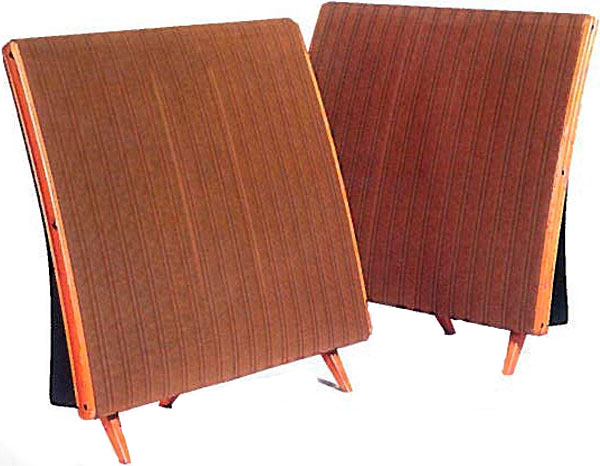
Founded in the mid-1970s, Acoustat was the first manufacturer of full-range electrostatics literally forced to address what had long been a major weakness of such speakers: high-voltage breakdown, or "arcing." The original design was built and used in JP (Jeep) Harned's home, where the living-room french windows opened out onto a stream in the back yard. That, plus Florida's legendary humidity, conspired to produce summer days when moisture would trickle down every vertical surface in the house, including the speaker elements.

Quad ESL loudspeaker

High fidelity took a giant step forward in 1956 with Peter Walker's introduction of the Quad ESL. Walker's research efforts had been motivated by his firm belief in the superiority of the electrostatic dipole over the box loudspeaker, but actually to take the economic plunge and market such a speaker was surely an act of bravery. After all, those were the pre-stereo, pre-audiophile days of the mid '50s, and the public's tastes and expectations were relatively unsophisticated. The average front end was abominable by today's standards, so that making definitive assessments of loudspeaker quality was a difficult task at best.

KEF Reference 5 loudspeaker

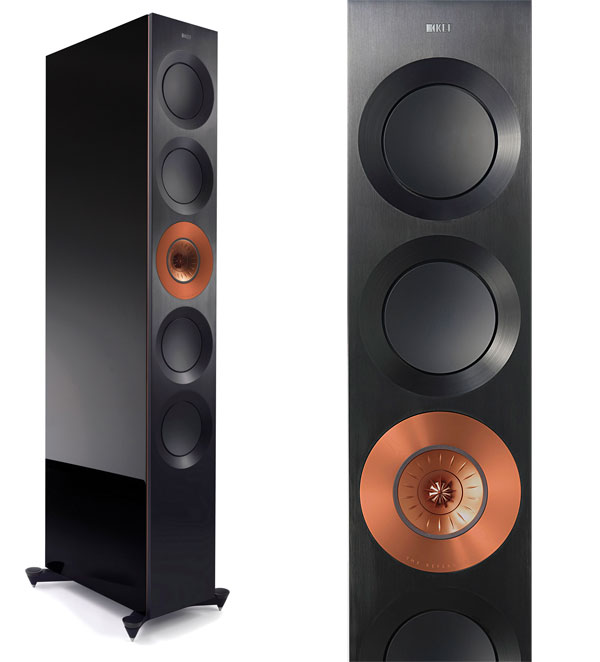
Of all the speakers I have most enjoyed in recent years, two were from British manufacturer KEF: the LS50 Anniversary Model ($1500/pair), which I reviewed in December 2012; and the Blade Two ($25,000/pair), which I reviewed in June 2015. Though these two speakers lie at opposite ends of the price scale, they have in common KEF's unique Uni-Q drive-unit, in which the tweeter is mounted on the front of the midrange unit's pole piece, so that the lower-frequency cone acts as a waveguide for the higher-frequency output.

Thiel CS1 loudspeaker

666thielcs1.promo.jpgKentucky manufacturer Thiel has acquired a reputation for the coherence of sound presented by its range of distinctive, sloping-baffle, floor-standing loudspeakers. Designer 221/index.html">Jim Thiel gives a high priority to linearity of phase response; as a result, he chooses to use phase-linear, first-order crossovers in his designs, the target response being the combination of electrical and mechanical filtering. As the out-of-band rejection is then only 6dB/octave, it places demands on his chosen drive-units to be well-behaved, not only in their passbands, but also outside of them. In effect, the loudspeaker has to be designed as a whole system, the interaction between the drive-units and crossover being considerable.
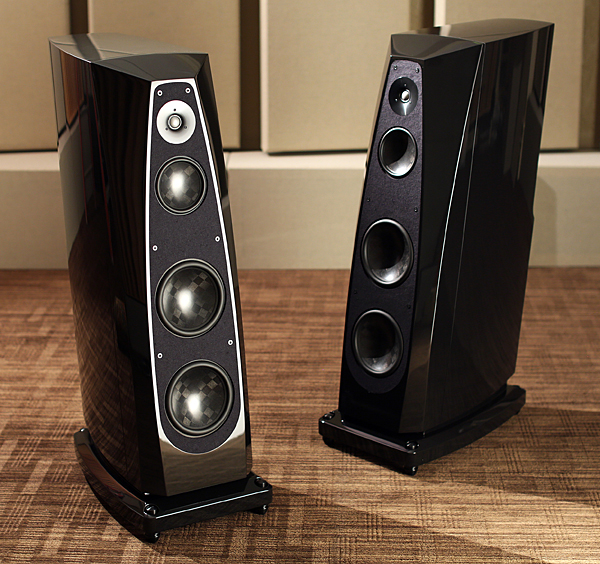
Rockport Technologies Avior II loudspeaker

Following my review of the floorstanding Magico S5 Mk.II last February, I spent some time with two-way stand-mounted speakers from Aerial Acoustics, Bowers & Wilkins, and Dynaudio. As much as I appreciated the small speakers' virtues, I found myself missing the big Magico's bass extension and ability to play loud; my next loudspeaker review, therefore, would be of another floorstander.

It's been a while since we published a review of a Rockport Technologies loudspeaker.

Quad ESL-2912 loudspeaker

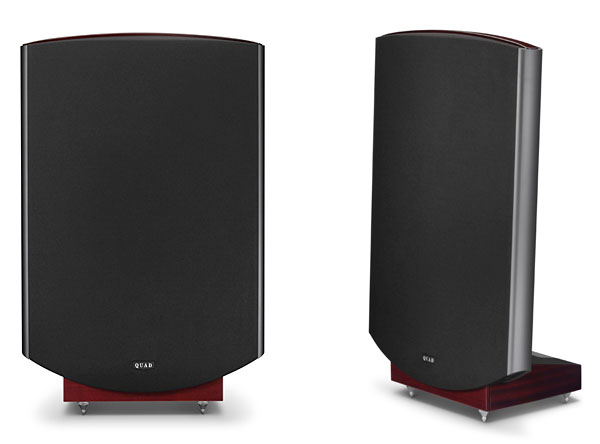
If Stereophile gave an award for Loudspeaker We've Most Frequently Reviewed, the hands-down winner would have to be the Quad ESL. The list of past and present Stereophile contributors who've written about the ESL's various incarnations includes John Atkinson, Martin Colloms, Anthony H. Cordesman, Art Dudley, Larry Greenhill, J. Gordon Holt, Ken Kessler, Dick Olsher, Herb Reichert, William Sommerwerck, Steven Stone, and Sam Tellig. The ESL-63 was John Atkinson's personal "Editor's Choice" in 1992, and the ESL-989, a successor to the ESL-63, was Stereophile's 2003 Loudspeaker of the Year and Product of the Year.

Volti Audio Rival loudspeaker

If, like me, you're a dues-paying audiophile who's circumnavigated the upgrade block a few times, you've seen a lot of gear and set up many systems. I've carried 80-lb line conditioners up the six knee-crunching flights to my bachelor's penthouse, managed 50-lb loudspeakers downstairs to a waiting van, and made more trips to FedEx than I can count. I've owned dozens of audio products and reviewed dozens more.

Wilson Audio Specialties Alexx loudspeaker

Having discontinued the MAXX3 loudspeaker ($68,000/pair in 2009, when I reviewed it), Wilson Audio needed to plug the resulting gaping hole between the Alexia ($48,500/pair) and the Alexandria XLF ($210,000/pair). Company founder Dave Wilson was busy with the limited-edition WAMM Master Chronosonic loudspeaker ($685,000/pair), so son Darryl Wilson set about creating a speaker with a retail price of about $100,000/pair. The result, the Alexx, finally came in at $109,000/pair.

TDL Studio 1 loudspeaker

TDL is part of ELAC, one of the most successful OEM drive-unit manufacturers in the UK, particularly renowned for the 1" aluminum-dome tweeter that they make for Monitor Audio, Acoustic Energy, and British Fidelity. Perhaps of even more interest to readers of Stereophile is that the TDL system designer is one John Wright, who designed the classic series of IMF loudspeakers and who also was one of the leading equipment reviewers in the UK back in the 1960s. (For a while John was also a contributor to this magazine, his comprehensive reviews of tonearms appearing in Vol.2 Nos.10 & 12.)
Advertisement
Advertisement