Audio Skies Michael Vamos - YG Acoustics, JMF Audio, Ideon at Capital Audiofest 2025
The Listening Room and Fidelity Imports - Diptyque DP-160 Mk.2 at Capital Audiofest 2025
Fidelity Imports Audia Flight and Perlisten System
Fidelity Imports Wilson Benesch and Audia Flight System at Capital Audiofest 2025
J Sikora Aspire, Innuos Stream 3, Aurender N50, Gryphon Antileon Revelation, Command Performance AV
Bella Sound Kalalau Preamplifier: Interview with Mike Vice
BorderPatrol Zola DAC – Gary Dews at Capital Audiofest 2025
Audio Note UK TT3 Reference Turntable Debut at Capital Audiofest 2025
Kevin Hayes of VAC at Capital Audiofest 2025
2WA Group debuts Aequo Ensium at Capital Audiofest 2025
Capital Audiofest 2025 lobby marketplace walk through day one
Lucca Chesky Introduces the LC2 Loudspeaker at Capital Audiofest 2025
Capital Audiofest 2025 Gary Gill interview
Sponsored: Pulsar 121
Acora and VAC together at Capital Audiofest 2025
Scott Walker Audio & Synergistic Research at Capital Audiofest 2025: Atmosphere LogiQ debut
Sponsored: Symphonia
Sponsored: Symphonia Colors

LATEST ADDITIONS

Listening #207

The stars are matter. We are matter. But it doesn't matter.—Don Van Vliet

Only sensibilities trained on poetry can wholly appreciate it.—T.S. Eliot (writing about Djuna Barnes's Nightwood)

In the 17th century, steam engines began appearing throughout Europe and Asia, ushered into existence by any number of different inventors. More recently, multiple inventors conceived and cooked up the atomic bomb, the jet engine, and the solid-body electric guitar.

Continue Reading »

Rethm Maarga loudspeaker

Hi-fi is like cake. Most people enjoy listening to music, and most people like cake.

People who like cake tend to like different things about it. Some people like a flourless cake, some people like a fluffy angel food cake, and some like a cake loaded up with little pieces of carrot and God-knows-what-else. People who like hi-fi also tend to like different things. Some like punchy, forceful sounds, some like realistic, natural tones, some like texture and color, some like "air," and some like to hear things go whooshing from one speaker to the other. It's all okay.

Continue Reading »

Sonus Faber Olympica Nova 1 loudspeaker

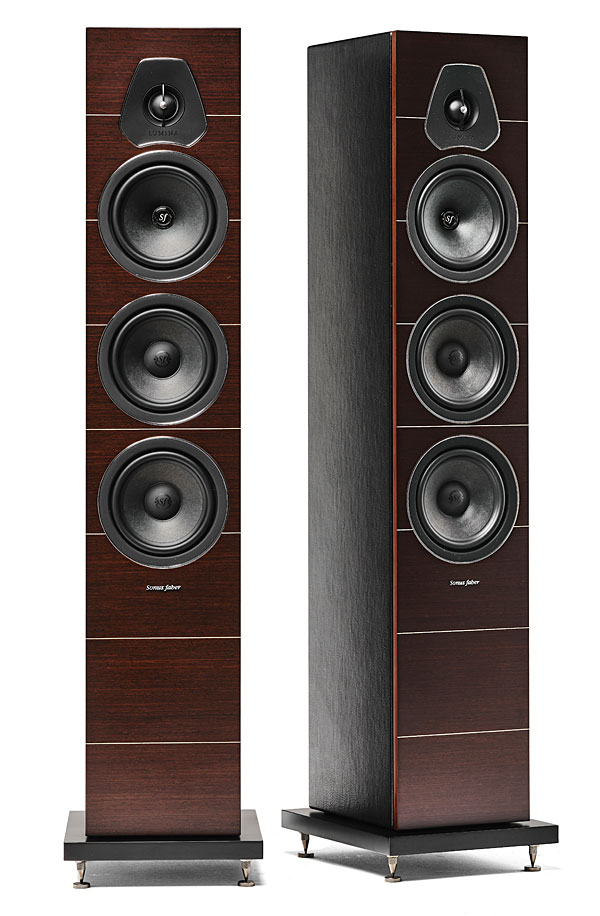
The Sonus Faber Olympica Nova 1 ($6500/pair) is the company's latest stand-mounted, two-way monitor—a lineage that began with their first speaker, the Minima, which I reviewed some 24 years ago. Like the products that followed, the Minima featured a 1" silk-dome tweeter and a 4" reflex-loaded paper-based midbass driver, both attached to a leather-covered baffle and housed in a beautiful wood cabinet, hand-crafted in Italy. I enjoyed the Minima's sound, as did this magazine's Sam Tellig, who praised its "sweet, forgiving, slightly rolled-off on top, and somewhat ripe . . . mid-to-upper bass," with superb focus and imaging that was a "treat for sore ears."
Continue Reading »

Parasound Halo A 21+ power amplifier

The components I needed to choose for my first system were never in doubt: a turntable or record changer, an integrated amplifier, and a speaker. One of each, please, in those mono days.

Today, even in stereo, that trinity would be regarded as rather traditional—or, if you prefer, purist. Digital has exploded the range of source options and loudspeaker options. Yet amplifiers have not changed much in how and what they do.

Continue Reading »

Chord Electronics Hugo M Scaler upsampling digital processor

The idea of using digital signal processing (DSP) to convert digital audio data sampled at 44.1kHz or 48kHz to a higher sample rate is not new. I first heard the beneficial effects of upsampling at Stereophile's 1998 hi-fi show in Los Angeles, where a pro-audio dCS 972 digital-to-digital processor was being used to convert 16-bit/44.1kHz CD data to a 24/192 datastream.
Continue Reading »

A High-Resolution Audio Primer

January's Industry Update included a report on a scientific article presented at last year's AES meeting, in which the authors used test tones and a modest audio system (albeit in an anechoic chamber) to prove that listeners can discriminate between high-rez and CD-rez audio. This is important because scientific evidence of an audible difference between high-rez and CD-rez music is considered weak by some, even as anecdotal evidence grows stronger by the day.

As I pondered this, I recalled a recent paper I'd seen in the Journal of the Audio Engineering Society but hadn't yet read. "High Resolution Audio: A History and Perspective," which the AES has made available free online, does precisely what the title says: reviews the history of digital audio beyond CD-rez and frames the issue of high-rez audio's audible superiority on the basis of the available evidence.

Continue Reading »

Let rolling streams their gladness show

In the 1980s, the CD nearly pushed the LP to extinction. Nearly. For all the claims of "Perfect Sound Forever," the main thing offered by the CD was convenience.

Then, in the mid-1990s, the MP3 and the Internet made it easy to extract and distribute the information encoded on a CD. Secret websites raced to be the first to distribute free MP3s of new recordings, sometimes even before they were released. This went on for years, undermining record-company profits, before Napster came along and gave the record industry a high-value lawsuit target: no more suing widows and small children.

Continue Reading »
Advertisement
Advertisement
Advertisement