Tonearm Reviews

Sort By: Post DateTitle Publish Date

Kuzma 4Point tonearm

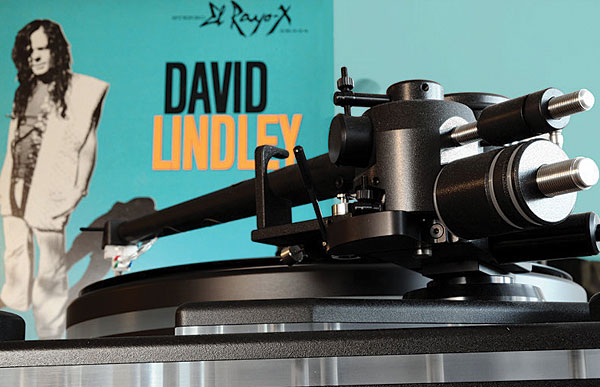
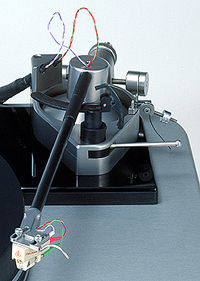
No one has ever accused Franc Kuzma of designing glamorous audio jewelry. His turntables and tonearms are industrial-strength examples of engineering know-how and machining excellence. But to those who appreciate such things, his products are truly beautiful, even if they're not adorned with chrome, wood, and sleekly polished surfaces. And if looking at the 4Point tonearm ($6500) in pebbly Darth Vader black doesn't get your analog juices flowing, perhaps its innovative design will. But first, this message:

Brinkmann 9.6 tonearm

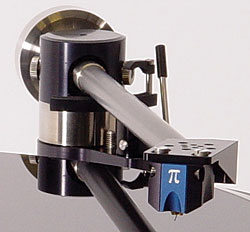
Brinkmann's 9.6 tonearm ($3990) resembles the German company's longer, more expensive 10.5 and 12.1 arms, which in turn resemble the legendary Breuer. The new arm includes the same headshell, armtube, mounting socket, and cueing device used in the other arms. The bearing system differs, though the Swiss-made ball bearings are identical.


While the more expensive arms use traditional fixed-gimbal bearings, the 9.6 has a unipivot-like construction for the horizontal bearing. The weighted arm housing sits on a small ball that rests on a pivot, also as in a typical unipivot design. A second ball at the bottom of the housing prevents "arm lean," but since the arm's weight rests on the top ball, the lower one isn't critical, and I could feel some play when I handled the arm. Vertical arm motion is effected via a second pair of captured bearings. This arrangement allowed the use of less costly parts and kept the price down, Brinkmann says. The arm's effective length is 248mm (231.5 from pivot to spindle, plus 16.5mm of overhang), while its effective mass, referenced to the center position of the headshell slot, is 12gm.

HiFiction Thales AV tonearm

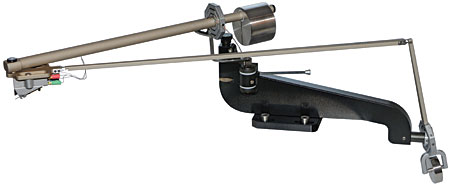
Ideally, LPs should be played with the pickup stylus remaining tangential (ie, at a 90° angle) to the groove—just as the lacquer from which the LP was ultimately stamped was cut in the first place. Over the years, many attempts have been made to accomplish this. Back in 1877, Thomas A. Edison's original machines tangentially tracked his cylinders, but Emil Berliner's invention of the flat disc put an end to cylinders altogether. In the 1950s, a number of companies marketed so-called "tangential" trackers that used dual arms, based on conventional pivoting arrangements, to change the angle at which the headshell was mounted as it moved across the LP side. In 1963, Marantz introduced the SLT-12, which used a plastic pantograph to move the stylus across the record surface. Garrard's Zero 100 pivoting arm controlled its independently pivoting headshell with a bar that extended from the main bearing of the tonearm.


Spiral Groove Centroid tonearm

Spiral Groove's new Centroid tonearm ($6000) arrived just a few days before press time, so it would be risky to say anything definitive about it. But I will take that risk: using the system described in my">http://www.stereophile.com/turntables/spiral_groove_sg2_turntable/">my review of the SG2 turntable, this may be the best tonearm I've heard. Its sound is different in ways that will open people's ears, and I predict that it will affect the design of every tonearm from now on. The Centroid's design deserves and will await full coverage in its own review, but here are the basics: It's a fluid-damped unipivot design unlike any other that gives the user fine adjustment of all relevant parameters.


Linn Ekos SE tonearm, Keel LP12 subchassis, & Trampolin turntable base

Visit www.stereophile.com and look at the Vote">http://cgi.stereophile.com/cgi-bin/showvote.cgi?522">Vote Results for June 17, 2007: You'll see that when we asked our readers to name the one audio product that's spent the greatest amount of time in their systems, the most common answer by far was the Linn">http://www.stereophile.com/turntables/1103linn">Linn Sondek LP12 turntable (footnote 1). Little wonder that Scotland's most famous record player endures as an object of attention for various and sundry commercial tweaks.


Graham Engineering Phantom B-44 tonearm

The Graham">http://www.stereophile.com/tonearms/400">Graham Engineering 1.5 tonearm, originally introduced in 1990, was a thoughtfully executed design that logically addressed all of the basics of good tonearm performance—geometry, resonance control, rigidity, dynamic stability—with effective, sometimes ingenious ideas, while providing exceptional ease and flexibility of setup. Over time, designer Bob Graham came up with ways to significantly improve the 1.5's performance, including the replacement of its brass side weights with heavier ones of tungsten, an improved bearing with a more massive cap, various changes in internal wiring, a far more rigid and better-grounded mounting platform, and a new, sophisticated ceramic armwand. (The original wand had hardly been an afterthought: its heat-bonded, constrained-layer-damped design consisted of an inner tube of stainless steel and an outer tube of aluminum.) The arm's name changed from the 1.5 to the 1.5t (tungsten), then the 1.5t/c (ceramic), and on to the 2.0http://www.stereophile.com/tonearms/401">2.0;, 2.1, and 2.2http://www.stereophile.com/tonearms/401/index7.html">2.2;.


Kuzma Air Line tonearm

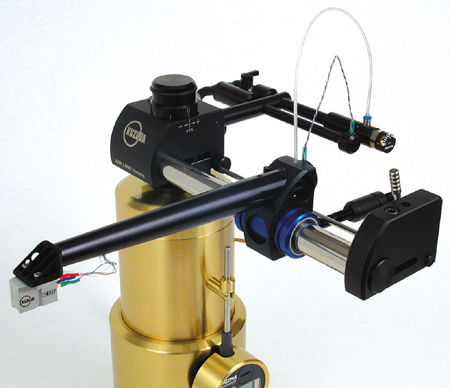
The lacquers from which LPs are pressed are cut in a straight line, and that's how the LP groove should be traced. Even when set up perfectly, a pivoted arm describes an arc across the disc surface, maintaining tangency to the groove at only two points on that arc. Yet despite numerous attempts at building and selling linear-tracking tonearms, few remain on the market, and most are fraught with technical problems. Linear-tracking arms can be anything but linear, committing more sins of geometry as they meander across the record surface than do their pivoted brethren.


Graham Robin tonearm

The best tonearm I ever heard was a second-generation Mission Mechanic, ca 1986. It was mounted on a Roksan Xerxes turntable, and I spent several happy hours listening to records on that combination (with a low-compliance EMT cartridge) in two very different systems: one with solid-state amplification from DNM and Roksan's own dynamic Darius loudspeakers, and the other—my home system of the time—using tube amplification from Conrad-Johnson and a borrowed pair of Stax electrostatic speakers.


Graham Model 2.0 tonearm

When Bob Graham introduced his 1.5">http://www.stereophile.com//analogsourcereviews/400/">1.5 tonearm at the end of the 1980s, many thought he was dreaming: Vinyl was going the way of the console radio—who would invest two-grand-plus in a tonearm? But there was a method to Graham's madness—he'd designed his arm to be a drop-in replacement for more than 20 years' worth of SME arms, all of which shared the same mounting platform. Perhaps, in his wildest dreams, Graham had already envisioned the current "analog revival"—but even without it, he figured there'd be a robust replacement market, and he was poised to exploit it with what he thought was a superior product.


Immedia RPM-2 tonearm

If the sole criterion for choosing a winner in today's hotly contested premium arms race was original thinking, the Immedia RPM-2 might well come out on top. While some of its design details resemble those found on other products, in many significant areas the arm is unique—not for uniqueness's sake, but in order to efficiently implement some clearly considered goals. If the unipivot RPM-2 bears a resemblance to any other contemporary arm, it is Naim's highly regarded ARO—which I've never heard. The similarity, though, would appear to be superficial.


Advertisement
Advertisement
Advertisement