Tonearm Reviews

Sort By: Post DateTitle Publish Date

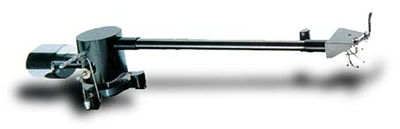
Naim Aro tonearm

When I was visiting Santa Fe last Easter (footnote 1), one of the subjects I raised with JA was Naim's ARO tonearm. This unique unipivot design has languished in Class K of Stereophile's "Recommended Components" listing for far too long. JA explained that the regular reviewers have quite enough to do, thank you, just keeping up with speakers, electronics, and especially digital. The esteemed Martin Colloms is happily using an ARO on his Linn Sondek, and wrote a review for the English magazine Hi-Fi News & Record Review in May 1991, but since there is a very small but nevertheless vociferous overlap in US readership between the two magazines, it is Stereophile policy not to have two reviews by the same reviewer of a given piece of gear.


Graham Model 1.5 tonearm

Frankly, I'm fed up with the prophets of doom, those false seers who forecast vinyl's imminent demise. Some claim to have seen the writing on the wall as far back as ten years ago, sensing that the advent of the CD would perforce relegate the stylus-in-groove method of transduction to the trashpile of history. First of all, most of the music I enjoy happens to be on LP. And I'm sure I speak for many audiophiles who have also spent a lifetime building up a vinyl collection when I say we're not about to throw away our cherished treasuries of music. These LPs I expect to enjoy until the end of my time. Thus, I welcome any phono-system technological advance that will recover more information from the groove.


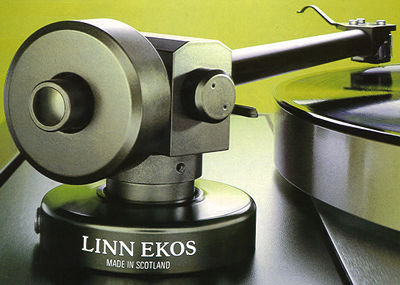
Linn Ekos tonearm

"Tonearm?" muttered John Crabbe, my erstwhile editor at Hi-Fi News & Record Review, as he bent over my shoulder some 12 years ago to see what I was writing about. "A tonearm belongs on an acoustic gramophone—you should use the term 'pickup arm,' which doesn't suggest that the arm has a sound of its own."


Airtangent tonearm

Tonearms, like Rodney Dangerfield, never get no respect. When was the last time you heard someone actually argue the merits of a tonearm? Right, not recently. "Hey, I just got that new Gizmo tonearm!" "Oh yeah? What cartridge are you using?" People pick out the cartridge for praise and consideration time after time, while the tonearm gets taken for granted.


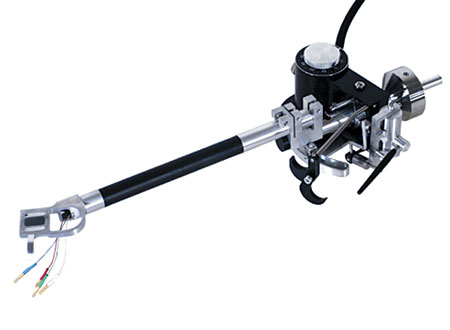
The Tri-Planar Tonearm

While brushing my teeth this morning, it occurred to me that there are significant similarities between a toothbrush and a tonearm/cartridge. The bristles would be analogous to the cartridge and the brush handle to the tonearm. In either case it is the business end of the device that does all the work. The bristles track the contours of your ivories in search of hazardous waste deposits, while the cartridge tracks the record groove transducing wall modulations into an electrical signal. I think that this is where the old adage came from: "A used cartridge is like a used toothbrush—nobody wants one!"


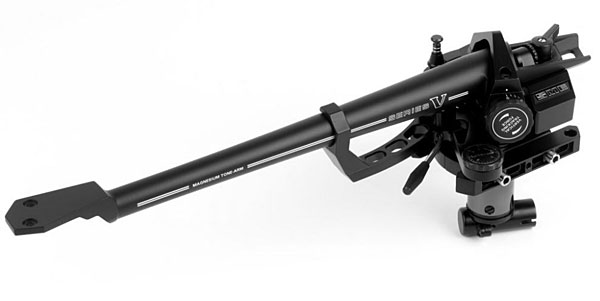
SME Series V tonearm

Once upon a time, SME made "the best tonearm in the world." That claim may have been justifiable through the 1960s and early '70s, but then something happened—SME failed to keep pace with their competition in coping with the increasing popularity of low- to medium-compliance, highish-mass, moving-coil cartridges. I had just about written SME off as a serious high-end company when, at the 1984 Summer CES, I saw the first prototype of the Series V.

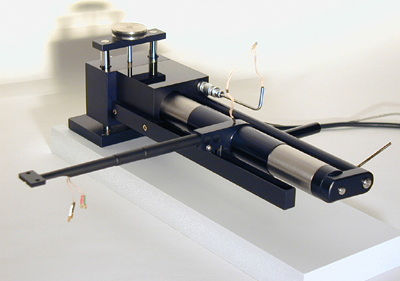
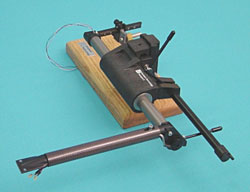
Eminent Technology Two tonearm

666et2.jpgIf analog disc is fading, it is a twilight of the gods. Tonearms, cartridges, and turntables get steadily better; the overall quality of the best analog disc systems today is far better than it was two years ago. Bruce Thigpen and Edison Price's new Eminent Technology Two tonearm is a case in point. It has evolved from a highly specialized product for only the bravest of audiophiles to a reference quality arm that any dealer can install, and any audiophile can safely use. More importantly, it may have no sonic equal at any price.
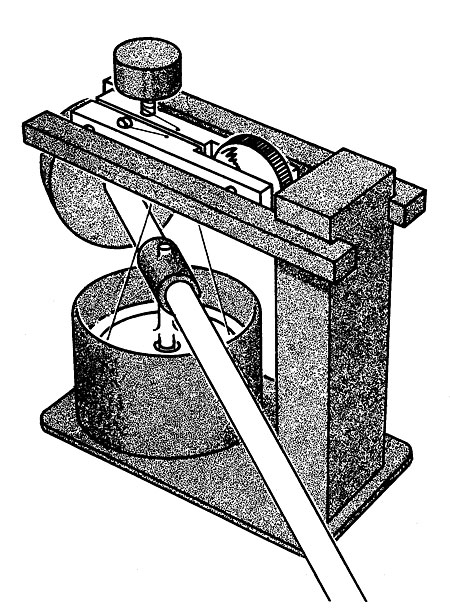
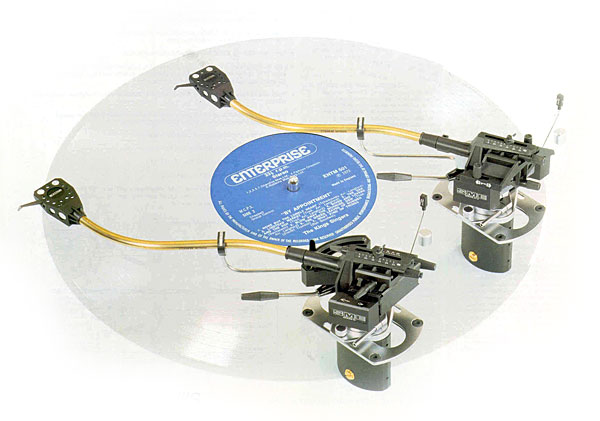
The Well-Tempered Arm

Remember Rube Goldberg? He was a cartoonist during the late 1920s to early 1950s who specialized in devising the most outlandish and ingenious devices ever conceived by man, before or since. A Rube Goldberg mousetrap, for example, would occupy an entire small room. In taking the bait, the mouse would tip a balance beam, dropping a steel ball into a gutter, down which the ball would roll to strike a paddle whose spin would wind up a string that hoisted a weight into the air until it reached a trigger at the top, which would then release the weight to drop onto the unsuspecting mouse. Splat!


Advertisement
Advertisement