

Airtangent tonearm
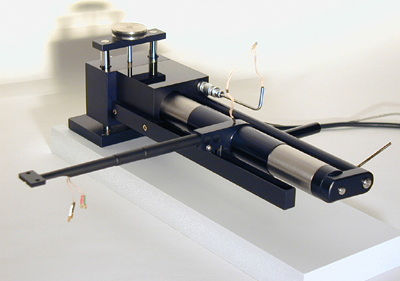
Tonearms, like Rodney Dangerfield, never get no respect. When was the last time you heard someone actually argue the merits of a tonearm? Right, not recently. "Hey, I just got that new Gizmo tonearm!" "Oh yeah? What cartridge are you using?" People pick out the cartridge for praise and consideration time after time, while the tonearm gets taken for granted.
Audio & Design M9BA tonearm
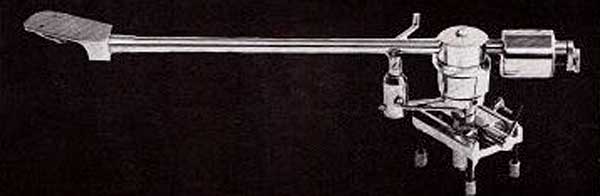
Back in the days of pre-stereo high fidelity, when a 6-gram phono pickup was considered to be "featherweight," the best universal-type tonearm we knew of was a bulky, very professional-looking device made by Gray Labs and designated the Model 108. One unusual thing about it was that, instead of using sleeve or cone-face bearings, it had a single up-ended needlea so-called unipivotfor both the vertical and lateral modes of motion. The other unusual thing about it was that the pivot system was viscous-damped, and it was this, we suspect, that was largely responsible for the arm's ability to make any pickup sound somehow sweeter and cleaner than it did in any other arm.
Brinkmann 9.6 tonearm
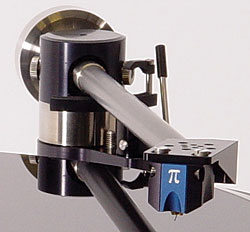 Brinkmann's 9.6 tonearm ($3990) resembles the German company's longer, more expensive 10.5 and 12.1 arms, which in turn resemble the legendary Breuer. The new arm includes the same headshell, armtube, mounting socket, and cueing device used in the other arms. The bearing system differs, though the Swiss-made ball bearings are identical.
While the more expensive arms use traditional fixed-gimbal bearings, the 9.6 has a unipivot-like construction for the horizontal bearing. The weighted arm housing sits on a small ball that rests on a pivot, also as in a typical unipivot design. A second ball at the bottom of the housing prevents "arm lean," but since the arm's weight rests on the top ball, the lower one isn't critical, and I could feel some play when I handled the arm. Vertical arm motion is effected via a second pair of captured bearings. This arrangement allowed the use of less costly parts and kept the price down, Brinkmann says. The arm's effective length is 248mm (231.5 from pivot to spindle, plus 16.5mm of overhang), while its effective mass, referenced to the center position of the headshell slot, is 12gm.
Brinkmann's 9.6 tonearm ($3990) resembles the German company's longer, more expensive 10.5 and 12.1 arms, which in turn resemble the legendary Breuer. The new arm includes the same headshell, armtube, mounting socket, and cueing device used in the other arms. The bearing system differs, though the Swiss-made ball bearings are identical.
While the more expensive arms use traditional fixed-gimbal bearings, the 9.6 has a unipivot-like construction for the horizontal bearing. The weighted arm housing sits on a small ball that rests on a pivot, also as in a typical unipivot design. A second ball at the bottom of the housing prevents "arm lean," but since the arm's weight rests on the top ball, the lower one isn't critical, and I could feel some play when I handled the arm. Vertical arm motion is effected via a second pair of captured bearings. This arrangement allowed the use of less costly parts and kept the price down, Brinkmann says. The arm's effective length is 248mm (231.5 from pivot to spindle, plus 16.5mm of overhang), while its effective mass, referenced to the center position of the headshell slot, is 12gm.
Eminent Technology Two tonearm
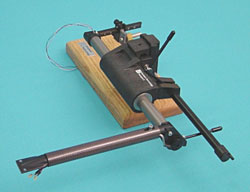 If analog disc is fading, it is a twilight of the gods. Tonearms, cartridges, and turntables get steadily better; the overall quality of the best analog disc systems today is far better than it was two years ago. Bruce Thigpen and Edison Price's new Eminent Technology Two tonearm is a case in point. It has evolved from a highly specialized product for only the bravest of audiophiles to a reference quality arm that any dealer can install, and any audiophile can safely use. More importantly, it may have no sonic equal at any price.
Formula 4 tonearm
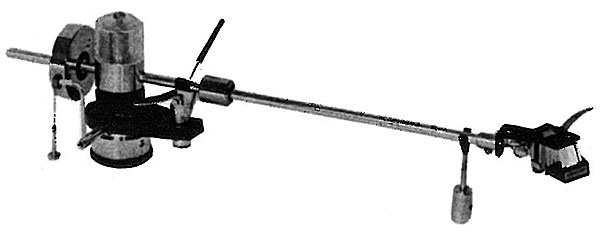
Not the easiest tonearm to set up (let your dealer do it if you aren't overly skilled at such things), this English-designed and Japanese-made device is the best pivoted tonearm we have tested to date, and at a very reasonable price at that. Polk Audio is importing them and distributing to dealers, most of whom sell them for around $130 to $140, and some buyers have managed to purchase them directly from stores in England for as little as $80. We received two samples of this for testing, one directly from the US distributor, Polk Audio, the other from Natural Sound, a Nebraska dealer and (naturally) one of our advertisers. Suffice it to say that both samples were identical in every perceptible manner.
Graham Engineering Phantom B-44 tonearm
The Graham">http://www.stereophile.com/tonearms/400">Graham Engineering 1.5 tonearm, originally introduced in 1990, was a thoughtfully executed design that logically addressed all of the basics of good tonearm performance—geometry, resonance control, rigidity, dynamic stability—with effective, sometimes ingenious ideas, while providing exceptional ease and flexibility of setup. Over time, designer Bob Graham came up with ways to significantly improve the 1.5's performance, including the replacement of its brass side weights with heavier ones of tungsten, an improved bearing with a more massive cap, various changes in internal wiring, a far more rigid and better-grounded mounting platform, and a new, sophisticated ceramic armwand. (The original wand had hardly been an afterthought: its heat-bonded, constrained-layer-damped design consisted of an inner tube of stainless steel and an outer tube of aluminum.) The arm's name changed from the 1.5 to the 1.5t (tungsten), then the 1.5t/c (ceramic), and on to the 2.0http://www.stereophile.com/tonearms/401">2.0;, 2.1, and 2.2http://www.stereophile.com/tonearms/401/index7.html">2.2;.
Graham Model 1.5 tonearm
Frankly, I'm fed up with the prophets of doom, those false seers who forecast vinyl's imminent demise. Some claim to have seen the writing on the wall as far back as ten years ago, sensing that the advent of the CD would perforce relegate the stylus-in-groove method of transduction to the trashpile of history. First of all, most of the music I enjoy happens to be on LP. And I'm sure I speak for many audiophiles who have also spent a lifetime building up a vinyl collection when I say we're not about to throw away our cherished treasuries of music. These LPs I expect to enjoy until the end of my time. Thus, I welcome any phono-system technological advance that will recover more information from the groove.
Graham Model 2.0 tonearm
When Bob Graham introduced his 1.5">http://www.stereophile.com//analogsourcereviews/400/">1.5 tonearm at the end of the 1980s, many thought he was dreaming: Vinyl was going the way of the console radio—who would invest two-grand-plus in a tonearm? But there was a method to Graham's madness—he'd designed his arm to be a drop-in replacement for more than 20 years' worth of SME arms, all of which shared the same mounting platform. Perhaps, in his wildest dreams, Graham had already envisioned the current "analog revival"—but even without it, he figured there'd be a robust replacement market, and he was poised to exploit it with what he thought was a superior product.
Graham Robin tonearm
The best tonearm I ever heard was a second-generation Mission Mechanic, ca 1986. It was mounted on a Roksan Xerxes turntable, and I spent several happy hours listening to records on that combination (with a low-compliance EMT cartridge) in two very different systems: one with solid-state amplification from DNM and Roksan's own dynamic Darius loudspeakers, and the other—my home system of the time—using tube amplification from Conrad-Johnson and a borrowed pair of Stax electrostatic speakers.
HiFiction Thales AV tonearm
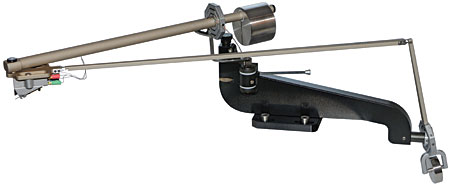
Ideally, LPs should be played with the pickup stylus remaining tangential (ie, at a 90° angle) to the groove—just as the lacquer from which the LP was ultimately stamped was cut in the first place. Over the years, many attempts have been made to accomplish this. Back in 1877, Thomas A. Edison's original machines tangentially tracked his cylinders, but Emil Berliner's invention of the flat disc put an end to cylinders altogether. In the 1950s, a number of companies marketed so-called "tangential" trackers that used dual arms, based on conventional pivoting arrangements, to change the angle at which the headshell was mounted as it moved across the LP side. In 1963, Marantz introduced the SLT-12, which used a plastic pantograph to move the stylus across the record surface. Garrard's Zero 100 pivoting arm controlled its independently pivoting headshell with a bar that extended from the main bearing of the tonearm.