Digital Processor Reviews

Sort By: Post DateTitle Publish Date

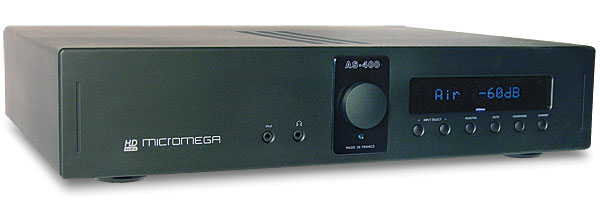
Micromega AS-400 D/A integrated amplifier

Blind though I am to the allure of blind testing, I can appreciate some degree of review-sample anonymity: Distinctive products elicit distinctive responses, but a plain black box encourages us to leave our prejudices at the door. It asks of us a certain . . . objectivity.


So it was with the Micromega AS-400 digital source/integrated amplifier ($4495), the anonymity of which was compounded, in my case, by a generous helping of forgetfulness: I suppose I was told, ahead of time, that this was a class-D amplifier, but at some point in time before my first at-home audition I apparently killed the brain cells responsible for remembering that fact. So I was innocent of conscious prejudice when I listened to this elegant cipher of a box and wrote, in my notes: "Dynamic, dramatic, and almost relentlessly exciting with some recordings. Imbued pianos with almost too much dynamism for the room—too much being very good!—but lacked some 'purr' in the die-away. Basically fine and fun. Wish it had a little more color and spatial depth."

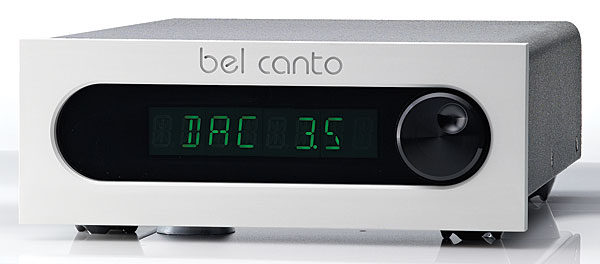
Bel Canto e.One DAC3.5VB D/A converter

Minnesota pride is a funny thing. As Garrison Keillor points out weekly on A Prairie Home Companion, to be a Minnesotan, the first and crucial step to be taken is that of self-effacement. It is unclear to me whether this is the cause or symptom of Minnesotans ability to endure brutal winters, excel at the creation and consumption of hot dish (which the rest of the God-fearing world knows as casseroles), or their miraculous lineage from generations of Norwegian bachelor farmers. Whatever it is, Minnesotans tend to quietly get their jobs done with little more fanfare than a cup of coffee and a slice of rhubarb pie.

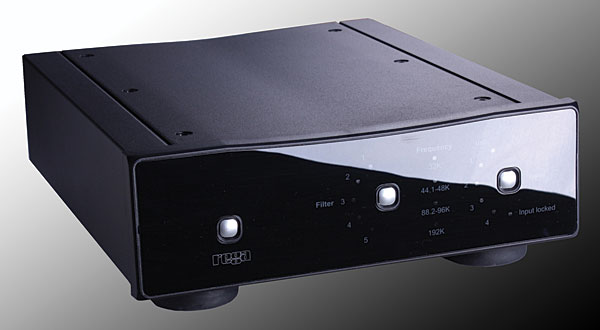
Rega DAC D/A processor

"We like to make things," Roy Gandy, Rega's founder and owner, once told me. "It's what we do." Or maybe it was Rega's chairman and chief engineering honcho, Terry Bateman. Rega products are designed and manufactured in the south of England. So far as I know, no one at the Rega facility, on the Temple Farm Industrial Estate, has committed suicide; the same cannot be said of workers at the factory in China where iPods are made. Al Gore is on the board of Apple. Al, what do you think?

Musical Fidelity V-Link USB-S/PDIF converter

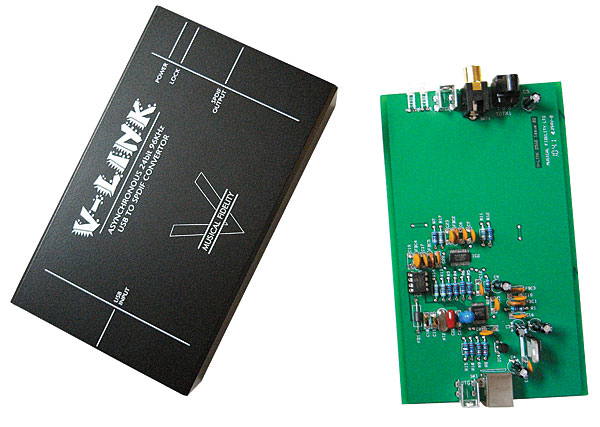
A computer is not optimized for the uninterrupted streaming of audio data. It has rapidly become established wisdom, therefore, that the optimal means of extracting audio data from a computer's USB port is to operate that port in what is called "asynchronous isochronous" mode. This lets the receiving device, such as a digital-to-analog converter (DAC), control the flow of data from the PC. In theory, asynchronous USB operation (not to be confused with the asynchronous sample-rate conversion used in some DACs) reduces jitter to unmeasurable levels, depending on the accuracy of the receiver's fixed-frequency oscillator, which is used to clock the data to the DAC. By contrast, in the alternative and almost ubiquitous USB operating mode, called "adaptive isochronous," while the sample rate of the output data, averaged over a longish period, will indeed be the specified 44.1 or 48kHz, there will be short-term fluctuations, or jitter, due to the oscillator having to change its frequency every millisecond to match the uncertain rate of data flow from the PC.

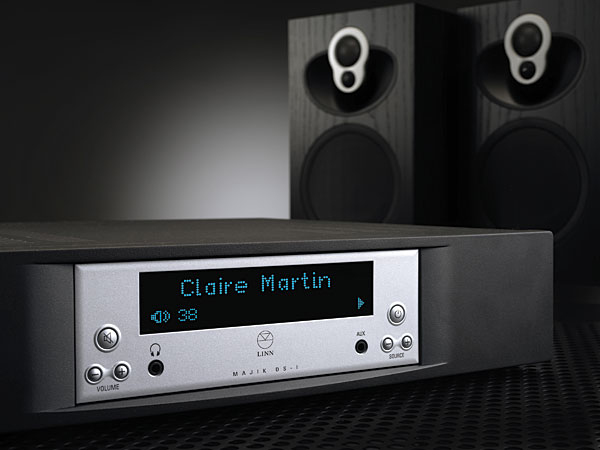
Linn Majik DS-I D/A integrated amplifier

My quandary on receiving for review the Linn Majik DS-I: What, precisely, is it supposed to do? Does the Majik DS-I contain a hard disk and music-ripping software, so I can use it to store all the music in my CD collection? Does it have a graphical user interface (GUI) that at least matches the one provided by the endearingly free Apple iTunes? Does it include a DAC that allows it to play the music files I've already put on my computer?

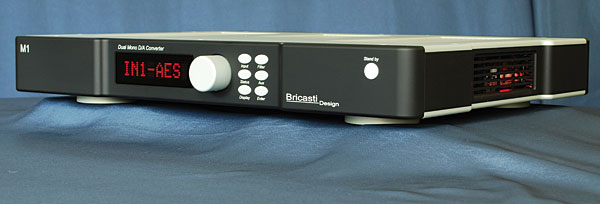
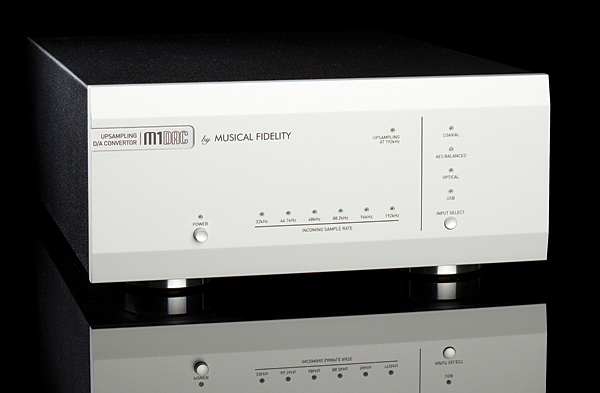
Musical Fidelity M1 DAC

The M1 DAC is by Musical Fidelity. At $699, it's a stunning bargain. Comparing it to $995 for the Digilog in 1989. Meanwhile, the M1 is far more versatile, way better built, and, if memory serves me right, sounds vastly better.


It appears that the way to sell a DAC in 2011 is to almost give it away, in real-dollar terms. Some people pay far more than this for a set of speaker cables, a pair of interconnects, even a power cord. The M1 DAC is a piece of kit that can transform your system. I kid you not.

HRT Music Streamer Pro USB D/A converter

Art Dudley and others have covered the first products released by HRT, and now the company has added to its product line a Pro version of its Music Streamer, which sports balanced circuit design from tip to tail.


Housed in the same simple, functional, six-sided case of extruded aluminum as HRT's other products, the Pro is painted a bright blue to distinguish it from the Music Streamer II (red) and Music Streamer II+ (gray). At 5.6" it is also a tad longer than the others, and includes a single B-type USB 1.1 jack centered on one end, and two small, fully balanced TiniQ output jacks on the other. More about these special mini sockets later.

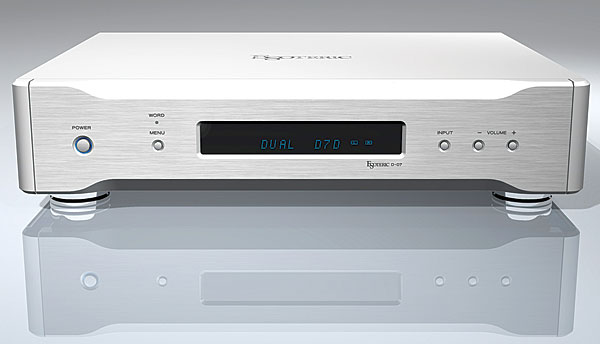
Esoteric D-07 D/A processor

In November 2009, I took part in an intriguing comparison between live and recorded sound. I first recorded a live piano recital in 24-bit/96kHz digital, then allowed the audience to immediately hear the recording in the same room. (See my February 2010 thoughts on the comparison here.) For playback, I used two of the mono Esoteric D-01VU D/A converters locked to the ultra-high-precision Esoteric G-0Rb "atomic" master clock. I was very impressed by the sound of this cost-no-object digital system, so when I visited the Japanese company's room at the 2010 Consumer Electronics Show and saw their new, relatively affordable D-07 D/A processor ($4800), I asked for a review sample.

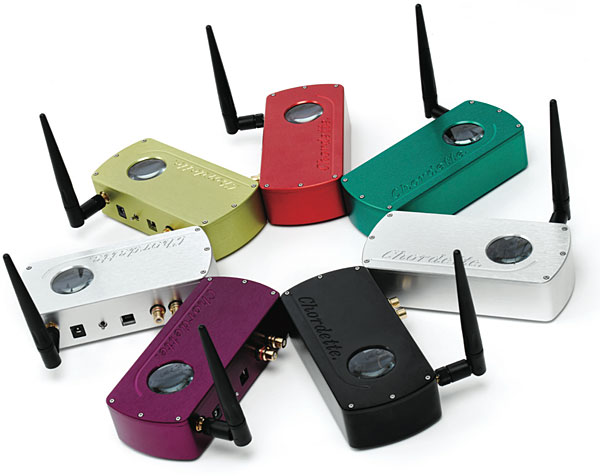
Chord Chordette Gem D/A processor

There's home cooking on one side of the hedge and fast food on the other, and the world moves farther from the former and nearer to the latter with each passing day. So it goes in domestic audio, where virtually every new milestone of the past quarter-century has pointed far more toward convenience than toward quality.


Depressed? Don't be. Those of us in the perfectionist community have a history of dealing with such things, howsoever slowly and inefficiently. (footnote 1). We're getting better at it, too, year by year. An example: Chord Electronics, of sunny southern England, has now brought to market their Chordette Gem D/A converter ($799) which they offer as an affordable means of getting perfectionist-quality sound from computer-music files.

Advertisement
Advertisement
Advertisement