Phono Preamp Reviews

Sort By: Post DateTitle Publish Date

Analog Corner #251: ModWright PH 150 phono stage
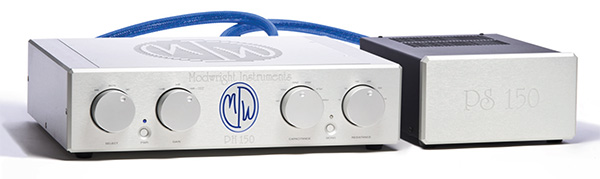
ModWright Instruments' PH 150 moving-coil/moving-magnet phono stage measures 17" wide by 5" high by 12" deep and weighs 19lb. Knobs on its front panel let you easily make adjustments that with some phono preamps require accessing the rear panel or going inside. Starting at the left, the Select knob offers settings for MC, MM, and Mute. The Gain knob offers levels of 0dB, –6dB, and –12dB. With MC selected, those settings would correspond with 72, 66, and 60dB of gain, respectively; with MM, the numbers would be 57, 51, and 45dB, the last being more typical of most MM stages.


First, let's talk about problems with grounding and hum...
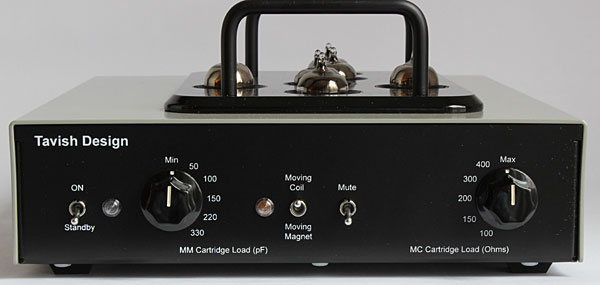
Listening #162: Tavish Adagio phono preamplifier

Though Westchester County, New York, seems a likelier locale for Bikram yoga studios, pet psychologists, and pricey restaurants specializing in "grain bowls" and fermented vegetables, the idea of manufacturing audio gear there is not without precedent. Cartridge manufacturer Micro-Acoustics (Elmsford, NY) thrived there for over two decades. George Kaye and Harvey Rosenberg's New York Audio Laboratories (Croton-on-Hudson, NY) assembled Moscode amplifiers there. Even the notorious loudspeaker manufacturer Fourier Systems (Yonkers, NY and Cocytus, Hell) got their start in the county that Hillary Clinton calls home, as needed.

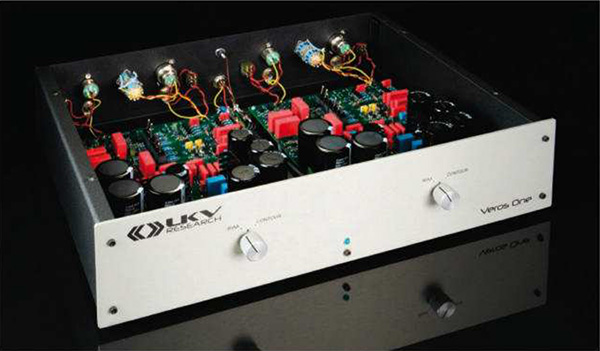
Analog Corner #249: LKV Research Veros One phono preamp, Triangle Art Apollo MC cartridge

Designer Bill Hutchins, of LKV Research, builds the 2-SB moving-magnet/moving-coil phono preamplifier in North Conway, in the White Mountains of New Hampshire; he uses as many US-sourced parts as possible, and sells his products factory direct. I reviewed the 2-SB in March 2014, on AnalogPlanet.com: the 2-SB's sound was exceptionally fine—especially if you like refined, solid-state quiet and detail, and especially considering its then-price of $2500. Since that review's publication, the 2-SB has been upgraded with a version of the third gain stage from LKV's JFET-based Veros One phono preamp ($6500; see below), and its price has risen to a still-reasonable $3000.


In May 2014, Bill Hutchins introduced the Veros One phono preamplifier ($6500).

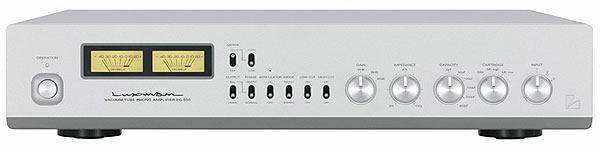
Luxman EQ-500 phono preamplifier

I still remember how difficult it was for me to transition from mass-market to high-end audio. The former, for all its flaws, gave me things to do: switches to flip, buttons to push, knobs to turn, meters to watch. I was in control—and if my attention happened to stray from the music or the liner notes, I still had something to keep me busy. By contrast, the first perfectionist-quality amplifier I bought—an Amber Series 70—was an oblong box with an on/off switch. Where's the fun in that?

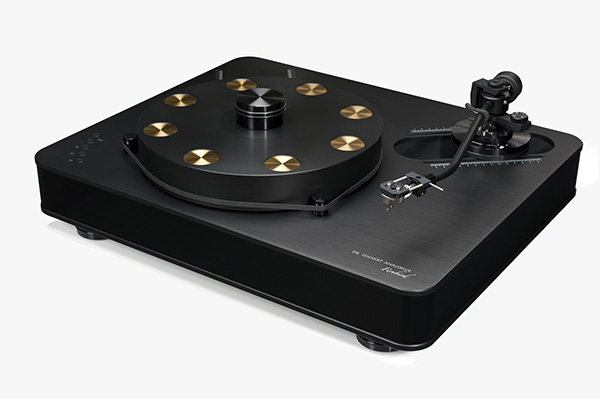
Analog Corner # 247: Dr. Feickert Firebird turntable, Viva Fono MC phono preamplifier, AcroLink and Fono Acustica interconnects

Dr. Feickert Analogue's top-of-the line turntable, the Firebird ($12,500), is a generously sized record player designed to easily accommodate two 12" tonearms. Its three brushless, three-phase DC motors, arranged around the platter in an equilateral triangle, are connected to a proprietary controller in a phase-locked loop (PLL); according to the Firebird's designer, Dr. Christian Feickert, a reference signal from just one of the motors drives all three—thus one motor is the master while the other two are slaves. (Man, today that is politically incorrect, however descriptively accurate.)

Gramophone Dreams #6

I used to get invited to these highly secret audio soirées, held in a basement workshop at the end of a dark, garbage-filled alley in Manhattan's Chinatown. There was no street address—only a wire-glass window in a metal door—and if you didn't know the password (ie, if you weren't carrying some type of audio amplification), you weren't allowed to enter. That said, sometimes nonmembers were allowed to attend, but only when a member needed help carrying monoblocks: There was no parking nearby.

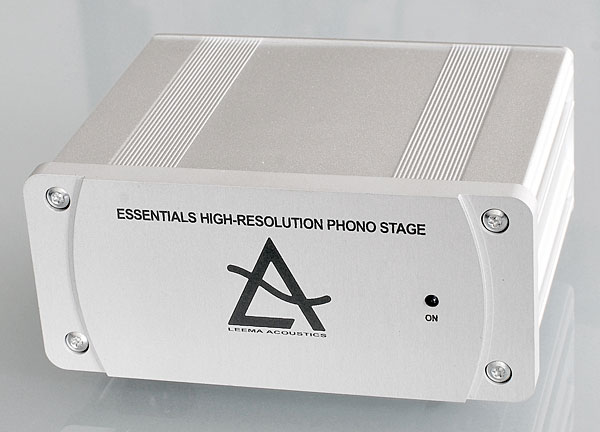
Leema Acoustics Essentials phono preamplifier

"The way that young people will get into high-end audio is not through streaming: It's through the LP."


When that observation was offered during a recent phone conversation, I wrote it down word for word—not just because I agree with it, but because it was so remarkable: The audio-industry veteran who offered it owns a digital front end worth tens of thousands of dollars, and hasn't owned a turntable for at least a dozen years. Nevertheless, as became clear during the remainder of our conversation, he understands the dynamic that keeps vinyl at the top: a confluence of marketing psychology and genuine sonic goodness.

Analog Corner #235: Kiseki & Lamm

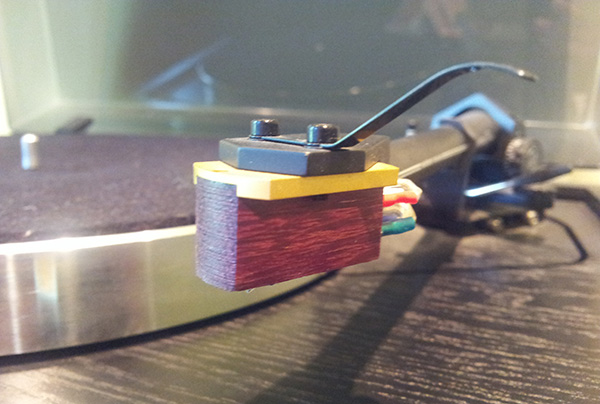
At the 2011 Consumer Electronics Show, Herman van den Dungen handed me a surprise: a brand new Kiseki Blue cartridge manufactured from new-old-stock parts. It wasn't mine to take home—only to look at, to prove it was real.


Herman van den Dungen may not be a household name even for audiophiles, but his products are: his PrimaLuna electronics are exported from the Netherlands to the US and distributed by tube connoisseur and collector Kevin Deal for PrimaLuna USA.


In the 1980s, Kiseki was legendary among audiophiles, even if their cartridges' prices were beyond the reach of most. But the brand's history is less well known—and younger analog devotees may not have heard of Kiseki at all.

Analog Corner #232: HiFiction Simplicity II tonearm, Miyajima Labs Madake phono cartridge, Rogers High Fidelity PA-1A phono preamplifier

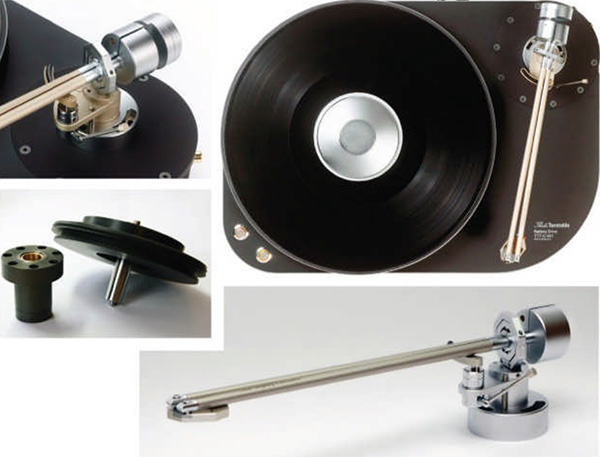
In my January 2014 column, I reviewed HiFiction's Thales TTT-Compact turntable and Simplicity tangential-tracking pivoted tonearm, an intriguing combo from Micha Huber, a talented Swiss watchmaker turned turntable designer.


The TTT-Compact's particulars, including its battery-powered motor and exceptional ease of setup, are described in detail in that review, which includes a link to a useful animation that shows how the design, as Huber says, "reduces the perfectly tangential tracking to pivot points, while the pick-up cartridge is taken and aligned on the Thales' Circle."


Suffice it to say that while the HiFiction tonearm is named Simplicity, its design is anything but.

Advertisement
Advertisement
Advertisement