Turntable Reviews

Sort By: Post DateTitle Publish Date

Kuzma Stabi XL turntable & Air Line tonearm

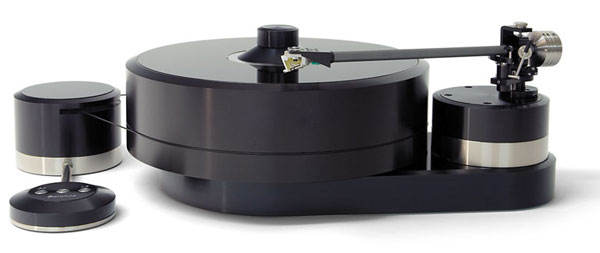
Almost immediately on entering the analog marketplace in 1982, Franc Kuzma, a mechanical engineer based in Slovenia, then part of the former Yugoslavia, established a reputation for manufacturing finely engineered, high-performance products that sold at reasonable prices. Kuzma's early industrial designs, however, while serviceable, looked less than distinguished.
VPI HR-X turntable & JMW12.6 tonearm

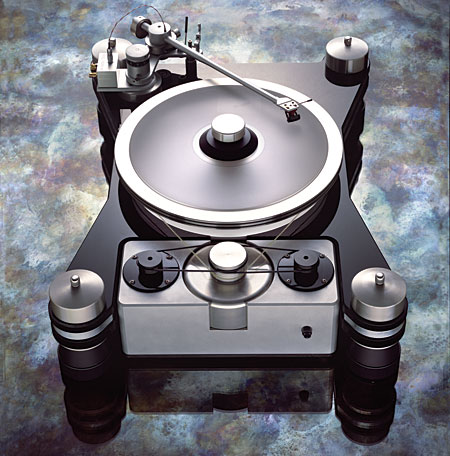
VPI Industries' TNT turntable and JMW Memorial tonearm have evolved through several iterations over the last two decades. Some changes have been large, such as the deletion of the three-pulley subchassis and the introduction of the SDS motor controller. Others have been invisible—a change in bearing or spindle material, for example, or the way the bearing attaches to the plinth. And, as longtime Stereophile readers know, I've been upgrading and evolving along with VPI, most recently reporting on the TNT">http://www.stereophile.com/turntables/498">TNT V-HR turntable (Stereophile, December 2001).


Continuum Audio Labs Caliburn turntable & Cobra tonearm

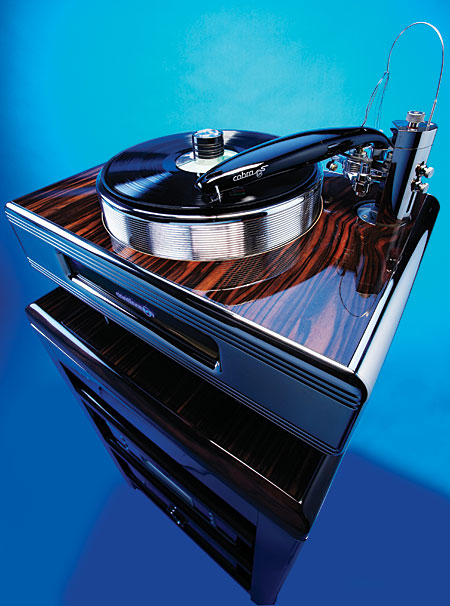
Part New Jersey diner, part Wurlitzer jukebox, with a snakelike tonearm that at certain angles looks vaguely lewd, this boxy, man-sized creation from Australia seems to have been built around its distinctive looks rather than for any functional purpose. Combine that with its sky-high price—itself almost obscene—and the result is apparently the sort of product that envious, cynical, self-loathing audiophiles love to hate, and reviewers love to write about.


Brinkmann Balance turntable

Everyone's got their prejudices, and mine are against turntables with box-like plinths and big slabs of undamped acrylic. I have no problem with either in models that cost a few grand or less, but once you get into high-priced terrain, less plinth and less acrylic usually yields better performance. Generally, though, all a plinth gets you is a vibrating surface to transmit or store and release energy. Who needs that? If your high-performance 'table has a plinth, you need to heroically damp it the way SME does in its Model 30, and the way Rockport did in its System III Sirius.

Rega Planar 5 & Planar 7 turntables

I saw it coming back in 1996. That was when Rega introduced their full-bore assault on the state of the art of record replay, the Planar 9 turntable. The P9 was and is a superb product, but because it sells for $3900—more than five times the price of the company's bread-and-butter model, the venerable Rega Planar 3—its introduction created an enormous price gap. And that's not to mention all the numbers between 3 and 9 that have languished for so long: How could you not expect Rega to fill in the blanks with Planars 4, 5, 6, 7, and 8?

Linn LP Playing System

Long before the Swedes at Ikea did it, the singular Scotsman Ivor">http://www.stereophile.com/interviews/1101ivor/">Ivor Tiefenbrun began giving his products funny-sounding names. For some reason positively phobic about the letter c, he banned its use in any of those names. Someone once told me his real last name is Tiefencrun, but since it wouldn't sound any different with a k, he settled for a b. "I could have been Ivor Tiefendrun, or Tiefenfrun, or Tiefengrun, for that matter," he's quoted as having said once while krunching a krakker.


Clearaudio Champion 2 turntable & Unify tonearm with Benz Micro L2 phono cartridge

Turntables are intrinsically cool. Maybe it's that I am of the pre-CD generation, for which the acquisition of one's first really good turntable marked an audiophile's coming of age. Just as turntable technology has progressed to such awe-inspiring pieces as the SME">http://www.stereophile.com//analogsourcereviews/796/">SME 30/2 and Rockport">http://www.stereophile.com//analogsourcereviews/258/">Rockport Technologies Sirius III, less stratospherically priced 'tables now offer levels of performance that, if not revelatory, show why so many audiophiles (including yours truly) continue to love their LPs with something just short of fanaticism.


SME Model 30/2 turntable

Dense, compact, and built to run O-rings around the competition, SME's flagship turntable makes every other design I've encountered—with the possible exception of Rockport's">http://www.stereophile.com//analogsourcereviews/258/">Rockport's System III Sirius—look almost homemade. I don't mean to insult the many fine, well-engineered designs out there, but I've seen nothing else to compare with SME's tank-like approach to spinning a record. Comparing the Model 30/2 to a tank isn't exactly fair: the machining is done to higher than mil-spec tolerances. I don't think anyone else building turntables today is capable of this level of construction quality, never mind design ingenuity and fit'n'finish.


VPI TNT V-HR turntable & JMW 12.5 tonearm

I'm a tinkerer. From homemade audio isolation and room-treatment products to a local area network (LAN) connecting my Macintosh laptops, I'm always building or modifying something. One of my latest projects is a combination of parts swaps and custom-machined bits to better adapt the ergonomics of my exotic Italian Bimota motorcycle to my distinctly un-Italian 6'3" frame. But regardless of what I'm into, I can't resist the urge to tinker.


Advertisement
Advertisement
Advertisement