Floor Loudspeaker Reviews

Sort By: Post DateTitle Publish Date

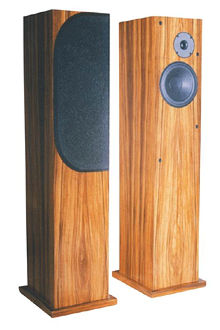
ProAc Response 2.5 loudspeaker

ProAc's designer Stuart Tyler sounded casual—almost bemused—when I spoke with him recently about the new 2.5, a floorstanding, two-way ported box in the middle price slot ($4500/pair) of his Response series. While answering my pressing queries about the crossover point, driver materials, cabinet construction, and other reviewer obsessions, his body language said, "Does any of that really matter with these speakers? You know what the real story is here."


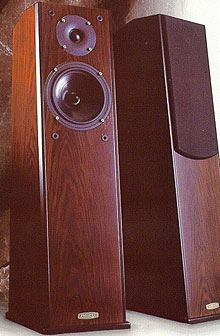
Ruark Templar loudspeaker

As I trundled the WATT/Puppyshttp://www.stereophile.com/standloudspeakers/477">WATT/Puppys; off to the Stereophile laboratory complex for our test procedures (see my review in the last issue), I idly wondered to myself, "Gee, what am I going to do for an encore?" Visions of exotic butterfly-like horns danced in my head (nope, J-10 Scull gets those babies). I was tantalized by the call of ambitiously designed behemoths (Major Tom gets those, he's got the room for 'em). Maybe some jewel-like, state-of-the-art minimonitors? (JA glommed 'em—editor's prerogative, y'know.) So what does that leave me?


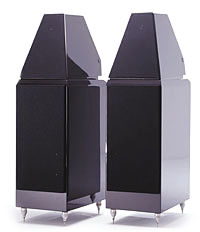
Wilson Audio WATT/Puppy System 5 loudspeaker

Some products are destined never to be seen for what they are. Instead, they exist as avatars, the very embodiment of their ages or concepts. The Wilson Audio WATT (Wilson Audio Tiny Tot) and its nigh-unto-ubiquitous subwoofer, the Puppy, have achieved this legendary status—no, have manifested it almost from their creation 10 years ago—to such a degree that they've come to stand for the entire class of no-holds-barred-monitor loudspeaker. They serve as the focus for a whole realm of the industry; indeed, to show any customer an expensive speaker possessing a modest footprint and not to invoke the incantation "better than a WATT" seems to abjure any pretense of serious sales strategy. At the same time, this speaker system has polarized the industry and its followers, strongly praised by some for its staggering accuracy, and equally dismissed by others for having little soul (musicality, to the initiated).


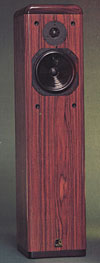
Swans Speaker Systems Baton

666swans.100.jpgAs a privileged reviewer-type person, I was sent the souped-up, all-rosewood, bi-wirable version that sells for $2905/pair. They're quite handsome and very solidly built, weighing in at a respectable 50 lbs each. At $2275–$2905/pair, the Baton is Swans' most affordable speaker, and reportedly employs many of the technical refinements of their larger, more costly models.


The Baton uses the tried-and-true two-way dynamic design, with a 7" coated-paper woofer and a 1" fabric-dome tweeter. The tweeter comes with a little Marigo dot stuck to its center to shape its response. It's not a physically easy task for a woofer to reproduce (well) all the frequencies from about 60Hz up to about 2 or 3kHz. One that succeeds is a nice find, though, because the sound has a nice coherence to it when most of the music is coming from the same driver. But don't take my word for it—just look how many zillions of two-way speakers there are out there.

Unity Audio Signature 3

666unity3.jpgWhen I saw the Unity Audio Signature 3 speakers ($1895/pair) arrive in one box, I was happy. Not just because it meant there would be that much more space left in my basement. No, because it means that Unity is saving money on packaging costs. That means they can spend more money on things like super-nice crossover components. That means...well, I think you know what that means. After all, any piece of audio gear is only as good as the parts it's made from.


To get these overgrown bookends to stand up, you slide little black boards into the slots in their bottoms. Each board is held in place by two set screws, and sticks out to support the speaker with two of the four spikes. The board also tilts the speaker back a little. How do they get sufficient bass out of such slim cabinets?

Thiel CS.5 loudspeaker

That's right, that's no typo; the name of this speaker is the Thiel CS.5—not 1.5, not 8.5, just point five. The CS.5 is the smallest of Thiel's floorstanding CS (Coherent Source) loudspeaker family, and is likely to remain so—a name like CS.125, for example, is a bit unwieldy. If you're familiar with the rest of Thiel's CS line, then you can imagine what the CS.5 looks like: it resembles the other CS speakers, except it's smaller (footnote 1). And, being a typical smartypants 'ender (as in "high-ender"), I bet you think you know 'zactly how these sound, too, don't you? Well? I thought so.


Infinity Composition Prelude P-FR loudspeaker


I can't think of two products at further ends of the audio spectrum than a single-ended triode tubed amplifier and a mass-market Home Theater loudspeaker. Single-ended tubed amplifiers are about reproducing subtlety, delicacy, nuance, and communicating the music's inner essence. Conversely, a Home Theater loudspeaker system—particularly one made by a mass-market manufacturer—would appear to put the emphasis on booming bass and reproducing shotgun blasts, with little regard for musical refinement.


What a bizarre marriage it was, then, to pair the new Infinity Composition Prelude P-FR loudspeakers with the Cary Audio Design CAD-300SEI 11W single-ended triode amplifier (reviewed elsewhere in this issue). This combination didn't happen by accident; as you'll see, these apparently disparate products are a match made in heaven.


I discovered the Infinity Preludes while surveying Home Theater loudspeaker systems for the upcoming second issue of the Stereophile Guide to Home Theater. In addition to evaluating the loudspeaker systems under review with video soundtracks, I assessed their musical qualities—or lack thereof. The Preludes were such a musical standout that I rescued them from the Home Theater room (where they had been powered by mass-market receivers and fed with a laserdisc source) and gave them a new lease on life in the larger music room, with reference-quality source and amplification components. The Preludes' extraordinary musical performance and unique design compelled me to tell you about how they performed in an audiophile-quality two-channel playback system.

Vandersteen Cinema loudspeaker system (SGHT Review)

The Vandersteen 3A is a higher-end variation on the theme established by the company's first loudspeaker, the 2C. The latter is still available, though much updated into the current, highly popular 2Ce. A four-way design, the 3A has separate sub-enclosures for each drive unit; the whole affair is covered with a knit grille-cloth "sock" with wood trim end pieces. A rear-mounted metal brace allows the user to vary the tiltback—an important consideration for best performance with this loudspeaker.


Metaphor 2 loudspeaker

"Wow!" Jerome Harris—jazz guitarist, bassist, and composer—stopped talking and listened intently to the rough-mixdown dub of his latest album, Hidden in Plain View: The Music of Eric Dolphy (New World 80472-2 CD) (footnote 1). He'd brought it by my house in order to hear it on another system before pronouncing judgment. "That sounds like us! And I ought to know because I was there..."


It wasn't the first time the Metaphor 2s had totally transfixed a visitor with their accurate portrayal of a musical event. This time, however, they'd done it to one of the participants of that specific performance. It isn't as if it was easy stuff to disentangle, either. Jerome's disc is texturally dense: Marty Ehrlich and Don Byron on reeds, Ray Anderson on trombone, E.J. Allen on trumpet, Bill Ware on vibes, Bobby Previte on drums, and Jerome himself on acoustic bass guitar—occasionally all wailing away simultaneously. The Metaphor 2s have the articulation to sort out all of those interweaving melody and rhythm lines, the frequency balance to render them with astonishing timbral veracity, and the speed to ensure that, even with four drivers in a large enclosure, it all arrives at the same time and with swing aplenty. Does it sound as though I'm describing one hell of a speaker? I think so anyway.

Advertisement
Advertisement
Advertisement